Californians Deeply Divided on Leaders—But Show Signs of Optimism

With Governor Newsom and President Trump clashing over policy and federal funding, how do Californians view the two leaders? Our January survey found that opinions of the governor and the president are very different—and very partisan. But while the partisan divide runs deep, Californians are unexpectedly hopeful about overcoming political differences and working together.

Not surprisingly, newly elected Governor Newsom is far more popular in California than President Trump. Our first reading of Governor Newsom’s approval rating came within the first few weeks of his term. A plurality of Californians said they approve of his job performance, while one in four disapproved and one in three were unsure how to rate him. Meanwhile, three in ten Californians approved of President Trump’s job performance, while two in three disapproved. This question was asked during and after the partial government shutdown in January.

Opinions of both leaders differ widely by party, but President Trump is more polarizing: nine in ten Democrats disapproved of President Trump, while a smaller share of Republicans—six in ten—disapproved of Governor Newsom. Notably, independents were twice as likely to disapprove of President Trump, compared to Governor Newsom.
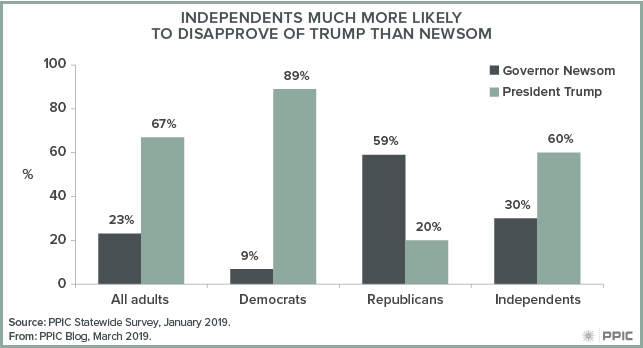
figure - Independents Much More Likely to Disapprove of Trump Than Newsom

The two leaders couldn’t be in more different positions when it comes to their legislative counterparts. Governor Newsom is working with Democratic supermajorities in both houses, while President Trump has to work with a new Democratic majority in the House of Representatives and a slim Republican majority in the Senate.

Californians are optimistic that Governor Newsom and the California Legislature will be able to work together and accomplish a lot in the next year. In fact, the share of Californians who are optimistic (67%) is the highest it’s been since we began asking this question in 2006.

In contrast, Californians’ views on the likelihood of cooperation in Washington, DC, are at a record low—with just 25% of Californians optimistic. Notably, Democrats and independents are polarized, while fewer than half of Republicans are optimistic about cooperation at either level.
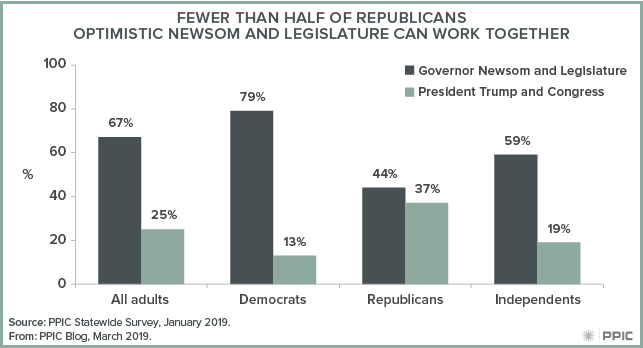
figure - Fewer Than Half of Republicans Optimistic Newsom and Legislature Can Work Together

Despite the rancorous political environment and the contentious relationship between Governor Newsom and President Trump, most Californians (58%) are optimistic that Americans of different political views can still come together and work out their differences. Notably, about half of Democrats (52%), Republicans (49%), and independents (52%) are optimistic these differences can be overcome. As the governor looks to advance his agenda during his first year in office, we will continue to track Californians’ perceptions of their leaders and monitor attitudes about the state and the nation.
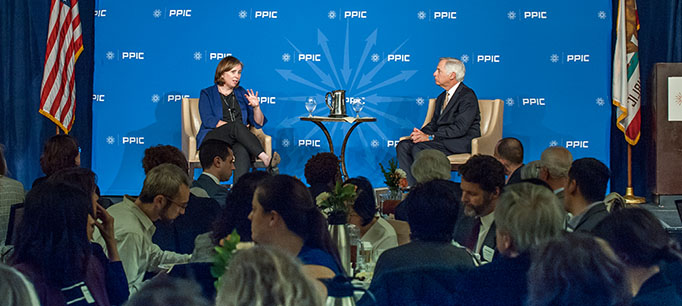
Video: A Conversation with Chief of Staff Ann O’Leary

As the Newsom administration lays out its initial plans, PPIC invited chief of staff Ann O’Leary to discuss some of the governor’s top priorities. In a wide-ranging discussion with PPIC president Mark Baldassare last week, O’Leary identified the “cost crisis” in California as one of the main challenges that Governor Newsom plans to address.

“By ‘cost crisis,’ I mean how do we make sure that people in California can have affordability and the opportunity to really take advantage of the California dream?” O’Leary said. “I think too many people in California are really seeing that slip away. They’re not able to afford homes, they’re not able to afford child care, and they’re not able to pay for college for their children as they grow older.”

O’Leary pointed out that confronting this cost crisis would take many forms, such as taking on health care affordability, investing in “cradle to career” education, and addressing housing production and rising rents.

She underscored that the governor’s first proposed budget reflects his vision for promoting affordability and opportunity while ensuring the state’s long-term financial stability. Newsom’s plan includes a mix of one-time and ongoing funding as well as a robust rainy day fund, but “we also go further than that. We have a reserve fund for the safety net, and we also look at how we could use some of the surplus to pay down pension liabilities.”

The governor has also focused on other key challenges—for example, responding to wildfires and tackling the unmet need for safe drinking water in many parts of the state.

On wildfires, O’Leary noted that the governor wants to “make sure that we’re continuing with those recovery efforts to help communities that have been harmed, but also to prepare for future wildfires.” On drinking water, O’Leary said that the governor has already worked with the legislature to provide $20 million in emergency funding to address this issue.

Navigating the PG&E bankruptcy filing is another immediate priority. O’Leary said that over the next 60 days the governor’s team would be creating a roadmap for the state to “protect wildfire victims, protect employees who are out there every day trying to make sure we’re safe, and make sure fundamentally that we have safe and affordable power and that we’re meeting our clean-energy goals.”

O’Leary also discussed the federal-state relationship and how the governor plans to manage it. While pointing out that the state and federal governments need to work together as much as possible, O’Leary also underscored that California must stand up for its values when fundamental disagreements exist, especially on issues such as immigration and family planning. “These are differences of opinion. And it’s a needle we have to thread, but we’re going to do our best.”

Commentary: Delta Interests Should Seize the Opportunity to Cease Water Fights

This commentary was published in CALmatters on February 21, 2019.

The Sacramento–San Joaquin Delta is a major source of water for cities and farms across the state, and a major source of water conflict.

In a Sacramento Bee editorial two years ago, we and our colleague Brian Gray promoted a grand compromise for the Delta. We suggested that the three broad interests fighting about its future—water users, environmental groups, and Delta residents—give up something in order to reduce conflict and make progress. During his first state of the state address, Gov. Gavin Newsom opened the door to just such a compromise.

Three interrelated issues in the Delta are in tension and need resolution:

  • First, the reliability and quality of its water are in decline. More than 25 million Californians and 3 million acres of farmland rely on the Delta for a portion of their water supply.
  • Second, ecosystems in its watershed are changing, harming fisheries and threatening extinction of some native species.
  • Finally, many of the 1,100 miles of fragile levees that protect people’s farms and homes are in need of costly upgrades.

Climate change and rising sea levels are making all of these problems worse.

Gov. Jerry Brown’s WaterFix program aimed to solve the supply problem by building two large tunnels underneath the Delta to route Sacramento River water to Bay Area and Southern California cities and San Joaquin Valley farms.

The project’s size, and its potential for ecological harm if mismanaged, made it untenable to most Delta residents and environmental groups. It also was very costly, with uncertain financing prospects. A stalemate developed in which none of these interrelated issues—water supply, ecosystems, levees—could be adequately addressed.

Gov. Newsom has changed that equation by proposing to build one tunnel, not two.

A single tunnel would perform almost as well as two tunnels, particularly when operated in tandem with the existing pumps in the south Delta. It would cost substantially less. And it would give assurances to environmental groups and Delta residents that the project would not create the large impacts many fear.

Environmental groups should take this opportunity to sign on to a new approach for managing the Delta.

This would involve focusing less on the volume of flows dedicated to protecting endangered species and more on how flows and habitat—managed together—can improve ecosystem conditions.

Doing this well will require major commitments to habitat restoration from the state and water users. It will also require new approaches to managing environmental water.

We recommend establishing ecosystem water budgets that can be stored, traded, and flexibly allocated. This makes the environment a partner in water management rather than merely a constraint. Reliable funding, good governance, and robust scientific support will be essential components of this package.

There’s an opportunity for the new governor to move forward on the ecosystem issue as well. The State Water Board is revising its Water Quality Control Plan for the Delta.

Governors Brown and Newsom have stated their desire that water users and environmental groups develop negotiated agreements as an alternative to new environmental flow regulations from the board.

Done well, such agreements have the potential to create flexible allocations of water for the Delta ecosystem. The clock is ticking. Getting these negotiations completed is critical to resolving the Delta’s problems.

The administration also must address the future of the Delta’s fragile levees. Some are essential for managing water quality, and all are under threat from climate change, sinking land, and earthquakes. There is an opportunity to build upon the recently completed Central Valley Flood Plan and the Delta Stewardship Council’s efforts to prioritize investments in levees. A comprehensive, reliably funded plan that accounts for the multiple threats to levees is sorely needed.

In California’s complicated water wars, some may consider “compromise” synonymous with surrender. But those who insist on fighting will only be rewarded with more fights. Progress happens when parties give up something to get what they really need. By proposing to build one tunnel instead of two, Governor Newsom has opened the door for a grand compromise in the Delta. The Delta’s many interests should seize this opportunity.

Video: Californians and Their Government

As efforts are gearing up in Sacramento to craft a new state budget, a majority of Californians say they approve of Governor Gavin Newsom’s proposed spending plan. Californians also express optimism about the general direction of the state. These and other key findings of the latest PPIC Statewide Survey were outlined by Alyssa Dykman at a Sacramento briefing last week.

The governor’s budget proposal, which calls for increased funds for education and health and human services, garners support from 70% of California adults. More than three-quarters approve of two key components of the proposal: 77% favor allocating $1.8 billion to expand pre-kindergarten and early childhood programs and facilities, and 78% support an $832 million funding increase for public colleges and universities.

The survey also asked whether Californians believe the state is going in the right direction. A majority of adults (55%) approve of where California is headed. This contrasts with less than a third (30%) saying things are going in the right direction for the country. In addition, a record-low 25% of Californians say that President Trump and Congress will be able to work together and accomplish a lot this year.

Other survey highlights:

  • Asked what the most important issue is for the governor and legislature to address in the coming year, more Californians name immigration and illegal immigration (15% adults) than any other issue.
  • Most Californians (67%) are optimistic that Governor Newsom and the legislature will be able to work together and accomplish a lot in the next year.
  • A strong majority of California adults (64%) say President Trump and Republicans in Congress were primarily responsible for the recent partial shutdown of the federal government. Only 24% say Democrats in Congress were responsible.
  • Only about a quarter of Californians (27%) say the situation with illegal immigration across the US-Mexico border is a crisis.

Proposed Budget Prioritizes College Students in Need

Governor Newsom’s January budget proposal includes $1 billion in new funding for higher education. Much has been made of his plan to cover two years of tuition for first-time, full-time community college students. But that is just one aspect of an overall approach that provides extensive support to a wide variety of students.

Newsom’s proposal increases by nearly 15% the number of “competitive” Cal Grants—a distinct type of support available to students who do not qualify for entitlement grants. Recipients of competitive Cal Grants are often older, non-traditional students. Further, all Cal Grant recipients who have dependent children would receive an additional $6,000 to help with non-tuition related costs. In addition, Newsom’s budget allocates nearly $50 million to programs that address housing and student hunger—and those that provide legal services for undocumented students, staff, and faculty.

The governor’s focus on affordability aligns with Californians’ concerns regarding higher education. According to the latest PPIC survey on Californians and higher education, 58% of all adults noted that affordability was a big problem for California’s public higher education systems; just 14% said that it was not much of a problem. Most Californians also said that higher education should be a high priority for the new governor. This budget proposal suggests that Governor Newsom is listening.

Governor’s Budget Targets Safe Drinking Water, Wildfires, Healthy Soils

Governor Newsom’s first proposed state budget, released earlier this month, addresses several critical water and natural resource management challenges. Here are highlights from his plans to mitigate problems with safe drinking water, improve forest health and reduce the risk of wildfires, and encourage healthy soils to reduce greenhouse gas emissions and increase drought resilience.

Safe and affordable drinking water: The governor’s budget proposal revives last year’s failed legislative proposal to tap urban water customers, agricultural fertilizer users, and dairies to pay for safe drinking water projects in small, disadvantaged communities with water quality challenges.

The proposed budget also includes a one-time capital investment of $168.5 million (compared to $93 million enacted in the previous budget) to fund safe drinking water and wastewater infrastructure projects in disadvantaged communities. The funds will come from Proposition 68—a $4 billion bond approved by voters in June 2018 for investments in water, parks, the environment, and flood protection. The proposed spending represents the remaining two-thirds of the $250 million in Proposition 68 funds for safe drinking water projects.

In addition, the governor proposes allocating $10 million from the General Fund for a State Water Board program that provides technical, operational, and managerial assistance to water systems serving disadvantaged communities. This funding will be used to implement the Board’s relatively new authority to hire third-party administrators to help water systems comply with safe drinking water standards—including tasks such as project planning and grant procurement. This authority was granted by SB 552 in 2016.

The budget also allocates $10 million from the General Fund for water supply emergencies in disadvantaged communities. During the latest drought, more than 2,500 domestic wells ran dry and nearly 150 small water systems requested emergency support. Many rural, disadvantaged communities still do not have reliable supplies, and these funds could provide emergency drinking water, extend water service lines, and repair groundwater wells.

Forests and wildfires: The budget calls for $415 million for programs to improve the health of forests and fight wildfires. Of this sum, $200 million will be sourced from the Greenhouse Gas Reduction Fund (GGRF). This is consistent with a legislative requirement from last year to spend $1 billion from the GGRF over five years for forest health, fire prevention, and fuel reduction activities. These funds will largely be allocated to Cal Fire’s grant programs for forest management projects on private and federal forest lands. The remaining half of the $415 million in proposed spending will go toward upgrading firefighting equipment and increasing firefighting capacity.

Healthy soils: The budget allocates $18 million to the California Department of Food and Agriculture to expand the Healthy Soils Initiative—a $3 million increase from its 2018 budget. Funded by the state’s cap-and-trade revenues, the program incentivizes farmers to adopt sustainable practices and increase their soils’ capacity to sequester more carbon. Activities might include installing riparian forest buffer, composting, and planting cover crops and wind barriers. Such practices can also improve crop yields, drought and flood tolerance, and air and water quality. The funding is projected to enable the sequestration of 5.3 million tons of CO2 on 500,000 acres by 2030, which is equivalent to nearly 2% of California’s annual emissions in 2016.

The proposed budget will be revised by May—and ultimately finalized and passed by the legislature in June.

One Step Closer to a Statewide Educational Data System

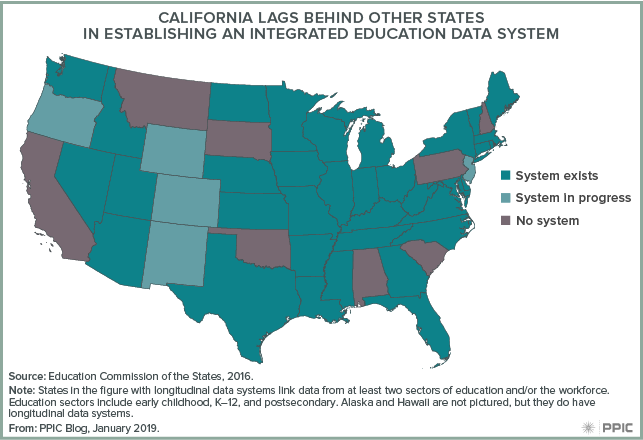
Governor Newsom’s recently proposed budget includes $10 million in one-time funding for the planning, creation, and implementation of a statewide longitudinal data system—including early childhood education, K–12, higher education, the workforce, and health and human services. As we wrote in a recent PPIC report, this idea holds a lot of promise. An integrated data system could allow for improved feedback for educational institutions, more efficient use of public funds, and better evaluation and coordination for the state. The idea also has support in the state senate, where Senators Glazer and Allen proposed a similar system (SB 2) last December.

Each public education system—K–12, the community colleges, California State University, and the University of California—already recognizes the importance of data. They all collect, store, and analyze data on students within their respective systems to improve instruction and outcomes. However, few connections are ever made between educational sectors. Even though a high school senior may graduate from a K–12 school, attend a community college, and then transfer to a UC, data isn’t shared across those systems in any systematic way. So each system has no idea if students are successful in the next stage of their academic career. California is one of the few states that does not follow students across sectors.

The governor’s budget summary also suggests that the data system could be used to improve K–12 measures of career and college readiness. Current measures are based on high school test scores and high school course-taking. But connecting K–12 data to higher education and employment data could lead to more meaningful measures of whether students are able to take and succeed in college-level courses, or whether they work in a job with a living wage.

With the Newsom administration’s support, California may be closer than ever to establishing a data system that can answer key questions about how students move along the educational pipeline. Creation and implementation will involve security, privacy, and governance challenges, but California has 42 other states that can serve as models. This is a much-needed first step in helping the state develop effective policy solutions that will improve students’ progress through school and into the workforce.

Californians’ Priorities for Their New Leaders

California enters 2019 with Democratic super-majorities in both chambers of the state legislature and a Democratic governor replacing another for the first time in more than a century. What do Californians want state leaders to prioritize? Although the state is projected to have a budget surplus of $21 billion, many are pessimistic about the state’s short- and long-term economic prospects. These economic concerns are possibly linked to Californians’ policy and spending preferences, and they are likely to inform their attitudes toward the governor’s recently released budget proposal for the next fiscal year.

According to the December 2018 PPIC Statewide Survey, fewer than half of Californians (46%) say the state will have good times financially in the next 12 months. The share of adults holding this view hasn’t been this low since October 2014 (45%).

About one in three (32%) also say California will be a worse place to live in 2025, and 50 percent think children growing up in the state today will be worse off financially than their parents.

When asked what the state government’s most important priority should be in planning for California’s future, 39% of residents say it should be improving jobs and the economy. In the shorter term, what issues should state leaders prioritize in the coming year? Findings from the December survey offer some possible answers.

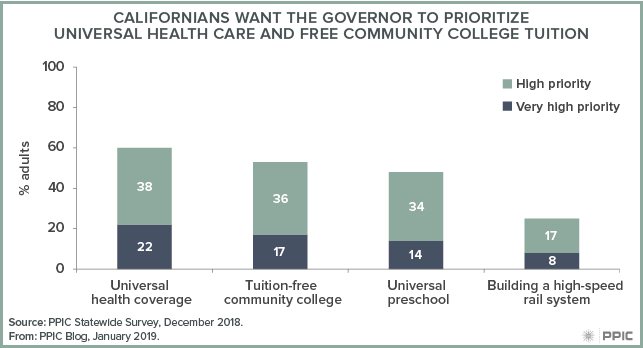
When asked what they would prefer to do with a projected budget surplus, a majority of Californians (57%) say they’d like to increase state funding for education and health and human services. When asked about several potential policies—most of which Governor Newsom highlighted during his campaign—majorities of adults say universal health coverage (60%) and tuition-free community college (53%) should be top priorities for new state funding. Fewer than half (48%) say the same about universal preschool, and one in four (25%) want to prioritize high-speed rail.

These findings underscore Californians’ preferences for programs that can help reduce economic uncertainty. They also indicate that Californians’ priorities are aligned with Governor Newsom’s budget proposal for the next fiscal year. The governor’s budget includes funding for an expansion of Medi-Cal coverage to young adults regardless of immigration status, a second tuition-free year at community college, and steps toward universal preschool for income-eligible four-year old children.

Over the next five months, as the governor and state lawmakers work toward a final budget, Californians will have the opportunity to voice their opinions. Stay tuned to the PPIC Statewide Survey as we track Californians’ attitudes toward new leaders and key policy issues.

Video: Californians and Their Government

As Governor-Elect Gavin Newsom prepares for his first term, half of Californians think he should take a different policy direction than Governor Brown. Four in ten approve of Newsom’s plans and priorities—while three in ten don’t yet know enough to have an opinion. These and other key findings of the latest PPIC Statewide Survey were outlined by Dean Bonner at a Sacramento briefing last week.

The survey asked Californians about four major policy areas that were highlighted in the governor’s campaign. Most see universal health coverage and free community college as top priorities, while fewer see universal preschool as a high or very high priority and only one in four prioritize high-speed rail.

The survey also asked how the state should use the projected surplus in the next budget year. A majority of Californians say they would prefer to use the surplus to increase funding for education and health and human services. Far fewer prefer to use it to pay down debt and build up a reserve or to spend on one-time funding for transportation, water, and infrastructure.

When asked to identify the state government’s highest priority in planning for the future, 39% name improving jobs and the economy, 20% say protecting the environment, and 15% say updating water and transportation infrastructure. Improving jobs and the economy is the highest priority across all parties and demographic groups.

Other survey highlights:

  • Two-thirds of Californians say the state is divided into two economic groups: the “haves” and the “have nots.” Four in ten characterize themselves as haves and 45% say they are have nots.
  • While more than half of Californians think the state is generally headed in the right direction, only about a third are satisfied with the way things are going in the nation. Half have no confidence that President Trump will make the right decisions for the country’s future.
  • Only two in ten likely voters approve of Congress; more than half see the shift in control of the US House from the Republicans to the Democrats as a good thing.
  • Two-thirds of state residents continue to see immigrants as a benefit, and there is still bipartisan support for allowing undocumented immigrants to stay in the US legally if certain requirements are met.

What Approval Ratings Say about Jerry Brown’s Legacy

Perhaps Governor Jerry Brown’s most important contribution—rooted in the higher approval ratings for the executive and legislative branches—was to restore public confidence in state government.

That’s my conclusion after we at the Public Policy Institute of California have taken 64 surveys since Brown took office in January 2011 asking the same question: “Overall, do you approve or disapprove of the way that Jerry Brown is handling his job as governor of California?”

For most of the time since 2011, political gridlock stymied Barack Obama, Donald Trump, and Congress.

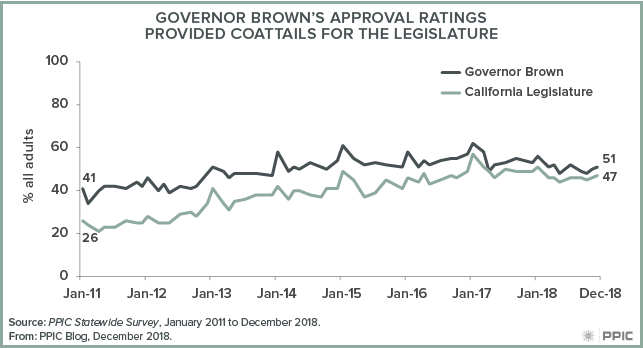
But in California, Brown and the state legislature were solving problems. Survey results show that the public responded. Brown’s latest (and our final) approval rating stands at 51 percent. That’s 10 points higher than his approval rating in our January 2011 survey. Brown’s approval rating surpassed 60 percent twice—after his 2014 reelection and after Trump’s election, when our January 2017 survey had the governor at a 62 percent approval rating. Not surprisingly, Brown’s highest approval ratings today are among Democrats and self-identified liberals, 68 percent and 69 percent, respectively, and is least popular among Republicans at 18 percent and self-identified conservatives at 36 percent.

Notably, his canoe theory of politics—paddle to the left, and then paddle to the right—seems to have worked well. About half of independents and moderates approve of the governor. Brown’s approval rating has never dipped below 47 percent since the voters passed his Proposition 30 tax increase in October 2012. The recent campaign for the Proposition 6 gas tax repeal and the race for his successor apparently had no effect on Brown’s popularity.

Brown steered through troubled fiscal waters that damaged other political careers. The approval rating for Gray Davis hit 31 percent in the September 2003 PPIC survey as he faced the recall that ended his time in office. His replacement, Arnold Schwarzenegger, had a 25 percent approval rating in the November 2010 PPIC survey, as the state suffered from massive budget deficits and he and the legislature struggled with unpopular spending and tax decisions.

The state legislature had been mired in low approval ratings for years. Perhaps the legislature rode the coattails of Brown’s success—its approval rating increased by 21 points, from 26 percent in the January 2011 PPIC survey to 47 percent in December. California’s fiscal recovery was certainly tied to more positive views of the governor and legislature. The perception that the state budget situation “is a big problem” fell by 25 points, from 68 percent in January 2011 to 43 percent in January 2018. At the same time, during Brown’s time in office, the belief that the state is generally going in the right direction grew by 16 points to 54 percent in December 2018.

Brown and the legislature took the drama out of the annual budget process, passed popular laws on education funding and climate change, responded to crises such as drought and wildfire, and maintained a united front against Trump’s unpopular policies.

Will Brown be be a hard act to follow for Gavin Newsom?

Maintaining fiscal stability and an effective partnership with the state legislature will be the key ingredients. Jerry Brown will be leaving office with Californians in a better state of mind than they were in eight years ago. His tenure offers a successful model for governing the state in the future.