The Mood of California Voters and the 2020 Election Cycle

This post is excerpted from my speech at the Sacramento Seminar on October 4, 2019 in San Francisco.

Pollsters often say that a public opinion survey is a snapshot in time. The latest PPIC Statewide Survey was conducted in the days after the California Legislature finished its work in 2019 and while startling news was breaking that the president called a foreign leader for a political favor—which has resulted in the launch of an impeachment inquiry. The mood of California voters in this timely survey—especially their level of unhappiness and anxiety—is noteworthy because of its far-reaching implications for the March primary and the November election.

Let’s start with President Trump’s approval rating, which now stands at 35% among California likely voters. This is unchanged from the last reading in our July survey and has been remarkably stable over time. Today, 83% of Republicans approve of his job performance, compared to just 38% of independents and only 7% of Democrats. Given its partisan makeup, California is a reliably blue state on the Electoral College map. Still, low approval ratings for the president will increase turnout, influence the Democratic presidential primary choice, and affect all of the legislative races next year.

Meanwhile, approval ratings for Congress remain low even in the wake of Democratic control of the US House of Representatives. Today, just 24% of California likely voters approve of the way that Congress is doing its job. This is unchanged from the start of the year—as well as from a year ago when Republicans controlled the House. In California, likely voters across party lines give low approval ratings to Congress. If this trend continues, incumbents will have to work harder to keep their seats in 2020.

Closer to home, Governor Newsom and the legislature are getting mixed reviews in their first year of making policy together. Among likely voters, 43% approve and 44% disapprove of the governor, while 38% approve and 51% disapprove of the legislature. Since the beginning of the year, disapproval has increased significantly for the governor (+15 points) and the legislature (+8 points). Today, more than six in ten Democrats approve of the job that the governor and legislature are doing, compared to fewer than four in ten independents, and less than two in ten Republicans. If their ratings remain in the doldrums, the governor and legislators will have little sway over Californians’ ballot choices next year.

figure - Approval Ratings of State Elected Officials

Equally important, California’s likely voters are in a negative frame of mind about the state of their state—even in the midst of low unemployment and budget surpluses. Fifty-four percent say that things in California are going in the wrong direction (41% say right direction). When asked about economic conditions in California for the next 12 months, a similar 54% expect bad times (37% say good times). Pluralities across party lines are now expecting bad economic times in the next 12 months—a timeframe that includes most of the 2020 election campaign season.

figure - Likely Voters Expect Bad Economic Times in the Next 12 Months

State bonds and tax measures will face headwinds if this level of economic unease continues. This is already evident in the modest support for the $15 billion school bond (54%) and the split-roll property tax initiative (47%) in our recent survey.

figure - Modest Support for Likely 2020 State Ballot Measures

Digging deeper into the survey, more than six in 10 likely voters worry about being able to afford the cost of their health care, six in ten are concerned about the threat of a mass shooting where they live, half are worried about experiencing natural disasters such as wildfires, and four in ten worry about someone they know being deported. Candidates’ promises and plans to address these fears will likely impact the standing of current frontrunners Joe Biden, Bernie Sanders, and Elizabeth Warren—and their challengers—in a Democratic presidential primary which is very much up for grabs, as our recent survey shows.

How will voters’ views change over the next 12 months? Clearly, the political wildcard is the impeachment inquiry and how it will impact perceptions of the president, Congress, and the major parties. Uncertainty about the economy is another unknown factor. In the short run, the impeachment inquiry is likely to increase polarization, lead to more political gridlock in Washington, and heighten expectations for the governor and legislature to do more to solve the problems facing California.

PPIC Statewide Surveys will continue to monitor the broader political and economic attitudes, as well as voters’ preferences for presidential candidates and ballot measures, throughout what will be a consequential 2020 election.
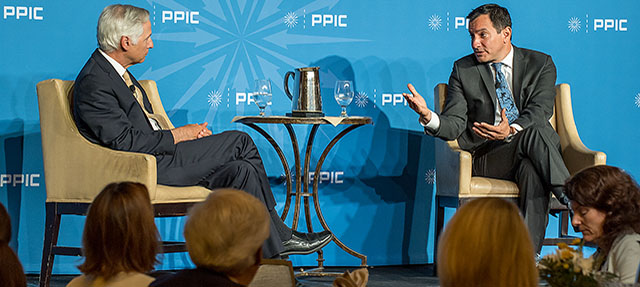
Video: A Conversation with Assembly Speaker Anthony Rendon

When Anthony Rendon was elected to the California State Assembly in 2012, he thought he would focus on early childhood education. “I came to Sacramento after working in early childhood education for 20 years . . . probably thinking that I would work on that.” However, he continued, “You come here and you realize the extent to which all of these issues impact one another. I think it’s dangerous to isolate any single issues.”

As he noted in his conversation with PPIC’s Mark Baldassare last Thursday, Rendon has focused on many individual measures in this legislative session, including a recently signed bill to modify the criteria for police use of deadly force and a bill to address predatory lending. In the wake of the Gilroy shooting, he has also prioritized a package of gun control bills. He sees these measures as part of a broader focus on improving opportunity for all Californians.

Rendon became Speaker in 2016, when Jerry Brown was governor. At first, he found working with Brown to be “a little frustrating,” but “eventually, we did a lot together. . . . There was a very narrow focus, two or three things—criminal justice reform, climate change, but that was about it. Those are still the things he cares about.” Governor Newsom focuses on a wider range of issues. And, Rendon said, “He’s also more sort of open-ended. He’ll come in and say, ‘Hey, housing, what do you think?’”

One of the issues Newsom cares about is early childhood education—which is still a major priority for Rendon. While Brown “helped us to start down the path” to reinvesting in this area, “now we have a governor who believes that . . . it has a positive impact on families and communities and children.” Newsom’s belief translated into significant funding increases for early childhood education in this year’s budget. “The budget was phenomenal,” said Rendon. Early childhood education is particularly important, in his view, because it’s “not trying to fix something that’s already broken. It’s a way of addressing issues early on, it’s a way of breaking the cycle of poverty.”

Although the Democratic Party controls both the governor’s office and the legislature, Rendon believes it’s important to work with Republicans whenever possible. He sees some common ground on issues such as climate change and education—“the real issues that really impact Californians.” More generally, it is important that state leaders represent all Californians: “I want to be able to tell people . . . ‘I’m working for you.’”


Interview: Filling the Gaps in California’s Education Data

California is one of only a few states without a database showing how students advance from K–12 schools to college and into the workforce. As part of his “cradle to career” initiative, Governor Newsom has proposed $10 million to develop such a system.

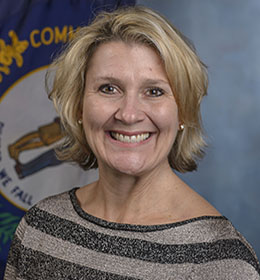
photo - Dr. Jessica CunninghamWe talked to Dr. Jessica Cunningham, interim executive director of the Kentucky Center for Statistics (KYSTATS), about Kentucky’s preschool-to-workforce data system and what California can learn from their experiences.

PPIC: What are the benefits of an integrated student database?

Jessica Cunningham: One major benefit is improving current programs and education-to-career pathways. We work with K–12 career technical education (CTE) programs to provide them with better labor market data to guide their offerings. We’ve also evaluated the impact of expanding work-ready scholarships for students earning high-demand associate degrees at community colleges.

Our research helps policymakers, practitioners, agencies, and the public make more informed decisions. We recently showed that students who completed K–12 CTE programs earned more than their peers. This information contributed to the state’s decision to include CTE pathways as an alternative to the standard high school equivalency test.

PPIC: What hurdles did you encounter establishing the system?

JC: Funding is an ongoing challenge. We’re 85% funded by federal grants, so we face some financial uncertainty year to year. We’re currently looking at the potential for state appropriations as a more sustainable funding source.

More broadly, managing the data system is like working on a puzzle. Sometimes there are missing pieces, since you’re only able to report on the data you have. For example, we don’t have data on private K–12 schools or on children’s experiences prior to preschool or Head Start, so we need to be mindful of those gaps.

Also, some benefits of a data system take time and it’s important to set expectations accordingly. When we published our very first report on high school graduates, readers were eager for information on college completion rates and earnings. But we needed many more years of data before we could examine those long-term outcomes.

PPIC: What recommendations do you have for California?

JC: In Kentucky, we’re legislatively authorized to receive education and workforce data. A governance structure that includes different stakeholder groups (K–12, higher education, workforce development, financial aid) is also critical.

In the early stages, it’s necessary to figure out the key questions for the state—and to determine who should be engaged in that process. Those questions will drive decisions about the data you collect. You won’t be able to do everything at once, so developing a strong research agenda is essential.

Setting up a centralized system makes things easier. This way, no one has to recreate all the necessary data connections for every report or request. Our reporting data warehouse has zero personally identifiable information. We do everything in house—we don’t have to send data back and forth to a vendor and we know that we’re maintaining confidentiality and following the rigorous rules outlined in our data use and access policy.

We also emphasize that we’re nonpartisan. We provide data and results, but policymakers and other leaders are the ones driving the conversation about how to use this information to improve programs and policies.

Video: Californians and Their Government

Less than a year before California’s presidential primary, likely voters who are Democrats or who lean Democratic are divided on strategy: is it more important for the party to nominate the candidate who seems mostly likely to defeat President Trump or the candidate whose positions align most closely their views? But almost all Californians see voting in the 2020 elections as very important. At a lunchtime briefing in Sacramento last Thursday, PPIC researcher Dean Bonner outlined these and other key findings from the latest statewide survey.

Two in three California likely voters say they will definitely or probably choose a candidate other than Trump. There is a huge partisan divide on this question: 93% of Democrats and 66% of independents would definitely or probably vote for another candidate if the election were held today, while 82% of Republicans would definitely or probably vote for Trump.

Most Californians say that the investigation by special counsel Robert Mueller did not clear the president of wrongdoing, and Californians are more likely that the nation as a whole to say impeachment proceedings should begin. But here, too, there is a partisan divide: 66% of Democrats say Congress should begin the process, compared to only 39% of independents and 9% of Republicans.

Other survey highlights:

  • A majority of Californians say their housing costs cause a financial strain; six in ten favor the governor’s plan to allocate $1 billion to address homelessness, and similar shares favor proposed new rules intended to create more affordable housing.
  • Three-quarters of Californians see participation in the 2020 Census as very important—but most have concerns about confidentiality.
  • An overwhelming majority are concerned about rising electricity bills in the wake of the PG&E bankruptcy.
  • Californians are concerned that the recent outbreak of measles could spread; most believe that vaccines are very safe and an overwhelming majority say vaccination against measles and other diseases should be required.

Expanding Enrollment at UC and CSU

California’s economy is increasingly demanding highly educated workers. To meet this demand, and to ensure that more Californians are successful in the 21st century economy, the state’s universities will need to admit and graduate greater numbers of students than they do today.

Governor Newsom’s budget proposal offers a step in the right direction, but it could go further.

The governor’s budget provides General Fund increases of 7% for the University of California (UC) and 8% for the California State University (CSU), including funding for enrollment increases of 1,000 and 7,000 students respectively.  The budget also provides $95 million ($50 million for UC and $45 million for CSU) in ongoing funding to improve student success efforts at both systems. This is good news and represents substantial reinvestment in the state’s public universities.

But the enrollment increases fall short of what CSU and UC had been hoping for, and more importantly, short of student demand. In its 2019-2020 budget plan, UC had sought enrollment increases for 2,500 California resident undergraduates in order “to maintain access for projected increases in UC-eligible high school graduates and transfer-ready California Community College students.” CSU had sought an even more ambitious increase of more than 18,000 in order to accommodate more freshmen and transfer students.

As the state moves into the eleventh straight year of economic growth, ensuring investments in higher education is critical—especially in the face of an eventual downturn. Higher education is often one of the first budget areas to be cut during a recession. Today, even after a decade of reinvestment and one of the largest economic expansions in state history, funding per student at UC and CSU still remains below pre-Great Recession levels. And it is far below the funding peaks of the late 1990s and early 2000s.

As the legislature and governor negotiate over the budget, it may be time to consider creating a long-term funding plan for public higher education. An effective multi-year plan would account for increased enrollment, incentivize student success, prioritize equity, and provide a sensible tuition growth plan.  This would allow students and their families, as well as universities, to better plan for the future—and would put the state on a path to meeting the economic demands of the future.

Health Care Access for California’s Immigrants

Governor Newsom is proposing to expand access to Medi-Cal—the state’s Medicaid program—for low-income young adults up to age 26, regardless of their immigration status. This could help a vulnerable segment of the immigrant population. Californians are signaling broad support.

Overall, immigrants make up about 27% of the state’s population and are less likely to have health insurance than US-born Californians. Immigrants are also less likely to have private insurance, partly due to differences in employment industries and income.

Figure - Health Care Coverage Rates are Lower For California Immigrants in All Age Groups

Documented immigrants—including those with green cards and visas—may qualify for Medi-Cal without being subject to the five-year waiting period required by federal law. They can also purchase private health plans through Covered California, the health insurance exchange that was created as part of the Affordable Care Act (ACA). However, most recently-arrived elderly immigrants are not eligible for Medicare because they have not paid Medicare taxes over a long enough period.

California offers a patchwork of health care options for undocumented immigrants, who are not covered by the ACA. For instance, low-income children and pregnant residents are eligible for Medi-Cal regardless of immigration status, and some counties include undocumented immigrants in programs for those who cannot afford medical care. Additional options for undocumented immigrants include community clinics, rural health clinics, emergency rooms, or a limited version of Medi-Cal for medical emergencies.

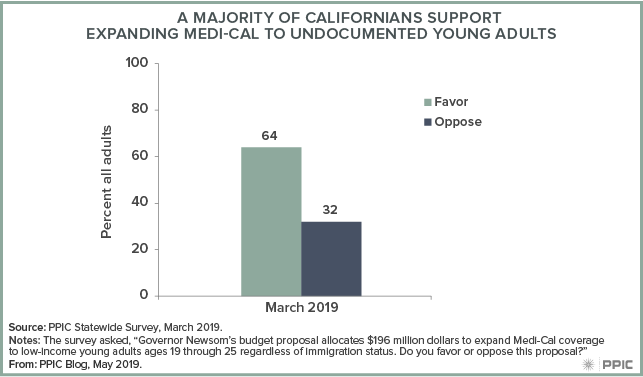
Californians support health care access for undocumented immigrants. In a 2015 PPIC Statewide Survey, a slim majority of Californians (54%) supported the idea of providing health care coverage to undocumented immigrants. In March 2019, about two-thirds (64%) expressed support for the governor’s proposed expansion of Medi-Cal coverage to low-income young adults, including those who are undocumented.

Figure - A Majority of Californians Support Expanding Medi-Cal to Undocumented Young Adults

The governor’s May budget revision delays implementation of the expansion, but it would still have an impact: by providing coverage to approximately 90,000 undocumented young adults in the first year, it could help make the health care landscape less complicated for an important share of California’s immigrant population.

Californians See Preschool as Important

Early childhood education, a policy priority for Governor Newsom, is viewed as important by an overwhelming majority of Californians. In the April 2019 PPIC Statewide Survey, 78% of Californians and 88% of public school parents said that attending preschool is important to a student’s academic success in kindergarten through grade 12.

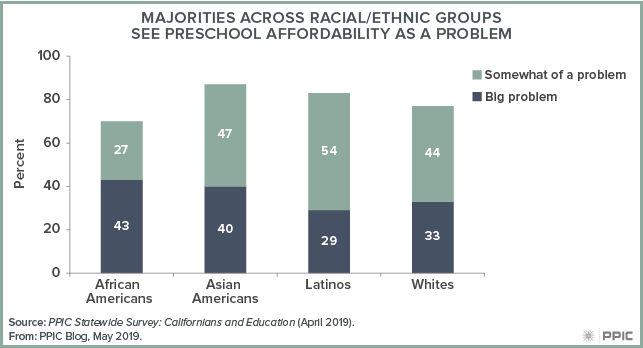
A similar share of Californians (80%) see the affordability of preschool as a problem. Democrats (46%) and Independents (38%) are much more likely than Republicans (25%) to say that it is a big problem. A majority across regions see affordability as a problem, with San Francisco Bay Area residents (42%) most likely to feel that it is a big problem. Across racial/ethnic groups, African Americans and Asian Americans are more likely than whites and Latinos to say that affordability is a big problem.

figure 1 - Majorities across Racial/ethnic Groups See Preschool Affordability as a Problem

Governor Newsom has proposed new funding that would address some of these affordability concerns. In April, we asked Californians if they were in favor of or opposed to the governor’s initial budget proposal from January, which allocated $125 million to expand full-day, full-year preschool to all eligible low-income four-year-olds. A majority of Californians—about two in three adults and three in four public school parents—favored this proposal. In addition, majorities across all demographic groups and regions favored it. In the May budget revision, the proposed funding was reduced to $31 million, which would pay for 10,000 new full-day preschool slots starting April 2020.

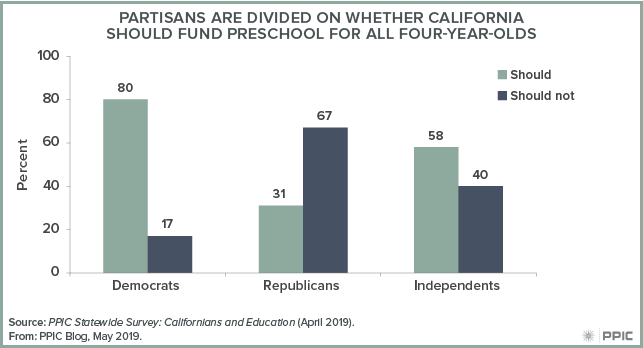
There is slightly less support for state-funded preschool in general: six in ten adults say that the government should fund voluntary preschool programs for all four-year-olds. State-sponsored preschool is a highly partisan issue, with Democrats much more likely than independents or Republicans to express support.

figure 2 - Partisans Are Divided on Whether California Should Fund Preschool for all Four-year-olds

With the release of the governor’s revised spending plan on May 9, the state budget process is well under way; the deadline for enacting the final budget is June 15. PPIC will continue to monitor the governor’s proposed allocations for early childhood education and the opinions of Californians on the issue.

Video: Californians and Education

Last week in Sacramento, Alyssa Dykman outlined the key findings from PPIC’s 15th annual survey on Californians and K–12 education, which tracks opinions on educational quality and school funding. This month’s survey was the first ever to be conducted with a fully online methodology.

A strong majority of Californians want Governor Newsom to prioritize K–12 public education, and majorities support many of the governor’s education-related budget proposals—including the expansion of special education and full-day preschool and kindergarten. Solid majorities also support teacher strikes for higher pay.

But Californians have mixed views on charter schools: most say they are an important option for parents in low-income areas, but many express concern about charters diverting funding from traditional public schools.

Other survey highlights:

  • Most Californians think the level of state funding for local public schools is not adequate.
  • More than half of residents across regions say teacher salaries in their community are too low.
  • Majorities of adults and likely voters would vote for a ballot measure that would amend Proposition 13 to create a “split roll” property tax system and direct some of the revenue to K–12 education.
  • Many parents think the goal of K–12 public education should be to prepare students for college—but many worry about the affordability of a college education.

Video: Californians and Their Government

Californians are increasingly concerned about the cost of housing—a record-high share see affordability as a big problem in their region, and a majority support Governor Newsom’s proposal to put $1.8 billion toward increasing housing production. Dean Bonner outlined these and other key findings of the latest PPIC Statewide Survey at a Sacramento briefing last week.

This month’s survey gauges views on statewide challenges and the governor’s proposals for addressing them. For example, in the wake of last year’s historically destructive wildfires, an overwhelming majority of Californians support the governor’s plan to spend $415 million on wildfire preparedness and forest management. About two-thirds say the gap between rich and poor is widening in their part of the state, and a solid majority favor the governor’s proposal to allocate a billion to expand eligibility for the earned income tax credit.

Other survey highlights:

  • Slim majorities support the governor’s plan to scale back two major infrastructure projects: high-speed rail and the Sacramento–San Joaquin tunnels.
  • When asked whether the penalty for first-degree murder should be death or imprisonment for life with no chance of parole, a record-high 62% of Californians choose life imprisonment.
  • An overwhelming majority oppose President Trump’s declaration of a national emergency over the border wall—but support for the declaration is much higher among Republicans.
  • A majority of residents have a favorable view of the Affordable Care Act and most say that Covered California, the state’s health insurance exchange, has been working well.

A Coordinating Council for Higher Education

The California Legislature and Governor Newsom are interested in creating a new coordinating entity for the state’s public higher education system. The state has been without such an entity since 2011, when Governor Brown vetoed funding for the California Postsecondary Education Commission (CPEC). A new coordinating entity can help the governor and legislature improve higher education by providing expertise and analysis. But it will require policymakers to provide a solid foundation for its work.

California’s 1960 Master Plan for Higher Education gives the three state public higher education segments—the University of California, the California State University, and the California Community Colleges—significant autonomy. CPEC was created to help policymakers conduct long-term planning, monitor student outcomes, and oversee intersegmental policies that make it easier for students to navigate through the college and university systems. A new PPIC report looks at the strengths and weaknesses of CPEC to provide suggestions about how to make a new coordinating entity as effective as possible.

CPEC’s experience underlines the need for clear state goals and objectives. A higher education coordinating body can advocate effectively for student success and assess how well the segments are meeting the needs of the state economy. But higher education in California has changed significantly over the past several decades, and the Master Plan is either silent or outdated in important areas.

CPEC’s history also shows that the details of the coordinating entity’s design are important in giving it a strong, unified voice in the budget and policy process. A coordinating entity should be empowered to monitor whether the state’s higher education goals are being met and suggest ways to make the system more effective. When the segments fall short or when there are conflicts about how best to accomplish state goals, the coordinating entity should be able to work with the colleges, universities, and state policymakers to find workable solutions.

In this time of heightened demand for higher education, the governor and legislature could benefit from a coordinating body that acts as an honest broker in helping the state provide access to all interested students while maintaining the quality of public higher education that California is known for.