Feeding Children When Schools Are Closed for COVID-19

By state law, all public schools in California must provide at least one nutritionally adequate meal to students—however, many students eat more than one meal a day at school. Nearly four million students received meals from California’s public schools in the 2018–19 school year: close to 300 million breakfasts and well over 500 million lunches. With schools closed to reduce exposure to the new coronavirus, many students now lack ready access to these meals.

By federal law, low-income students (about $48,000 for a family of four in 2020) are eligible for free or low-cost school meals. Higher income students paid on average $0.98 for breakfast and $2.11 for lunch in 2017–18, according to the California Department of Education.

The vast majority of low-income students eat some or all breakfasts, lunches, or both at school. Free and reduced-price meals lower food insecurity, and according to the California Poverty Measure (CPM), meaningfully reduce poverty among families with public school students. Without school meals, the share of students living in deep poverty would be 17% higher; increases for students in less severe poverty would be 2% to 8%.
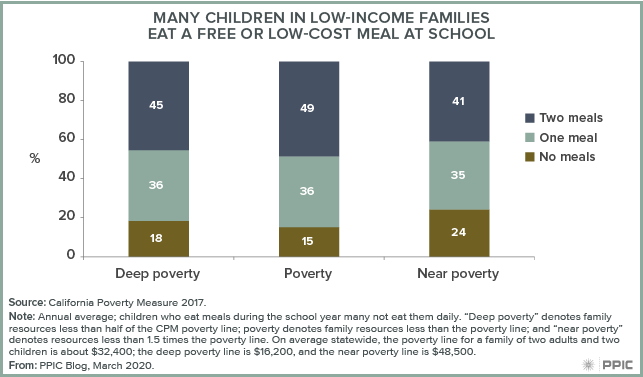
figure - Many Children in Low-Income Families Eat a Free or Low-Cost Meal at School

With school closures in place for several weeks, school districts have already designated sites where families can pick up meals for children. In higher poverty areas, all children can access meals regardless of enrollment in the local school or eligibility for meal programs because authorities have temporarily relaxed federal regulations.

During closures, Governor Newsom assured that schools will continue to receive state funds to operate and requested efforts focus on certain areas, including providing school meals. However, access remains a concern. For example, Los Angeles Unified School District lists 64 “grab-and-go” sites for its roughly 1,000 schools. San Diego Unified School District has 13 sites for 181 schools, as of March 16. Elk Grove, with 67 schools, has 34 sites for drive-through and grab-and-go meal services along with a mobile service for families with limited transportation.

With pandemic EBT (P-EBT), ATM-like cards pre-loaded with funds for groceries, the federal government is also helping low-income students replace missed school meals. The cards will cover the expected number of days that schools will be closed. For students whose families already receive monthly CalFresh benefits on EBT cards, funds can readily be added. For low-income students who do not already receive CalFresh (34% statewide), families must complete some paperwork—mainly electronically—to obtain an EBT card.

Because the reach of CalFresh varies across the state, barriers to getting P-EBT funds to students will also vary. Fortunately, the state already matches student data with their CalFresh, CalWORKs, and Medi-Cal data to automatically determine students eligible for free and reduced-price school meals. If the state can use all existing sources of family income to provide P-EBT to students, they will reach more low-income students.
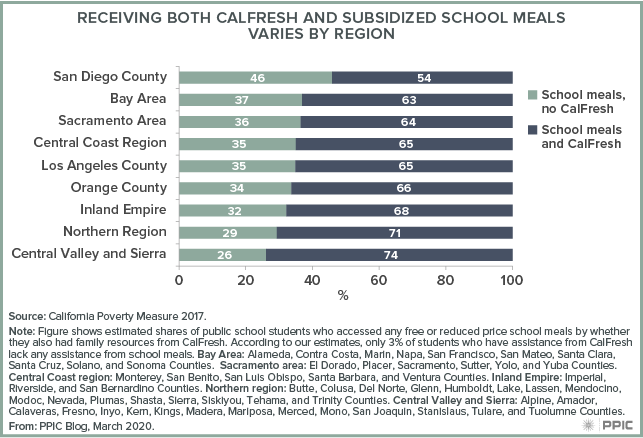
figure - Receiving Both CalFresh and Subsidized School Meals Varies by Region

Ready access to meals influences student health, learning, and economic wellbeing. Robust access to free and reduced-price meals can decrease the stress low-income families are facing as efforts to limit the spread of COVID-19 dampen economic activity.
Video: Californians and Their Government

In California’s March 3 primary, the state ballot will feature several initiatives—including a $15 billion bond for the construction and modernization of public education facilities. Slightly more than half of likely voters approve, while 42% are opposed and 8% are undecided. PPIC researcher Dean Bonner outlined this and other key findings from the latest PPIC Statewide Survey at a briefing in Sacramento last Friday.

In November, Californians may be asked to vote on a constitutional amendment that would require state and local governments to provide housing or shelter beds to all homeless residents. About six in ten adults and 55% of likely voters say they would vote yes on such an amendment. Majorities of adults and likely voters also support Governor Newsom’s proposal to allocate $1 billion to address homelessness.

Other survey highlights:

  • More than six in ten Californians say housing affordability is a big problem in their part of the state, and the cost of living is causing many to consider moving out of California.
  • A majority of Californians (53%) approve of the way Governor Newsom is handling his job; this is the governor’s highest approval rating to date.
  • Views on the governor’s plan to scale back the high-speed rail project are mixed, while most approve of his proposal to build only one tunnel under the Sacramento–San Joaquin Delta.
  • Bernie Sanders leads all other Democratic presidential candidates with 32% support among Democratic primary likely voters. Joe Biden has 14% support, 13% support Elizabeth Warren, and Pete Buttigieg and Michael Bloomberg were tied at 12%.

Californians Are Grappling with Homelessness

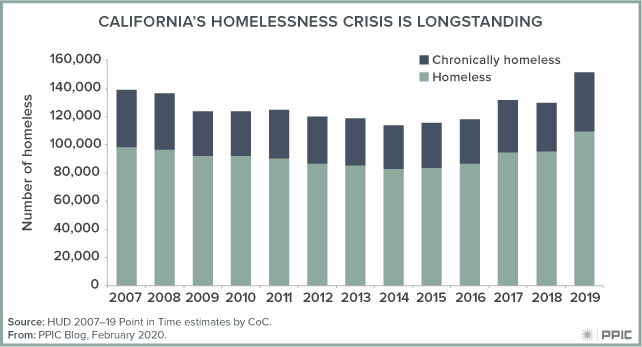
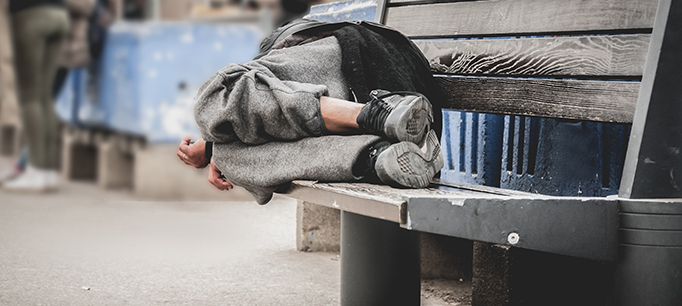
In his State of the State address last week, Gavin Newsom focused almost exclusively on homelessness—a significant long-term problem and major concern for state residents. In 2019, 150,000 Californians—more than a quarter of the US homeless population—were counted as homeless. California’s rate of homelessness rose to 38 per 10,000 residents, the third highest in the nation.

What is more, 72% of California’s homeless residents are unsheltered, living on the street or in parks and other makeshift spaces. And nearly three in ten self-report as chronically homeless—having been on the streets for more than a year.

Figure: California's Homelessness Crisis is Longstanding
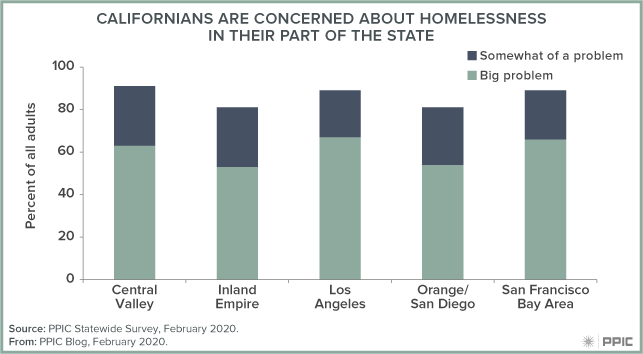
Californians across the state are feeling the gravity of this issue. The latest PPIC Statewide Survey finds that more than 8 in 10 Californians see homelessness as a problem in their part of the state (86% adults, 89% likely voters).

figure -

Considering these numbers, it does not come as surprise that Governor Newsom has made homelessness a major focus. Citing the connection between chronic homelessness, mental health, and behavioral health, Newsom has underlined the importance of policies and investments that allow for “whole person” care. By linking current funding sources and asking lawmakers to expand the use of funds for services provided to the homeless population—especially those involved with the criminal justice system and at-risk foster youth—the governor hopes to improve and integrate these services.

The PPIC Statewide Survey finds that a full 70% of Californians—and 64% of likely voters—favor the governor’s proposed $1 billion budget expenditure to address homelessness. State leadership and investment are key, but there is only so much that can be done at the statewide level. Finding solutions to homelessness requires coordination between the federal, state, and local levels, as well as collaboration across sectors—including housing, health, and social services.

Commentary: Newsom’s Water Framework Is Imperfect but Necessary. The Alternative Is Further Deterioration of the Delta

This commentary was published in CALmatters on February 10, 2020.

Gov. Gavin Newsom has put forward a framework for managing water and habitat in the Delta and its watershed. As far as we can tell, no one is very happy with the framework—and that may be a good sign.

The framework is the product of years of effort to negotiate an agreement among water users, other stakeholders, and regulatory agencies. Details are yet to be worked out, including firm commitments for water and funding, along with critical negotiations with the federal government on how to cooperatively manage upstream dams and the Delta pumps. Ultimately, the package has to be acceptable to state and federal regulators.

The scope of this effort is vast.

Over the next 15 years, the proposal is to spend more than $5 billion on new river and floodplain habitat to benefit salmon and other native fish species.

This funding will also pay for a mix of new water projects, water purchases, and fallowing of farmland will provide additional water for the environment. Additionally, new governance and science programs will manage the water and habitat in the Delta, as well as the rivers that flow into it.

For many years and in multiple publications by the Public Policy Institute of California, we have been calling for a negotiated agreement in the Delta and its watershed. This agreement needs robust management that includes shared governance, reliable funding, strong science support, and regulatory backstops if parties fail to live up to their obligations.

These must-haves are outlined in our recent report: A Path Forward for California’s Freshwater Ecosystems.

It is also time to shift away from the traditional approach to addressing environmental concerns in the Delta, which has overemphasized a handful of endangered fishes and a single management tool: the volume of water dedicated to these fishes.

Success will require a broad portfolio of actions to manage the connections between water, land, and the many species—including humans—who rely on healthy ecosystems. The proposed framework makes an earnest attempt to take this broader approach.

A negotiated agreement will, by necessity, be imperfect and controversial. That’s because it is just not possible to satisfy all interests in the Delta. The trade-offs are real, sometimes painful, and can only be resolved through compromise.

Many Delta combatants are dug in, committed to fighting the same battles with the same arguments that they have been using for decades.

We can appreciate why many parties would want to hold out for a better deal, and absent that, turn to the courts in the hopes of getting their way. But as seasoned veterans of the Delta know well, the delay-and-litigate strategy has inherent risks because the outcomes are hard to predict.

In the meantime, the Delta and its watershed are changing rapidly—faster than science and management can keep up.

Many factors are to blame, including current and historic land and water management, the introduction of innumerable non-native species, declining water quality, the inexorable rise of sea level, and the changing climate.

This important ecosystem needs attention now, before conditions deteriorate further.

An agreement, with all its imperfections, provides some measure of certainty to water users and the environment alike.

If a coalition of interests sign on, even if reluctantly, the likelihood of success goes up, because all parties will have an interest in making the agreement work.

Perhaps most importantly, an agreement is the only way to comprehensively address the Delta’s problems. Drawn-out legal battles over how much water is allocated to the environment ignore all the other factors that affect ecosystem health.

We are not endorsing the specific contents of the Newsom Administration’s proposed framework. But we believe it has the “bones” of an eventual agreement that can be durable and binding, avoiding lengthy delays in addressing the Delta’s many problems.

The many Delta interests should persevere and try to make this agreement happen.  This is an opportunity—the kind that comes along rarely—to shift from fighting about the Delta’s future to actually shaping it.

Video: A Conversation with Governor Gavin Newsom

Governor Gavin Newsom’s conversation with PPIC president Mark Baldassare last week focused on energy policy and climate change. After noting that it had been one year since PG&E declared bankruptcy, Baldassare asked the governor about his vision for the future of California utilities. Newsom responded by broadening the question. “We have to start thinking about our energy future and our transportation future and our low-carbon, green growth future in a collaborative mindset.”

In this context, he continued, “PG&E’s bankruptcy has turned out to be an extraordinary opportunity for this state. . . . It’s allowed us to ask questions . . . that otherwise weren’t front and center.” PG&E, he said, has to come out of bankruptcy with a vision for the future that prioritizes long-term thinking and public safety rather than shareholder return. The bottom line? California needs a “transformatively different” utility. And, he added, “if PG&E can’t do it, we’ll do it for them.”

Key to planning for the state’s energy future is making sure it works for all Californians. Going green, Newsom said, “can’t mean more income inequality.” It has to benefit both the “haves” and the “have nots”—creating jobs and ensuring affordable energy, and mitigating the dislocation that comes with change.

Another key area is wildfire mitigation and prevention. Newsom noted that the 2019 fire season was less damaging than other recent seasons, in part because “we’ve never been more prepared.” The state has been investing in new technology that monitors and predicts wildfires, as well as equipment for suppressing fires and responding to crises.

Wildfire prevention is complex, in part because, as Newsom pointed out, the federal government owns the majority of forest land in California. “We are doing the job the federal government is no longer doing,” Newsom said, adding that “the Trump administration’s budgets have been proposing cuts to forest management.” Land-use patterns are another complicating factor. New building codes have helped recently built housing survive fires, but there are a large number of older buildings in fire-prone areas.

As Newsom sees it, the challenge of implementing the state’s ambitious climate mandates is to bring politics and policy into alignment. “Politically, I recognize that what’s necessary may be impossible. But also I recognize from a policy perspective that what is impossible has to become necessary.” The ultimate goal, of course, is to move California forward: “The world is changing. We have to change with it.”

Governor Newsom Proposes New Investments in Math and Science Teachers

The governor unveiled his proposed 2020-21 budget last week, which includes record-high levels of K-12 and community college funding—a $3.8 billion dollar increase over last year. This includes $900 million for K–12 educator recruitment and development, building on a nearly $150 million investment from last year’s budget.

These new investments are an attempt to address the statewide teacher shortage, which is most acute in the high-need subjects of math and science (special education is also a high-need area). The hope is that these investments will pay dividends in improving the size and the quality of the teaching force in these subjects, which are important for college success and for jobs in the 21st century economy.

Most notably, the proposed funding includes one-time increases to address teacher shortages in key ways:

  • $350 million in competitive grants for teacher professional development
  • $193 million to address teacher shortages in high-need subjects
  • $175 million for residency programs to prepare and retain teachers in high-need subjects
  • $100 million to fund $20,000 stipends for teachers in high-need subjects at a high-need school for at least four years

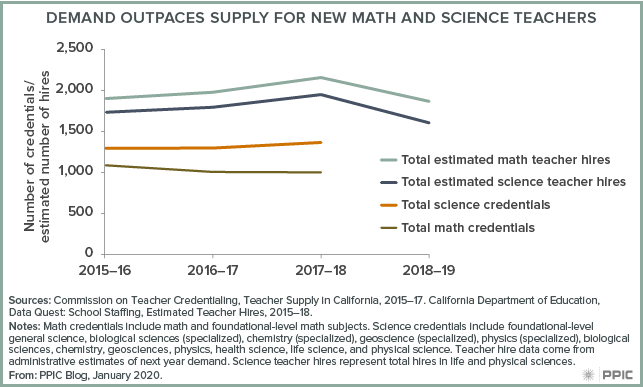
Schools across the state face critical teaching shortages in math and science, leading many schools to increase their reliance on less-credentialed and less-experienced educators. Difficulty in staffing these subjects also means that some schools must reduce course offerings, impeding student access to math and science coursework. Indeed, the number of new math and science teaching credentials has not matched demand for such teachers in recent years. In fact, the number of new math credentials has actually fallen over the past two years, constraining schools in both hiring and course offerings.

figure - Demand Outpaces Supply for New Math and Science Teachers

These continued shortages have important implications for student opportunities in STEM fields. For example, nearly one-third of high school graduates do not meet current UC and CSU requirements for science coursework, and many schools do not have the number of teachers required to offer three or four years of math and science to all interested students. Proposed increases to science eligibility requirements for UC admission—and for math requirements at CSU—mean that increasing the supply of qualified new math and science teachers is more essential than ever. Continued shortages will make it difficult to both accommodate this increased demand and to address equity gaps in the availability of high-quality math and science coursework.

In this light, the governor’s proposal provides reason for optimism. Increased funding for teacher recruitment and retention should help to encourage young adults to enter teaching and retain those who do. And more money for training and development should help to ensure that schools are able to choose among qualified teachers. Whether this will be enough to truly make a dent in the state’s teacher shortage remains to be seen; it depends crucially on whether these investments will be continued in future years or end up as one-time relics from a strong budget year.

Covering the Real Costs of College

Faced with the state’s high cost of living, California college students struggle to secure adequate food and housing. Even amid one of the largest and longest economic expansions in state history, 33% of students are housing insecure and 35% have low or very low food security, according to a California Student Aid Commission survey of 150,000 college students. As the state seeks to meet economic demand by producing more students with degrees and certificates, the full cost of college remains a barrier to progress.

Governor Newsom and the legislature have recognized the need to reform state financial aid programs to address the full cost of college. The 2019–20 state budget provided $41 million in ongoing funding to help colleges address food and housing insecurity, $19 million to support rapid rehousing programs, and increased the number of competitive state grants for non-traditional students from 25,750 to 41,000.  Additionally, the legislature increased the maximum award amount that students with children pay for non-tuition college costs from $1,672 to about $6,000.

However, broader reform of the state grant aid program remains elusive. Two recent bills sought to expand eligibility for Cal Grants by eliminating current age, time out of high school, and high school GPA requirements. The bills also sought to provide additional non-tuition aid to community college students and students in career education programs.  The bills did not make it to a vote; however, they will be re-examined in the next legislative session. Estimated at $2 billion per year, proposed reforms would nearly double the annual cost of the program.

Consequently, the California Student Aid Commission, the agency that distributes financial aid, intends to streamline these proposals to constrain costs while increasing access. Higher education is a vital tool that increases economic and social mobility; ensuring all students have equal access to an affordable education is paramount to modernizing California’s economy. An equitable and financially viable approach to financial aid will be critical if the state’s booming economy slows in coming years.

Video: Californians and Their Government

Joe Biden, Elizabeth Warren, and Bernie Sanders continue to lead the field in California’s primary race. Most Californians say President Trump should be impeached and removed from office, though views are mixed on how Democrats in Congress are handling the impeachment inquiry. In Sacramento last Wednesday, PPIC researcher Alyssa Dykman outlined these are other key findings from PPIC’s latest statewide survey, which was conducted before the November 20 debate.

Among Democrats and Democratic-leaning likely voters, support for Joe Biden (24%), Elizabeth Warren (23%), and Bernie Sanders (17%) is much higher than for Kamala Harris (8%), Pete Buttigieg (7%), and Andrew Yang (5%). No other candidate is preferred by more than 1%, while 9% say they don’t know which candidate they would choose.

Views on impeachment are divided along party lines: 83% of Democrats, 51% of independents, and 11% of Republicans think the president should be impeached and removed from office. Democrats are also much more likely than independents or Republicans to approve of the way the inquiry is being handled in Congress.

In other news, most Californians are concerned about wildfires (34% very, 29% somewhat) and power shutoffs (32% very, 27% somewhat). Governor Newsom gets mixed reviews for his handling of these issues: 46% of adults and 42% of likely voters approve, while 39% of adults and 46% of likely voters disapprove. Only about a third of Californians have either a great deal or quite a lot of confidence in their utility providers.

Other survey highlights:

  • Six in ten Californians (61% adults, 63% likely voters) say things in the US are generally going in the wrong direction, but about half think the nation will have good times financially over the next 12 months.
  • Nearly two-thirds of adults (63%) say California is divided into the “haves” and the “have nots”; 41 percent say they are haves, while 44 percent see themselves as have nots.
  • Most Californians are very concerned about homelessness in their communities; majorities across regions say the number of homeless people in their local community has increased over the past 12 months.
  • A potential citizens’ initiative that would raise state income taxes on the wealthiest Californians to fund K–12 public schools has majority support. Fewer than half of likely voters favor two other measures—a school construction bond and a “split roll” property tax—that would benefit the K–12 system.

Approval Ratings in a Hyper-Partisan Era

One of the most surprising findings in our PPIC Statewide Surveys this year has been the consistency of the approval ratings of the California governor and US president during a very eventful year. It’s yet another sign of deep divisions between Republican and Democratic voters—and a split in partisan preferences within the growing ranks of independent (also known as no party preference or NPP) voters in California.

The latest PPIC survey shows Governor Gavin Newsom’s approval rating to be statistically unchanged among California’s likely voters over the course of his first year in office (43% January, 45% March, 47% May, 47% July, 43% September). Despite low unemployment and a multi-billion dollar budget surplus, Newsom’s approval rating is still falling short of 50 percent—even as he has become more widely known.

Meanwhile, President Trump’s approval rating has also held steady in 2019 (36% January, 34% March, 38% May, 38% July, 35% September). Trump’s approval may be low, but it has been rock solid in the wake of numerous controversies and political setbacks, including the current impeachment inquiry.

One of the major contributors to the ceiling on the Democratic governor’s approval rating is his very weak support among Republicans (12% January, 14% March, 13% May, 14% July, 12% September), even while strong majorities of Democrats approve of the job that he is doing (65% January, 68% March, 69% May, 72% July, 68% September).

Similarly, the floor on President Trump’s approval rating is largely explained by overwhelming approval from Republican voters (82% January, 82% March, 84% May, 87% July, 83% September) even while his Democratic support has mostly been in single digits (7% January, 5% March, 8% May, 10% July, 7% September).

Behind these disparate views of two starkly different political figures is a growing inclination to see the world through a highly partisan lens. About seven in ten Republicans now call themselves “strong” Republicans (63% January, 69% March, 72% May, 65% July, 72% September)—up sharply in a decade (55% September 2009). Similarly, about seven in Democrats now say they are “strong” Democrats (69% January, 66% March, 69% May, 60% July, 68% September)—again, much higher than 10 years ago (58% September 2009).

How does hyper-partisanship impact approval ratings? In our latest survey, only 5% of “strong” Republicans approve of the governor, compared to 76% of “strong” Democrats. And 94% of “strong” Republicans approve of the president, compared to just 1% of “strong” Democrats. The “not so strong” Republicans and Democrats give more mixed reviews—but their diminishing ranks means that approval ratings are more polarized and static.

One would expect that the growing number of independent voters—now about a quarter of the California electorate—would be a reliable source of volatility in the governor and president’s approval ratings. But most nonaligned voters are clearly taking sides in the partisan conflict. In our recent survey, we find that most independent likely voters are split fairly evenly between the two parties, with seven in ten saying either that they lean Democrat (36%) or Republican (35%). Of those who lean Republican, 18% approve of the governor while 69% approve of the president. Of those who lean Democratic, 63% approve of the governor while 2% approve of the president.

Most Californians have made up their minds about whom they do and do not trust in government. Many view their federal and state officeholders through party labels rather than ideas and actions. It would take extraordinary circumstances for Governor Newsom to rise much higher in public esteem—or for President Trump to fall much lower.

The emergence of hyper-partisanship has significant implications for California’s democracy. Will California voters be reluctant to cross party lines in the top-two primary in March? Will independent voters continue to side with one of the two major parties or are they open to a third party alternative? Will California’s elected leaders be able to find common ground and bipartisan solutions?

The answers to these questions will have far-reaching impacts on the 2020 election and the future of the state. The PPIC Statewide Survey will continue to track partisanship throughout this highly contentious and consequential time.

Waning Confidence in the Electoral Process

Just ahead of the next Democratic presidential primary debate, and as California heads into a particularly consequential election year, residents express the lowest confidence in the state’s electoral system ever recorded by the PPIC Statewide Survey.

In our most recent survey, 36% of all adults and 42% of likely voters say that they have either a great deal (18% adults, 22% likely voters) or quite a lot (18% adults, 20% likely voters) of confidence in California’s electoral system. Confidence has continually declined since we first asked this question in October 2004.

figure - Confidence in the Electoral Process Has Declined Significantly

Levels of confidence in the electoral system differ across partisan lines. Today, Democrats (52%) are slightly more likely than they were in 2004 (45%) to say they have either a great deal or quite a lot of confidence in the system. But confidence has declined somewhat among independents (35% today; 47% 2004) and significantly among Republicans (27% today; 76% 2004).

Since 2004, confidence has declined across nearly all age, education, income, and racial/ethnic groups—with the exception of African Americans, who express similar levels of confidence today (37%) as they did in 2004 (32%).

Much recent debate has centered on two opposing concerns about elections: some are concerned about voter fraud, in which ineligible people vote, while others are concerned about voter suppression, in which eligible voters are unable to cast a ballot.

Currently, voter fraud is the stronger concern. A slight majority of Californians (54%) and likely voters (57%) are either very or somewhat concerned that it is too easy for ineligible people to vote. But many still consider voter suppression to be an issue, with 45% of all adults and 42% of likely voters either very or somewhat concerned that it is too hard for eligible people to vote.

Views on these issues differ across party lines. Republicans (79%) are far more likely than independents (53%) or Democrats (43%) to be either very or somewhat concerned about voter fraud. In contrast, Democrats (50%) are more likely than independents (43%) or Republicans (34%) to say voter suppression is either very or somewhat of a concern.

figure - Partisan Differences in Concerns about Voting in California Elections Are Sizeable

Concern about voter fraud has increased among certain groups since we last asked this question in 2017. In particular, we see increases among likely voters (57% today; 50% 2017), as well as among those age 55 and older (63% today; 53% 2017), Asian Americans (54% today; 43% 2017), and college graduates (48% today; 40% 2017).

Concern about voter suppression has grown among African Americans (66% today; 49% 2017), residents of the Inland Empire (54% today; 35% 2017), and Republicans (34% today; 22% 2017).

Governor Newsom recently signed legislation that will allow voters to register and vote on Election Day anywhere ballots are cast. This is the latest in a number of reforms meant to broaden voter access in the state. Stay tuned as we monitor Californians’ perceptions on these issues throughout this important election season.