The Top Two and Turnout in California’s Primary

California voters face many decisions on a long and crowded June 5 primary ballot. None will be more closely watched than the choices made in the top-of-the-ticket governor’s race that will determine the top two candidates in the November election runoff. Six candidates—four Democrats and two Republicans—have been serious contenders in this race. In the May PPIC Survey, Democrat Gavin Newsom continues to lead the pack, with little separation between Republican John Cox and Democrat Antonio Villaraigosa for the coveted second-place finish. It’s a toss-up if the gubernatorial race will include two Democrats or a Democrat and a Republican. Why does this matter so much?

It is likely that a Democratic candidate will prevail—no Republican has won a statewide election since 2006. Since then, the gap in partisan registration has ballooned to 19 points (44% Democrat, 25% Republican; Secretary of State, April 2018). The issue today is turnout. The partisan makeup of this November’s electorate has consequences for the Democrats’ efforts to flip several Republican House seats in competitive California districts (Cook Report, May 10) to gain party control of the US Congress. Without a candidate at the top of the ticket, Republicans have one less reason to vote.

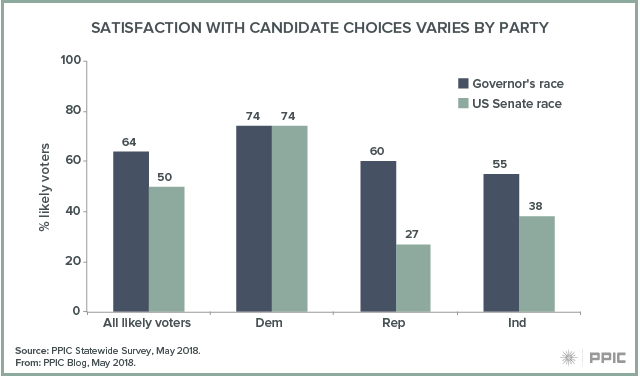
Californians have warmed up to the current gubernatorial contest. The May PPIC Survey finds that likely voters’ interest in news about the gubernatorial candidates has almost doubled since January (30% to 58%). Equal proportions of likely voters across parties are very or fairly closely following election news today (58% Democrats, 61% Republicans, 60% independents). Moreover, likely voters’ satisfaction with the candidate choices has grown since January (54% to 64%)—especially among Republicans, who were the least satisfied earlier this year. Majorities of likely voters across parties are now satisfied with their choices (74% Democrats, 60% Republicans, 55% independents). In addition, more likely voters have found a candidate to support for governor since January (76% to 85%), and by similarly large margins across parties (86% Democrat, 86% Republican, 81% independent) today. Democratic pluralities are favoring Newsom, Republican pluralities are supporting Cox, and independents are dividing their support across two parties and four candidates.

By contrast, we need to look no further than the US Senate primary to foreshadow the impact of a one-party governor’s contest this fall. Democratic US Senator Dianne Feinstein is on the ballot with Democratic California State Senator Kevin de León. There are no major candidates from the Republican ranks in this race. In the May PPIC Survey, likely voters’ satisfaction with senate candidate choices (50%) is much lower than in the governor’s race (64%), with vastly different satisfaction levels across parties (74% Democrat, 27% Republican, 38% independent). More importantly, fewer voters have found a candidate to support in the senate race (64%) than in the governor’s race (85%), and this trend is especially pronounced among the GOP likely voters (87% Democrats, 41% Republicans, 53% independents) today.
The top-two system was created in 2010 to encourage the growing ranks of independent voters to participate in the June primary. Third parties countered that their voters would be shut out of the November election, an outcome that has largely proven true. With the dwindling ranks of Republicans today, another flaw that impacts the two-party system has surfaced—lack of participation from those feeling unrepresented on the ballot. And with deepening partisan divisions in the country, voters cannot be counted on to cross party lines and choose a candidate from outside their ranks. Republicans face an unprecedented obstacle of unknown proportions if a one-party governor’s race depresses their turnout. In the long run, California’s democracy has a bigger problem if many voters are feeling disenfranchised by the top-two primary results and choose not to participate in a statewide election. To fully assess the significance of these issues, PPIC surveys will continue to track voter interest, candidate satisfaction, and ballot choices in this consequential election.

Do Californians Support State Action on Immigration?

California became the nation’s first sanctuary state in January, when Governor Jerry Brown signed legislation (SB 54) that limits cooperation by local law enforcement with federal immigration authorities. In March, the US Justice Department announced that it was suing California over three immigration-related laws—including SB 54. Since then, six counties—including San Diego and Orange—and at least 13 cities have voiced opposition to the sanctuary laws, either by passing resolutions or by joining the Justice Department’s lawsuit against California.

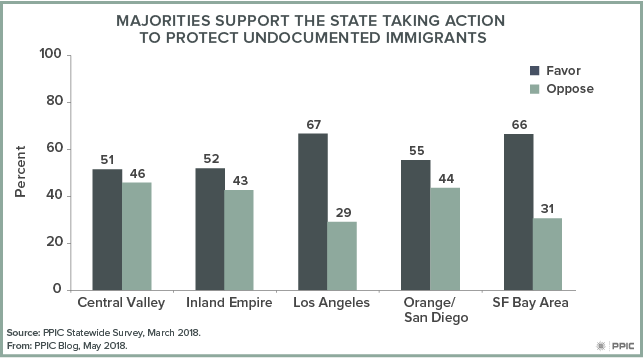
A solid majority of Californians (61%) support the state taking action to protect undocumented immigrants. But there is a stark partisan divide: the March PPIC Statewide Survey found eight in ten Democrats in favor of and eight in ten Republicans opposed to the state taking action. It is notable that there is majority support across the state’s regions. This includes 55% support among residents in Orange and San Diego Counties, home to a majority of the cities opposing the sanctuary laws. About half of residents in the Central Valley and the Inland Empire favor the state taking action. And support is even higher in Los Angeles and the San Francisco Bay Area, where it hovers around two-thirds. There are some differences between coastal (64%) and inland (52%) residents.

Across demographic groups, there is considerable support for state action on this issue—in fact majority support drops below 50% only among whites (47%). Support is highest among Latinos (76%), immigrant residents (73%), those with a high school degree or less (71%), Californians age 18 to 34 (67%), and those living in households making less than $40,000 (67%).

While the courts will ultimately decide the fate of the federal lawsuit, two things are clear: 1) California will continue to chart its own course on issues its leaders care about, and 2) immigration continues to be a topic that divides partisans but unites many other Californians across the state. Stay tuned to PPIC as the Statewide Survey will continue to monitor the opinions of Californians on this important policy issue.

Video: Californians and Education

In the wake of the Parkland, Florida, killings, the latest PPIC survey finds an overwhelming majority of Californians are concerned about a possible shooting in their local schools. But most oppose having teachers carry guns in school facilities.

Lunna Lopes, PPIC researcher, detailed these and other key findings at a Sacramento briefing last week.

When asked about school shootings, 73 percent of California adults and 82 percent of public school parents say they are very or somewhat concerned. Yet two-thirds of adults (67%) and public school parents (68%) oppose allowing more teachers and school officials to carry guns in schools. Strong partisan differences emerge on this issue. An overwhelming majority of Democrats (86%) and a strong majority of independents (69%) are opposed to arming teachers and school officials, while a solid majority of Republicans (60%) favor the idea.

A few other survey highlights include:

  • Californians (65%) support having local school districts declared sanctuary safe zones for undocumented students, but there are deep partisan divisions.
  • California adults and likely voters continue to see the state’s K–12 funding as inadequate. Solid majorities (60%) of likely voters favor local school bonds, while fewer (48%) support local parcel taxes for schools.
  • Across parties, majorities of likely voters agree that gubernatorial candidates’ positions on K–12 education are very important.
  • Among likely voters in the gubernatorial race, Democrat Gavin Newsom maintains his lead (26%), followed by Republican John Cox (15%) and Antonio Villaraigosa (13%). Nearly a quarter of likely voters (22%) remain undecided.

The PPIC Statewide Survey: Reflections at the 20th Anniversary

Mark Baldassare, president and CEO and survey director, and Abby Cook, vice president of communications, at the Public Policy Institute of California have worked on every PPIC Statewide Survey.

This year, the 20th anniversary of the PPIC Statewide Survey, is an important one in California. The state is at the forefront of many major national issues, and our voters will be electing new leaders across the board. Over the past two decades, PPIC has conducted nearly 175 public opinion surveys, interviewing more than 350,000 Californians—allowing us to see how the attitudes of state residents have evolved and providing valuable context for today’s policy landscape.

Our surveys show that Californians have long had a progressive streak when it comes to such topics as environmental protection, gun restrictions, and a woman’s access to abortion. However, views on other key issues have undergone significant change. Among them:

  • The perception that immigrants are a net benefit to California has been steadily climbing. In 1998—the first year of the PPIC survey—46% of Californians said that immigrants are a benefit to California because of their hard work and job skills; 42% said immigrants are a burden because they use public services. Last year, 76% said immigrants are a benefit, while 20% said they are a burden.
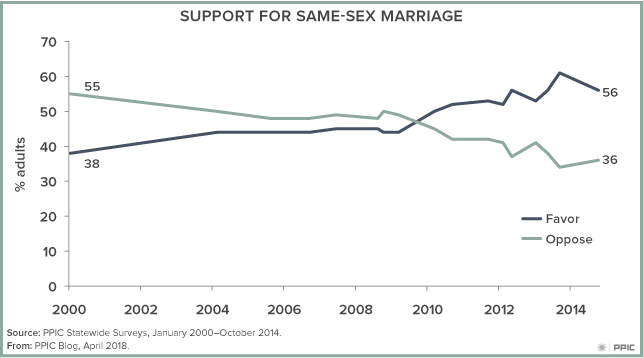
  • Majority support for legalizing same-sex marriage is now the norm. In 2000, we asked whether Californians favored or opposed allowing gay and lesbian couples to be legally married. Just 38% were in favor and most (55%) were opposed. By 2014, opinions reversed. A majority—56%—were in favor and 36% were opposed.

  • State action to combat climate change has evolved from a bipartisan issue to a partisan one. The Global Warming Solutions Act of 2006, landmark legislation that required the state to reduce greenhouse gas emissions to 1990 levels by 2020, enjoyed the support of a strong majority of Californians (65%)—including more than six in ten adults across parties—the year it passed. By 2016, support was similar (69%), but there was a wide partisan divide: majorities of Democrats (80%) and independents (56%) expressed support, while fewer than half of Republicans (44%) did so.

At the same time, the survey shows Californians holding steadfast on other issues:

  • The citizens’ initiative process in lawmaking is highly valued. In 2000, 68% of Californians were somewhat or very satisfied with the initiative process. By 2016, that figure had changed little (64%).
  • Californians express unwavering praise for Proposition 13. In 2003, the 25th anniversary of the landmark ballot measure, 57% of Californians said it had been mostly a good thing. This year, the 40th anniversary, that number remains the same.
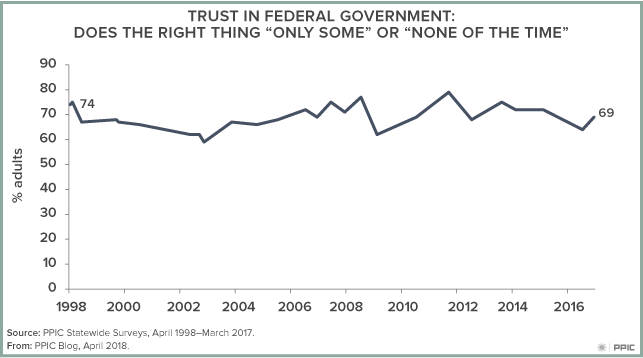
  • Distrust of government is a constant undercurrent in voter sentiments. In April 1998, 74% of Californians said they trusted the federal government to do what is right only some or none of the time. In 2017, a similar percentage—69%—expressed that view.

Above all, the survey has revealed that the most persistent element in California policymaking is what we call the state’s “exclusive electorate.” California voters tend to be older, white, affluent, homeowners, and college educated. Nonvoters tend to be younger, Latino, less affluent, renters, and less likely to be college educated than likely voters. Voters make significant policy decisions at the ballot box—but nonvoters provide a unique perspective on the role of government. At a time when economic inequality has become one of most important policy issues in the state, this divide is a key reason we conduct the PPIC Statewide Survey as we do. Our survey gives all Californians—nonvoters and registered voters alike—a real-time voice on current topics, political leaders, and public institutions.

PPIC is unique in California in its ability to combine state-of-the-art polling with an institutional commitment to tackling major issues affecting Californians. We are often asked about how we conduct the survey and the philosophy behind it. Here is a brief look behind the scenes.

First, our surveys adhere to the high-quality standards set by the most respected nonpartisan polling organizations that conduct national surveys—such as the Pew Research Center, the Washington Post, ABC, CBS, CNN, and Gallup. Like these organizations, we use a random digit dialing (RDD) methodology. Despite changes in the polling landscape, this method remains the most effective way to reach all adults. It allows for random sampling of households within California, meaning that each person in the population has an equal probability of being selected. Our surveys include live telephone interviews with adults (age 18+) in English and Spanish. After each survey is completed, we compare the survey sample to census statistics and make any necessary statistically weighted adjustments to achieve a representative sample.

Second, while our methods remain the same, our approach has changed in response to the challenges of reaching people by phone. Since 2003, we have worked exclusively with interviewing firms that conduct surveys for our national peers. Starting in 2008, we have conducted both landline and cell phone interviews. After the 2016 election, based on extensive analyses of the performance of online surveys and live telephone surveys, we decided to maintain our RDD methodology and increase our cell phone interviewing (65% in 2017, 70% in 2018).

Third, every survey is designed with the intent of delivering accurate, independent, nonpartisan information on the perceptions, attitudes, policy preferences, and ballot choices of California residents. Our core audiences are policymakers, the media, and other engaged Californians—all of whom have come to depend upon the PPIC Statewide Survey as a critical barometer of public opinion in the state. And amid the partisan rancor of political debate, PPIC’s surveys also point out areas of consensus among the state’s diverse residents, providing valuable information to policymakers.

Fourth, PPIC produces a range of products in conjunction with each survey—including blog posts, fact sheets, and a survey report with crosstabs. Large sample sizes (currently 1,700 adults) allow us to accurately report the findings of key subgroups, such as likely voters, partisan groups, major regions, and age, income, and racial and ethnic groups.

Finally, our surveys are free of charge and available to all. We disseminate the findings through outreach activities that include public briefings in Sacramento—videotaped and posted on our YouTube channel—and broad use of social media, where our followers include state legislators, nonprofit and business leaders, and reporters from major media outlets. We also convene forums around the state for constructive discussion of the issues raised in our surveys. As a result, the PPIC Statewide Survey has had a significant impact on informing policymaking, as measured by activities such as bill citations in the state legislature.

We are grateful to many PPIC colleagues who have worked diligently over the years to produce surveys that are timely, relevant, and accessible. For every survey, the staff makes the call on survey methods and questions, and the content of reports and press releases. We benefit greatly from the leadership of the PPIC board of directors, which is dedicated to maintaining the institute’s mission and values, and a survey advisory committee that provides substantive input and expertise. Lastly, we would not have arrived at the 20-year mark without grant support from foundation partners—the James Irvine Foundation for the “Californians and Their Government” survey series and the consortium who fund the annual education and environment surveys. These ingredients make it possible for PPIC to conduct independent, nonpartisan, high-quality polling that provides a voice for the public and likely voters.

The 20th year of the PPIC Statewide Survey is shaping up to be the most important to date. We are monitoring the attitudes of California adults on a host of critical issues while tracking the ballot choices of California likely voters in the 2018 election. We look forward to keeping you well informed during a consequential election year—and into the future.

The 2020 Census Is Critical for California

The decennial census plays an essential role in American democracy. Most fundamentally, it ensures that communities get the right number of representatives in government. Less well known is the role it plays in determining how hundreds of billions of federal dollars are allocated to states and localities for a wide range of public services, including health care and child nutrition programs.

Although census information is essential, the Census Bureau is currently budget constrained, behind schedule, and scaling back the number of full-scale test runs it was planning. This is of particular concern since several key changes to the census process are in the works: the majority of census information will be collected online, resources for door-to-door outreach may be reduced, and a question about immigration status will be added to the official questionnaire. These and other factors increase the potential for an undercount, especially among vulnerable populations. Just today, California Attorney General Xavier Becerra has filed a lawsuit over this issue.

Why are the stakes so high? A significant undercount could cost California political representation in Congress at a time of record polarization and a deep partisan divide over the direction of the state and the nation. Critical decisions that affect California’s future will be determined to a large extent by federal rules on such issues as climate change, health care, and immigration.

An undercount also means that an important amount of federal funding could dry up. Federal, state, and local government programs that target disadvantaged neighborhoods or populations rely critically on census surveys to identify those in need and distribute funds accordingly. For example, two programs crucial to the health and well-being of children in California—the Children’s Health Insurance Program and the Women, Infants, and Children program—rely on population estimates that use the decennial census count as a baseline for population estimates with which they aim to accurately allocate funds across states.

The impact on California could be huge—and 2020 is fast approaching. At a time when objective facts and information are in short supply, PPIC will be working to raise awareness about the importance of the 2020 Census for California and motivate elected leaders and organizations across the state to work together to ensure an accurate count. Stay tuned for more facts and analysis of the 2020 Census from PPIC.

Californians and the Gas Tax Repeal

Governor Brown’s 2018–19 budget proposal includes a large boost to transportation funding because of recently passed legislation. In 2017, California raised the gas tax for the first time in 23 years, increasing gasoline and diesel fuel by 12 and 20 cents per gallon, respectively. The state also created a new annual fee based on vehicle value. The taxes and fees are estimated to raise over $4.6 billion in the next year to repair state and local roads, highways, and bridges, and to strengthen mass transit. However, a Republican-led initiative to repeal the bill continues to collect signatures to qualify for the November ballot.

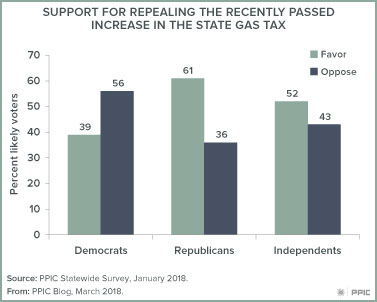
In January, the PPIC Statewide Survey asked whether Californians favor a repeal of the recently passed increase in the gas tax. We found California’s likely voters are divided, with 47% favoring repeal and 48% opposed. But there are partisan differences: 61% of Republican and 52% of independent likely voters favor a repeal, compared to 39% of Democrats. Regionally, Republican (68%) and independent (60%) likely voters on the southern coast are the most likely to favor a repeal, while inland Democrats (62%) are the most likely to oppose it. We also saw strong partisan disparities on the importance of repeal in our December survey: among likely voters, Republicans (85%) were far more likely than independents (46%) and Democrats (36%) to say repeal of the recently passed gas tax was very important to them.

Opponents of the repeal argue that the gas tax increase was necessary to fund much-need repairs to the state’s infrastructure. Conversely, proponents—in addition to generally opposing tax increases—reason the state is well situated to fund transportation projects through other funding sources. For example, Republicans in the state assembly have introduced a measure that would dedicate at least 2% of General Fund revenues to infrastructure projects.

Changes to federal policy could also affect the state’s transportation funding. Last month, the White House released a plan that aims to generate an unprecedented $1.5 trillion—including an allocation of $200 billion in federal spending over the next decade—to repair and upgrade the nation’s infrastructure. To be eligible for matching federal funds, California would need its own state and local revenue streams, whether through the new gas tax or other sources. The White House also expressed interest in raising fuel taxes by 25 cents per gallon to help pay for the plan. This would represent the first increase at the federal level since 1993 and could create an additional burden for Californians, who already face one of the highest gas prices in the nation.

As California engages in its ongoing debate over how best to fund transportation projects, upcoming federal and state policy decisions may have major consequences for residents.

California’s Partisan Divide on Higher Education

New national polling shows a big divide has opened up between Democrats and Republicans on higher education. A Pew Research Center poll taken in June shows that a majority of Republicans and those who lean Republican (58%) think colleges and universities have a negative effect on the way things are going in the country, while a vast majority of Democrats and those who lean Democrat (72%) think colleges and universities have a positive impact. This is a big change from two years ago, when majorities in both parties said higher education institutions had a positive impact on the direction of the nation.

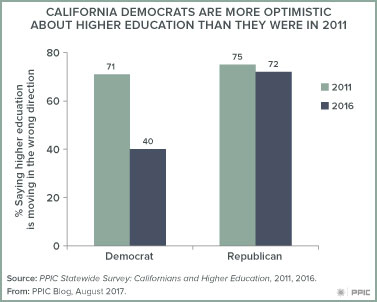
Is there a similar partisan divide over higher education in California? The PPIC Statewide Survey found a similar divergence over the past few years when we asked a different question: Is the state’s public higher education system generally going in the right or wrong direction? In 2016, California Republicans were far more likely than Democrats to say the system is headed in the wrong direction. This marked a change in the five years since we’d last asked this question. When we asked the question in 2011—toward the end of the recession and after large tuition increases—Californians in both parties overwhelmingly said higher education was moving in the wrong direction. Unlike national polling, which shows a shift in Republican opinion, PPIC surveys show a shift in the opinions of Democrats, who have become more positive, while Republicans have remained about the same.
Californians’ responses to other survey questions about higher education point to longer-term partisan divisions. Republicans have generally been more likely than Democrats to say that the overall quality of education in California’s public colleges and universities is a big problem or somewhat of a problem. Views about the direction and overall quality of public higher education are reflected in attitudes about California’s three public higher education systems. Currently about half of Republicans say that each of the systems—community colleges, California State University, and University of California—are doing an excellent or good job. More Democrats—about three-fourths—express this view.

Partisans have also historically differed on higher education funding. Compared to Republicans, Democrats are more likely to say that higher education does not receive enough funding, and Democrats are generally willing to pay higher taxes to support higher education.

Interestingly, there is some evidence that Californians’ views about the importance of college for individual success differ along party lines. A majority of Democrats (68%) say a college education is necessary for a person to be successful in today’s working world, while a majority of Republicans (72%) say there are other pathways to success. It is also true, however, that Californians in both parties have become more optimistic about the chances of success without a college degree since 2011—when the state was recovering from recession.

Finally, there are some areas of agreement. We find that members of both parties generally think that college affordability is a problem and students have to borrow too much money. Perhaps most significant is our finding that overwhelming majorities of both Republicans and Democrats say that the state’s system of higher education is important to California’s economic future and quality of life.

Learn more

Visit the PPIC Higher Education Center

Californians’ Views on ACA Repeal

With control of the presidency and both houses of Congress, Republicans now have the opportunity to act on their oft-stated promise to repeal and replace the Affordable Care Act (ACA), and legislation to replace the 2010 law is advancing in the House. In California, PPIC Statewide Surveys have found majorities of adults viewing the Affordable Care Act favorably since 2015. In our January survey, over half opposed repeal.

A slight majority (53%) of Californians said Congress should not vote to repeal the 2010 health care law, including majorities of those living in the San Francisco Bay Area (59%), Orange/San Diego Counties (59%), and Los Angeles County (56%). Statewide, 42% favored repeal, with just over half saying so in the Central Valley (51%) and Inland Empire (52%).

Not surprisingly, there were wide partisan differences on the question of repeal, with 78% of Democrats and 57% of independents opposing repeal and 80% of Republicans in favor. Whether living in coastal or inland counties, Democrats generally opposed repeal and Republicans generally favored it. But independents on the coast (61%) were more likely than independents in inland counties (46%) to oppose repeal.

In response to another question, 51% of Californians expressed a generally favorable opinion of the ACA. The Kaiser Family Foundation found in a survey conducted shortly after ours that adults nationwide held similar views (48% favorable in February). Majorities of adults in the San Francisco Bay Area (60%), Los Angeles County (56%), and Orange/San Diego Counties (53%) view the ACA favorably, compared with 44% and 41% in the Central Valley and Inland Empire, respectively. In California, there is little difference in opinion on the ACA by age or income, with about half across categories expressing a favorable view. White Californians (44%) are less likely to express a generally favorable opinion of the law, while majorities of other racial/ethnic groups hold a favorable view. Whites without a college degree (36%) are even less likely to view the ACA positively, and 60% favor repeal.

Though majorities of adults have viewed the ACA positively in our surveys over the past two years, opinions were more divided in prior surveys. We will continue to monitor Californians’ views as congressional proposals develop and as potential changes to health care in California become clear. Considering the support we found in our most recent survey for state action to address climate change and protect the rights of undocumented immigrants, it will be interesting to see what state action Californians may want to see if the federal government changes its approach to health care policy.

Learn more

Read the January PPIC Statewide Survey: Californians and their Government
Learn more about the PPIC Statewide Survey

Californians Favor Higher Taxes over Higher Tuition

After six years without tuition increases, California’s public universities are considering proposals to modestly raise tuition for California residents. The University of California (UC) has proposed increasing systemwide tuition and fees for undergraduates by $336 to a total of $12,630 for the academic year. The California State University (CSU) has proposed increasing in-state student undergraduate tuition by $270 to a total of $5,742 for full-time students. Campuses at each system charge additional fees, which currently average about $1,200 at UC and $1,400 at CSU.

A recent PPIC Statewide Survey on Californians and higher education indicates that these proposals are likely to be unpopular with the public. The survey found that Californians are concerned about the cost of college: 57% said that the overall affordability of California’s public colleges and universities is a big problem. Only 23% of Californians would be willing to increase student fees in order to increase funding for California’s public higher education system.

This is not the first time Californians have voiced disapproval of tuition increases. Before UC and CSU raised tuition in 2011, PPIC’s 2010 higher education survey found that only 35% of Californians favored increasing student fees as a way to maintain higher education funding levels in the face of state budget cuts. In 2011, our survey found that 65% of Californians were very concerned about increasing student tuition and fees as a way to deal with decreased funding.

Today, when many policy preferences are often divided along party lines, there is partisan consensus on this issue: at least 70% of Californians across parties say they would be unwilling to increase student fees to fund higher education. Indeed, less than a third of Californians across all regions and demographic groups say they would be willing to increase student fees.

At the same time, a majority of Californians (67%) believe that the current level of state funding for public colleges and universities is inadequate. So what are Californians willing to do to increase funding for public higher education? Overall, they are twice as likely to say they are willing to pay higher taxes as to say they are willing to increase student fees (48% to 23%). However, and perhaps unsurprisingly, we see notable partisan differences when it comes to willingness to pay higher taxes. While 68% of Democrats say they would be willing to pay higher taxes to increase funding for public colleges and universities, only 20% of Republicans say the same.

Another way to increase funding for California’s public colleges and universities would be to admit more out-of-state students, who pay higher tuition. Californians are somewhat divided on this issue, with half saying they would not be willing to admit more out-of-state students, while 46% say they would be willing to do so. However, only 21% of Californians support admitting more out-of-state students if this would mean admitting fewer in-state students. This view holds across party lines: only one in four Republicans (25%), and even fewer independents (21%) and Democrats (16%), are willing to admit more out-of-state students if this would mean admitting fewer in-state students. UC has proposed increasing systemwide out-of-state tuition and fees by over $1,600 to almost $40,000.

Our survey findings suggest that the proposed UC and CSU tuition and fee increases may be unpopular among Californians of all political persuasions—and that Californians’ reluctance to increase the financial burden on the state’s students may be driven by concerns about access and affordability.

Learn more

Read the PPIC Statewide Survey: Californians and Higher Education
Find out more about the PPIC Statewide Survey
Visit the PPIC Higher Education Center

Changing Attitudes toward Marijuana Legalization

Six years ago, a California ballot initiative to legalize marijuana for recreational use fell short of a majority—46.5% voted yes. This November, Californians will vote on Proposition 64, another marijuana legalization initiative. Since the 2010 election, four other states and the District of Columbia have legalized marijuana for recreational use, and, in California, the PPIC Statewide Survey series has found increased support for legalization among likely voters and within some key groups.

In our September survey, after hearing the Proposition 64 ballot title and label, 60% of California likely voters said they would vote yes. That includes strong majorities of Democrats and independents and nearly half of Republicans.

  • Support has increased among likely voters. In response to a separate, more general question, a similar share (61%) of likely voters said that they think marijuana use should be legal. That’s a 10 point increase in support for legalization in general since September 2010, when about half of likely voters said they were in favor.
  • The partisan divide has narrowed. We have consistently found support for legalization in general to be lower among Republican likely voters than among Democrats or independents, but the gap is somewhat narrower today than it was in 2010. Then as now, at least 60% of Democratic and independent likely voters supported legalization. Among Republicans, though, support has increased from 32% in September 2010 to 45% in September of this year.
  • Support has grown among older Californians. Today, nearly three-fourths of California likely voters under age 35 favor legalization, and they are more likely than older Californians to do so—a pattern that has held since 2010. But support for marijuana legalization has increased among older Californians over the past six years. Today, nearly two-thirds of likely voters age 35 to 54 support legalization, compared to about half in 2010. A slight majority of likely voters age 55 and over are in favor today, while fewer than half favored it in 2010.

As with any election outcome, much will depend on who turns out to vote. Based on past election cycles, we can expect a larger—and younger—electorate in this presidential election year than we saw in the midterm election year of 2010. It remains to be seen, though, if Californians’ changing attitudes toward marijuana legalization will be reflected in the vote on Proposition 64.

Learn more

Read the September PPIC Statewide Survey
Visit the PPIC Statewide Survey website