Medi-Cal Expansion for Undocumented Seniors

Under the proposed expansion of Medi-Cal to undocumented seniors, vulnerable Californians would gain comprehensive health insurance. The policy improves access to care for individual seniors and could alleviate the financial burden on counties that serve undocumented immigrants in indigent care programs, increasing resources for other low-income groups.

The senior population in California is projected to increase by over 2 million in the next decade, dramatically outpacing growth of younger groups in a demographic shift known as the Silver Tsunami. This increase, in particular among those in older age groups (75 to 84), will test California’s health care delivery and financing systems, because seniors are more likely to be disabled and to have complex or multiple health conditions than younger groups.
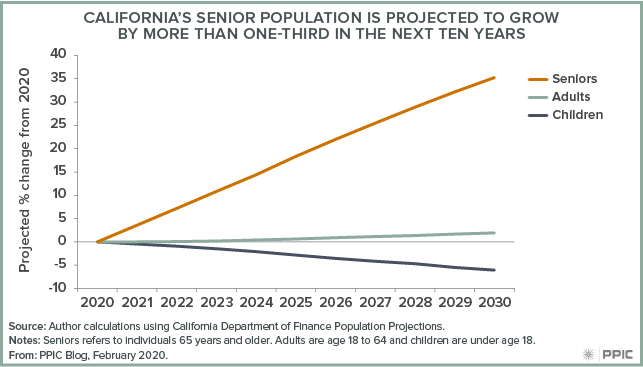
Figure - California’s Senior Population Is Projected to Grow by More than One-Third in the Next Ten Years

While most California seniors have health insurance—with Medicare being the most common—not all seniors have coverage. Many uninsured seniors are likely to be undocumented, making them ineligible for Medicare or to purchase coverage through Covered California, the state’s health insurance marketplace. These same seniors may have limited finances and therefore also are likely to struggle to access and afford health care.

Currently, most uninsured, undocumented seniors rely on safety net providers and a limited form of Medi-Cal that covers only emergencies, along with indigent care programs in certain counties that choose to cover undocumented immigrants. Under the expansion, these seniors would gain access to full-scope Medi-Cal, connecting them to preventive care and to programs to improve their disease management. Some expansion funds would also apply to the In-Home Supportive Services (IHSS) program, which pays for a caregiver—often a relative—to provide support for a senior to continue living at home rather than entering a costly long-term care facility.

The budget estimates state costs of $320 million for the expansion, which would benefit 27,000 individuals. If enacted, the policy could have implications for local finances. Counties in California provide health care and mental health services to the medically indigent, with some areas—most notably Los Angeles—serving undocumented immigrants. These county programs, together with community clinics and emergency rooms, are essential access points to health care for undocumented, uninsured seniors. If undocumented seniors become eligible for full-scope Medi-Cal, the state would finance their care instead of the county, where applicable. This shift could free up funding that could then be invested in other health-related county responsibilities, such as disaster preparedness, prevention activities, and substance use disorder treatment.

A complicated fiscal relationship between the state and counties, however, makes it difficult to estimate how much funding could be redirected if this group of seniors gain access to Medi-Cal. As state lawmakers consider the policy change, it will be important to consider how it may affect local and state finances.

Expanding Health Care Coverage for Undocumented Immigrants

As efforts to create a state-based single-payer health system confront complex questions of costs and federal uncertainty, advocates and state lawmakers are pushing forward with incremental policy measures to expand access to health coverage. The largest group of Californians that remain without comprehensive health insurance are undocumented immigrants, who were largely excluded from the coverage expansions created by the Affordable Care Act. Estimates suggest that almost 60% of uninsured Californians are undocumented.

Today, the Senate Health Committee is holding a hearing on SB 974 (Lara), which would allow all income-eligible California residents, regardless of immigration status, to enroll in comprehensive coverage through Medi-Cal (the state’s Medicaid program). California has already extended Medi-Cal coverage to undocumented children under 19, who have been eligible for comprehensive health benefits since May 2016. At the end of last year, nearly 220,000 undocumented children were enrolled in Medi-Cal, with costs estimated at $280 million in the recent fiscal year’s budget. No cost estimates are available yet for covering undocumented adults. But comprehensive coverage for the undocumented population must come from state funds, since federal Medi-Cal funding can only be used to support emergency services for undocumented immigrants.

In previous research, we estimated that about half of California’s undocumented population would likely qualify for Medi-Cal based on their income levels if restrictions on immigration status were removed. But this varied across regions. In Los Angeles County and parts of the Central Valley, more than half of undocumented immigrants had incomes below the Medi-Cal eligibility threshold of 138% of the federal poverty level, or FPL ($34,600 for a family of four). Bay Area counties had lower shares of income-eligible undocumented immigrants.

Currently, undocumented adults rely on the health care safety net—including community clinics, public hospital systems, and emergency departments—to access needed medical care. These providers play an integral role in caring for both those that remain uninsured and those covered by our vastly expanded Medi-Cal program. As policymakers consider ways to expand comprehensive health coverage, it is important that they continue to support the state’s safety net providers.

Californians and Immigration Policy

During President Trump’s first year, perhaps no issue caused more conflict between the state and federal government than immigration. In January, California became a sanctuary state. Yesterday, the US Justice Department filed a lawsuit against California over three state immigration-related laws that were passed by the California Legislature in 2017. How do residents feel about the state and local governments making their own policies and taking actions, separate from the federal government, to protect the legal rights of undocumented immigrants?
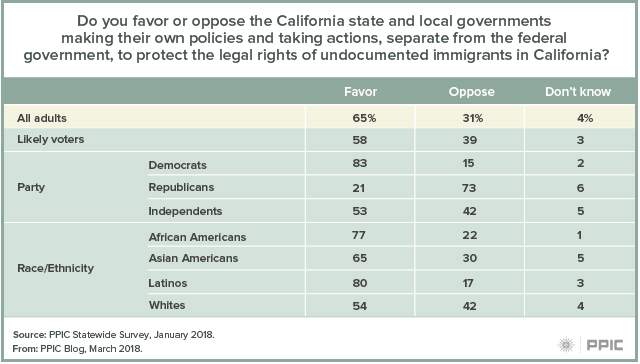
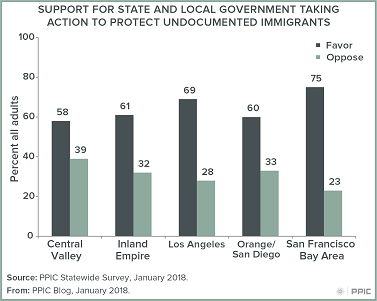
In January, we found that most Californians are in favor (65% adults, 58% likely voters), as we also found a year ago (65% adults, 58% likely voters). Today, eight in ten Democrats are in favor, compared to half of independents and two in ten Republicans. Majorities across regions support state and local government action.

We also find support across age, education, income, and racial/ethnic groups. Latinos and African Americans are more likely than Asian Americans and whites to be in favor.

Read “Californians and DACA” (PPIC blog, February 6, 2018)


Video: How Californians View National Issues

With the nation focused on a range of contentious issues, the September PPIC Statewide Survey provides a California perspective. Dean Bonner, associate survey director, shared the key findings at a Sacramento briefing last week.

Among them:

  • A record-high share of Californians have a favorable opinion of the Affordable Care Act, and most want Republicans to work with Democrats to improve the law. While most Californians say it is the federal government’s responsibility to make sure that all Americans have health coverage, just a third favor a single-payer, government-run national health insurance system.
  • Three-fourths of Californians—also a PPIC record high—view immigrants as a benefit rather than a burden. There is broad and bipartisan support for protections provided by DACA, which shields from deportation some undocumented immigrants brought to the US as children and allows them to get a work permit if they pass a background check.
  • Half of Californians say they are very concerned about the possibility of North Korea having a nuclear missile that could reach the state.
  • Two-thirds of Californians view possible Russian interference in the 2016 as a serious issue.
  • Half of Californians say race relations have gotten worse in the United States over the last year. They are less pessimistic when it comes to race relations in the state.

PPIC Polling and the Immigration Debate

This post is excerpted from a presentation to the PPIC Board of Directors and guests on September 12, 2017, in Los Angeles.

One of the most important issues for Californians in the first year of the Trump administration is changing federal immigration policy. Immigrants are a significant presence in California, and even more so in Los Angeles County. Los Angeles, the state’s most populous county, is home to more than 10 million people, including more immigrants than any other California county. Twenty-seven percent of California’s population is foreign born—about twice the US percentage—while 35% of Los Angeles County population is foreign born. Moreover, about 2.6 million undocumented immigrants—about a quarter of the total number in the US—live in California. More than 800,000 of these undocumented immigrants live in Los Angeles. Major shifts in federal immigration policy that are under way thus have profound impacts on California and Los Angeles.
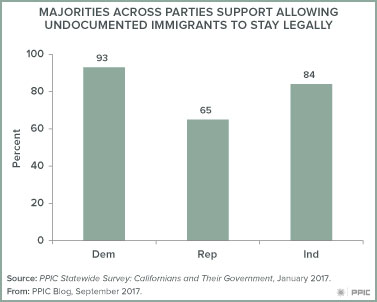
Since January, PPIC has been monitoring state and local responses to changing federal immigration policy through our public opinion polling. We have asked 11 questions about federal immigration policy in four monthly surveys, each involving 1,700 California adults, including more than 400 adults from Los Angeles County, interviewed by landline and cellphone in English or Spanish. The margin of error is +/-3% for California and +/-6% for Los Angeles. While the country is politically divided on immigration issues, we have found some bipartisan agreement in California. Here’s a sampling of our findings this year:

  • Undocumented immigrants living in the US: In our January PPIC Statewide Survey, 85% of Californians and 89% of Los Angeles residents agreed that undocumented immigrants who are living in the US should be allowed to stay legally. These results are consistent with earlier PPIC surveys. Moreover, solid majorities were in favor of state and local governments making their own policies and taking actions, separate from the federal government, to protect the legal rights of undocumented immigrants in California (65% California, 73% Los Angeles).
  • Border wall, travel ban on residents of six Muslim-majority nations: In our March PPIC survey, when asked about building a wall along the entire Mexico border, more than 7 in 10 were opposed (72% Californians, 76% Los Angeles). In the same survey, about 6 in 10 (58% California, 63% Los Angeles) opposed the president’s revised travel ban involving six Muslim countries.
  • Immigration enforcement and schools: In our April survey, 46% of Californians and 55% of Los Angeles residents said they are very concerned that increased federal immigration enforcement efforts will impact undocumented students and their families in their local public school districts. More than 6 in 10 (65% Californians, 73% Los Angeles) favored having their local public school district designated as a sanctuary safe zone in order to protect its undocumented students and their families from federal immigration enforcement efforts.
  • Worries about deportation, impact of enforcement on business and jobs: In our May PPIC survey, 30% of Californians and 34% of Los Angeles residents said they worry a lot that someone they know could be deported as a result of increased federal immigration enforcement. About half said that increased federal immigration enforcement will have a negative impact on businesses, jobs, and the economy in their part of California (49% California, 53% Los Angeles).

As the federal policy landscape shifted this year, PPIC Statewide Surveys continued to find majority support for a path to citizenship for undocumented immigrants who are living in the US: in our March survey, 68% of Californians and 71% of Los Angeles residents remained supportive. In contrast to the political divide in the rest of the nation, strong majorities across parties in California continue to agree that undocumented immigrants who are living in the US should be allowed to stay legally.

California’s path forward on immigration is a work in progress, as is the case in other areas that are undergoing federal and state policy changes. Moreover, there are uncertainties about federal actions such as the fate of the DACA program—which protects young undocumented immigrants brought to the US as children from deportation—the imposition of fiscal sanctions on sanctuary states and cities, the ban on travel from Muslim countries, and the construction of a wall along the US-Mexico border. As we have seen, California’s immigration policymaking is occurring in the context of strong public opposition to federal shifts, high levels of public concern about how these shifts are affecting undocumented immigrants and our regional economies, and strong support for actions by state and local governments to protect the legal rights of undocumented immigrants. At PPIC, we hope to foster conversations about immigration that lead to a better future for all Californians.

Learn more
Find out more about the PPIC Statewide Survey.

California’s Dream Act

As the federal government moves to end the Deferred Action for Childhood Arrivals (DACA) program, California is continuing to support the higher education aspirations of undocumented students. California’s Dream Act is a set of laws intended to lower the cost of higher education for certain undocumented immigrants brought to the US as children and raised in California. Thousands of California students have benefited from the program so far.

College can be especially expensive for undocumented students. For tuition purposes they are not technically California residents and therefore are not eligible for in-state tuition. Public colleges and universities charge extra tuition for nonresidents: currently an additional $28,000 per year at UC and $6,000 per year at CSU. In addition, undocumented students are not eligible for federal financial aid, such as Pell Grants or federal loans, leaving college out of reach for many who are low-income.

California passed AB 540 in 2001, which waives the nonresident portion of tuition for undocumented childhood arrivals as long as they meet certain criteria, including spending three or more years in California K‒12 schools, graduating from a California high school, and promising  to apply for legalizing their immigration status as soon as they are eligible to do so.  In addition, the state passed AB 130 and AB 131 in 2011, which allows state and institutional financial aid to be given to students eligible under AB 540.

Undocumented students cannot file the Free Application for Federal Student Aid (FAFSA) to apply for federal and state financial aid for college. This means that many do not have access to Cal Grants, one of the state’s main forms of financial aid. Instead, those who are eligible can apply for Cal Grants using the California Dream Act application.

Of all Cal Grant offers in 2014‒15, about 3% have been made to California Dream Act applicants. Of those eligible for the awards, both FAFSA filers and Dream Act filers have similar GPAs. However, those obtaining a Cal Grant through the state Dream Act application were more likely to come from families with parents without college degrees and with lower family incomes.

A student’s DACA status has no bearing on the California’s Dream Act, so AB 540 students will continue to pay in-state tuition rates and can apply for and receive state and institutional aid to help lower the cost of college, even if the federal DACA program ends. However, without a work permit these undocumented students still cannot work legally in the US, even if they obtain a degree from a California college or university. The approximately quarter of a million Californians covered by DACA will still be subject to deportation without further federal legislative or executive action. That uncertainty could keep otherwise qualified students from earning a college degree.

Learn more

Read “DACA and California’s Future” on the PPIC Blog.

Visit the PPIC Higher Education Center.

DACA and California’s Future

Figure Projected Pop Change

President Trump’s administration has announced the end of the Deferred Action for Childhood Arrivals (DACA) program, which allowed some undocumented immigrants who were brought to the United States as children to avoid deportation, obtain work permits, and continue their schooling. California is home to about 223,000 “Dreamers,” as DACA recipients are known, more than one-fourth of the national total. According to estimates cited by EdSource, about 70,000 Dreamers and other undocumented immigrants attend public colleges in California. The president gave Congress six months to come up with a legislative solution to address the issue before the decision takes full effect. Because California is home to a large share of the nation’s immigrants, including undocumented immigrants, changes in federal immigration policies are particularly important in the state.

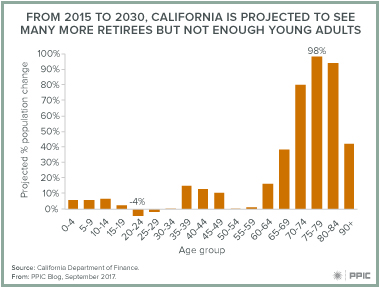
In California, as in the rest of the nation, a central economic challenge over the next couple decades will be to ensure an adequately sized and skilled workforce to meet the demands of a growing economy.  This challenge is especially daunting in the face of unprecedented increases in the number of retirees. As the baby boomers—a large group that is highly educated—exit the labor market, California and the nation will be hard pressed to find an adequate supply of workers to replace them and help provide for their healthcare and other needs. According to the California Department of Finance, over the next 15 years, the number of people age 65 and over will increase by 3.4 million, while the number of young adults age 20 to 34 will decline by almost 200,000. Requiring the Dreamers to leave the country will deepen this decline. Many of the older adults, about one-third, have a bachelor’s or graduate degree. Largely as a consequence of this demographic certainty, PPIC has projected that the state will see a shortfall of 1.1 million workers with at least a bachelor’s degree by 2030. Were it not for highly educated immigrants, the skills gap would be even larger.

The solution to this demographic, economic, and educational challenge is to make sure that more young Californians acquire the skills necessary to replace those exiting the labor market and to ensure that California’s economy can continue to grow with high-skilled and high-wage jobs. Increasing the number of young Californians going to and graduating from college is essential to closing this workforce skills gap. Because DACA recipients must be high school graduates or attending school, the program helps increase the number of Californians who are on the educational trajectory we need. The large number of Dreamers in college is evidence that they hold promise for helping the state meet its future need for educated workers.

Learn more

Read Higher Education in California: Addressing California’s Skills Gap

Visit the PPIC Higher Education Center.

Video: Attorney General Becerra on the Issues

The Trump administration has clashed with California on a range of issues, and the state’s new attorney general, Xavier Becerra, is at the forefront of the legal battles with Washington. Before a large crowd in Sacramento, Becerra talked about his views and what he has done so far on a range of issues. He spoke with Mark Baldassare, PPIC president and CEO.

Some key highlights:

  • Environment: Becerra said he has been most active so far on this issue and vowed to continue to be aggressive, whether it is initiating lawsuits, joining other suits, or moving forward with the Paris climate agreement, to the extent the state can do so. “I’ve got the governor’s back on anything he wants to do on the environment,” he said.
  • Immigration: Becerra said he favors legislation to make California a sanctuary state as long as it does not undermine the ability of local law enforcement to protect public safety by, for example, combating drug and sex trafficking.
  • Health care: Becerra said that single-payer health care is ultimately the right approach to coverage. “I hope California gets further along in recognizing that affordability only comes when you have universality,” he said.

Californians Favor State Action on Climate, Immigration

The Trump administration has set a new course on two issues that have deep roots in California politics and policy: climate change and immigration. As state policymakers consider responses to the federal government on these issues, our most recent PPIC Statewide Survey finds that Californians are broadly supportive of the state taking its own action.

In PPIC surveys dating back to 2005, strong majorities of Californians have said that global warming is a threat to the state’s future economy and quality of life. Over the same period, majorities have said that they favor the state government making its own policies to address the issue of global warming: 63% said so in the January survey. When it comes to specific action the state has taken on climate change at least two-thirds have said since 2006 that they favor AB 32, the state’s landmark law limiting greenhouse gas emissions.

Many Californians also want to see state action on immigration. When asked the most important issue for the governor and legislature to work on this year, immigration was the most common response (tied with jobs and the economy). Furthermore, 65% of Californians favored state and local governments making their own policies and taking action to protect the legal rights of the undocumented. This is the first time we’ve asked about state and local action on immigration, so we don’t know how Californians might have answered under previous presidential administrations. We can, however, look to some longstanding attitudes toward immigrants in the state.

Consistent with what we saw in PPIC surveys over the previous year, an overwhelming majority (85%) said in January that there should be a way for undocumented immigrants to stay in the country legally if certain requirements are met. In surveys since 2013, we have also found at least 60% of Californians saying that immigrants are a benefit to California because of their hard work and job skills, rather than a burden because they use public services.

On climate change and immigration, we find wide differences between the parties, with Democrats and independents far more likely than Republicans to be in favor of independent state action. Among Trump voters, few want state action on either issue, but they are more likely to favor state policymakers acting on global warming (26%) than to protect the rights of the undocumented (16%). On both issues, majorities of Californians across regions of the state want independent action, though residents of the Central Valley are among the least likely to be in favor.

While President Trump has been in office for just over a month, he already has state and local policymakers in California considering responses to his early actions. We currently find widespread support for state action on climate change and immigration, and we will continue to monitor public opinion on these issues as federal policy changes and California responses unfold.

Learn more

Read the January PPIC Statewide Survey: Californians and Their Government
Find out more about PPIC Statewide Survey

Video: PPIC Survey Examines Election Landscape

As California heads into an election year, the PPIC Statewide Survey looks at residents’ views on a broad range of issues that are already flashpoints in the presidential primary races and will likely surface in statewide campaigns next year.

PPIC research associate Lunna Lopes presented the survey’s key findings at a Sacramento briefing last week. She was joined by Mark Baldassare, PPIC president and CEO, for a question and answer session afterward. He noted a link between Californians’ “modestly optimistic view of the economy,” their belief that there is income inequality in the state, and their attitudes about which ballot issues are important. Twice as many residents say that increasing the state minimum wage is very important than say legalizing marijuana is very important.

“In California, the belief that this state is divided into the haves and have-nots—and the feeling among many Californians that they are among the have-nots—are going to be driving forces in the election,” he said. The survey briefing was held just after the mass shooting in San Bernardino, and the briefing touched on Californians’ views about gun laws. PPIC research associate David Kordus provided findings from the September survey on this issue: Compared to adults nationwide, Californians are more likely to favor stricter laws than we have now. Most also say that controlling gun ownership is more important than protecting the right of Americans to own guns.