Evaluating Corrections Reforms

Three years into California’s dramatic experiment in decentralizing the adult criminal justice system, we still have very limited knowledge of which correctional programs and services are most effective at reducing recidivism and which counties are achieving success under realignment. Even more troubling, this is not the first time the state has made a major corrections policy change without putting in place the tools to evaluate it. Nearly 20 years ago, California initiated a similar experiment with the juvenile justice system, and we still lack the necessary data to evaluate its success. This time, the stakes are even higher.

To understand whether and how well corrections reforms work, we need individual-level data, records that allow us to follow people as they move through the corrections system. Unfortunately, neither reform effort mandated this type of data collection. Neither charged a single state entity with devising a means of collecting, standardizing, and integrating data across the myriad components of the criminal justice system—police, courts, jails, prisons, and parole and probation departments. In fact, in both cases realignment magnified data integration problems. It transferred responsibility for certain offenders from the state to the counties, further decentralizing authority over offender management and data collection.

Troubled state correctional facilities were an impetus for both juvenile and adult reform. In each case populations in youth and adult state facilities declined—as intended—after lower-level offenders were transferred from state to county authority. In the case of juvenile justice, the youth population in state facilities dropped by 69 percent between 2007 and 2013; in the adult system, the state prison population dropped by 17 percent between 2011 and 2013.

But the impact at the county level differed for juveniles and adults. Adult county jail populations have increased by 14 percent since reform of the adult system began. By contrast, juvenile populations—held in county juvenile halls, camps, and ranches— have dropped by 37 percent. This decline occurred even though the reform gave counties the incentive—and later the obligation—to retain lower-level offenders.

The juvenile justice reforms coincided with a steady drop in juvenile felony arrest rates. This decline undoubtedly played a role in the dwindling number of youths in county confinement. But what remains unknown is the role of county corrections programs in rehabilitating juveniles and, in turn, driving arrest rates down. Good data would help us to make those assessments.

Any sense of urgency to create an integrated data system may have been diminished by the decline in juvenile crime rates that followed the 2007 reform. These rates are still near historic lows. Similarly, adult crime rates are also near historic lows. Realignment of that system has resulted in only a modest rise in crime so far. If these historically low crime rates are the new normal, California may choose the same path it followed after juvenile justice realignment.

However, before choosing this path we should consider the stakes. About 200,000 adults, most of whom will return to their communities at some point, are incarcerated in California’s jails and prisons. This is 26 times larger than the number of youth confined in all state juvenile facilities, county juvenile halls, ranches, and camps. Californians should ask themselves if they want to forego a greater understanding of what will be most effective in helping to rehabilitate these offenders—now and in the future.
PPIC Honors Statesman George Shultz

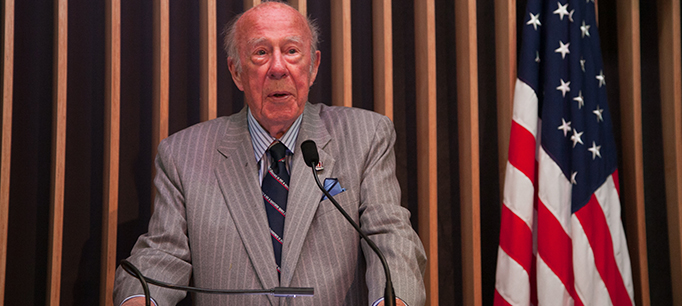
PPIC yesterday dedicated the George P. Shultz Forum at its Bechtel Conference Center, in honor of the U.S. statesman, economist, and businessman.

Shultz attended the dedication in the Bechtel Conference Center, a meeting and learning space located on the ground level at PPIC’s San Francisco headquarters. The George P. Shultz Forum is the main convening area at the conference center.

Mark Baldassare, PPIC president and CEO, noted that the George P. Shultz Forum will be a gathering place for a growing number of civic-minded groups. Speaking to an audience that included the PPIC board of directors, staff, donors, and special guests, Baldassare said, “This is a fitting way to honor George Shultz’s remarkable career in public service and his reputation for bridging policy divides on issues ranging from climate change to nuclear proliferation. It will be an inspiration to our guests.”

Senator Dianne Feinstein, speaking on video from Washington, noted key accomplishments in Shultz’s career. “When it comes to public policy and public service, there is no better model than George Shultz,” she said.

Shultz, who has a Ph.D. in industrial economics, was appointed secretary of labor in 1969, director of the Office of Management and Budget in 1970, and secretary of the treasury in 1972. He was president of the Bechtel Group from 1974 to 1982. He also served as chairman of the President’s Economic Policy Advisory Board from 1981 to 1982 and secretary of state from 1982 to 1989. He was awarded the Presidential Medal of Freedom, the nation’s highest civilian honor, in 1989. Since then, he has been a distinguished fellow at the Hoover Institution at Stanford University.

In his comments, Shultz reflected on lessons he had learned in his career of government service—including the importance of nonpartisanship. He said it is important that “PPIC keep the nonpartisan spirit alive.”

“Democracy is not a spectator sport,” he added. “And nonpartisan work is a very important part of it. You identify problems, get the facts straight, figure out how people feel, and put the information forward in a way that people can understand.”

The PPIC event also included a conversation between Lieutenant Governor Gavin Newsom and Baldassare. They talked about climate change and energy policy—issues that Shultz has focused on for many years. Newsom noted that Shultz’s career is a reminder that environmental stewardship and sustainability used to be bipartisan issues. He also said California needs to step up its leadership on climate policies and work to expand the clean technology sector.

Other guests at the event included former San Francisco mayor Willie Brown; Stephen D. Bechtel, Jr., retired chairman and a director of the Bechtel Group, Inc., and his family; and John Gunn, chairman emeritus of Dodge & Cox.

The Bechtel Conference Center was made possible by a gift from the Stephen Bechtel Fund in 2009. Its design and operation reflect PPIC’s focus on neutrality, consensus building, and respect for different perspectives. And the center’s LEED Gold certification highlights the emphasis that both PPIC and the Bechtel family place on environmental and technological innovation. This year, a group of donors led by Stephen D. Bechtel, Jr., provided a gift to dedicate the forum to Shultz. The gift will be used to upgrade the technology in the forum and establish a fund to make the space available to and affordable for other civic-minded organizations.

How Can California Increase Voter Turnout?

Days after a California primary that may set a record for low voter turnout, election experts gathered to take stock: What happened last week and how can the state engage more Californians in elections?

PPIC research fellow Eric McGhee first provided a brief overview of how California’s electoral reforms have worked so far. He noted that the top-two primary probably did not worsen voter turnout but did nothing to reverse the decline either. In the absence of an exciting race or issue, it’s unlikely that a primary reform alone will draw more voters to the polls, he said.

The consensus among panelists is that there is no single reform that will reverse declining primary turnout. Improving outreach, educating voters, making registration and voting easier—all are needed to increase engagement.

Jill LaVine, Sacramento County voter registrar, highlighted the importance of voter education. Because there were no high-profile candidates or issues in the June primary, there wasn’t much advertising on television—where many voters get information. She noted the efforts that election officials have made to make voting easier—for example, an app to help voters find polling places, and phone banks to help answer questions. But many Californians are confused by the number of changes in the state’s primary, from the date to the process of voting itself. Along with other panelists, she stressed the importance of fully funding election programs that are mandated by the state. For example, the state no longer provides funding to counties to carry out the permanent vote-by-mail program, which is used by a majority of the state’s voters.

Ethan Jones, chief consultant of the Assembly Elections and Redistricting Committee, said the legislature is addressing structural barriers to voting, such as allowing residents to register and vote on the same day. This reform, which will go into effect in future elections, will allow Californians who become engaged in an issue or candidate at the last minute to participate. There have also been efforts to address attitudinal barriers, to allow 16- and 17-year-olds who are taking civics classes to “pre-register” to vote and be added to the voter rolls when they are 18, for example.

Astrid Garcia, deputy director of the nonpartisan Future of California Elections, noted that in a state as large and diverse as California, it’s crucial to address all the steps that lead up to voting and make the experience positive, so that voters turn out again in the next election. She noted that beginning this year, legal permanent residents can be poll workers, which will educate these Californians about the process and train a cadre of bilingual poll workers for the future. She also noted the importance of “meeting voters where they are,” by allowing residents to register to vote when they seek government services. She also said that it will take time to realize the results of these reforms.

Is the Top-Two Primary to Blame for Low Turnout?

Turnout in California’s recent primary election was abysmal: the secretary of state is reporting that 21.5 percent of registered voters participated. This report doesn’t include many ballots yet to be counted but, according to educated guesses, those ballots won’t push turnout over 23 percent. This would be a record low for California.

Should we blame California’s new “top two” primary for this sad state of affairs? After all, turnout has been pretty low in both of the top-two primary elections California has had so far. Surely it’s part of the story?

This is an explanation in search of a theory. There is no clear reason why California’s new system would discourage people from voting. Many voters probably don’t even remember that we have a top-two system until they look at their ballot. When I examined this issue in a recent PPIC report, I found little evidence that open primaries affect turnout one way or the other. We can’t credit the top-two, but we can’t blame it, either.

The ups and downs of statewide turnout are driven by top-of-the-ticket competition: president, U.S. Senate, governor, and initiatives. An interesting race in one U.S. House, state assembly, or state senate district is going to engage only the voters in that district—often only a fraction of them.

For better or worse, top-of-the-ticket competition has been in short supply of late. In 2012, the presidential primary season was basically over by the time California had its primary, and Dianne Feinstein’s reelection to the U.S. Senate that year was all but a foregone conclusion. This time around, there is no presidential contest and no U.S. Senate race, and the gubernatorial contest has yet to catch fire. On top of all that, statewide citizen initiatives are now banned from the primary ballot. The legislature can place its own measures on the primary ballot (and did so in 2014), but these often lack the hot-button excitement of a citizen initiative campaign.

California does need to think seriously about how to improve primary turnout, which has been declining for decades. But we can’t pin this primary’s low participate rate on the top-two system. It was a predictable result of the statewide campaigns offered to voters. We had one of the highest primary turnouts on record in February 2008, when both the Republicans and Democrats had competitive presidential primaries and California had a say in deciding the outcome. If we get more competition in 2016 or 2018, we’ll probably see a different outcome than we did last week.

Quirks of the Top-Two Primary

This week, California voted for the second time under its new top-two primary system. The boldest innovation of this system is that it allows the top two primary winners to be from any party, even the same one. There will 25 such same-party races this fall, out of 160 total.

In an earlier blog post, I pointed out key differences between the primary and the general electorates: primary voters are typically older and less diverse—and often tilt Republican. These differences can end up producing same-party contests in places where they probably would not have occurred if primary and general election voters weren’t so different.

These same-party contests do not raise questions unless they occur in a district in which either party would typically have a legitimate shot at winning. And so far, the vast majority of same-party contests have been for seats that would have gone to somebody of that party no matter what.

But in 2012, Congressional District 31 in San Bernardino County hosted a same-party Republican runoff—although this district would likely be competitive between the two parties under most circumstances. The complexion of the primary electorate partly explained this outcome, but it also occurred because more Democrats than Republicans competed for the seat. This caused the Democratic candidates to split the loyal Democratic vote too many ways—none of them gained enough support and two Republicans advanced.

The pattern has continued in 2014. Congressional District 31 is again in the mix, avoiding a same-party Republican runoff by just 390 votes (out of more than 42,000). Meanwhile, in Los Angeles and Ventura Counties, Congressional District 25 will host a runoff between two Republicans—although this district slightly preferred Obama in 2012. That doesn’t necessarily mean that CD 25 would have been competitive this year, but all the same, it’s worth thinking about whether a same-party contest is really the match-up voters there would like to see.

The most surprising contest to come close to same-party status this cycle is the statewide race for California controller. The Democrats ran three candidates and the Republicans ran two. At the time of this writing, a same-party Republican race in the fall has been avoided by just 1,924 votes out of almost 3 million cast, a difference of less than one-tenth of one percent. This outcome may well hold, but races this close occasionally flip as more ballots are counted.

These sorts of outcomes are never going to be common under the top two. But in two election cycles they have been common enough that we ought to think about ways to address them. As part of the top-two reform, the legislature banned write-in and independent candidacies in the fall election. I have suggested we revisit that decision, and allow for such candidacies if there is demand. The bar could be set high enough to ensure that the option was rarely used, but low enough to make the option realistic, just in case.

The question is not whether same-party competition is a good idea. In uncompetitive seats, one can make a solid case that it offers choices that voters would not otherwise have—choices about which faction of the party ought to represent the district. But in places where the real conflict is between Democrats and Republicans, a same party contest closes off the very choice the top two is meant to promote.

Drought Watch: Lessons from Kansas

This is part of a continuing series on the impact of the drought.

As summer approaches, signs of the drought are intensifying, with early season wildfires, new reductions in supplies from California’s depleted rivers, and many farmers scrambling for appointments with well drillers to access more groundwater. In Sacramento, there is also a heightened sense of urgency regarding money for the water system, as the June 26th deadline looms for legislative action on a new bond for the November 2014 ballot. The drought has drawn policymaker attention to water system investments, and it has raised hopes that the public will be willing to support new borrowing. While this is good news for California’s water system, the focus on bonds is a missed opportunity to go bigger.

As we showed in our March 2014 study, Paying for Water in California, a new bond can at best provide about $1 billion per year in new funds for water. So even if a bond passes in November, California will still be facing an annual funding gap of $1– $2 billion to meet critical needs. Bonds alone can’t do the job, and now’s the time—during, not after the drought—to consider a broader package of solutions.

One important place to look for additional funds is new state fees and taxes dedicated to underfunded areas like safe drinking water, flood protection, and healthy watersheds. And here’s where Kansas comes in: Since 1989, Kansas has had a small surcharge on urban water use (6 cents/1,000 gallons) to help fund projects of statewide importance. A small surcharge on agricultural chemicals also goes into this fund, as do fines charged to water polluters. And Kansas is not alone. Missouri and New Jersey both have surcharges on urban water use (1 cent/1,000 gallons) to support safe drinking water programs. Maryland, whose environmental problems in the Chesapeake Bay rival those of California’s Delta, has small parcel taxes to fund stormwater control. Minnesota uses a small increment on the state sales tax (0.12 cents/dollar) to support healthy watersheds.

For perspective, the typical price of tap water in California is $2.67/1,000 gallons, so a 6 cent surcharge (as in Kansas) would raise this to $2.73/1,000 gallons, an increase of just 2.2 percent. And the typical California sales tax is 8.5 cents/dollar, so a 0.12 cents/dollar surcharge (as in Minnesota) would raise this to 8.62 cents/dollar, an increase of just 1.4 percent. And these small surcharges would bring in some badly needed cash: About $175 million/year for a Kansas-style urban water fee, and about $575 million/year for a Minnesota-style sales tax increment.

These surcharges could be passed by California’s legislature (by a simple majority or two-thirds vote of both houses, depending on whether they qualify as regulatory fees or taxes) and then signed into law by the governor. Or they could be put before voters alongside a new bond. Of course, the politics of new fees and taxes are trickier than those of new state bonds, for which the bill comes later, when most current officeholders will be termed out. But for the sake of a healthy and secure economy, society, and environment, the time for bold action is now. California will have plenty of company.

Are Voters Ready for the Primary?

All signs point to a low turnout in the primary next week. The most important factors that might bring voters to the polls are absent. California recently shifted all citizen initiatives to the fall ballot, depriving this year’s primary ballot of the draw that comes from those campaigns. And the race at the top of the ticket, for the governor’s seat, has not energized voters, as our latest PPIC Statewide Survey shows.

We find that Governor Brown, with the support of 48 percent of primary likely voters, will likely advance to the November general election. In the contest to see who would meet Brown in November, Republicans Tim Donnelly and Neel Kashkari are locked into a close race (Donnelly 15%, Kashkari 10%). However, one in four primary likely voters (27%)—including 34 percent of Republicans and 35 percent of independents—are still unsure of who they will vote for (17% of Democrats are undecided). And there are other signs that point to voter malaise.

We asked primary likely voters how closely they are following news about the gubernatorial candidates, finding that just 46 percent of primary likely voters are following news about candidates very or fairly closely. By comparison, in May 2010, 67 percent of likely voters were closely following news about candidates. And while attention this year has dropped across parties, it is especially low among Republicans. Today, just 39 percent of Republicans report closely following news about gubernatorial candidates; in May 2010, 68 percent said they were doing so (Democrats: 52% today, 66% 2010; independents: 52% today, 66% 2010).

Looking elsewhere in the survey, we find that only half of primary likely voters (53%) say they are satisfied with their candidate choices in the primary election for governor, while one in three are not satisfied (32%). Democrats (65%) are by far the most satisfied with their choices, while fewer than half of Republicans (43%) and independents (48%) express satisfaction. Of particular note, among those who are not satisfied nearly half (46%) say they are undecided on who they would vote for.

So with the election just days away, it appears as though many Californians have yet to tune into the governor’s race. Time will tell whether future gubernatorial contests can capture the attention of California voters and reverse the state’s recent history of low turnout in its primary elections.

Who Likes Proposition 13?

One of the most remarkably stable trends in California public opinion is the strong majority support for Proposition 13, even as the state’s demographics and politics have changed dramatically. This historic citizens’ initiative had the immediate fiscal impact of lowering property tax rates, restricting annual property tax increases, and raising the bar for local special taxes to a two-thirds majority vote. It also fundamentally changed the state-local relationship in California and ushered in the national tax revolt. Its supporters are shaping our fiscal choices today—even though many were not old enough to vote when the measure passed 36 years ago.

Proposition 13 passed in June 1978—toward the end of Jerry Brown’s first term as governor—with a 65 percent yes vote. Our most recent poll finds that 63 percent of likely voters today say that Proposition 13 has been mostly a good thing—as majorities have said since we began asking this question in 2003.

Among Proposition 13’s supporters today, about half were not old enough to vote, and 14 percent were not even born in 1978. As a group, they are mostly whites and homeowners, with annual household incomes of $60,000 or more. But they are also politically diverse. Supporters are evenly divided along party lines, with four in 10 Democrats, four in 10 Republicans, and two in 10 independents or other party members in this camp. More than half describe themselves politically as middle-of-the-road or liberals, while 45 percent say they are conservatives. About half live in the San Francisco Bay Area or Los Angeles.

What unites Proposition 13 supporters? One of their signature features is their higher level of distrust in state government. Large majorities say that the state government wastes a lot of the taxpayer’s money, believe that the state government is run by a few big interests looking out for themselves, and say that they trust the state government to do what is right only some time or none of the time. Six in 10 say that the state is headed in the wrong direction, disapprove of the way that the state legislature is handling its job, and rate the state budget situation in California as a big problem. Most say they would prefer to use the budget surplus to pay down the debt rather than restore social services. They are evenly divided when asked if they approve or disapprove of Governor Jerry Brown’s job performance—however, seven in 10 are in favor of his budget plans and approve of a rainy day fund plan that is going to the voters in November.

Proposition 13 supporters register the most consensus when asked about who should make choices for the state budget today: 83 percent want the California voters to make some of the decisions about spending and taxes at the ballot box, while only 13 percent want the governor and legislature to make all of the decisions.

Perhaps the most enduring contribution of Proposition 13 is that it has given the voters a significant and growing role in fiscal policymaking. Voters will decide the fate of the rainy day fund proposal, as well as a multibillion-dollar state water bond also scheduled for the November ballot.

When voters cast their ballots this year, it is important to be aware of the mindset of the sizable and politically diverse coalition of Proposition 13 supporters: a suspicious view of state government and a cautious approach to spending—even in the context of a strengthening fiscal and economic recovery in California.

May Survey Looks at Views on Budget, Drought

The May edition of the PPIC Statewide Survey, Californians and their Government, explores attitudes toward the governor’s latest proposed budget and gauges preferences in the gubernatorial primary. It also examines opinions on health care reform, the drought, poverty, and climate change.

PPIC research associate Dean Bonner presented the results of this wide-ranging survey at a lunch briefing in Sacramento last week.

Drought Watch: Groundwater, Our Hidden Asset

This is part of a continuing series on the impact of the drought.

The drought has brought the term storage to the forefront of political debate over how to manage water in California. Water scarcity during this drought is perceived by many, including prominent elected officials, as a failure of government to build sufficient storage.

For most, storage refers to water kept in reservoirs behind dams. People tend to forget that we also store water underground, in the state’s many aquifers. And during a drought, this groundwater storage is usually much more important.

Managed well, groundwater is the state’s best hedge against drought. The volume of potential groundwater storage in California is several times greater than surface storage. On average, about 35 percent of annual water use for cities and farms comes from groundwater, and 60 percent or more in some important agricultural regions such as the Tulare Basin and the Central Coast. During a severe drought such as this one, when groundwater pumping increases, this share can go up significantly. But groundwater is not easing the effects of this drought as much as it could because we don’t manage it as drought storage.

A fundamental principle of sustainable groundwater management is that you allow water to accumulate in aquifers during wetter years so that you can pump it out during the dry years when surface water sources are insufficient. In most of California’s main agricultural areas—especially the southern Central Valley and parts of the Central Coast—the total water demands are so great that we have stopped allowing groundwater levels to recover during the wetter years. Instead, we are “mining” groundwater, treating it like oil and gas, extracting it as if it was a non-renewable resource never to be replaced.

This mining—or overdraft—reduces the available supply of groundwater during dry years. It raises the costs of remaining supplies, as wells need to be drilled deeper and electricity bills rise because water has to be pumped from deeper depths. Unsustainable pumping also creates a host of other problems, including dewatering of rivers and wetlands that support fish and wildlife as well as land sinking—or subsidence—that damages roads, bridges, canals, and flood control infrastructure.

Some of California’s large urban areas—including much of Southern California and Silicon Valley—provide valuable lessons on how to move toward more sustainable management of groundwater basins. In these areas, acute groundwater overdraft spurred groundwater users—often with the aid of the courts or the state legislature—to develop management schemes that work. These groundwater basins are overseen by court-appointed water masters or special management agencies that can collect fees, monitor use, and allocate pumping rights. Most important, they can compel users to store water during wet times, so it is available when drought strikes.

A silver lining of the current drought is that it has brought focus to how we manage groundwater, the other water storage in California. Innovative proposals for comprehensive reform are coming from the Brown administration and from grassroots efforts orchestrated by the Association of California Water Agencies and the California Water Foundation. These proposals have the common goal of creating sustainable groundwater management by

  • providing local agencies the tools necessary to manage groundwater sustainably, and
  • giving the state the power to ensure that these standards are achieved if local agencies fail to act.

Now is the time to move forward on this issue, while the consequences of groundwater overdraft are at the center of debate and impacting so many.