Commentary: California’s Top-Two Primary, Explained

This commentary was published in the Washington Post on June 6, 2018.

The California governor’s race and all its key House races will feature a Democrat against a Republican in the fall campaign. What would normally be an unremarkable statement counts as breaking news for California.

Read the full commentary on washingtonpost.com.

Video: Improving Outcomes for English Learners

An important aim of California’s recent K–12 reforms is to change how the state funds, assesses, and holds districts accountable for the education of English Learners (ELs). These policies are beginning to have an impact, and more reforms are on the horizon. At a recent event in Sacramento, PPIC senior fellow Laura Hill outlined the effects of these reforms on ELs and an expert panel delved into the issues from state and local perspectives.

As Hill pointed out, in many ways English Learners are the future in California. A key group in the state’s K‒12 system, ELs currently make up about 21% of the public school population. English Learner status is meant to be temporary—indeed, reclassified ELs (who are deemed proficient enough in English to succeed academically without language support) are among the best performing students in the state. But students who remain ELs for longer periods have poor outcomes.

The panel covered a range of issues, from the aims of reform and the challenges of implementation to the impact of recent immigration enforcement efforts on teachers and students. Panelists agreed that integrating English language development into the academic curriculum is a key aspect of the reforms.

Hilda Maldonado, executive director of the Multilingual and Multicultural Education Department of the Los Angeles Unified School District, said that in LAUSD, “the priority should be to value our students’ home languages as we look at how we can ensure that they succeed.” She also emphasized early intervention: “Focusing on intervening for students in the later grades is a lot harder than focusing on K–3 literacy instruction.”

Veronica Aguila, director of the English Learner Support Division at the California Department of Education, said that the state prioritized the translation of the new academic standards into Spanish. This means that the vast majority of ELs have full access to academic content while they are gaining proficiency in English.

The panelists agreed that the reforms require many teachers to modify their approach so that language development is intertwined with academic content. WestEd’s Robert Linquanti—who works with states and districts on EL assessment, evaluation, and accountability—explained that “teachers need support in order to create the conditions in classrooms where kids really have those rich language opportunities every day.” For example, instead of asking a question that only one student answers, a teacher could set up “situations where students have to work together to solve problems.”

Although there are still many challenges to be addressed, the reforms mark an important shift toward seeing the bilingualism of ELs as an asset. As Aguila put it, “Multilingual education is for all students, not just ELs.”

Single-Payer Health Care and the Governor’s Race

One issue that may prove decisive for Democrats in the 2018 governor’s race is single-payer health care. With the leading Democratic candidates supporting a single-payer system—and the leading Republican candidates in opposition—the race has shed light on the financial, political, and regulatory challenges associated with expanding health coverage across the state.

Last year, the state senate passed a bill (SB 562) that would establish a single-payer health insurance program to cover all Californians. However, the bill was shelved in the state assembly until further notice. According to estimates by the nonpartisan Legislative Analyst’s Office, the bill’s total annual costs would be about $400 billion. Democratic gubernatorial candidates Gavin Newsom and Delaine Eastin have been the most vocal proponents of single-payer health care and have publicly backed the bill. Democratic candidates Antonio Villaraigosa and John Chiang, while supportive of the idea, have expressed concerns over financing and implementation. Both the leading Republican candidates, John Cox and Travis Allen, strongly oppose single-payer health care and have emphasized the need for more competition in the marketplace.

With candidates’ differing positions, how are Californians feeling about single-payer health care today?

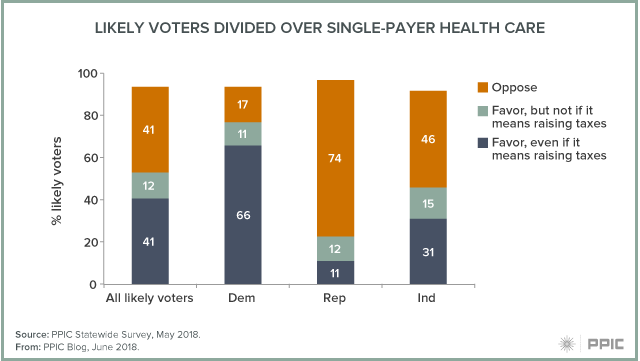
The May PPIC Statewide Survey found a majority of California’s likely voters (53%) favor a single-payer state plan. However, if this plan requires raising taxes, support declines to 41%. Across parties, an overwhelming majority of Democratic likely voters (77%) are in favor, while an overwhelming majority of Republicans (74%) are opposed; independent likely voters are divided (46% favor, 46% oppose). Notably, 66% of Democratic likely voters would favor a single-payer system—even if it means higher taxes.

The issue has become a litmus test for Democrats—pitting progressives against pragmatists—but, overall, Democrats express strong support for a single-payer system. Among likely voters who call themselves strong Democrats, 81% are in favor, compared to 69% who say they are not very strong Democrats. Among likely voters who call themselves strong Republicans, 83% are opposed to a single-payer system (the sample size for those calling themselves not very strong Republicans is too small for analysis).

Given partisan divides, the next governor may face significant political hurdles moving forward with single-payer health care. Coupled with statewide challenges, California would need to collaborate with the federal government to implement such a system. In consideration of these factors, the June primary is an opportunity for Californians to determine their future leadership and the state’s policy directions—including a possible step toward single-payer coverage.

The Governor’s Revised Budget Targets Tuition at UC and CSU

Governor Brown’s May Budget Revision has short- and long-term funding implications for both CSU and UC. The annual May Revision to the governor’s January budget proposal reflects an unanticipated revenue increase of $7.6 billion. The revised budget does add $100 million in one-time funding for deferred maintenance at each system as part of a larger infrastructure spending plan. However, while increases are proposed for other major spending areas, funding for UC and CSU remains unchanged from the January budget: each system is still slated to receive $92.1 million from the General Fund. This is in contrast to revised budgets in previous years that increased funding for both systems by 3% to 4%. Moreover, if UC and/or CSU raise tuition, the Department of Finance would be allowed to reduce each system’s funding by an amount equal to the additional revenues raised.

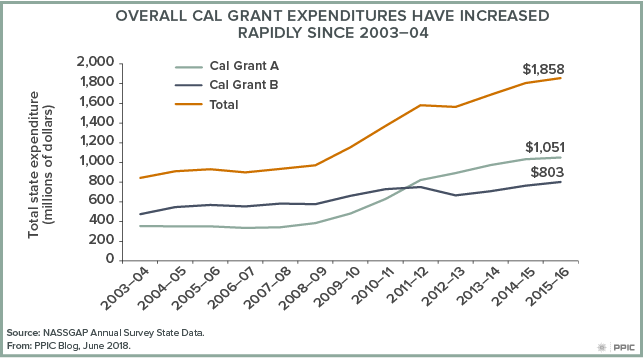
This proposed policy has two goals: it creates a disincentive to raise tuition and is meant to account for additional state costs incurred when tuition increases. California’s primary financial aid programs— the Cal Grant A and B entitlements—cover tuition for more than 300,000 students, most of them enrolled at UC and CSU. For students who meet financial and academic requirements, UC or CSU tuition is fully covered for the equivalent of four years for Cal Grant A and three years for Cal Grant B. Consequently, when UC and/or CSU raise tuition, the state must cover the additional cost. Since the Cal Grant program’s inception in 2000, tuition increases in response to state funding cuts coupled with a rise in the number of eligible students has increased annual program costs from a little more than $800 million to nearly $2 billion.

Although the governor’s proposal, coupled with a healthy state funding reserve, could help keep tuition flat in the near future, it may have unintended consequences for large numbers of students. UC and CSU allocate one third of the revenue from tuition increases to institutional aid that augments Cal Grants and Federal Pell Grants to cover tuition for more than half of their students. Moreover, restricting state allocations to the two systems while also discouraging tuition increases could prompt each institution to turn away eligible students (in fact, CSU turned away 32,000 students last fall) or ratchet up eligibility requirements.

In the longer term, restricting access to UC and CSU could have a negative effect on California’s economy. If the state hopes to meet growing demand for skilled workers, it must produce 1.1 million more bachelor’s degrees by 2030. Achieving this goal will require a long-term funding plan that addresses not only the cost of tuition but also the full cost of attending college as part of a larger effort to increase access and improve outcomes for all students.

Three Water Challenges for Almonds

California is a force of nature when it comes to almonds. The state’s farmers produce virtually the entire US almond crop and dominate the international market. As the market has grown, almonds have become California’s largest single crop—now accounting for about 12% of irrigated acreage, with more than 1.2 million acres harvested in 2016. Availability of water is clearly a major issue for the industry, since the trees must be irrigated throughout the long spring and summer dry season. At a May event on water issues organized by the Almond Board of California, I was asked for some thoughts on the water realities almond growers must grapple with in coming years. Here are three key takeaways.

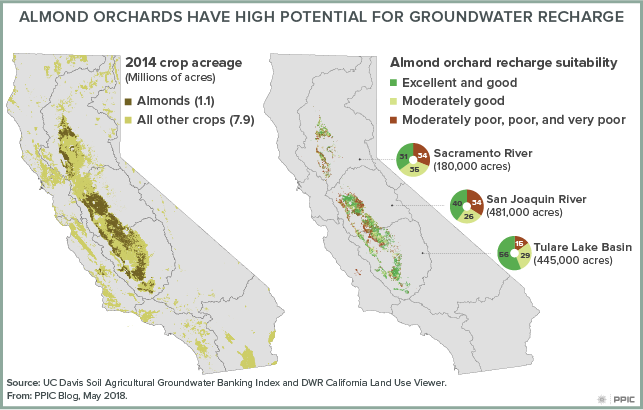
  • Growers in the San Joaquin Valley must address a long-term groundwater deficit. More than 80% of almond acreage is in the San Joaquin Valley (see map). Decades of unchecked pumping in the valley have resulted in a chronic groundwater deficit averaging nearly 2 million acre-feet per year—equivalent to about two Folsom reservoirs. Groundwater sustainability agencies must now devise plans to comply with the state’s 2014 groundwater law by bringing their water supply and use into balance over the next two decades. This means both augmenting supplies and reducing water use. Almond growers—along with others—need to be engaged in this process.
  • Augmenting local supplies can fill some of the gap––and almond growers can help. Up to a quarter of the San Joaquin Valley’s groundwater deficit could be eliminated by replenishing aquifers during high-flow events and wet winters like 2017. Spreading water on farmland is a cost-effective way to capture this water. Almond orchards are good candidates for such a process, given the suitability of much of the land for recharge (see map). Moreover, almond trees are dormant in winter and early spring, when extra water is most often available. Pilot projects and groundwater-recharge research are helping establish best practices and addressing ongoing questions among growers about the impact of winter flooding on almond crops. Almond growers also need to support other types of groundwater banking projects—such as recharge basins—that can help maximize available water supplies.
  • Managing demand will also be essential for reaching sustainability. Water use will need to fall to reduce the groundwater deficit. While this will pose some challenges, the good news is that farmers have been managing water demand for decades in this water-scarce region. Since the early 1980s, irrigated crop acreage in the San Joaquin Valley has hovered around 5 million acres, while the value of valley agriculture has roughly doubled (in today’s dollars). Farmers have responded to water scarcity by investing in crops and practices that generate more dollars per drop. The expansion of crops like almonds—and the corresponding decline in cotton and other field crops that bring in less revenue—reflects this shift. During the recent drought, farmers also used tools such as water trading and selective fallowing of less-productive lands. These same tools can help smooth the transition to balanced groundwater use, given the willingness of  water users who benefit most from using scarce supplies—for instance, those who need to keep orchards thriving during droughts—to compensate others who can use less.

Almonds are expected to remain a top crop in the state, and a leading source of farm revenues, for decades to come. But water stress will be an increasingly important factor for California’s almond growers and for the San Joaquin Valley more generally. The farm sector’s water challenges can’t be addressed farm by farm, or crop by crop. Cooperative approaches—including trading and groundwater recharge—will be essential to a smooth landing for the valley’s almond industry and the regional economy overall.

The Top Two and Turnout in California’s Primary

California voters face many decisions on a long and crowded June 5 primary ballot. None will be more closely watched than the choices made in the top-of-the-ticket governor’s race that will determine the top two candidates in the November election runoff. Six candidates—four Democrats and two Republicans—have been serious contenders in this race. In the May PPIC Survey, Democrat Gavin Newsom continues to lead the pack, with little separation between Republican John Cox and Democrat Antonio Villaraigosa for the coveted second-place finish. It’s a toss-up if the gubernatorial race will include two Democrats or a Democrat and a Republican. Why does this matter so much?

It is likely that a Democratic candidate will prevail—no Republican has won a statewide election since 2006. Since then, the gap in partisan registration has ballooned to 19 points (44% Democrat, 25% Republican; Secretary of State, April 2018). The issue today is turnout. The partisan makeup of this November’s electorate has consequences for the Democrats’ efforts to flip several Republican House seats in competitive California districts (Cook Report, May 10) to gain party control of the US Congress. Without a candidate at the top of the ticket, Republicans have one less reason to vote.

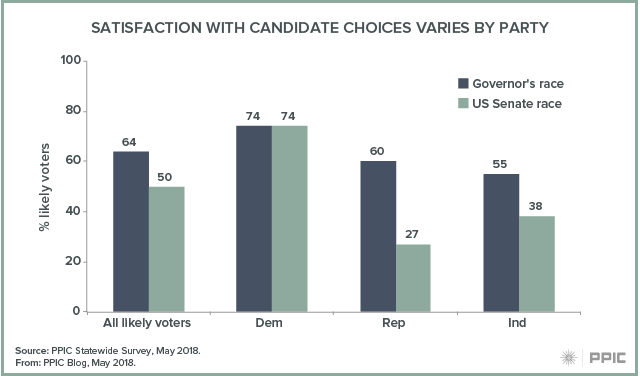
Californians have warmed up to the current gubernatorial contest. The May PPIC Survey finds that likely voters’ interest in news about the gubernatorial candidates has almost doubled since January (30% to 58%). Equal proportions of likely voters across parties are very or fairly closely following election news today (58% Democrats, 61% Republicans, 60% independents). Moreover, likely voters’ satisfaction with the candidate choices has grown since January (54% to 64%)—especially among Republicans, who were the least satisfied earlier this year. Majorities of likely voters across parties are now satisfied with their choices (74% Democrats, 60% Republicans, 55% independents). In addition, more likely voters have found a candidate to support for governor since January (76% to 85%), and by similarly large margins across parties (86% Democrat, 86% Republican, 81% independent) today. Democratic pluralities are favoring Newsom, Republican pluralities are supporting Cox, and independents are dividing their support across two parties and four candidates.

By contrast, we need to look no further than the US Senate primary to foreshadow the impact of a one-party governor’s contest this fall. Democratic US Senator Dianne Feinstein is on the ballot with Democratic California State Senator Kevin de León. There are no major candidates from the Republican ranks in this race. In the May PPIC Survey, likely voters’ satisfaction with senate candidate choices (50%) is much lower than in the governor’s race (64%), with vastly different satisfaction levels across parties (74% Democrat, 27% Republican, 38% independent). More importantly, fewer voters have found a candidate to support in the senate race (64%) than in the governor’s race (85%), and this trend is especially pronounced among the GOP likely voters (87% Democrats, 41% Republicans, 53% independents) today.
The top-two system was created in 2010 to encourage the growing ranks of independent voters to participate in the June primary. Third parties countered that their voters would be shut out of the November election, an outcome that has largely proven true. With the dwindling ranks of Republicans today, another flaw that impacts the two-party system has surfaced—lack of participation from those feeling unrepresented on the ballot. And with deepening partisan divisions in the country, voters cannot be counted on to cross party lines and choose a candidate from outside their ranks. Republicans face an unprecedented obstacle of unknown proportions if a one-party governor’s race depresses their turnout. In the long run, California’s democracy has a bigger problem if many voters are feeling disenfranchised by the top-two primary results and choose not to participate in a statewide election. To fully assess the significance of these issues, PPIC surveys will continue to track voter interest, candidate satisfaction, and ballot choices in this consequential election.

How the Census Affects State Finances

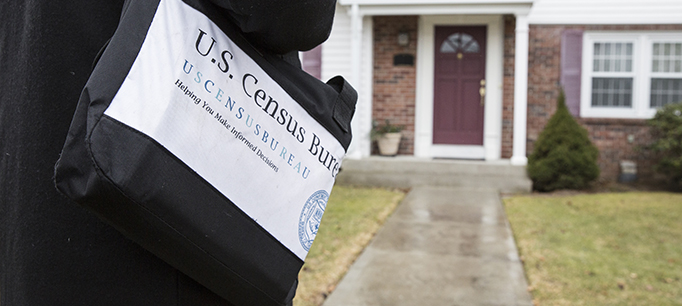
The US Constitution requires a decennial census for the purposes of determining how many seats each state will have in the House of Representatives. Just as critical, a number of federal programs rely on census data to calculate the share of federal dollars distributed to each state. In the case of California, the census-connected funds are big money. Undercounting Californians in the upcoming census could have significant fiscal consequences for the state.

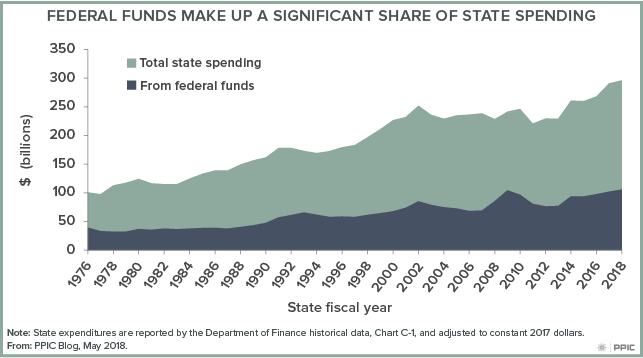
Federal dollars account for more than one-third all state spending (including the general fund, special funds, and bonds). This translates into more than $100 billion in state spending derived from the federal government.

Not all federal programs rely on the census to determine the distribution of dollars, but the vast majority are connected to it in some way. One study estimates that 132 federal programs rely on census data to distribute more than $675 billion. Another estimates the share of census-related funding for the largest programs for each state. For California, that amount was $77 billion, or more than 80 percent of the federal funds the state received in 2015 (the most recent estimate available).

Given the dollars at stake, getting an accurate count of California’s residents is critical—but could be a challenge since large segments of California’s population are historically difficult to count.

But population counts alone do not determine funding, so it is difficult to precisely forecast the impact of an undercount. Compounding the difficulty, the way federal programs use census data to allocate dollars varies, and in some cases, involves other factors such as the relative wealth of the state. For example, a significant share of census-related dollars are determined by a specific federal reimbursement rate. Because California already receives the minimum rate, an undercount would not reduce the amount of federal dollars that the state can count on.

Finally, the use of the census to distribute dollars is, in some cases, a zero-sum-game. For California to avoid “losing” relative to other states, it needs to count as well, or better, than the rest of the country. Other large states—notably Texas and Florida—face similar challenges.

California’s creation of a state committee to ensure an accurate count—along with funding to support such efforts—are crucial to a successful outcome. In fact, a relatively modest investment has the potential to provide enormous returns to the state.

Video: California Primary Preview

In the run-up to California’s June 5 primary, Democrat Gavin Newsom remains the top choice among likely voters in the governor’s race, according to the latest PPIC poll. Republican John Cox is in a close race with Democrat Antonio Villaraigosa to gain the second spot on November’s general election ballot. Senator Dianne Feinstein holds a wide lead over fellow Democrat Kevin de León.

Dean Bonner, PPIC associate survey director, detailed these findings and more at a recent Sacramento briefing.

The survey shows Newsom (25%) leading among likely voters, followed by Cox (19%), Villaraigosa (15%), Republican Travis Allen (11%), and Democrats John Chiang (9%) and Delaine Eastin (6%). Fifteen percent of likely voters are still undecided. Results were similar in an April PPIC poll (26% Newsom, 15% Cox, and 13% Villaraigosa). Cox’s support has more than doubled since the January (7%) PPIC poll.

Other highlights of the survey include:

  • A majority of likely voters (63%) favor Governor Brown’s final budget, and overwhelming majorities like his idea of additional one-time spending on infrastructure, homelessness, and mental health programs.
  • Immigrants are viewed as a benefit to the state by a majority of likely voters (67%) because of their hard work and job skills. The vast majority (80%) favor a way for undocumented immigrants to stay in the US legally—if certain requirements are met.
  • Californians are divided on the motivation of the Russia investigation, but a strong majority of likely voters (74%) think the Russian government tried to influence the outcome of the 2016 presidential election.
  • Californians distrust both the state and federal government—just 18 percent of likely voters say you can trust Washington to do what’s right.

Expanding Groundwater Recharge in San Joaquin Valley Cities

The San Joaquin Valley is ground zero for groundwater management challenges. While agriculture is the region’s predominant water user, its cities are more likely to rely on groundwater as their primary source of water. For this reason, the urban sector will need to play a bigger role in the regional effort to balance groundwater use and replenishment.

Our recent research indicates that cities in the valley lag behind agricultural districts in the intentional recharge of groundwater. That’s primarily because most have limited access to two things necessary for storing more water underground: extra surface water and unpaved land on which to spread it so it can percolate into the ground. But some cities have had success with recharge activities. Here are three methods that can serve as models.

  • Partner with nearby agricultural districts. The city of Tulare relies entirely on groundwater for its potable water supply. It has an agreement with the Tulare Irrigation District (TID) for purchasing surface water, which is delivered to a recharge basin that the city co-owns with TID. The basin’s location allows for the recharged water to flow into the city’s pumping zone, even though the basin itself is not within city boundaries. The cities of Clovis and Fresno have similar recharge partnerships with the Fresno Irrigation District.
  • Partner with off-site groundwater banks. The city of Tracy relies on both surface and groundwater. In years when it doesn’t use its entire surface water allocation, it stores the unused portion in one of Kern County’s formal groundwater banks. Even though Tracy and the water bank are on opposite ends of the valley, a conveyance system allows for easy exchanges of water.
  • Recharge within city boundaries. The city of Bakersfield has rights to Kern River water. The city uses a direct recharge basin located within city boundaries to store some of its Kern River allotment.

Some cities engage in multiple recharging strategies. For example, both Tulare and Fresno operate flood control basins to maximize recharge, and Tracy pumps surplus water directly into a nearby aquifer through an “injection well.”

While these are all innovative models, most are still small-scale in terms of volumes recharged. Given the state’s mandate to balance groundwater use with replenishment by 2040, urban efforts will need to be scaled up as much as possible. Expansion will require better water accounting and basin planning. Cities can raise funds to partner with agricultural districts and undertake recharge projects, but they will need incentives and assurances that they will have access to the stored water.

Another critical step is to map and protect undeveloped urban land that is particularly appropriate for recharge. Cities should take steps to prevent the paving over of suitable soils, and encourage recharge on open space lands not only within city boundaries but also in areas into which they are likely to grow in the future—called their “spheres of influence.” As the figure below shows, suitable soils in these areas are extensive, especially in Kern and the eastern part of the valley.

It’s also important to remember that cities won’t be able to go it alone. In addition to partnerships with agricultural districts, broader local and regional cooperation will be critical for managing groundwater resources in the long run.

New Admission Requirements at the University of California?

The University of California (UC) is considering revising its eligibility standards for admission, focusing on requirements for science education. California changed its K–12 standards in this area five years ago, when the State Board of Education adopted the Next Generation Science Standards (NGSS). UC must decide whether and how to align the NGSS with the a–g requirements—a set of courses students must complete in order to be considered eligible for admission to UC. A change in science requirements was proposed by the UC Board of Admissions and Relations with Schools and was approved by the UC Academic Senate earlier this year.

The NGSS has profound implications for science curriculum and instruction in high schools. Currently, to meet the a–g requirements, students must take two science courses from three core disciplines: biology, chemistry, and physics. But the NGSS includes four science categories: physical sciences; life sciences; earth and space sciences; and engineering, technology, and applications of science.

Changes approved by the UC Academic Senate include increasing the minimum science requirement from two to three years. UC would continue to require two years of work in at least two of three disciplines: biology, chemistry, and physics. Students may take a third course within these disciplines or in other science disciplines identified by the NGSS.

If the UC Regents vote on and approve the recommendations of the UC Academic Senate, the change will take effect in the fall of 2023—meaning that students entering high school in the 2019–20 school year will be subject to the new requirements. (CSU is in the process of updating its science requirements—which are currently similar to those of UC—and may follow UC’s guidelines.)

Some high schools would need to make changes to align their curriculum with the NGSS. One area of concern is the relatively low number of course-offerings in science among small and rural schools. PPIC’s work has shown that not every high school offered the entire a–g sequence in science in 2016–17; small and rural schools were much less likely to do so. Another area of concern is staffing, as a teacher shortage has left California schools struggling with large class sizes for years. Finally, ensuring awareness of these changes will be important. Parents and students should be informed of the new requirements with adequate time and detail to be able to plan accordingly.

Under NGSS, science course sequencing in high school may affect whether and how students meet the proposed a–g requirements. PPIC researchers are examining early implementation of the NGSS in the K-12 system and will discuss findings in an upcoming report. Moving forward, more research is needed to understand the implications of any new a–g requirements for high school graduates’ eligibility for UC and CSU.