Californians’ Views of Political Outsiders

One of the early surprises in the 2016 presidential election is the strength of polling support for primary candidates who have never held elected office. A recent Pew national survey also found that Americans chose “new ideas and a different approach” by a wide margin over “experience and a proven record” when asked what was more important in a presidential candidate (57% to 36%). What are the political ramifications of this emerging national trend for the 2016 California elections?

Californians have a storied history of choosing political outsiders, electing movie stars Ronald Reagan and Arnold Schwarzenegger as their governors. But in the past five years, career politicians have won by wide margins over political outsiders with business credentials. Voters chose Jerry Brown over Meg Whitman and Barbara Boxer over Carly Fiorina in 2010 and Jerry Brown over Neel Kashkari in 2014.

PPIC’s recent polling does not show a swing toward political outsiders among Californians this year either. When we repeated the Pew survey question in a recent PPIC Statewide Survey, California adults were less likely to say they favor new ideas over experience than their national counterparts (51% to 41%). More importantly, California likely voters are closely divided on new ideas versus experience (46% to 44%).

We also asked our tracking question about which qualification is more important to Californians when voting for statewide elected offices such as governor or US senator: experience in elected office or experience running a business. Today, California likely voters have a slight preference for experience in elected office (49% to 43%). In the past, the electorate has been divided on this issue—for example, during statewide elections in 2010 (44% elected experience, 43% business experience) and 2002 (43% elected experience, 43% business experience), which featured experienced politicians running against business leaders.

In other words, political insiders are more appealing in California today than they were in the state’s past, while the movement toward political outsiders is more limited here than in the nation as a whole. Still, a sizable number of Californians say they prefer political outsiders. Who are they and why might they have this preference? Our polling offers these insights: those who prefer outsiders are more likely to give their elected leaders low job approval ratings, more likely to have negative views of the two-party system, and more likely to be Republican than Democrat.

Majorities of those who prefer new ideas in presidential candidates say they disapprove of President Obama (54%), while majorities who say they favor experience in running a business for gubernatorial and US Senate candidates say they disapprove of Governor Brown (59%). Conversely, solid majorities who chose experience and a proven track record for a presidential candidate say they approve of President Obama (64%), and overwhelming majorities who are looking for experience in elected office for governor and US senator say they approve of Governor Brown (71%).

Negative attitudes toward the two-party system are also part of the profile for those who prefer a political outsider over an experienced officeholder. Just 31 percent of California likely voters say that the Republican and Democratic parties do an adequate job of representing the American people, while 58 percent say that they do such a poor job that a third major party is needed. Majorities across partisan groups today say that a third major party is needed (52% Democrats, 57% Republicans, 69% independents). Solid majorities who prefer new ideas for a presidential candidate (64%) and favor experience running a business for gubernatorial and US Senate candidates (65%) also say that a third major party is needed.

Finally, partisanship is strongly related to preferences for political outsiders. Republicans are much more likely than Democrats to favor new ideas in presidential candidates (61% to 34%) and to favor experience running a business for governor and US senator (71% to 23%). By contrast, Democrats are much more likely than Republicans to favor experience and a proven track record in presidential candidates (56% to 33%) and experience in elected office for governor and US senator (72% to 21%). Independents are more divided, with about half favoring new ideas in presidential candidates (48%) and preferring experience in running a business for governor and US senator (47%).

In sum, we do not find fresh evidence of the national movement toward political outsiders among likely voters in California. This is because of the state’s partisan makeup (43% Democrat, 28% Republican) and approval ratings of President Obama (56%) and Governor Brown (54%) that favor the presidential and US Senate candidates with experience in elected office. If these political trends hold steady next year, then Democratic insiders should continue to have the edge over Republican outsiders in statewide elections.

However, we should not discount the importance of the finding that California’s GOP voters are aligned with most Americans in their strong preference for political outsiders. GOP voters will be swayed by the qualifications of presidential candidates who represent “new ideas and a difference approach” and by US Senate candidates who reflect “experience in running a business.” These preferences could have a profound impact on the election choices of GOP voters in California’s presidential and senate primaries.

Finally, the large and growing number of independent voters (i.e., no-party-preference) is a political wildcard in California. Independent voters account for 24 percent of the state’s electorate today. They overwhelmingly believe that a major third party is needed, and about half prefer a presidential candidate who represents new ideas and statewide candidates with experience running a business.

Most independent voters supported Democratic “insiders” in recent statewide elections, but we know from our surveys that their party leanings can shift in a relatively short period of time. In the 2000s, California’s independent voters aligned with GOP voters and supported Republican “outsider” Arnold Schwarzenegger for governor. The ease with which independent voters are able to change partisan and candidate preferences will add uncertainty to next year’s election, and may lead to surprises in 2016.

Video: PPIC Survey Examines Election Landscape

As California heads into an election year, the PPIC Statewide Survey looks at residents’ views on a broad range of issues that are already flashpoints in the presidential primary races and will likely surface in statewide campaigns next year.

PPIC research associate Lunna Lopes presented the survey’s key findings at a Sacramento briefing last week. She was joined by Mark Baldassare, PPIC president and CEO, for a question and answer session afterward. He noted a link between Californians’ “modestly optimistic view of the economy,” their belief that there is income inequality in the state, and their attitudes about which ballot issues are important. Twice as many residents say that increasing the state minimum wage is very important than say legalizing marijuana is very important.

“In California, the belief that this state is divided into the haves and have-nots—and the feeling among many Californians that they are among the have-nots—are going to be driving forces in the election,” he said. The survey briefing was held just after the mass shooting in San Bernardino, and the briefing touched on Californians’ views about gun laws. PPIC research associate David Kordus provided findings from the September survey on this issue: Compared to adults nationwide, Californians are more likely to favor stricter laws than we have now. Most also say that controlling gun ownership is more important than protecting the right of Americans to own guns.

Video: Governing in a Time of Change

At a time when economic, environmental, and demographic forces are changing California, Governor Jerry Brown’s chief aide, Nancy McFadden, was asked to describe three administration priorities requiring bold leadership.

The first priority is keeping the state on a fiscally stable road, she told PPIC president and CEO Mark Baldassare before a Sacramento audience last week. This requires tough choices, she said, as the governor demonstrated when he vetoed bills that were worthy ideas but had budget implications for the state General Fund.

“Sometimes bold leadership means saying no,” she said.

Second, the administration will continue to implement the far-reaching changes adopted in past years, such as corrections realignment and the Local Control Funding Formula for schools, which targets money to the state’s neediest students and shifts funding control to the local level.

McFadden said the third priority is the “whole panoply of climate change and environment issues facing not only our state but our world.” Extreme weather events—drought, wildfires, and flooding—pose immediate challenges that have to be managed.

McFadden’s conversation with Baldassare was followed by a panel discussion about leadership—what it takes and when elected officials have demonstrated it. The panelists were Jim Brulte, chair of the California Republican Party and former state senate Republican leader; state senators Loni Hancock and Carol Liu; and Darrell Steinberg, chair of the California Government Law and Policy Practice at Greenberg Traurig and former senate president pro tem. The moderator was John Myers, Sacramento bureau chief of the Los Angeles Times.

Voter Registration: Not Quite Automatic Yet

The New Motor Voter Act creates a computerized voter registration process for anyone who uses the Department of Motor Vehicles (DMV) to apply for a new driver’s license, renew an old one, or change their address. The law—AB 1461—reduces paperwork and transfers voter registration information electronically from the DMV to the secretary of state. It has the potential to register millions more residents and virtually eliminate one of the most important administrative hurdles to voter participation.

However, the devil is in the details. Whether AB 1461 will result in big increases in registration will depend largely on how the law is implemented. Though the new registration process is sometimes called automatic, it does not actually register anyone by default. At its core, the law simply tells the DMV to transfer information to the secretary of state and then tells the secretary what to do with that information.

Some information is guaranteed to be there. DMV applicants will be required—as they are now—to provide their name, date of birth, address, and the like. If they don’t answer these questions, the process of getting a driver’s license stops.

Other information is less certain. The law adds two pieces of information that together determine whether DMV customers get registered to vote: first, whether they attest that they are eligible to vote, and second, whether they decline to be registered. Customers who attest to eligibility and do not decline will be added to the voter rolls. Yet unlike the other items listed above, applicants don’t currently have to answer either question to get a driver’s license.

Note also the significant difference between the two questions. The eligibility question has the secretary of state looking for a “yes”: DMV customers will not be registered unless they attest to eligibility, which means that any customer who fails to answer the question will not be registered. By contrast, the registration question has the secretary looking for a “no”: customers will be registered unless they do not want to be. That means that those who fail to answer this question will be registered, as long as they also say they are eligible.

It is hard to overstate the importance of this distinction. Research on how people make decisions has consistently demonstrated the power of the default option. People are much more likely to sign up when enrollment is the default option—even when there is an option to decline—than they are when nonparticipation is the default. The option to enroll as an organ donor when getting a driver’s license offers a particularly apt example. Many do not sign up even though it’s not very hard to do, and even if they say they are willing, in principle, to become donors. In one study, 82 percent became donors when they had to opt out explicitly, compared to 42 percent when they had to opt in.

Given this reality, the default option can be critical. If the goal is a large increase in registration, the fact that the eligibility question requires people to opt in should be a cause of concern.

This suggests a solution: the DMV should make a response to the eligibility question a condition for receiving a driver’s license. Some have already called for this approach, which is not as onerous as it may sound. Driver’s license applicants are already required to provide documented proof of legal residence, such as a birth certificate or passport. That’s a much higher hurdle than answering a single question.

In Oregon—which became the first state to adopt automated registration earlier this year—such proof of legal residence is also required, but it’s automatically treated as evidence of eligibility. No additional question is needed. If California were to require a response to its eligibility question, its system would be essentially identical to the one in Oregon on most important dimensions. In fact, by allowing people to opt out up front, the California system would be more transparent and might do a better job of preserving freedom of choice.

The California DMV could go a step further and also require a response on the registration question, thus ensuring that people know they are being registered. There is no reason to think that forcing a choice in this way would limit the law’s impact. The study on organ donor participation mentioned above found that enrollment declined only slightly (from 82% to 79%) when people were asked to make the choice explicitly. It seems fair to expect a similar dynamic with voter registration. Only those firmly opposed to being registered are likely to say “no” to registration, and that group will probably be small.

In short, AB 1461 could result in a legitimately automatic registration system similar to the one in Oregon and many other countries. Such a system would eventually bring the vast majority of eligible unregistered adults onto the voter rolls. But the law’s potential will only be realized if the state truly streamlines the process to make it as easy as possible.

Leon Panetta on Leadership and Crisis

In 50 years of public life, Leon Panetta said he has learned that “in a democracy, you can govern either by leadership or by crisis.”

“If for some reason the leadership is not there, then we will govern by crisis,” said Panetta, who has served as US secretary of defense, CIA director, presidential chief of staff, director of the Office of Management and Budget, and director for the Office of Civil Rights—as well as representing California’s Central Coast in Congress for 16 years.

In a wide-ranging conversation with Mark Baldassare, PPIC president and CEO, Panetta touched on global flashpoints, presidential politics, dysfunction in Washington, and electoral reform in California.

His main criticism of Washington today? “Too much in Washington is done on a crisis-by-crisis basis.” He contrasted last week’s budget agreement—a temporary solution to the threat of default and government shutdown—to earlier budget negotiations that involved two presidents, George H. W. Bush and Bill Clinton, making tough trade-offs with members of Congress. Leadership requires taking risks and that can mean paying a political price—as the elder Bush believes he did in the 1992 election.

Panetta said that as CIA director, he saw President Obama demonstrate leadership in the raid on Osama bin Laden’s compound, an operation fraught with risk. Despite good evidence that the al-Qaeda leader was in the compound—including confirmation that the laundry hung on the clothesline matched up with bin Laden’s family—there was no certainty he was there.

A majority of members of National Security Council thought the mission was too risky. The president asked Panetta’s advice. Panetta told him about a method he had used to make decisions as a member of Congress: “If I had a tough issue I’d ask myself, what if I asked an ordinary citizen in my district, ‘If you knew what I know, what would you do on this issue?’ And I think that if I told an ordinary citizen that we had the best evidence on the location of bin Laden since Tora Bora, then I think the average citizen would say, ‘You have to do this.’”

The next morning Obama made the decision. The mission was a go.

“Tough decision. Leadership. Taking a risk,” said Panetta. “But ultimately, that’s what it takes to be president of the United States. That’s what it takes to be a member of Congress.

Other highlights from Panetta’s remarks:

  • Of all the global threats, what does he worry about most? “Cyber-attack.”
  • What does he think of Republican presidential candidates who promote their lack of experience in government? “Deep down, people know that you don’t want to elect a snake-oil salesman.”
  • Who’s to blame for the logjam in Congress? “You can’t reach this level of dysfunction and not have both parties share a little bit of the blame.”
  • What’s the difference between Washington and California? “I feel pretty good about California.”

Commentary: California Leads in Voting Reform

When Gov. Jerry Brown recently signed Assembly Bill 1461, the New Motor Voter Act, he ushered in a new chapter of California electoral history. The law seeks to boost California’s recent record-low election turnout rates with a new system of automated registration.

Under existing law, citizens must register to vote before they can cast a ballot. The new law all but eliminates this step by registering anyone who applies for a new driver’s license, renews an old one or updates an address with the DMV, unless they opt out. With the stroke of a pen, California is now at the vanguard of American voting reform.

(Continue reading on sacbee.com.)

Video: Survey Looks at Taxes and Pensions

As interest groups work to turn their ideas into initiatives for next year’s statewide ballot, the September PPIC Statewide Survey examined Californians’ views in two areas that may be put before voters in 2016: taxes and public employee pension reform.

Mark Baldassare, PPIC president and CEO, and Dean Bonner, associate survey director, presented the findings at a briefing in Sacramento last week.

Among the survey findings:

  • Half of likely voters favor extending the tax increases in Proposition 30 temporarily, but just a third favor making them permanent.
  • There is bipartisan support for raising taxes on cigarette purchases.
  • A majority of likely voters favor changing Proposition 13 to tax commercial properties according to their current market value.
  • Solid majorities of Californians see public pension spending as a problem, and most think voters should weigh in on changes to the system.
  • Most likely voters favor placing new public employees in a defined contribution system, similar to a 401(k) plan, rather than a defined benefits system.

The survey shows that Californians give their state leaders—the governor, legislature, and their own legislators—high approval ratings at the close of the legislative session. Baldassare offered his explanation at the briefing: there was little drama around the budget, the economy’s going well, and very few respondents in the survey mentioned fiscal issues as the most important ones.

Congress, on the other hand fares far less well in Californians’ eyes. Its 17% rating is not only much lower than the ratings likely voters give their state leaders, it is much lower than those of President Obama, Senators Barbara Boxer and Dianne Feinstein, and Californians’ own representative in the US House.

“Congress is a government institution that needs work, according to most Californians,” Baldassare said.

Californians and Congress

The recent announcement of Speaker Boehner’s resignation comes at a time when national approval ratings of the US Congress are in the teens (14% in September Gallup Poll). With the early talk of majority leader Kevin McCarthy stepping into the Speaker position, what are Californians saying about the powerful federal institution that the congressman from Bakersfield is well-positioned to lead?

In the latest PPIC Statewide Survey, we asked Californians to rate eight state and federal elected leaders and legislative bodies—interviewing was completed just before Pope Francis’ speech to Congress and Speaker Boehner’s surprise announcement. California likely voters give their lowest approval by far to the US Congress. Just 17 percent say they approve of the way the US Congress is handling its job.

Surprisingly, there is overwhelming consensus about Congress even in this era of hyper-partisanship. In the recent PPIC Statewide Survey, California likely voters of different political stripes are united in their low approval of Congress. By contrast, other political figures in Washington elicit highly partisan responses—including President Obama, Senator Boxer, and Senator Feinstein. Remarkably, approval among Republican likely voters of President Obama (13%) and Senator Boxer (15%)—both Democrats—is about the same as approval of Congress (17%), while Republican approval of Senator Feinstein (27%) and Governor Brown (29%) is higher than approval of Congress. It’s also noteworthy that Republicans (36%) are less likely than Democrats (62%) and independents (50%) to approve of their own House representatives—this may be related to their low approval of a Congress controlled by their party.

The 53 members of the California House delegation may take some solace in the fact that Californians are much more approving of their own representatives to the US House than of the Congress as a whole. And California’s US senators have approval ratings around 50 percent. Still, the California State Legislature has recovered from several years of low approval ratings while the US Congress has not. Moreover, the members of the California congressional delegation are working in an institution that is mostly seen as not doing its job. This raises doubts about their political futures, especially given the top-two primary—which takes away the certainty that candidates from both major parties will appear on the November ballot—and more competitive elections through independent legislative redistricting.

Low approval ratings of the US Congress have been a consistent feature in PPIC Statewide Surveys throughout this decade. Approval ratings of Congress among California’s likely voters have been in the mid-teens each September since the Republicans (and Speaker Boehner) took control of the House in January 2011. Under Democratic control (and Speaker Nancy Pelosi’s leadership, beginning in January 2007), approval ratings were somewhat higher. This could be partly because the California electorate leans Democratic, but it is worth noting that approval ratings of Congress under Republican leadership 10 years ago were higher than they are today.

Clearly, low approval of Congress is a national phenomenon tied to intense media focus on legislative gridlock and government shutdowns. But Californians do have fundamental policy disagreements with the current Congress that also affect their views of its job performance. Specifically, the recent PPIC Statewide Survey finds that Californians are more likely than people nationwide to express support for immigration reform, abortion rights, and stricter gun laws. The actions of Congress in recent years are at odds with California public opinion in all three of these controversial policy domains.
In the California context, immigration reform stands out as a special case. Sixty-nine percent of California likely voters—compared to 60 percent of adults in a national ABC News/Washington Post Poll in July—say that undocumented immigrants currently living in the United States should be allowed to live and work here legally if they pay a fine and meet other requirements. Moreover, majorities of likely voters across party groups (83% Democrats, 66% independents, 51% Republicans) support a way for undocumented immigrants to stay in the US legally. Importantly, 68 percent of those likely voters disapprove of Congress want there to be a way for undocumented immigrants to stay in the US legally. And among likely voters who support a way for undocumented immigrants to state in the US legally, 77 percent disapprove of Congress.

The next Speaker will face the major challenge—critical to the nation’s future—of restoring public trust and confidence in Congress. Our poll sheds light on the need for Congress to show leadership in addressing the complex problem of immigration, which is surfacing early and often as the defining issue for the Republican presidential candidates. The view from California is that the path to higher approval of Congress runs through immigration reform. It won’t be easy, but there is a way forward for a new leader who seeks to improve perceptions of the way that the Congress handles its job.

Inspiring Civic Engagement

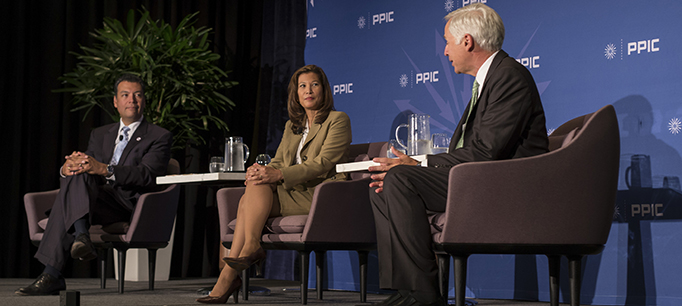
Many eligible Californians don’t register to vote, turnout in statewide elections has reached record lows, and PPIC surveys show many residents are disengaged from state government. What can be done to increase participation in elections and engage residents more broadly in all aspects of civic life? Tani G. Cantil-Sakauye, California’s chief justice, and Alex Padilla, California secretary of state, offered their responses last week in Los Angeles at an event co-sponsored by PPIC and the California Community Foundation.

In a conversation with Mark Baldassare, PPIC president and CEO, both emphasized the contribution schools can—and should—make to civic engagement.

Cantil-Sakauye noted that her teen-agers were taught civics in the second semester of his senior year in high school. “Now, think back where you were mentally in your second semester of senior year,” she told the audience. “Not the best place.”

She described Power of Democracy, a judicial branch initiative that includes Padilla and is an effort to elevate the status of civics education. Rather than focusing on teaching civics as a stand-alone subject, the group helps to integrate it into all school subjects, school projects, and community service. Partnering with Tom Torlakson, state superintendent of public instruction, as well as organizations and school districts, Power of Democracy provides schools the resources to do so, she said.

Padilla and Cantil-Sakauye each described personal experiences that sparked their interest in government and the people who had been influential along the way. Padilla said that after his freshman year at MIT, he returned to Los Angeles and visited his high school government teacher, who told his former student, “You’re 18 years old now. Have you registered to vote?” Then the teacher pulled out a voter registration form from his desk. “He wouldn’t let me leave until I filled it out,” said Padilla. That teacher, Alex Reza, was in the Los Angeles audience at last week’s event.

Cantil-Sakauye said she developed an interest in how decisions are made and who makes them after hearing adults in the Filipino community talk about their frustrations with government. When she was 9 years old, her family lost their home in an eminent domain proceeding. Cantil-Sakauye said her mother went to court and came back feeling “disrespected and humiliated.” Later on, her mother took her to see the pioneering Filipina lawyer, Gloria Megino Ochoa. “My mom threw me an elbow and said, you could do that!”

Video: Senator Boxer Comes to PPIC

In more than 20 years in the US Senate, Barbara Boxer said there have been good changes (more women today) and bad (the “chasm” that divides the parties). But sometimes, despite the gridlock and insults, there is common ground, she told an audience at PPIC yesterday. She and Republican Senator Mitch McConnell found it in teaming up on a multi-year highway bill.

“Working with Mitch McConnell was unexpected,” she said. “We actually hadn’t talked too much in 20 years.” Bringing senators from both parties to an agreement—particularly on how to pay for the bill—was tough. But the bill got the votes. It passed the Senate and is now pending in the House.

Boxer told this story and others in a wide-ranging conversation with Mark Baldassare, PPIC’s president and CEO, that touched on climate change, California water policy, the presidential race, and the nuclear deal with Iran.What’s next? For the record, Boxer says she is not retiring. She’s just not running for Senate again.