Video: Countdown to Census 2020

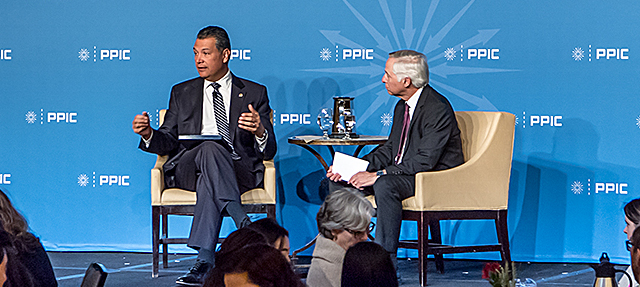
Census Day 2020 is fast approaching, and results from the population count will determine political representation and federal funding for California for the next 10 years. Speaking at a PPIC event in Sacramento last week, Alex Padilla, California secretary of state, joined Mark Baldassare, president and CEO of PPIC, to reflect on the importance of counting the country’s most populous state.

Padilla stressed that along with billions in funding for education, health care, and other critical areas, the count affects the state’s representation in Congress as well as lines drawn at all district levels. “It affects you regardless of the issues you care about, regardless of where you live,” Padilla said. He further emphasized that the census is a population count, not a citizen or adult count. In 2010, California undercounted children under five, which led to underfunded schools over the next 10 years. “Here is a way to make sure schools get the funding they deserve without raising taxes.”

Following the conversation with the secretary of state, Sarah Bohn, PPIC vice president of research and senior fellow, convened an expert panel that expanded on strategies at the frontlines for reaching hard-to-count communities.

Assemblymember Marc Berman discussed the investment by California— which has directed $187 million toward census infrastructure at state, regional, and local levels—that sets the groundwork for outreach and coordination. Partner organizations are now pushing a public awareness and information campaign. “Nobody has ever tried anything like this in a state of 40 million people at the level of specificity and detail that we really need to be successful,” Berman said.

Success depends on participation, however, and trust in government can influence participation in the census—especially among hard-to-count groups who may feel suspicion of the federal government. Apathy is another obstacle. Carolyn Coleman, executive director for the League of California Cities, described how the census returns funds to communities: “We send a lot of dollars to Washington, DC, every year via the tax code, and this is one of the most important ways we get those dollars reinvested back into our communities.”

It takes coordination by trusted messengers to reach hard-to-count groups and communicate this idea. Ditas Katague, director of California Complete Count, said, “We have amazing partners on all levels—whether we’ve contracted them, whether they are foundations, whether they’re state agencies.” Katague outlined efforts by a Sacramento organization mapping territory from the Oregon border to Yolo County, and San Diego ambassadors doing outreach in Arabic, Kurdish, Farsi, Vietnamese, and Somali. Regions are playing to their strengths: Silicon Valley is emphasizing tech; the San Joaquin Valley is partnering with faith-based organizations.

Californians can participate in the census starting in March, and assistance centers around the state will offer help through April. Katague emphasized the importance of motivating others to complete it, saying, “There are 9 questions on the census. It takes 10 minutes to secure the future for the next 10 years.”

Concerns about Poverty and Income Inequality Are Running High

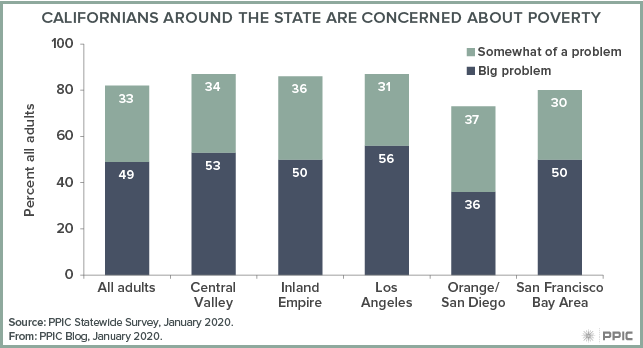
Even as California’s economy is surging—with unemployment at a historically low 3.9% last month—residents around the state are worried about poverty. About eight in ten adults say that poverty is a big problem (49%) or somewhat of a problem (33%) in their part of California. Likely voters hold similar views (47% big, 35% somewhat). This concern is high across every region of the state.

figure - Californians around the State Are Concerned about Poverty

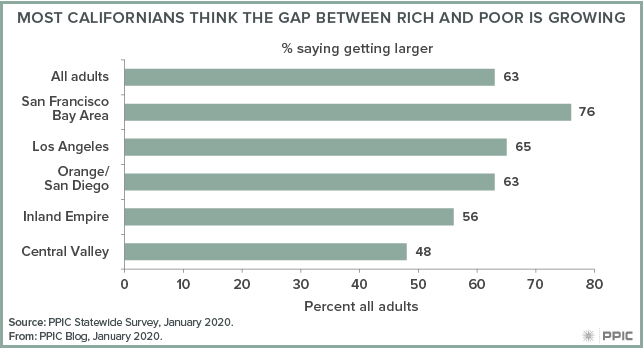
Income inequality has grown substantially across the nation, and it is particularly notable in California. About two in three adults (63%) and seven in ten likely voters (68%) think the gap between rich and poor is getting larger in their part of California. Across regions, nearly half to three-quarters of residents hold this view.

figure - Most Californians Think the Gap between Rich and Poor Is Growing

For Many Californians, Poverty Is One Minor Expense Away

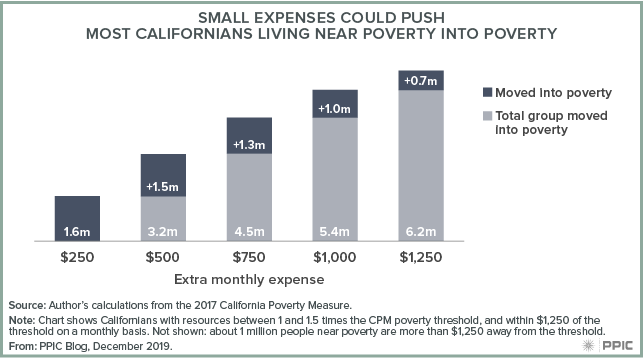
Add one extra expense and families living just above the poverty line could fall into poverty. Data from the California Poverty Measure (CPM) show that 7.2 million Californians live near poverty, that is, with just enough resources to meet their basic needs. All told, in 2017 as many Californians lived just above the poverty line as below it, or about 18% in each case. Even a small change, a monthly expense of $250 or less, could push 1.6 million people under the line.

We define “near poverty” to mean having resources worth 1 to 1.5 times the poverty threshold after taxes and necessary expenses. Since the CPM accounts for California’s varied living costs, the range for near poverty differs across regions. In Fresno County, a family of four who rents their home and has $25,900 to $38,900 in resources is near poverty, while in Santa Clara County, the same is true of a family of four with $40,000 to $60,000.

Because the poverty line is a blunt standard, “near poverty” includes families earning just a few dollars above the poverty threshold—even though a few dollars are unlikely to make it easier to make ends meet. This makes it especially important to understand how many Californians are near poverty, and how close those near poverty are to falling into it.

Californians can be pushed into poverty by the smallest expenses. Overall, people near poverty are more likely to be pushed into poverty by a small expense than a large expense. As expenses grow, the total number of people threatened climbs. Three out of four people near poverty, or 5.4 million, are pushed into poverty by an extra $1,000.

figure - Small Expenses Could Push Most Californians Living Near Poverty into Poverty

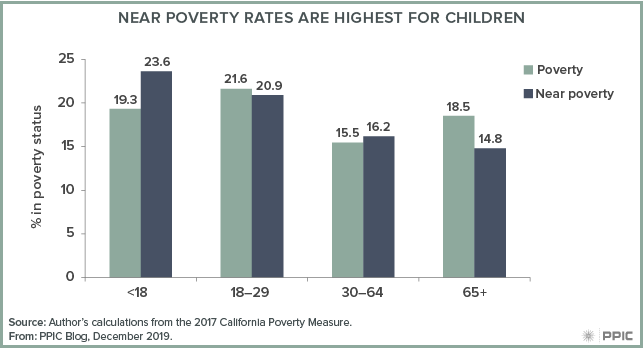
Near poverty affects young people more than it does older Californians, and children under 18 are more likely to be near poverty (23.6%) than in poverty (19.3%). Young adults and seniors, however, are more likely to be in poverty. Regional differences in living costs, opportunity levels, and the impact of existing policies and programs are key factors driving this variation.

figure - Near Poverty Rates Are Highest for Children

Without safety net programs, more people, and in particular, more families with children, would face poverty instead of near poverty: resources from programs including CalFresh and the federal and state Earned Income Tax Credits (EITCs) keep 7.1% of Californians out of poverty. Yet almost all people (93%) who move out of poverty via the safety net move into near poverty. This fact has implications for policymakers’ ongoing efforts to help ensure all Californians can meet their basic needs. As the state works to reduce poverty, strategies that promote economic mobility complement investments in programs like the CalEITC and the new Young Child Tax Credit.

Improving Equity in Mental Health Services

California has seen historic declines in the number of residents without health coverage—since 2014, the state’s uninsured rate has decreased from 17.3% to 10.3% percent among adults  younger than 65. Expansions in the Medi-Cal program account for most of this expanded coverage; since 2014 enrollment in Medi-Cal has increased more than 50% and now provides coverage to nearly one-third of Californians. However, many challenges remain to ensure that coverage translates into access, particularly in the area of mental health.

Over one million Californians use the state’s public mental health system, which includes services provided through Medi-Cal managed care plans and county mental health plans. For many patients, the system is difficult to navigate. The fragmented delivery system is part of the issue, but there are also concerns that mental health providers are unable to meet the needs of California’s diverse communities—and those needs are notable. In a recent survey, 11.2% of Latinos were identified as likely to have experienced serious psychological distress during the past year.

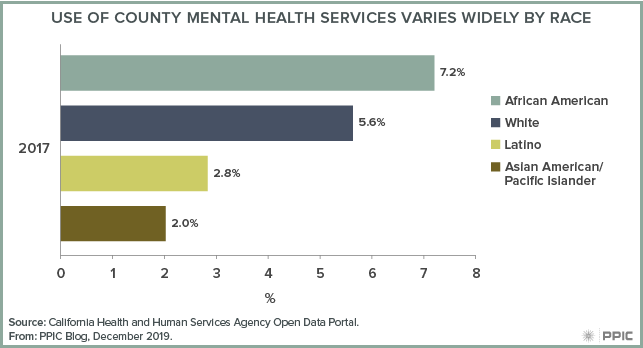
The disparities in access for underrepresented communities may be reflected by current utilization patterns of county mental health services. Among adult Medi-Cal enrollees, fewer Latinos and Asian/Pacific Islanders use these services than African Americans and whites.

figure - Use of County Mental Health Services Varies Widely by Race

These disparities are similar nationwide—and are likely to be related to a variety of factors. One possibility is the higher share of Latinos and Asian Americans/Pacific Islanders who may experience language barriers, compared to African Americans and whites.

A primary vehicle for reducing these disparities are Cultural Competence Plans, which are intended to guide county mental health plans in meeting the cultural competence and linguistic requirements already mandated by law. Recent legislation seeking to codify these requirements for county mental health plans did not make it past the governor’s desk. But its advancement through the legislature signals growing recognition of the need for communities of color to have access to culturally and linguistically appropriate mental health services. As California’s population becomes more diverse, culturally competent care will become even more important in the coming years.

The Democratic Presidential Primary: What Do Californians Care About?

Mark Baldassare, PPIC president and CEO, and director of the PPIC Statewide Survey, participated in a panel on election issues at the Pacific Chapter of the American Association of Public Opinion Research meeting on December 6, 2019 in San Francisco. This post is excerpted from his prepared remarks.

Californians are turning their attention to the March 3 Super Tuesday primary as they play a new role in deciding the next Democratic presidential nominee. This is unfamiliar territory for California’s Democratic primary voters, who have become accustomed to casting ballots in June after other states have already determined the winner of their party’s presidential sweepstakes.

The 2019 PPIC surveys have consistently identified three frontrunners—Joe Biden, Bernie Sanders, and Elizabeth Warren—with no clear favorite. At the same time, likely voters have signaled an openness to considering alternatives. In this context, the debates loom large, and eight in ten likely voters in the September PPIC survey say they are important (41% very, 43% somewhat) in deciding their vote.

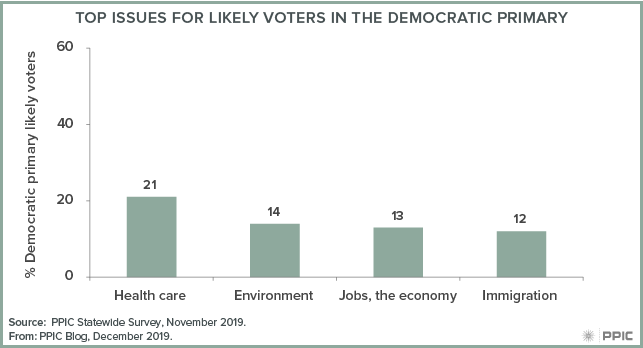
What do California’s Democratic primary likely voters most want to hear from the candidates as the stage is being set for a December 19 Democratic debate in Los Angeles? In an open-ended question in the November PPIC survey, the top four issues mentioned are health care (21%), the environment (14%), jobs and the economy (13%), and immigration (12%). Several other issues—such as education, homelessness, housing affordability, gun control, crime, and taxes—are each mentioned by less than one in ten likely voters.

figure - Top Issues for Likely Voters in the Democratic Primary

Across demographic groups, likely voters differ on the issues that matter the most. For instance, voters age 45 and older want to hear about health care more often than younger voters do (26% to 13%), while Latinos want to hear about immigration more often than whites do (24% to 5%), and whites want to hear about the environment more often than Latinos do (23% to 4%). Jobs and the economy is the only top issue generating a similar amount of interest across age, education, gender, income, race/ethnic, and regional groups.

The issues of greatest concern also vary according to candidate preference. Biden’s supporters name health care more often (25%), Warren’s supporters mention the environment more often (26%), and Sander’s supporters name immigration more often (22%). By contrast, supporters of the three leading candidates are similarly likely to mention jobs and the economy (13% Sanders, 11% Biden, 7% Warren).

One area of strong consensus? Views of President Trump. In the November PPIC survey, 91% of California Democratic primary likely voters say they disapprove of President Trump and 84% support his impeachment and removal from office.

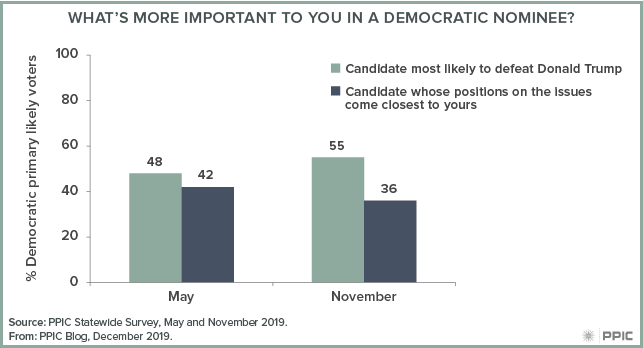
When asked what’s more important, nominating a candidate who seems most likely to defeat Trump or one whose positions on issues are closest to theirs, 55% want to defeat Trump, while 36% want alignment on positions. Since the May PPIC survey, support for impeachment (65% to 84%) and the importance of nominating an electable candidate (48% to 55%) has risen.

figure - What’s More Important to You in a Democratic Nominee?

Those who say that electability is most important, compared with those who say policy positions are most important, are more likely to mention health care (25% to 15%) and less likely to name immigration (7% to 18%) as the issue that they most want to hear about in the presidential debates. We find no differences between these two voter groups in the mention of the environment or jobs and the economy. Interestingly, education (11% to 2%) is noted more often among those who say that alignment on the issues is more important to them.

The Los Angeles debate is the next big opportunity for the presidential candidates to connect with California voters whose preferences are still being formed. Many Democratic primary likely voters already report that they are closely following the election news, but the debate could still result in an expanded electorate—and a scrambling of the race—if candidates connect with voters on issues that matter the most to them.

Throughout 2020, PPIC surveys will be monitoring what is likely to be an historic year for voter participation, as Californians engage in a consequential primary and a highly anticipated general election.

Interactive: Californians’ Views on Homelessness

[vc_row][vc_column][vc_column_text]Homelessness is a growing concern in California, where nearly a quarter of the nation’s homeless population lives. The crisis comes amid sky-high housing costs and widening income inequality. PPIC’s latest survey explores residents’ perceptions of homelessness in their part of the state.

Eighty-five percent of Californians say they are concerned about the presence of homeless people in their local community, including 58 percent who are very concerned. Majorities across regions and demographic groups say they are very concerned about this issue.

In addition, about six in ten Californians (58%) say the presence of homeless people has increased in their local community over the past year. Four in ten say it has stayed the same, while only 3% say it has decreased.

The chart below allows you to take a closer look at how different Californians view this issue. Across regions, Los Angeles (63%) residents are the most likely to say the presence of homeless people has increased. This is in line with recent data showing Los Angeles County saw a spike in homelessness in 2019. African Americans (73%) and residents with annual household incomes under $40,000 (61%) are also especially likely to report an increase in homelessness in their community. Very small shares of Californians report a decrease in the presence of homeless people.[/vc_column_text][/vc_column][/vc_row][vc_row max_width=”80″ visibility=”visible-desktop”][vc_column][vc_column_text][infogram id=”1p0621pw3w90yltegez9kvk6xdanq1qd6ey?live”][/vc_column_text][/vc_column][/vc_row][vc_row max_width=”80″ visibility=”visible-tablet-landscape”][vc_column][vc_column_text][infogram id=”1p0621pw3w90yltegez9kvk6xdanq1qd6ey?live”][/vc_column_text][/vc_column][/vc_row][vc_row visibility=”visible-tablet-portrait”][vc_column][vc_column_text][infogram id=”1p0621pw3w90yltegez9kvk6xdanq1qd6ey?live”][/vc_column_text][/vc_column][/vc_row][vc_row visibility=”visible-phone”][vc_column][vc_column_text][infogram id=”1p0621pw3w90yltegez9kvk6xdanq1qd6ey?live”][/vc_column_text][/vc_column][/vc_row][vc_row][vc_column][vc_column_text]Given the complexity of the homelessness crisis, the governor and state legislature must think of creative and sustainable solutions. One possible approach is a law that would require local governments to construct enough shelter beds so that any homeless person requesting to come indoors could do so. When asked about this proposal, an overwhelming majority of Californians (76% adults, 70% likely voters) are in favor. There is support for the policy across parties, regions, and demographic groups.[/vc_column_text][/vc_column][/vc_row][vc_row max_width=”80″ visibility=”visible-desktop”][vc_column][vc_column_text][infogram id=”1prd6drdjkx025ig27z3kwz276smgp3jj2r?live”][/vc_column_text][/vc_column][/vc_row][vc_row max_width=”80″ visibility=”visible-tablet-landscape”][vc_column][vc_column_text][infogram id=”1prd6drdjkx025ig27z3kwz276smgp3jj2r?live”][/vc_column_text][/vc_column][/vc_row][vc_row visibility=”visible-tablet-portrait”][vc_column][vc_column_text][infogram id=”1prd6drdjkx025ig27z3kwz276smgp3jj2r?live”][/vc_column_text][/vc_column][/vc_row][vc_row visibility=”visible-phone”][vc_column][vc_column_text][infogram id=”1prd6drdjkx025ig27z3kwz276smgp3jj2r?live”][/vc_column_text][/vc_column][/vc_row][vc_row][vc_column][vc_column_text]As state policymakers work on their policy agendas for the next year, we will continue to monitor Californians’ views on homelessness and related policies closely.[/vc_column_text][/vc_column][/vc_row]

Video: Counting the Central Valley

The 2020 Census is fast approaching, and the stakes are high for California—political representation and federal funding are on the line. The San Joaquin Valley, with a population of 4.3 million, may be one of the state’s hardest-to-count regions. In Sacramento last Friday, PPIC convened a discussion about how valley communities are preparing for the census.

California has long been home to high numbers of “hard to count” residents—including young children, renters, and immigrants. In 2020, the difficulty of counting all Californians will be greater than ever. PPIC researcher Joe Hayes outlined the challenges, which range from uneven internet access to a lack of trust: “Individuals are less likely to respond out of privacy concerns, on the one hand, but also out of distrust for the federal government.”

The good news is that state and local governments have invested heavily in outreach. Complete Count Committees have been established counties across the state, and community-based organizations are spearheading outreach efforts. To help guide these efforts, PPIC created interactive maps that show hard-to-count communities across the state. Maria Jeans, program coordinator for the Maddy Institute, moderated a panel discussion about the factors that make counting the Central Valley so challenging—and how challenges are being addressed.

Jesus Martinez, executive director of Central Valley Immigrant Integration Collaborative, highlighted the challenge of organizational capacity. As local preparations for the census got under way in 2018, he realized that “only a handful” of those who wanted to get involved “had any type of personal or institutional experience with the census.”

Don Saylor, a Yolo County supervisor, cited the difficulty of reaching remote rural settings across the Central Valley and the large numbers of farmworkers, language minorities, young children, and residences with multiple households. He included students enrolled at UC Davis and other colleges in the Central Valley—especially those “who are renters, living in different kinds of group settings”—as a hard-to-count population.

The panelists agreed that the fear generated by federal immigration rhetoric and policies are particularly challenging for the Central Valley. As a result, census outreach must focus on more than just making sure California gets its fair share of federal funding. As Martinez put it, “This is a human rights and civil rights issue for us now. It is the right of immigrants to be included in the 2020 Census.” Much of the outreach involves person-to-person conversations—canvassing and phone banking, “house meetings” among neighbors, and interactive media.

Cindy Quezada, senior program officer at Sierra Health Foundation, noted that encouraging people to participate is not the only challenge. “Sometimes people might want to participate but they don’t have a way to,” she said. “Either you’re living in a trailer in a backyard so you’re not going to get the invite and you’re not going to get an enumerator visit, or you may not speak a language that’s supported.” These structural barriers “are something we should really be paying attention to.”

Proposition 187 and a Changing California

Twenty-five years ago, in the midst of the worst economic crisis since the Great Depression, 59% of Californians voted to pass Proposition 187. The landmark ballot measure sought to set up a state-run immigration system and deny most public benefits—including K–12 education—to undocumented immigrants. The measure was later found to be unconstitutional, but its impact was pivotal in transforming California into what it is today.

Most Californians now support policies to protect undocumented immigrants. A recent PPIC survey found 61% of Californians and 54% of likely voters are in favor of state and local governments making their own policies and taking actions, separate from the federal government, to protect the legal rights of undocumented immigrants. In addition, our April survey found 57% of Californians (54% likely voters) support public school districts designating themselves “sanctuary safe zones” to indicate they will protect undocumented students and their families from federal immigration enforcement efforts.

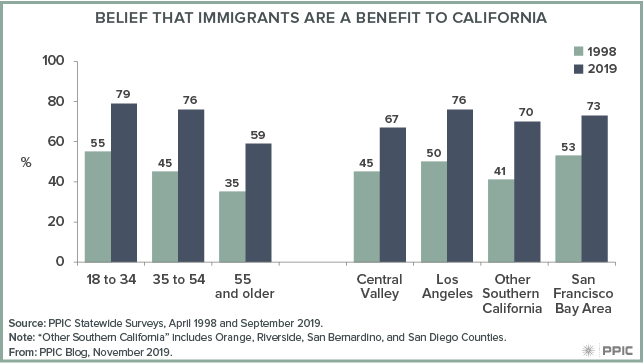
Californians’ overall views toward immigrants have also shifted. The PPIC Statewide Survey has monitored this issue since 1998. In April 1998, Californians were divided: 46% viewed immigrants as a benefit to California because of their hard work and job skills, while 42% viewed immigrants as a burden because they use public services. Since then, the share of Californians viewing immigrants positively has increased 25 points (71% benefit, 22% burden).

Across age groups and regions, the perception that immigrants are a benefit has risen by more than 20 points. Positive perceptions are also up across racial/ethnic groups, by 27 points among African Americans, 20 points among Latinos, 18 points among whites, and 12 points among Asian Americans. The share of Democrats viewing immigrants positively has increased 37 points, while the share of Republicans holding this view has decreased 2 points.

figure - Belief that Immigrants Are a Benefit to California

In recent years, Californians have supported policies to improve the lives of immigrants, such as providing health care for young undocumented Californians, taking state and local actions to protect immigrants, and supporting a pathway to citizenship. What role will immigration play in the upcoming election? Stay tuned to the PPIC Statewide Survey as we continue to examine Californians’ view of immigrants.

Video: Poverty and Opportunity in California

Although California has seen strong job growth in recent years, poverty remains persistently high. In many inland regions, the prevalence of unemployment or low-wage work is a key driver of economic hardship, while elsewhere—especially in coastal areas—the high cost of housing and other necessities plays a major part.

At an event in Sacramento last week, PPIC researcher Tess Thorman discussed the latest findings from the PPIC-Stanford California Poverty Measure (CPM), and a panel of experts discussed the role that policymakers, community organizations, and other stakeholders can play in reducing poverty and broadening economic opportunity.

Poverty has declined—slowly—in California, Thorman said. Also, while nearly 7 million people in California (17.8%) are in poverty, a roughly equal number are living just above the CPM poverty threshold. Certain groups are more likely to be living in poverty, such as young children, Latinos, and families without any college graduates.

Panelists discussed the key role that housing stability plays in achieving financial security. Richard Raya, director of Mission Promise Neighborhood in San Francisco, said his organization connects families with a range of supports, including below-market rental housing. He explained how the city has partnered with local foundations to create “an ‘accelerator fund’ that allows affordable housing developers to identify existing apartment buildings that are rent-controlled” and purchase them in order to keep them affordable – an approach Raya says could be a model for other communities.

Kimberley Johnson, director of the California Department of Social Services (CDSS), underscored how housing and financial stability are fundamental to meeting educational and career goals. Johnson noted that the governor has boosted investments in key elements of the social safety net, such as CalFresh food assistance and the California Earned Income Tax Credit. An important focus for CDSS currently is creating linkages across “a very robust array” of programs and services to make them more accessible to those in need.

California Bridge Academies, launched in Fresno and now active in six counties, offers a voluntary, 18-month program designed to help families exit poverty. According to founder Pete Weber, each household has a “career and family navigator” who assesses needs, skills, and interests. The navigator ensures that “each client is connected to the right on-ramps” so that parents as well as their children receive all necessary services and supports.

The panel highlighted the importance of coordinating services with an eye toward improving family well-being. Caroline Danielson, PPIC policy director and senior fellow, discussed the importance of creating linkages “across different kinds of programs” because “it can be a fragmented safety net.” Danielson pointed out that California has made progress in this effort, while also noting that further efforts to “connect these dots” for children could make a substantial difference in poverty.


The Mood of California Voters and the 2020 Election Cycle

This post is excerpted from my speech at the Sacramento Seminar on October 4, 2019 in San Francisco.

Pollsters often say that a public opinion survey is a snapshot in time. The latest PPIC Statewide Survey was conducted in the days after the California Legislature finished its work in 2019 and while startling news was breaking that the president called a foreign leader for a political favor—which has resulted in the launch of an impeachment inquiry. The mood of California voters in this timely survey—especially their level of unhappiness and anxiety—is noteworthy because of its far-reaching implications for the March primary and the November election.

Let’s start with President Trump’s approval rating, which now stands at 35% among California likely voters. This is unchanged from the last reading in our July survey and has been remarkably stable over time. Today, 83% of Republicans approve of his job performance, compared to just 38% of independents and only 7% of Democrats. Given its partisan makeup, California is a reliably blue state on the Electoral College map. Still, low approval ratings for the president will increase turnout, influence the Democratic presidential primary choice, and affect all of the legislative races next year.

Meanwhile, approval ratings for Congress remain low even in the wake of Democratic control of the US House of Representatives. Today, just 24% of California likely voters approve of the way that Congress is doing its job. This is unchanged from the start of the year—as well as from a year ago when Republicans controlled the House. In California, likely voters across party lines give low approval ratings to Congress. If this trend continues, incumbents will have to work harder to keep their seats in 2020.

Closer to home, Governor Newsom and the legislature are getting mixed reviews in their first year of making policy together. Among likely voters, 43% approve and 44% disapprove of the governor, while 38% approve and 51% disapprove of the legislature. Since the beginning of the year, disapproval has increased significantly for the governor (+15 points) and the legislature (+8 points). Today, more than six in ten Democrats approve of the job that the governor and legislature are doing, compared to fewer than four in ten independents, and less than two in ten Republicans. If their ratings remain in the doldrums, the governor and legislators will have little sway over Californians’ ballot choices next year.

figure - Approval Ratings of State Elected Officials

Equally important, California’s likely voters are in a negative frame of mind about the state of their state—even in the midst of low unemployment and budget surpluses. Fifty-four percent say that things in California are going in the wrong direction (41% say right direction). When asked about economic conditions in California for the next 12 months, a similar 54% expect bad times (37% say good times). Pluralities across party lines are now expecting bad economic times in the next 12 months—a timeframe that includes most of the 2020 election campaign season.

figure - Likely Voters Expect Bad Economic Times in the Next 12 Months

State bonds and tax measures will face headwinds if this level of economic unease continues. This is already evident in the modest support for the $15 billion school bond (54%) and the split-roll property tax initiative (47%) in our recent survey.

figure - Modest Support for Likely 2020 State Ballot Measures

Digging deeper into the survey, more than six in 10 likely voters worry about being able to afford the cost of their health care, six in ten are concerned about the threat of a mass shooting where they live, half are worried about experiencing natural disasters such as wildfires, and four in ten worry about someone they know being deported. Candidates’ promises and plans to address these fears will likely impact the standing of current frontrunners Joe Biden, Bernie Sanders, and Elizabeth Warren—and their challengers—in a Democratic presidential primary which is very much up for grabs, as our recent survey shows.

How will voters’ views change over the next 12 months? Clearly, the political wildcard is the impeachment inquiry and how it will impact perceptions of the president, Congress, and the major parties. Uncertainty about the economy is another unknown factor. In the short run, the impeachment inquiry is likely to increase polarization, lead to more political gridlock in Washington, and heighten expectations for the governor and legislature to do more to solve the problems facing California.

PPIC Statewide Surveys will continue to monitor the broader political and economic attitudes, as well as voters’ preferences for presidential candidates and ballot measures, throughout what will be a consequential 2020 election.