Covering the Real Costs of College

Faced with the state’s high cost of living, California college students struggle to secure adequate food and housing. Even amid one of the largest and longest economic expansions in state history, 33% of students are housing insecure and 35% have low or very low food security, according to a California Student Aid Commission survey of 150,000 college students. As the state seeks to meet economic demand by producing more students with degrees and certificates, the full cost of college remains a barrier to progress.

Governor Newsom and the legislature have recognized the need to reform state financial aid programs to address the full cost of college. The 2019–20 state budget provided $41 million in ongoing funding to help colleges address food and housing insecurity, $19 million to support rapid rehousing programs, and increased the number of competitive state grants for non-traditional students from 25,750 to 41,000.  Additionally, the legislature increased the maximum award amount that students with children pay for non-tuition college costs from $1,672 to about $6,000.

However, broader reform of the state grant aid program remains elusive. Two recent bills sought to expand eligibility for Cal Grants by eliminating current age, time out of high school, and high school GPA requirements. The bills also sought to provide additional non-tuition aid to community college students and students in career education programs.  The bills did not make it to a vote; however, they will be re-examined in the next legislative session. Estimated at $2 billion per year, proposed reforms would nearly double the annual cost of the program.

Consequently, the California Student Aid Commission, the agency that distributes financial aid, intends to streamline these proposals to constrain costs while increasing access. Higher education is a vital tool that increases economic and social mobility; ensuring all students have equal access to an affordable education is paramount to modernizing California’s economy. An equitable and financially viable approach to financial aid will be critical if the state’s booming economy slows in coming years.

Strengthening Career Pathways in California’s Community Colleges

California lawmakers have made large state investments—totaling more than $1 billion over the past five years—to support and expand career education.  As the primary provider of career training in the state, California’s community college system was the recipient of much investment in this area, and their creation of the Strong Workforce program has established an ongoing source of funding to continue this work.

To assist policymakers, practitioners, and students to better understand how career education programs can meet regional workforce needs and connect students to well-paying, in-demand jobs, PPIC has engaged in a multi-year research agenda focused on community college career education pathways. We highlight our work in this area in a recent article, Strengthening Career Pathways in California’s Community Colleges, in Techniques magazine, a national publication that provides career education faculty and practitioners with timely analysis and insights to inform the delivery of high quality career education programs.

The article highlights recent research from PPIC’s Higher Education Center on the structure of career education pathways and their value to the students who complete them. Since many career education students are older than typical college-age students—and are likely to have work or family obligations (or both)—the article also highlights how various reforms being enacted by the community colleges could help students complete career training pathways, with a focus on the new online-only college, CalBright, that began enrolling students for the first time in October 2019.

College Applications Are Up and Admission Rates Are Down

Across California, thousands of high school seniors are in the process of completing college applications. If recent trends continue, the number of applications this year should be staggering. Keeping up with demand has been a challenge; most colleges have reduced their admission rates in the face of large increases in student interest.

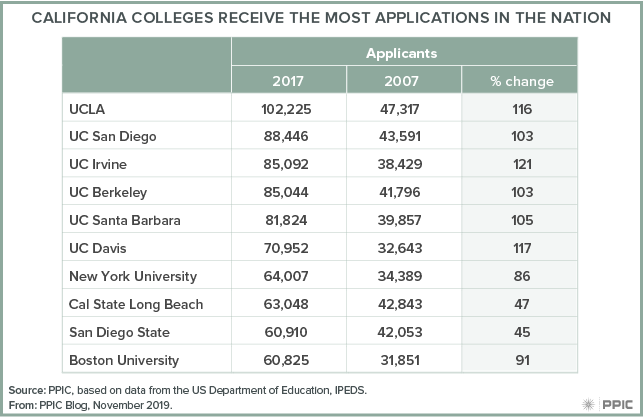
California colleges and universities garner the most applications in the nation. Of the top 10 most popular schools in the country, eight are in California (six UC campuses and two CSU campuses). UCLA has led the nation in applications every year for at least the past 17 years. In 2017, it became the first college in the country to receive more than 100,000 freshmen applications.

table - California Colleges Receive the Most Applications in the Nation

The popularity of UC campuses has surged over the past 10 years, with UC Irvine moving to 3rd in the nation in 2017, up from 7th in 2007. UC Davis moved to 6th from 11th, and UC Santa Cruz jumped to 15th from 32nd.

In the CSU system, Cal Poly San Luis Obispo has moved to 18th from 23rd. And even though other CSU campuses fell in the rankings, they still experienced large increases in applications.

Of course it makes sense that California colleges would lead the nation: the state has more high school graduates than any other and offers a robust system of public universities. And students are applying to more colleges than they did in the past, which contributes to the growth in applications.

But much of the increase is attributable to improvements in college preparation. Between 2007 and 2017, the number of California high school graduates completing the courses required for UC and CSU eligibility increased by almost 60%. In 2007, only about one third of high school graduates completed the required college preparatory courses, but by 2017 almost half had done so, a remarkable improvement in a relatively short time.

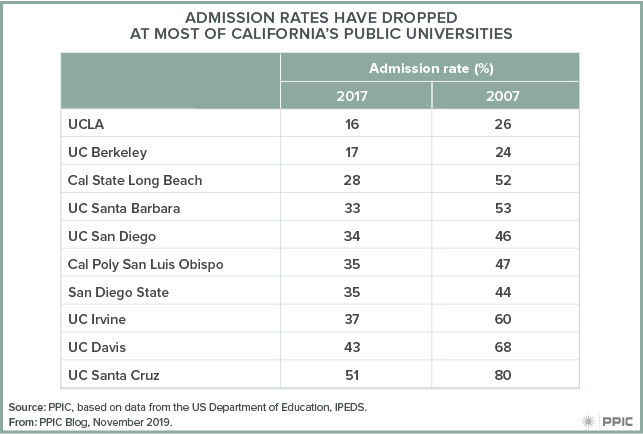
Unfortunately, California’s public universities have not been able to accommodate all qualified applicants. In fact, they lead the nation in turning applicants away.

table - Admission Rates Have Dropped at Most of California’s Public Universities

Each of the UC campuses except Merced are unable to admit all of the eligible students who apply. Seven CSU campuses (including Long Beach, San Diego, and San Luis Obispo) are impacted for all undergraduate programs, meaning they cannot admit all qualified applicants; all but one of the other campuses are impacted in certain majors. Both UC and CSU refer qualified applicants to campuses that have more room, but more needs to be done to expand capacity at campuses with high demand.

Video: Broadening Access to Transfer-Level Courses at California’s Community Colleges

The majority of California community college students never complete their education. For many students, the biggest barrier to success has been the traditional approach to remedial education. Until recently, the vast majority of entering students were placed in remedial—or developmental—courses, and relatively few of them went on to receive a degree or transfer to a four-year institution. In recent years, several colleges have responded to this longstanding challenge by experimenting with placement and curricular reforms, and state legislation enacted in 2017 aimed to accelerate the pace of change.

A new PPIC report examines what happened at colleges that were early in implementing large-scale reforms, focusing on student access to and completion of transfer-level courses in English and math. Marisol Cuellar Mejia, PPIC senior research associate and report coauthor, reported on the findings at a briefing in Sacramento last week, followed by a panel discussion of higher education experts moderated by coauthor Hans Johnson, PPIC senior fellow and director of the PPIC Higher Education Center.

Panelists included Julianna Barnes, president, Cuyamaca College; Laura Metune, vice chancellor for external relations, California Community Colleges Chancellor’s Office; and John Stanskas, president, Academic Senate for California Community Colleges.

The three panelists emphasized the equity implications of placing students in transfer-level classes, as opposed to remedial courses.

Barnes said that “we cannot deny the data” showing that placement and curricular reforms are particularly helpful to students who are historically underrepresented in college. Making these changes became “an equity imperative” at Cuyamaca College.

Thoughtful leadership and a commitment to addressing equity gaps are particularly important in managing change, according to Metune. She noted that “we need to just be careful that it’s not our own implicit bias that’s resulting in differences in student outcomes.”

All community colleges now have a plan for implementing reform, Stanskas said. He pointed to the importance of tailoring programs to specific student populations. Colleges should be ready to “get down to being more nuanced about who [their] students are and what they need from us to be successful.”

How Community College Reforms Could Help English Learners

[vc_row][vc_column][vc_column_text]Due in large part to their mission of access and affordability, community colleges play a key role in educating immigrant students, especially those who are English Learners. In 2016–17, more than 58,000 first-time community college students in California enrolled in English as a Second Language (ESL) courses.

For many students, taking ESL courses may be linked to the desire to improve their socioeconomic prospects. Indeed, community college students who earn a credential or transfer to get a four-year degree are well positioned to climb the economic ladder. In an economy that increasingly demands skilled workers, there is tremendous untapped potential in increasing the educational attainment—and economic trajectories—of ESL students.

California’s community colleges have undertaken several reforms that aim to improve student success and close equity gaps. These reforms—spurred by AB 705 and the new Guided Pathways framework—present a ripe opportunity to help more ESL students get on the path to completing college composition, a requirement to earn a college credential or transfer.

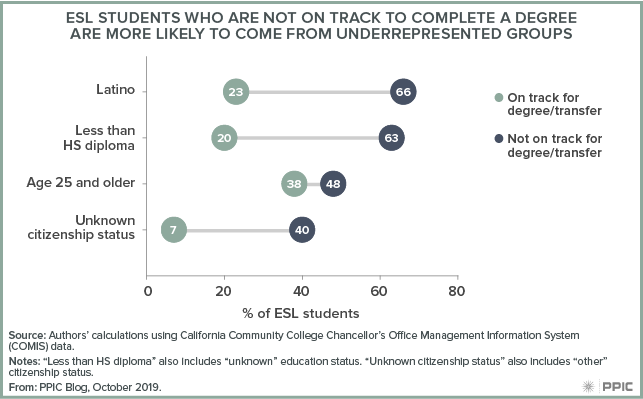
These initiatives are primarily focused on addressing the needs of students who intend to pursue a degree or transfer. However, our most recent research finds that about two-thirds of ESL students (66%) are not on track to do so—and may consequently be left out of the reforms. (We consider students on track if they take any ESL course required to access college composition and at least one course other than ESL or English.)

ESL students who are not on track are more likely to come from historically underrepresented groups. For instance, we find that compared to students taking ESL courses needed for college composition, those not taking these courses are more likely to be older and Latino. They are also more likely to have unknown citizenship status (a possible signal of being undocumented) and to have not graduated high school.

figure - ESL Students Who Are Not on Track To Complete a Degree Are More Likely To Come from Underrepresented Groups

As colleges across the state reform their ESL sequences and programs of study, it will be critical to ensure that all students have the opportunity to earn a degree or transfer. The two-thirds of ESL students currently not on track to do so are the most vulnerable. These students have already taken the major step of enrolling in college. To improve their likelihood of advancing, colleges could provide clearer and more effective ESL sequences and degree and transfer pathways, as well as stronger student supports, including advising, placement, and information about available degrees and certificates.

Some colleges are already working on these issues. Initiatives like the Guided Pathways ESL Milestone certificates at Cypress College—the result of AB 705 and Guided Pathways efforts—present a unique example of how colleges can structure ESL programs and certificates to help English Learners get on a pathway toward a college credential.

Finally, it is important to acknowledge that there are some ESL students who take ESL coursework for reasons unrelated to a degree. As colleges redesign their ESL programs, working alongside non-credit ESL programs, adult education schools, and community-based ESL programs could help ensure that colleges are keeping the diverse needs of ESL students in mind.[/vc_column_text][/vc_column][/vc_row]

Video: Career Education and Economic Mobility in California

[vc_row][vc_column][vc_column_text]

Career education, also known as vocational education or career technical education (CTE), prepares a wide range of Californians for employment and economic advancement. Community colleges are a major provider of career education in California, offering short- and long-term certificates along with associate degrees across a variety of fields of study.

In this video, senior research associate Shannon McConville discusses the importance of career education for California and what new PPIC research says about its economic benefits. Career education credentials can provide substantial earnings gains and also helps create a strong California workforce over the long term.

[/vc_column_text][/vc_column][/vc_row][vc_row visibility=”hidden-phone”][vc_column][vc_video link=”https://youtu.be/5qmlPVWwiEw” el_width=”70″ align=”center”][/vc_column][/vc_row][vc_row visibility=”visible-phone”][vc_column][vc_video link=”https://youtu.be/5qmlPVWwiEw”][/vc_column][/vc_row][vc_row][vc_column][/vc_column][/vc_row]

Should Applying for College Financial Aid Be a High School Requirement?

A majority (58%) of Californians consider affordability at the state’s public colleges and universities a big problem, according to a 2018 PPIC Statewide Survey. Requiring all high school students to apply for financial aid could help more students pay for college.

Currently, around 60% of high school students in California complete the federal application for financial aid (FAFSA)—a student’s gateway to receiving federal grants and loans, as well as state aid. The remainder of students are unlikely to receive aid, even though there’s evidence that many of them would probably have qualified.

Requiring students to apply for aid may result in greater numbers of high school graduates enrolling in college, which could increase California’s college-going rate of 64% (2017–18). Earlier this year, a bill was introduced in the California Legislature that would require students to complete a financial aid application before graduating from high school.

Louisiana was the first state to have such a requirement, starting in 2017–18. The state saw FAFSA completion rates increase from 48% to 84% between 2015 and 2018, and college-going numbers increased by 12.6% (from 22,200 to 25,000) in the same time frame. Texas and Illinois are following suit, with the requirement taking effect in those states in fall 2019 and fall 2020, respectively.

California needs more college graduates to meet the increasing demand for highly skilled workers—and the proposed bill could make a difference if it increases access to college, especially for lower-income students. In addition, better financial support during college can reduce students’ debt load and might help more students complete their programs. Improved access to college and higher graduation rates would set more students up for success in the workforce and benefit the state’s economy.

Integrating California’s Education Data

[vc_row][vc_column][vc_column_text]California needs an integrated data system that connects pieces of the education pipeline that are currently maintained separately.  An integrated system could perform a variety of critical functions and reach a diverse audience of stakeholders. For example, it could provide feedback to educational institutions on student outcomes, even after students graduate. It could also encourage better planning and coordination between educational sectors, increase the state’s ability to evaluate educational programs and policies, and provide students and families with better information about successful educational and workforce pathways.

The state has recently invested $10 million toward planning for this type of system, establishing the California Cradle to Career Data Systems Working Group to “recommend data system structural components, processes, and options” and to “advise ongoing efforts to develop, administer, and enhance the data system” (per Senate Bill 75).

The Public Policy Institute of California has also been focused on this issue, facilitating a group of research and policy organizations interested in the establishment of an integrated student data system in the state. Known as the California Education Data Collaborative, this group has met regularly throughout this year to discuss the opportunities and challenges associated with advancing education through connected data.[/vc_column_text][/vc_column][/vc_row][vc_row][vc_column width=”1/2″][vc_column_text]

The collaborative’s activities are designed to build knowledge and skills among diverse stakeholders involved in improving access, equity, and success across California’s educational systems. As a collaborative, we have engaged with national experts, leaders in successful data systems from other states, policymakers from California, and those with experience in working for an integrated data system in California.

As the state’s California Cradle to Career Data Systems Working Group takes shape, the collaborative is working to:

  • Engage with stakeholders—including students, parents, educators, and institutions—about how to implement a data system that best serves them.
  • Connect with policymakers to ensure that the data system answers critical questions about policies and programs to foster student success.
  • Provide research and advice on how to construct a system that will improve California’s education systems.
  • Examine issues of privacy and security to ensure confidentiality of student records.

[/vc_column_text][/vc_column][vc_column width=”1/2″][vc_column_text css=”.vc_custom_1567624867972{padding-top: 20px !important;padding-right: 20px !important;padding-bottom: 20px !important;padding-left: 30px !important;background-color: #384763 !important;border-radius: 4px !important;}”]

PPIC’s California Education Data Collaborative

California Competes
California College Guidance Initiative
California EDGE Coalition
California Policy Lab
Cal-PASS Plus
The Campaign for College Opportunity
Children Now
CORE Districts
Education Insights Center
The Education Trust- West
First 5 LA
Policy Analysis for California Education
Public Advocates
Public Policy Institute of California
Strategic Education Services
The Institute for College Access and Success
WestEd
[/vc_column_text][/vc_column][/vc_row][vc_row][vc_column][vc_column_text]Establishing an integrated, longitudinal student data system will take a multifaceted, sustained approach. In the long run, the value of this system will lie in the policy questions that can be asked—and answered with confidence—and the ability of practitioners, students, and families to access information that helps them make informed choices. To assess reforms accurately and comprehensively will require strong partnerships, clear long-term planning, identified goals—and good data.[/vc_column_text][/vc_column][/vc_row]

Proposed Changes in Admission Requirements at CSU

For the first time in over 15 years, California State University (CSU) and the University of California (UC) may have different course requirements for admission. CSU is currently considering changing its three-year high school math requirement to a quantitative reasoning requirement of four years that broadens the list of eligible courses.

The proposed change—scheduled for a November vote by the CSU Board of Trustees—would create a difference from UC’s three-year requirement, meaning that some students who would qualify for UC may not qualify for CSU. Both CSU and UC have historically defined their math requirements around algebra, geometry, and advanced algebra, as well as any advanced courses (e.g., pre-calculus and calculus) that require these subjects as prerequisites. Under the proposed change, students could continue with the traditional math sequence or take applied courses in the fourth year, including personal finance, laboratory science, computer science, or statistics. The new requirement would first apply to the high school graduating class of 2026.

The goal of the change is to better prepare students for success at CSU and to enable more students to pursue STEM majors once they enter college. But critics cite access and equity concerns, arguing that the changes may disproportionately affect low-income students in districts that are struggling to hire enough math teachers. CSU, which trains a large share of California’s K–12 teachers, has recently announced an expansion of its Mathematics and Science Teacher Initiative to increase the number of new math and science teachers.

CSU and UC have had the same course requirements since 2003, when UC adopted CSU’s visual and performing arts requirement, thus fulfilling “the long-sought goal of giving UC and the California State University a common set of subject requirements” (2000-05-24 Notice of the Meeting, Assembly of the UC Academic Senate).

The proposed change could cause confusion for students who may want to apply to more than one system. Complicating the issue, UC is currently considering adding another year to its science requirement but has not yet scheduled a vote by the UC Board of Regents.

Students in California would benefit from clearly organized admission requirements, but the state lacks an entity that could help K–12 and the higher education systems coordinate these requirements. A higher education coordinating body could provide expertise around this decision, clarify its goals, and help determine whether the proposed requirement is the best approach to meet those goals.

A New Look at College Enrollment Rates

California’s K–12 districts and schools are responsible for preparing students for college and career. But until recently, data has not been available to determine their success in actually getting students to apply to and attend college. Now, however, the California Department of Education has published data on college enrollment among recent high school graduates, using information from the National Student Clearinghouse. Initial findings show wide disparities in college enrollment across racial/ethnic groups and throughout the state’s regions—including within school districts themselves.

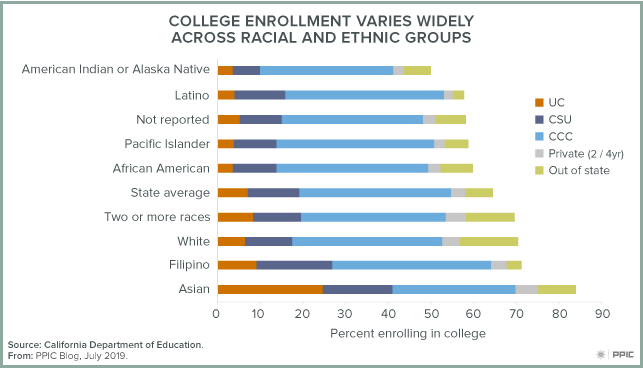
According to the data, about 65% of California’s high school graduates attended college within a year of graduation in 2017–2018 (the most recent data available). But there are wide differences. For instance, Latino students—the majority of K–12 students—have a relatively low rate of college enrollment (58%), while rates for Asian American students (84%) are quite high. Asian American students are also much more likely to attend a University of California campus than other students. African-American students have a similar enrollment pattern as Latino students, except many more opt to go to college in another state. White and multi-racial students also enroll in out-of-state colleges or universities at rates above the state average.

Figure - College Enrollment Varies Widely Across Racial and Ethnic Groups

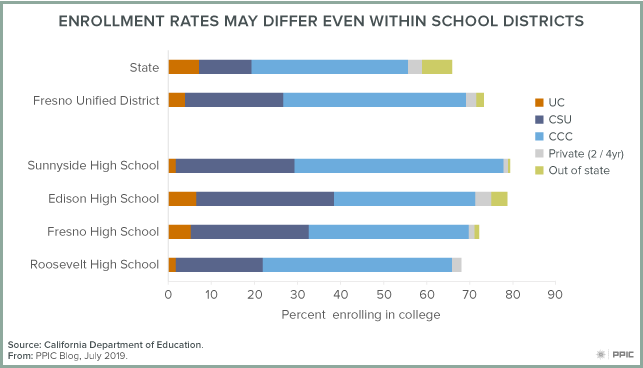
Differences by school, district, and region are also available in the data (you can check your local district’s college enrollment rates here). Fresno provides a good example. Fresno County has higher college enrollment rates than the state, but students are much less likely to attend a UC and much more likely to attend a CSU or community college—perhaps because of the strong presence of Fresno State and local community colleges, as well as the greater distance to most UC campuses.

Figure - Enrollment Rates May Differ Even Within School Districts

Among the many districts in Fresno County, students from Fresno Unified School District are relatively more likely than others to attend college. But there is plenty of variation within the district. Sunnyside High has very high enrollment rates; however, rates are lower than the district average for UC and much higher for community college. By contrast, Edison High has much higher than district average enrollment at UC, private, and out-of-state schools.

Enrolling in college or university is a goal for many high school students. But because the existing K–12 and higher education data systems are not linked in California, this is the first time in over a decade that the state has good information about whether high school students are meeting that goal. With the passage of SB75, California has begun the process of building a statewide longitudinal data system that will connect the existing student data systems between K–12 and higher education. The new enrollment data provide the first glimpse of the promise of a connected education data system. Linking data across segments could yield useful new information—such as whether students were successful in their college courses—which would fit nicely in the state’s dashboard on college readiness.