Testimony: Transfer Is Key to Closing the Workforce Skills Gap

Hans Johnson, director and senior fellow at the PPIC Higher Education Center, testified March 20, 2018, before the Senate Select Committee on Student Success.

Here are his prepared remarks.

California faces a shortage of highly educated workers. Specifically, economic projections to 2030 show that about two in five jobs will require at least a bachelor’s degree, while demographic projections suggest that only about one in three Californians will attain this level of education. This shortfall equates to 1.1 million workers. To close the gap, all higher education systems will need to play a role, increasing access, transfer, and completion. Improving access and outcomes among groups historically underrepresented in higher education—including low-income students, first-generation college students, Latinos, and African Americans—is essential if we are to close the workforce skills gap.

The good news is that California’s students are rising to the challenge. College preparation among high school graduates has increased, with the share of students completing the college preparatory requirements of UC and CSU now at an all-time high. Strong demand for UC and CSU is likely to continue as college preparation improves and the transfer pathway becomes more efficient and effective. In addition, new initiatives, including reforms in remedial education at the community colleges and CSU, have the potential to substantially improve student success rates and boost transfer. Finding ways to accommodate all these students remains a central challenge, but one that must be met in order to ensure a better future for all Californians.

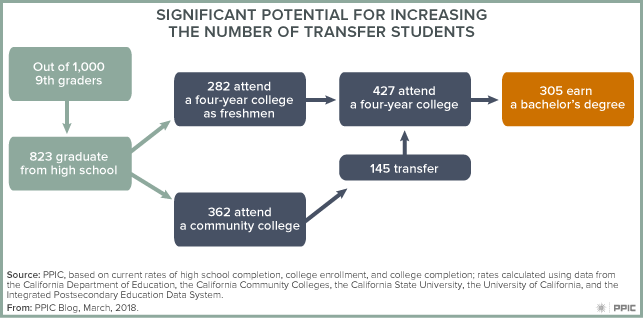
In this testimony, I will focus on the importance of transfer. California enrolls a disproportionate share of students in community college. We rank 47th in the nation in the share of recent high school graduates enrolling in four-year colleges and 5th in the nation in the share enrolling in community colleges. This means that we must do more to ensure that community college students reach their educational goals—since the vast majority of recent high school graduates attending community colleges say that they want to transfer and earn a bachelor’s degree. As shown in the chart below, there is a lot of room for improvement—only 40% of recent high school graduates who go to community college will end up transferring to a four-year institution.
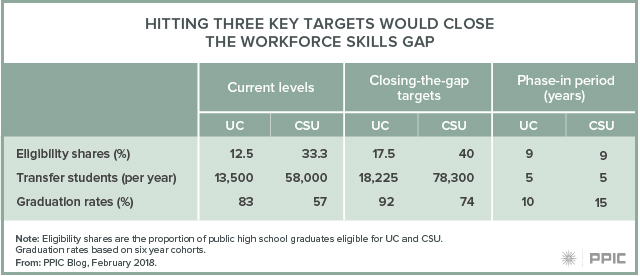
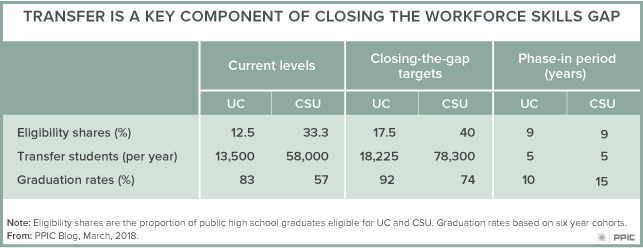
PPIC has identified ambitious targets that would close the workforce skills gap. As shown in the table below, doing so will require large increases in access to UC and CSU, both for first time freshmen and for transfer students. In its Vision for Success, a blueprint for improving student outcomes, the community colleges have established new goals for transfer that align exactly with the PPIC targets. Those targets include a 35% increase in the number of transfer students at UC and CSU, increasing from about 72,000 combined in 2015 to almost 100,000 by 2020.
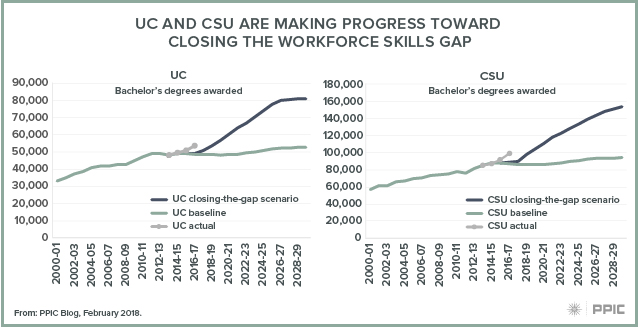
I’m pleased to say that the colleges are currently on track to meet those targets. We are now two years into PPIC’s projections, and both UC and CSU have met the closing-the-gap targets (see charts below). The concerted efforts of policymakers, higher education officials—including staff and faculty—and, of course, students have led to these early gains.  State general fund allocations for each system have increased since the Great Recession, allowing for increased enrollment. At UC, those budget allocations were partially tied to increasing enrollment, hence the sharp rise in transfers from 2015 to 2016.  New articulation agreements, such as the Associate Degree for Transfer (ADT), have streamlined the pathway from community colleges to four-year colleges, especially CSU. And an increased focus on improving student outcomes in the community colleges has led to multiple substantive reforms designed to increase persistence and completion (including transfer).

These early successes are very promising. Still, California needs to build on them if it is to close the degree gap.  We offer the following recommendations for moving forward:

  • First, the state should work with the systems to ensure that students who are eligible for transfer successfully make the transition. Some students who are eligible to transfer never even apply to do so. More work needs to be done to understand factors that prevent those students from moving on, including an assessment of equity implications. At the same time, many transfer-eligible students do apply to transfer, but are not admitted because of insufficient resources at UC and CSU. Because of budget constraints, CSU reports turning away more than 32,000 transfer applicants from 2013–14 through 2016–17, even though they had met CSU admission requirements (based on systemwide unduplicated counts of California resident applications). UC does not report how many qualified applicants have been turned away, partly because UC eligibility is less clearly defined. UC has general transfer requirements, including courses and grade point average requirements, but advises students that “meeting these basic requirements doesn’t guarantee admission to the campus or major of your choice.” Enrolling more students will almost certainly require more funding, either from the state via the general fund or from students and their families through tuition increases.
  • Second, the pathway from community college to UC and CSU needs to become systematically and comprehensively streamlined. The Associate Degree for Transfer is a step in the right direction. Students earning an ADT are guaranteed admission to CSU in a major aligned to their course of study. But these degrees are offered only in some majors at some colleges. While the number of students earning an ADT has grown rapidly, it is still the case that the majority of transfers to CSU do not have the degree. As shown in the chart below, institutional participation in the program varies by college and by major. Some majors, including engineering, have no ADT at all.  Moreover, UC does not formally participate in the ADT guarantee. At UC, transfer admission requirements vary by campus and by majors within campuses.  For example, UC Berkeley’s College of Engineering has much higher standards than the UC minimum requirements for transfer, including a 3.5 grade point average and the completion of courses that are not offered at all community colleges.

  • Third, the state and its higher education institutions need to plan for potentially large increases in the number of community college students prepared and ready to transfer. New reforms in the community colleges hold the promise of dramatically increasing persistence and completion. Assessment and placement reform, spurred by AB 705, is likely to lead to an enormous increase in the number of students placed directly into college-level English and math courses—bypassing traditional remedial classes that have been the single largest impediment to student success. Other new initiatives, including “guided pathways” intended to provide a clear road map to students on courses of study and the supports needed to succeed, could lead to further gains. Because most transfer students enroll in CSU and UC, capacity issues at those institutions must be addressed. The state’s private nonprofit colleges are also an important destination for transfer students, and continued efforts should seek to gain greater participation and enrollment in that vital sector.

Through thoughtful planning—and yes, additional funding—closing the workforce skills gap is possible. Improving the transfer pathway is a necessary and critical component. And because community colleges are highly representative of California’s economic and demographic diversity, improving transfer pathways will ensure that more low-income, first-generation, and underrepresented students have access to a four-year degree.

The Rising Cost of College: Student Fees

Students, parents, and lawmakers often express concern about tuition increases at California’s public universities. But tuition is not the only college cost that has been rising. Students also pay fees that cover many non-instructional costs, and between 2013 and 2016, student fees increased an average of 21% at both the UC and CSU systems, even as tuition itself stayed flat.

UC charges a systemwide fee ($1,228 for 2017‒18) to cover student affairs operations, and UC campuses can assess their own fees. CSU does not assess a systemwide fee; instead, the Chancellor’s Office allows campuses to decide how much to charge for each of seven fee categories, ranging from health services and facilities to instructionally related activities to the student association. When students vote to approve referenda, they are agreeing to implement fees for new or expanded services.

Fees typically pay for things like student affairs services, health center services, campus gym services and facilities (initiated at UCLA and UC Irvine in the early 2000s), and student union seismic retrofit fees. Today, student-advocated fees commonly pay for expanded psychological health services and recruitment and retention centers.

Campus-based and systemwide fees add from 15% to 25% to tuition at UC and 15% to 65% at CSU. Total fees assessed in 2017‒18 range from $1,759 (UCLA) to $2,949 (UC Santa Barbara) in the UC system and from $843 (Fresno State) to $3,718 (Cal Poly San Luis Obispo) at CSU schools.

While financial aid protects low income students from tuition increases, it doesn’t always cover fees. State and institutional aid programs cover only tuition and systemwide fees, so most campus-based fees must be paid by all students. This lack of coverage is becoming a bigger issue now that fees are on the rise. The UC Regents systemwide fee increased more than 10% from 2013 to 2016, and campus-based fees increased an average of 24%. At CSU, campus-specific fees increased by an average of 23%. This has increased the total cost of attending college even though the state and the two systems made a deal to freeze tuition.

Fees have become an important source of revenue for campuses, enabling them to provide non-instructional services. But, along with high housing costs, rising college fees are having an impact on students and families. As policymakers consider revising the master plan and the administration of state financial aid, they need to address growing non-tuition costs.

Learn more


Video: Improving English Courses at California’s Community Colleges

California’s community colleges are in the midst of numerous reforms to improve developmental—or remedial—education. Developmental education is supposed to help prepare students for college work but it has long been an obstacle to student success: most students in developmental classes never go on to complete a college-level course in English or math. A recent report by the Public Policy Institute of California (PPIC) looks at the effectiveness of some of these reforms in English. It finds that one reform in particular shows real promise. Called one-semester acceleration, it’s a highly intensive course that leads directly to a college composition class. Still, there is much room for improvement, especially for underrepresented students.

PPIC researcher Marisol Cuellar Mejia presented findings from the report in Sacramento this week. In a discussion following the presentation, panelists talked about promising initiatives underway in developmental education. Many of the current efforts to more accurately place students in appropriate classes and transform course sequences are motivated by AB 705, a legislative proposal signed into law by Governor Jerry Brown last fall. Assemblymember Jacqui Irwin, who authored the bill, said it provides flexibility to the state’s individual community colleges “but with clear requirements that colleges use the best of multiple measures—including high school performance—in placing students.” The bill also instructs colleges to maximize the possibility that students pass a transfer level class within a year.

Laura Hope, executive vice chancellor for educational services at the California Community Colleges Chancellor’s Office, described the central challenge involved in full-scale implementation of reforms across the state’s 114 community colleges as an instructional paradigm shift. “It’s about changing minds and hearts about student capacity and the belief that they don’t come to us just a jumble of deficits . . . It’s about shifting that mindset away from fixing students into activating students.”

Summer Serpas, assistant director of the California Acceleration Project, underscored the professional support that teachers will need as a larger and more diverse group of students move out of developmental courses and into transfer-level ones: “These students are capable of doing the work, but they come in needing [additional] support.” Serpas said it will be critical to learn from colleges that have already adopted successful reforms, including accelerated pathways and the “co-requisite” model, in which students enroll directly in college composition with concurrent support.

Occupational Shifts Favor California’s High-Skill Workers

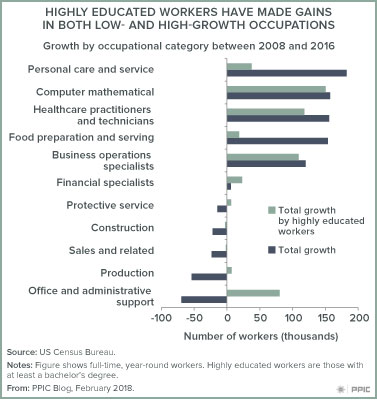
[vc_row][vc_column][vc_column_text]The recession and recovery have reshaped California’s workforce. Between 2008, when employment peaked, and 2010, when it bottomed out, the state lost three quarters of a million jobs. Since then, the state has experienced sustained job growth; according to US Census Bureau data, by 2016 there were 1 million more workers in California than there had been in 2008. This job growth has not been evenly distributed. Some occupations experienced large losses during the recession and have not fully recovered, while others experienced small losses and now have much higher employment levels than they did at their pre-recession peak. While there are some high-growth occupations that do not require high levels of education, workers with at least a bachelor’s degree have prospered the most over the past several years.

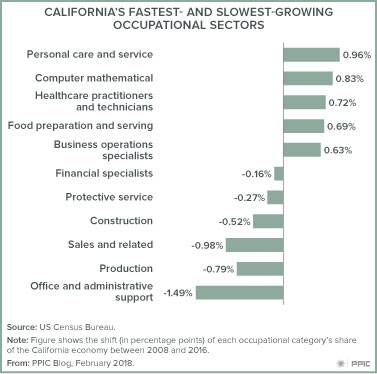
Overall, California’s workforce is becoming more educated: the share of the full-time year-round workforce with at least a bachelor’s degree grew from 31% in 2008 to 35% in 2016. Highly educated workers got more than half of the jobs created in the five fastest-growing occupational categories (based on increases in the share of total full-time year-round workers) between 2008 and 2016:
  1. Personal care and service
  2. Computer and mathematical
  3. Healthcare practitioners and technicians
  4. Food preparation and serving
  5. Business operations specialists

All of these occupations experienced small declines during the recession and strong growth during the recovery. The number of full-time year-round workers increased 28%—from 2.5 million in 2008 to 3.2 million in 2016. Workers in some of these occupations, such as food preparation and serving, earn relatively low wages and tend to have low levels of educational attainment, while workers in other areas, such as computer and mathematical, collect high wages and tend to be college graduates. Altogether, workers with at least a bachelor’s degree made up 433,000 (56%) of the 770,000 jobs gained between 2008 and 2016 by the top five categories.

Workers with at least a bachelor’s degree also made gains in the five slowest-growing occupational categories:

  1. Protective service
  2. Construction
  3. Production
  4. Sales and related
  5. Office and administrative support

These occupations experienced sharp losses during the recession and have not returned to their pre-recession peaks. The number of full-time year-round workers in these occupations declined from 5.3 million in 2008 to 5.1 million in 2016. On average, educational attainment levels are low in these occupations, but workers with at least a bachelor’s degree fared relatively well: the number with at least a bachelor’s degree grew by 89,000, even though these categories have experienced a net loss of 184,000 jobs.

In short, the recession and recovery have accelerated some long-term trends in California’s economy. High-skill occupations and highly educated workers have fared well, while less-educated workers in lower-skilled jobs have faced declining employment opportunities.

[/vc_column_text][/vc_column][/vc_row]

Retraining Workers for the Future Economy

As the economy continues to shift toward computers and digital technology—and braces for a potential future with more robots—workers have been called upon to adapt and learn new skills. New industries and new kinds of jobs may lead to economic growth, but whether these gains are shared by all of California’s workers depends critically on their retraining. And that retraining, in turn, depends on the ability of educational institutions to also adapt to new labor market needs.

While workers can sometimes learn new skills on the job or on their own, other times retraining means obtaining a new credential and returning to the classroom. That’s especially true for people who work in technical industries that are being reshaped by forces like routinization, automation, and outsourcing.

California’s higher education system has an important role to play in delivering retraining options. The state’s community colleges are the primary provider, with hundreds of programs in skilled trades and applied sciences and technologies. Notably, community colleges offer retraining options at a much lower cost to students than do private for-profit two-year colleges, another major provider. In addition, many community college programs show substantial economic returns for students—especially in health professions.

Effective retraining through the state’s colleges would help ensure that all Californians are productive and self-sufficient, which would benefit not just families but also employers and the state economy. However, the current model of higher education was largely built for 18-year-old, first-time freshmen and does not necessarily work for older, returning students, who are almost certainly balancing training with career, family, and other demands.

Flexible course scheduling—for example, through online courses or “distance” education—is one way to better reach workers. California’s community colleges are the clear leader in offering online options. PPIC research has highlighted some limitations to online training and outlined ways to improve student outcomes. Online courses for technical programs may require additional innovation, especially those that require hands-on training. Governor Brown’s proposed budget for fiscal year 2018–19 includes funding for a fully online community college that has the potential to bring innovation to how retraining opportunities (and educational opportunities, broadly speaking) are offered to Californians.

For individuals or training programs not amenable to online options, expanding course offerings near job centers is key. Cal State Los Angeles’s satellite campus in downtown LA aims to do exactly this. Information about the job market is also crucial—and California’s community colleges have taken a big step in the right direction by providing easily accessible information on the labor market outcomes of different colleges and programs across the state.

Retrained workers may pursue all kinds of new skills, but career technical programs, most of which are in community colleges, are particularly important because they offer short-term credentials in industry-relevant fields. Efforts to make career technical programs more flexible—through, for example, online courses, convenient locations, and partnerships with employers—are critical to filling student, employer, and state needs in a rapidly changing workplace.

Learn more
Visit the PPIC Higher Education Center


Testimony: How Can California Produce More College Graduates?

Hans Johnson, director and senior fellow at the PPIC Higher Education Center, testified today, February 6, 2018, before the Assembly Budget Subcommittee No. 2 on Education Finance and the Assembly Higher Education Committee. The master plan defined a strategy to meet the state’s education needs in 1960—but today, California faces new challenges. The topic of today’s hearing: how to meet the state’s future economic need for more college graduates. Here are his prepared remarks.

PPIC’s work has revealed a serious gap between the number of highly educated workers that California’s future economy will need and the number the state is on pace to produce. We call this the workforce skills gap—and it’s quite large. To meet economic demand and secure a more prosperous future for our state, California’s higher education institutions will need to produce 1.1 million more college graduates by 2030.

Admittedly, doing so is an ambitious goal. But there is significant room for improving how many students graduate from college—especially if we consider that currently only about 30 percent of California’s 9th graders will earn a bachelor’s degree.

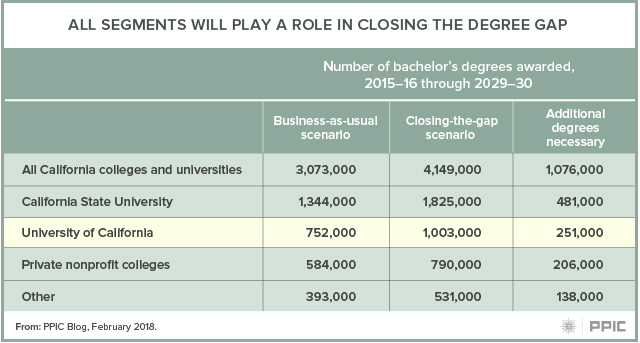
PPIC has quantified the role of each university segment—the University of California, the California State University, and private nonprofit colleges in California—in closing the workforce skills gap. Overall, the number of bachelor’s degrees would need to increase by about one-third over baseline projections. Almost half of the gains would need to occur at CSU, the nation’s largest public university system. UC and private nonprofit colleges would also play an important role.

Most immediate to today’s conversation about goal setting for the state’s public systems, PPIC has identified the combination of increases in freshman eligibility, transfer, and completion rates necessary to close the gap.

Our preferred approach—a closing-the-gap scenario—combines increases in eligibility, transfer, and graduation rates, as shown below. Along with increases in enrollment and completion at private institutions, reaching these targets would fully close the workforce skills gap.

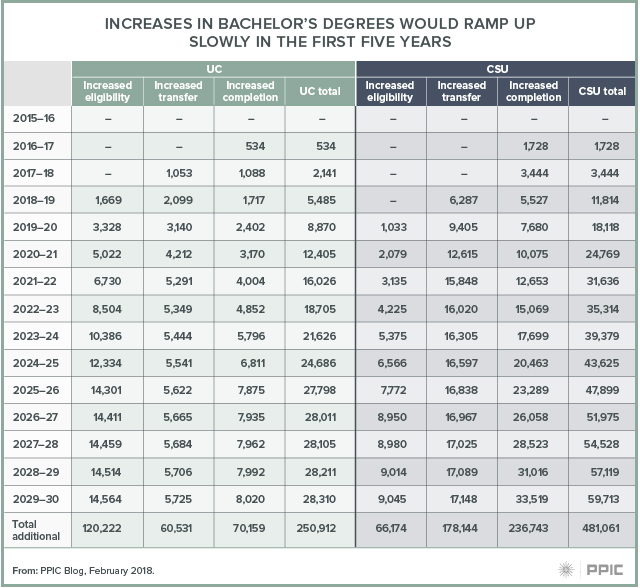
In our scenario, each target would be reached gradually through a phase-in period. In the first few years, projected increases would be minimal as the systems would enroll more students and implement policies to improve completion and transfer. But within five years, the increases would become quite large. By 2020–21, CSU would award almost 25,000 additional bachelor’s degrees; UC would award more than 12,000.

For the purposes of setting annual goals, we are identifying annual targets in new freshmen enrollment, transfer, and completion rates that would match the closing-the-skills gap degree targets. Enrollment and transfer targets depend on graduation rates and time to degree—meaning that enrollment increases could be lower if graduation rates improve and students complete their degrees more quickly. For example, students who take 12 units per semester will take five years of continuous enrollment to earn the 120 units necessary for graduation.  If those students instead took 15 units per semester, they would graduate in four years and free up additional space for other students.

It has been a couple years since PPIC first developed our projections, and we’ve now been able to chart early progress by the systems. Later you will hear in detail from the segments about their plans, but right now I am happy to report some good news: the number of bachelor’s degrees awarded at UC and CSU is actually higher than our initial scenario called for.

Of course, we are just at the start of our projection period, and to close the gap the numbers must ramp up quickly after the first few years. Nonetheless, growth in graduation rates and enrollment has led to a notable expansion in degrees awarded at both systems. Over the past two years, UC and CSU combined have awarded 295,000 bachelor’s degrees—21,000 more than in our closing-the-gap-scenario and 23,000 more than in our baseline scenario. In addition, the number of transfer students has increased 8%, also higher than in our closing-the-gap scenario.

In addition, community colleges and CSU have adopted new goals for student success that are entirely consistent with PPIC’s closing-the-gap scenario. CSU’s new graduation initiative calls for reducing time to degree and increasing both four-year and six-year graduation rates. CSU’s goal of a 70% six-year graduation rate by 2025 is in line with and in fact slightly more ambitious than our scenario. In their new “Vision for Success,” the community colleges have adopted a goal to increase transfer to UC and CSU by 35% over the next five years, a goal that is entirely consistent with our work.

There is an important additional benefit of meeting these goals: reducing equity gaps. Today, students who have been underrepresented in higher education—including Latino, African American, low-income, and first-generation students—make up a majority of California’s high school graduates. Strong increases in college preparation among the state’s high school graduates are expanding the pool of potential college graduates, with the share of students—including African American and Latino students—completing the college preparatory requirements of UC and CSU reaching an all-time high. Ensuring that the growing number of prepared high school graduates have meaningful access to and success in higher education will not only help California meet its economic challenges, it will ensure that higher education continues to serve as a ladder of economic and social mobility.

Our focus at PPIC has been on college graduates with at least a bachelor’s degree, but we acknowledge the importance of other postsecondary training. We have a series of reports and ongoing projects that identify successful vocational pathways and high value awards (certificates and associate degrees) offered by the state’s community colleges. Lande Ajose of California Competes will discuss in more detail the need for sub-baccalaureate post-secondary education. We also acknowledge the importance of post-baccalaureate education, including professional and academic graduate degrees offered primarily by UC and the state’s private nonprofit colleges. Those degree holders have the best labor market outcomes in the state.

Figuring out how to pay for all these increases is no easy task and will be discussed later in this hearing.  Let me alert you to two projects underway at PPIC that will help shed light on this issue. One will examine the role that tuition policy could play and the other will focus on capital finance. In addition, we will continue to monitor affordability issues, including student debt, identified by respondents to the PPIC Statewide Survey as the number one higher education issue.

Finally, it is worth noting that the governor has proposed a funding formula for the community colleges that for the first time will provide additional funding based on student outcomes and enrolling low-income students. PPIC has argued that this approach has the potential to incentivize investment by the state’s higher education systems in areas that further state priorities.


Funding Increase for Community Colleges

Nearly 70% of new funding for higher education—or $570 million—in Governor Brown’s proposed budget goes to the state’s community colleges. This continues a trend that has seen community colleges get an ever-growing portion of higher education funding even as overall funds for higher education have shrunk—from 18% of the General Fund 40 years ago to just under 12% now. This trend is likely to continue—mostly because Proposition 98, passed by the voters in 1988, sets minimum funding levels for the state’s K–12 and community college systems.

Blog figure: 2018-19 Budget, Community College FundingThese mandated minimum funding levels have protected community colleges from the kind of budget cuts that have affected California’s other public higher education institutions. In addition, Governor Brown has prioritized investments in the community college system, which serves 2.1 million students and is the gateway to higher education for the vast majority of California students.
Governor Brown and the legislature have vastly increased investment in community college programs intended to improve student outcomes and eliminate achievement gaps, including programs focused on adult education and career technical education. Moreover, last year the governor provided a one-time allocation of $150 million to develop the Guided Pathways program, aimed at integrating disparate student success programs into one model and creating clear pathways for students to earn a certificate or degree, or transfer to a four-year college.

The governor’s current budget proposal also contains a new funding formula for the community colleges. This formula would shift future funding to districts with higher proportions of low-income students and those that have achieved better student outcomes. Under this formula, each district would get 50% of its funding based on enrollment, 25% based on enrollment of low-income students—those who receive a tuition waiver or Pell grant—and 25% based on district performance. Performance would be measured by the number of degrees and certificates provided, the number of students who complete a degree or certificate in three years or less, and the number of Associate Degrees for Transfer granted.

California’s community colleges have long struggled with low completion rates, low transfer rates, and persistent achievement gaps. Additional funds and a new funding formula may help to address these issues and lead to greater student success—which, for most community college students, means transferring to a four-year institution. Today, more than half of CSU students are community college transfers, as are nearly one-third of UC students. If current investments in community colleges do in fact improve student outcomes, then California’s four-year institutions will need to be ready for even more transfers.


Improving Community College Course Catalogs

Before the start of a new semester, students at California’s community colleges must sift through hundreds of courses and decide which ones will help them make progress toward their college and career goals. However, course prerequisites and program requirements can be complicated, and staff and counseling centers aren’t always readily available to help students make informed decisions. Course catalogs are a widely available resource at all 114 California community colleges—and improving these catalogs could help students better navigate their way through college.

Course catalogs contain most, if not all, of the information students need to build their college and career pathways. These resources are about 300 pages long on average and list detailed information about the college itself and the courses taught in a given academic year. They generally include degree and program descriptions, assessment and placement procedures, course prerequisites, credits earned per course, and much more. But course catalogs are often not structured in a way that makes this crucial information accessible.

Using clear flowcharts and diagrams is one way to help students understand the sequence of courses they need to take to achieve their academic goals. For instance, there is evidence that many students don’t fulfill math requirements, earn a degree or certificate, or transfer to a four-year university due to lengthy and confusing math course sequences. While most colleges depict course sequences using flowcharts and diagrams (88 out of the 114 colleges), there are still students at 26 colleges who have to figure out the appropriate sequence for themselves. San Jose City College has a good example of a flowchart that illustrates the sequence of math courses students need to take depending on their academic discipline—with different possible sequences for STEM and non-STEM majors (see p. 40 of the course catalog). Even among colleges that do provide helpful illustrations, less than half (46 colleges) provide them in a central resource like a college catalog. This adds an extra step for students who need to know which math courses will count toward their degree.

In addition, students on a vocational track may want to collect or combine different types of certificates within the same program. But only five colleges attempt to illustrate the course requirements for related degrees and certificates, and even then, the information is only available for a small number of programs. Including a diagram helps organize and distill this complicated set of information. For example, LA Trade Tech College designed a flowchart for the renewable energy program that shows how students can advance through and collect different degrees and certificates within a single program (see p. 120 of the course catalog).

There is a growing awareness that students need comprehensive tools that will allow them to make informed course selections. As part of the Guided Pathways project—which aims to better align campuses’ program structures with those of four-year colleges and the needs of the labor market—20 California community colleges are using “program maps” that include clear course sequences and academic milestones to help streamline students’ decision-making process. Leveraging the course catalog to make key information more accessible is another way that colleges can help students more efficiently achieve their college and career goals.

Visit the PPIC Higher Education Center.

California’s Brain Gain

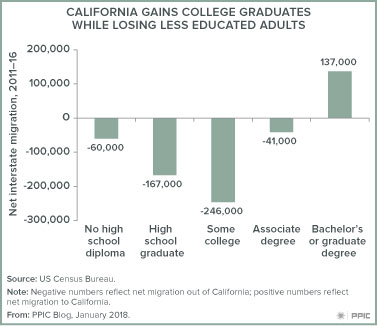
Recently released data from the US Census Bureau show that even as California continues to experience large net losses of residents moving out of state, the state is still a net importer of college graduates from other states. This interstate migration pattern—gaining large numbers of college graduates while losing large numbers of less educated adults—is unique among the states. Over the past five years, California has attracted 137,000 more college graduates (adults with at least a bachelor’s degree) from other states than it has sent to those states. For comparison purposes, the University of California (UC) awarded about 250,000 bachelor’s degrees at its nine undergraduate campuses over this same time period. In other words, interstate migration provides California with half as many college graduates as the entire UC system.

College graduates come to California from all over, but seven states send California substantially more college graduates than they get in return. Between 2011 and 2016, net gains of college graduates from New York (45,000), Illinois (32,000), New Jersey (20,000), Pennsylvania (17,000), Michigan (15,000), Florida (14,000), and Massachusetts (14,000) totaled more than 150,000. California experienced sizable net losses of college graduates to just four states: Texas (-26,000), Oregon (-20,000), Nevada (-14,000), and Arizona (-11,000).
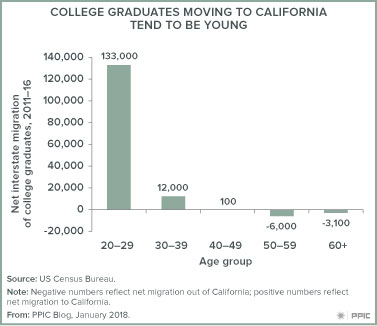
The new migrants to California tend to be quite young. Indeed, college graduates age 20–29 account for almost all of the net gains. (In contrast, California experiences small net losses of older college graduates.) From a labor market perspective, attracting young college graduates is especially advantageous. Young adults with college degrees are at the start of their careers and provide the state with much-needed highly educated workers. The largest gains are in majors that are in relatively high demand in the labor market, including engineering (22,000), social sciences (19,000; mostly economics and political science), computer science (17,000), communications (17,000), biology and health sciences (14,000), and business (13,000).

The migration of young college graduates to California is a consequence of the state’s growing demand for highly skilled and highly educated workers. But the numbers are not high enough to meet the state’s changing needs. PPIC’s research has shown that by 2030 California will face a shortfall of 1.1 million college graduates. Failing to keep up with the demand for skilled workers could curtail economic growth and limit economic mobility—resulting in a less productive economy, lower incomes, less tax revenue, and increased dependence on the social safety net. Although many college graduates move to California from other states, the most important source of highly educated workers in California are the state’s colleges and universities. Policies and practices to improve college access and completion in the state will ensure that more Californians are able to help create and benefit from a strong economy.

High Housing Costs Hurt College Affordability

A majority of Californians say affordability is a problem in the state’s public colleges and universities, according to the PPIC Statewide Survey. In addition, three-quarters of residents in the survey agree that the price of college prevents students who are qualified and motivated from going to college. Not surprisingly, state leaders are exploring new strategies to help students and families better cope with college costs. Most current approaches, such as state and institutional financial aid, focus primarily on tuition relief. This makes sense, as tuition more than doubled at California universities from 2006 to 2012—and is on the rise again.

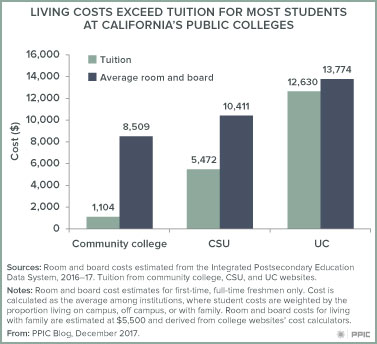
However, housing costs also play a significant role in the total cost of attending college. Californians are well aware of the issue: 85% of residents in the PPIC survey say colleges and universities should do more to make sure that all students have affordable housing options. Indeed, even with the rapid increases in tuition, living costs for many students exceed tuition at California’s public institutions—the state’s community colleges, California State University (CSU), and the University of California (UC). Average room and board costs also differ substantially across the three systems, from $8,509 per year at the community colleges to $13,774 at UC.

These differences in costs are related to whether students live on campus, off campus on their own, or off campus with family. Estimated average costs of housing and food for students living on campus top $13,000 per year, and those living off campus pay an average of $10,000 to $13,000 in room and board. The costs associated with living with family are not estimated in the available federal data, but most college websites suggest these costs range from $5,000 to $6,000—about half the cost of living on or off campus.

Students’ housing choices also partially depend on where they go to school. Only nine cities in California have UC campuses (excluding UCSF which only enrolls graduate students), and most UC freshmen live on campus in their first year. Historically, the 113 community colleges and 23 CSU campuses have been seen as local and low-cost options. Indeed, both systems show about 30% or more of freshmen living with their families, which helps keep average room and board costs lower than at UC. But it is worth noting that the share of CSU freshmen living on campus may grow. More dorms are being built on CSU campuses as administrators see on-campus housing as a strategy to increase graduation rates. Data on students’ living arrangements are based on institutional reporting on freshmen who receive some sort of federal financial aid, which includes more than 60% of students at most institutions.

As state leaders reexamine the goals in the 1960 Master Plan for Higher Education and consider changes to financial aid, they should take into account the role that living costs play in the total cost of education.

Learn moreRead the PPIC Statewide Survey: Californians and Higher Education
Visit the PPIC Higher Education Center