Drought Watch: What’s in Proposition 1?

This is part of a continuing series on the impact of the drought.

California voters are deciding the fate of Proposition 1—a $7.5 billion water bond. If Prop 1 passes, the water sector will get a big boost in funding. Prop 1 contains $7.12 billion in new debt (the remaining $400 million dollars is money that would be re-authorized from previously passed bonds).

So what kind of water projects will be funded if Prop. 1 passes? The bond focuses mainly on water supply ($3.6 billion) with the majority ($2.7 billion) designated as matching funds for storage projects. These matching funds are intended to support up to half the costs of projects that store water either in surface reservoirs or underground aquifers, and they can only be used to fund “public benefits.” Public benefits include, among other things, better flood protection and recreation opportunities, as well as improved environmental conditions. For instance, expanding surface reservoirs makes it possible to store more cold water, which can be released during warm months to support salmon habitat. Likewise, expanding ponds to recharge groundwater basins can create bird habitat.

The California Water Commission will determine which storage projects receive these funds through a competitive process. The rest of the water supply dollars are mainly for matching funds for water recycling and desalination projects ($725 million), with $100 million each for water conservation and groundwater sustainability planning.

Proposition 1 also has funds for the five areas PPIC has identified as critically underfunded “fiscal orphans” in our recent study of water system finance: ecosystems, drinking water quality, flood protection, stormwater pollution management, and integrated water resources management. Of the funds designated for water quality improvements, $520 million is intended for disadvantaged communities and $800 million is for cleaning up groundwater basins that have been contaminated with industrial and agricultural chemicals. Just over half a billion dollars is designed to encourage agencies to collaborate on water management priorities, with funds going to different regions for priority projects in Integrated Regional Water Management plans. These projects would overlap with the previously mentioned categories, and they would need to improve regional self-reliance and help adapt to the effects of climate change.

Since 2000, California voters have approved six water bonds, totaling nearly $20 billion dollars. These bonds looked a little different than Prop 1. Ecosystem improvement and flood protection were the main priorities, with smaller amounts for drinking water quality, integrated management, stormwater, and water supply projects (these bonds also had large amounts for parks and public access). While these bonds provided welcome support to these areas, they also came with fiscal tradeoffs: bonds are repaid with general fund tax dollars that also support other state programs.

The current drought is likely helping the bond’s chances of passage: according to the most recent PPIC Statewide Survey a record-high 68% of all adults say that the supply of water is a big problem in their part of the state. In this context, it is important to keep in mind that while continued investments in our water system will help us be better prepared for future droughts, this bond is not designed to provide immediate relief from the current one. Most water projects take time to design and build. And, whether or not Proposition 1 passes, the state’s water system will face significant challenges that require funding sources more reliable than a bond can provide.

Drought Watch: California as a Testing Ground

This is part of a continuing series on the impact of the drought.

An international consortium of water economists gathered at the World Bank headquarters in Washington, D.C. earlier this fall for two days of meetings on water policy research. The timing was opportune, as the World Bank – which provides financial and technical assistance to developing economies around the globe – recently reorganized to provide a new emphasis on water resources. The conference theme was the economics of water conservation and efficiency, with researchers looking at the role of technology, pricing, and institutions to effectively and efficiently manage water resources under conditions of increasing scarcity. In light of the national and international attention to California’s ongoing drought, I was asked to give keynote remarks about lessons from California for other regions of the world.

I highlighted four central ideas. (My presentation is 22 minutes into this video.) First, urban areas the world over can improve drought resilience by diversifying their water portfolios, rather than relying on a single source of water. Second, although conservation is important, policymakers should be mindful that improved irrigation efficiency is not a panacea to cope with drought, because much of the water “saved” is already being reused by others downstream.

Third, sustainable groundwater basin management—the approach now called for under California’s historic groundwater legislation—is an invaluable drought management tool because it means more groundwater will be available to help get through dry times. But getting there can imply costly trade-offs in basins that rely heavily on groundwater, requiring institutional and financial support to help water users make the transition.

And fourth, like California, many regions can benefit from repurposing their storage and conveyance infrastructure to better cope with droughts and the growing water scarcity expected with climate change. In particular, storing more water for dry years in groundwater basins, and using surface reservoirs for seasonal storage and flood protection, can be cost-effective ways to adapt to an increasingly variable climate.

PPIC’s Role in a Changing State

California is changing quickly and in ways that touch the lives of all of its residents. The state has enrolled millions of people in health insurance under the federal Affordable Care Act. It is moving ahead to expand the cap-and-trade program that is a cornerstone of AB 32, the landmark law mandating a reduction in greenhouse gas emissions.

In K–12 education, California is implementing two sweeping policy changes at the same time. New English and math standards, called the Common Core, require big changes in what is taught in the classroom. A new school funding formula, the Local Control Funding Formula, gives districts increased flexibility over spending and provides extra money for disadvantaged students.

Historic changes are playing out in the corrections system as well. Realignment, which shifted responsibilities for many offenders from the state to the local level, has had a significant impact on the state, counties, and communities.

Amid these policy shifts, California is coping with a major drought that has focused attention on the state’s need to improve its water management.

These changes are also taking place in an election year—and California’s elections have also undergone major changes. This is the first election in which state constitutional officers, such as governor and controller, will be elected under the top-two primary system.

At PPIC we are focused on monitoring and analyzing the impact of these changes—both short and long term—and examining other steps the state can take to meet its critical challenges. In recent months, we have delivered objective, nonpartisan research on all of these topics. We plan to release many more publications in the months ahead. Our PPIC Statewide Survey will continue to give California residents a voice in the policy changes that affect them, as it has since 1998. The PPIC blog provides regular updates on the impact of the drought, as well as news and analysis on a range of policy topics from our experts.

Through our extensive outreach, we have hosted discussions on these important topics and more. We invited California’s two top legislative leaders to share their priorities for the upcoming session. At another recent event, the two secretary of state candidates talked about how they would improve elections and increase voter participation, if elected. Both of these events were webcast live to engage Californians from all over the state.

We encourage you to sign up for our announcements to learn about future events. We hope you’ll stay up to date with our publications and videos by signing up for our monthly e-bulletin, following us on social media, and subscribing to the PPIC blog.

As always, we welcome your comments and suggestions.

Drought Watch: Video Seminars

This is part of a continuing series on the impact of the drought.

A series of videos available online is a great resource for water wonks and newcomers alike. Researchers and cooperative extension specialists from the University of California’s Division of Agriculture and Natural Resources, with support from the California Department of Water Resources, have put together these video seminars on drought-related water management issues. You can bone up on topics ranging from drought impacts on wildlife and groundwater basins, to the latest research on California’s climate in centuries past (and the mega-drought we experienced in medieval times), to tips for managing crops and rangeland when water is in short supply.

I contributed to the series with an overview of how water marketing and groundwater banking can help mitigate the worst economic impacts of droughts, drawing on PPIC’s ongoing research on this issue. The series is being updated regularly with new videos.

California’s New Leaders Focus on Poverty

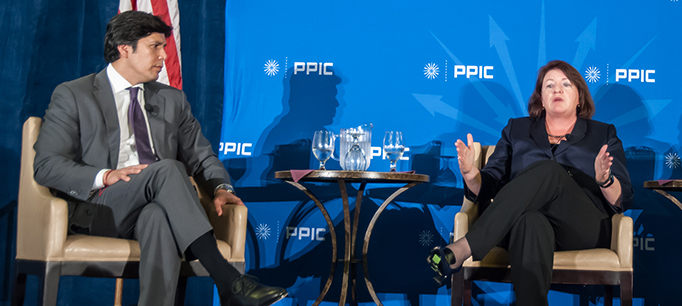
Assembly Speaker Toni Atkins and Senator Kevin de León, who will take over as senate president pro tem later this month, each told a Sacramento audience about growing up in poverty and the role it has played in their shared view of the state’s responsibility to those in need.

“We share similar values and similar stories that have made us care about the values and the issues that we’re talking about today,” said Atkins, who was raised in a poor, rural Virginia family and now represents the San Diego area. De León, who was born in San Diego and represents Los Angeles, said he is the youngest child of a single immigrant mother and the only family member to graduate from high school. Atkins and de León, both Democrats, were elected by their respective legislative chambers earlier this year to serve as leaders.

Both lawmakers cited a recent PPIC report — Child Poverty and the Social Safety Net in California by Caroline Danielson and Sarah Bohn — that said about 50% of California children live in poverty or near-poverty. The remarks, part of the PPIC 2014 Speaker Series, were made to a capacity audience of about 400 in the ballroom of the Sheraton Grand Hotel. The discussion was moderated by PPIC President Mark Baldassare and streamed live to hundreds more.

The wide-ranging conversation touched on a number of major issues—including health care, the drought, immigration, and taxes. Both leaders said that they believe the state should talk about changes to the state tax structure and consider whether to extend the temporary taxes that voters passed in Proposition 30. Atkins cautioned that it will be difficult to gain support from voters for an extension of the taxes.

De León expressed strong support for affirmative action, which he credited for his ability to attend college and become a legislator. He also said California should continue to lead on immigration issues because the federal government has been unable to pass a reform plan. And he noted that polls suggest Californians support health coverage for undocumented residents.

Atkins, meanwhile, encouraged more cities to follow San Francisco and San Jose, which recently increased the minimum wage. Both leaders also said they have worked together in the past and believe they will have a good working relationship going forward.

Majorities Favor State Government Downsizing

The recent PPIC Statewide Survey offers an early snapshot of voters’ choices as we enter the November election cycle. The majority support for Governor Jerry Brown’s reelection and the Proposition 1 state water bond was widely cited in the media last week. But the poll also reveals surprising news about the voters’ overall mood this year: by a wide margin, likely voters would rather pay lower taxes and have a state government that provides fewer services (53%) than pay higher taxes and have a state government that provides more services (41%).

What is so special about this finding? We have been observing a slow but steady rise in the preference for lower taxes and fewer services since November 2012—when voters approved the Proposition 30 tax increase. In the 24 times since we first asked this question in our February 2003 poll, the preference for lower taxes and fewer services has usually been below 50 percent. Moreover, this preference has never exceeded 55 percent, placing the current reading close to the historic high.

This finding seems to run counter to the strong support we found for the Democratic governor and the multi-billion dollar state water bond on the November ballot. It is also seems at odds with another Golden State mega-trend: the steady decline in the number of Republican voters. The secretary of state recently reported that Republicans now account for just 28 percent of the electorate.

While a preference for smaller government has long been expressed by Republicans, the 53 percent of California likely voters who want lower taxes and fewer services are a politically mixed group. Forty- eight percent are registered Republicans and 55 percent are self-described conservatives—which means that many who hold this view are Democratic and independent voters, and see themselves as political moderates. They are predominantly homeowners (81%), and most are white (66%). But only a slight majority are age 55 and older (54%), and less than half are college graduates (41%) or have annual household incomes above $80,000 (44%). So, this likely voter group has a diverse demographic profile.

What do they have in common? Seven in 10 say the state is headed in the wrong direction. Three in four say that the state budget situation—that is, the balance between government spending and revenues—is a big problem for the people of California. Eight in 10 say that major changes are needed in the state budget process in terms of both revenues and spending. In sum, they are the core audience for fiscal restraint and reform.

Governor Brown’s emphasis on fiscal prudence, including the downsizing of the state water bond, seems to have struck a chord here. Among those who prefer a smaller role for state government, one in three are supporting Jerry Brown in the governor’s race. This trend helps to explain the Democratic candidate’s sizable 21-point lead over Republican challenger Neel Kashkari. This group is also leaning toward support for the Proposition 1 state water bond (46% yes, 37% no), helping this multi-billion dollar spending measure to now have a commanding two-to-one lead.

This likely voter group may be a major hurdle for a Democratic Party seeking to regain a supermajority in the state legislature. Seven in 10 of these likely voters say they disapprove of the way that the state legislature is handling its job. Six in 10 say it would be a “bad thing” for the Democrats to gain a two-thirds majority in the legislature in the November election. Only 18 percent say that this would be a “good thing.”

Our poll’s findings on the preferred role of state government suggest that the election is unlikely to result in a mandate for expanding services and raising taxes—they also point to an opening next year to discuss fiscal reforms that the state needs for the 21st century economy.

Briefing Focuses on Survey Election Findings

Less than two months before the election, PPIC’s latest survey looked at Californians’ views on the governor’s race and four statewide ballot measures. Dean Bonner, associate survey director, presented the findings at a briefing in Sacramento on Wednesday. As most of the media coverage noted, the survey found that Governor Brown is doing well in his reelection bid and that the water bond he approved is fairly popular.

The survey found that Proposition 2, labeled the Budget Stabilization Act in the ballot statement but known elsewhere as the rainy day fund, does not currently have majority support among likely voters. Proposition 45, which would regulate health insurance premiums, has a similar level of support, but Proposition 47, which would reduce sentences for some crimes, is favored by 62 percent of likely voters. The survey also found high levels of concern about the drought and mixed feelings about the Affordable Care Act and immigration policy priorities.

Drought Watch: Crises as Catalyst for Policy Change

This is part of a continuing series on the impact of the drought.

Today Governor Brown signed three bills that require portions of the state to start managing groundwater sustainably. These bills are historic. Until today, California was the only western state that did not regulate groundwater, typically the source of more than one-third of the state’s supply, and much more during dry years.

Why, after a century of failing to address much-needed reform, has the state finally acted on this problem? It’s the drought.

The problem of groundwater overuse is nothing new in California. Calls for reform began as far back as the early 1900s, when severe excess pumping in many groundwater basins began to cause problems. Chronic overdraft—taking more out of the ground than nature puts back in—has left many basins severely depleted.

When the current drought arrived and communities and farms turned to groundwater to make up for shortages in surface water supply, a century of neglect—the hydrologic equivalent of deficit spending—caught up with California. The groundwater that, managed well, should have been cheap and plentiful, became expensive and scarce, leading to an economic and social crisis. The well-publicized effects of unsustainable pumping include sinking ground, dry wells, crumbling canals and roads, intense competition to drill deeper (and more costly) wells, the fallowing of more than 410,000 acres of farmland, and losses of more than $2 billion in farm revenues and more than 17,000 farm-related jobs. These factors combined to create pressure to tackle what had been, up to now, off limits to reform.

In our 2011 book, Managing California’s Water: From Conflict to Reconciliation, we note that significant advances in state water policy are often tied to droughts and floods, along with the inevitable lawsuits that follow. Extreme events like the current drought reveal fundamental weaknesses in California’s water management policies and practices. Perhaps more importantly, they create pressure on government to respond.

This is the silver lining of water crises in California: they are often the way we get things done. (The comprehensive reform of flood management enacted in 2007 was spurred on by the graphic images of Hurricane Katrina two years earlier, for example.) Indeed, one strategy for advancing water management reform is to plan and prepare for the inevitable, and then take advantage of a crisis to push ahead on needed reforms.

This year’s groundwater package is indeed historic, but California still has a long way to go in improving the way it manages water. With our changing climate, we should expect more frequent droughts and floods (and lawsuits)—so there will be no shortage of opportunities to tackle other problems in the future.

Drought Watch: Rethinking Urban Water Pricing

This is part of a continuing series on the impact of the drought.

The California Water Resources Control Board adopted a statewide policy last month requiring local agencies to implement drought plans, including restrictions on outdoor water use. Local agencies have responded in a variety of ways. Some have imposed mandatory cutbacks while others are still only asking their customers to make voluntary cutbacks. Mandatory water use restrictions can be more effective and, according to the July PPIC Statewide Survey, 75 percent of Californians say they strongly favor them. So why aren’t more water agencies enacting mandatory cutbacks during this crisis?

Last month, Jay Lund—a professor of civil and environmental engineering at UC Davis and an adjunct research fellow at PPIC— outlined some of the factors that might cause local agencies to shy away from mandatory restrictions. One important factor is that when conservation measures work, agencies sell less water and their revenues fall. But the costs of providing water services do not decrease as much, so agency balance sheets can end up in the red. As a result, investments in system maintenance and upgrade generally take a hit, and agencies often have to increase rates. This sends a confusing signal to customers, who just did what was asked of them.

There is an alternative: drought pricing. Charging more per gallon during drought years provides an additional conservation incentive and ensures that agencies can cover costs while they are selling less water. According to a June survey by the State Water Resources Control Board, only 4 percent of urban agencies have enacted drought pricing strategies. The city of Roseville is one community using the drought pricing tool, which was adopted—and vetted with customers—before the drought hit. In June, Roseville implemented a temporary 15 percent drought surcharge while also mandating a 20 percent reduction in water use.

Like most things that alter the status quo, drought pricing policies require effective communication with ratepayers. Agencies need to emphasize the need for higher prices alongside increased conservation during droughts to ensure customer buy-in. But a big advantage of a drought pricing policy is that customers understand in advance that prices need to go up to keep their water system solvent, rather than feeling blindsided by a rate increase after the fact. While they require additional effort—and advance planning—by local agencies, drought pricing policies result in better financials and customer relations while contributing to the primary goal of reducing water use during times of scarcity.

Drought Watch: Trends in Urban Water Use

This is part of a continuing series on the impact of the drought.

Most of California is now in an exceptional drought, but water use statewide has actually increased over the last year. In response, the state has imposed short-term restrictions intended to help us get through the current drought. As state and local water agencies look beyond the current emergency for ways to adapt to a future in which droughts are likely to be more frequent and more severe, it is instructive to examine and compare urban use in two relatively normal water years, 2000 and 2010.

First, the good news: Total statewide urban water use (for residential, commercial, and industrial purposes) decreased by 12 percent from 2000 to 2010, even as California’s population increased by more than three million. Reductions have been especially significant in central and southern California, where investments in conservation programs and new technologies seem to be paying off. In the commercial and industrial sectors, water use fell 36 percent and 18 percent, respectively, while residential interior water use declined by 20 percent overall and 27 percent per capita. The Great Recession probably played a role in these reductions, so it will be interesting to see if this trend holds as the economy continues its recovery.

Now for the bad news: Outdoor water use for both residential exteriors and large (commercial or public) landscapes rose 12 percent across the state between 2000 and 2010. This trend was largely driven by increases in southern California—in marked contrast to the region’s reductions in indoor water use. And it is likely to persist as California’s population continues to grow, especially in hot and arid inland areas with a higher proportion of single-family homes (which use twice as much water outdoors per household as multi-family buildings) and large lots.

One important takeaway is that more stringent building codes, increasing efficiency requirements, and new technologies seem to have resulted in more efficient indoor water use. But when it comes to landscaping, any improvements in irrigation technology seem to have been offset by our taste for large lawns and plants that need a lot of water (and our habit of overwatering them). To encourage long-term reductions in outdoor water use, agencies can implement new pricing structures, turf buy-back programs, and public education programs emphasizing drought-friendly landscaping. After our current water emergency ends, these long-term incentives and outreach efforts can help us be better prepared for future droughts.

(The map below shows the change in per capita outdoor urban water use between 2000 and 2010 in each hydrologic region. To see details of the state’s hydrologic regions, including county boundaries, visit our Map Room.)

Chart source: California Department of Water Resources.