Early Insights on California’s Economic Downturn

California’s unemployment rate jumped from a historically low 3.9% to 5.3% in March. For comparison, it took a full year from the official start of the Great Recession for unemployment to increase by 1.4 percentage points (although the levels were higher: 5.9% in December 2007 to 7.3% in December 2008). Notably, the March rate is based on data from the middle of the month, so it does not fully reflect the massive layoffs that occurred as the COVID-19 pandemic took hold.

Between March 15 and April 18, 3.4 million Californians applied for unemployment insurance. There has been much forecasting (including by us) about the sectors and workers that will feel the immediate effects of the downturn. We do not have demographic breakdowns and we don’t know which industries employed these workers. But recently released labor market data can provide some new insights.

By mid-March, California had recorded a net loss of 100,000 jobs, comprising about one-seventh the decline nationwide and reflecting the state’s early response to COVID-19 crisis. That’s less than 1% of the state’s 17 million jobs. The lion’s share of job loss (more than 80%) occurred in three service sectors: arts, entertainment, and recreation; accommodation and food; and “other services” (a category that includes automotive repair, personal care, and dry cleaning).

A comparison with the Great Recession highlights the severity of the current situation. Between February and March this year, employment in arts, entertainment and recreation fell 6.4%. Over the first year of the Great Recession, employment in this sector fell 1.6%. The number of jobs lost in the accommodation and food service sector was much higher between February and March, but these losses represented only 2.7% of the workforce in this much-larger sector.

A look at job losses in the industries that were hit hardest during the Great Recession shows that jobs are being lost much more quickly during the COVID-19 crisis. In the first month, construction—the recession’s most severely affected industry—saw a 2.2% decline, and no other sector experienced losses greater than 2%.
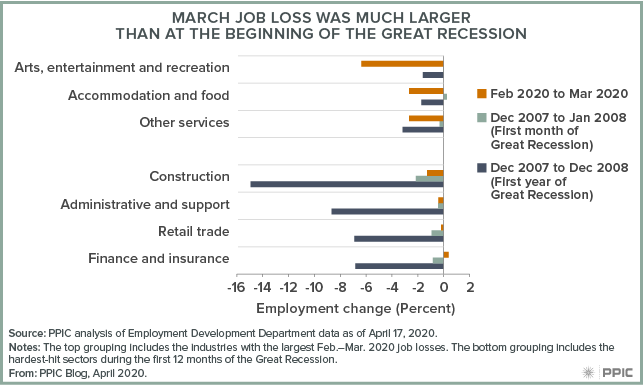
figure - March Jobs Loss Was Much Larger Than at the Beginning of the Great Recession

These initial data clearly show that the current crisis is hitting a different set of sectors than the Great Recession. It also shows that workers in the initially affected industries are more likely to be women (52% versus 45%), Latinos (25% versus 22%), and young adults (23% versus 10%) compared to workers in other sectors—and to workers in the hardest-hit industries during the first year of the Great Recession.
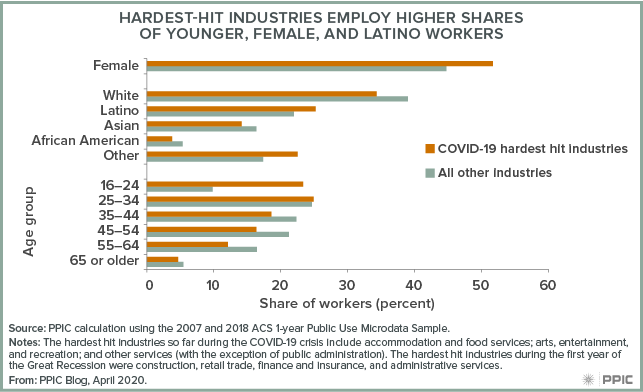
figure - Hardest-Hit Industries Employ Higher Shares of Younger, Female, and Latino Workers

As the current crisis continues to unfold, a more complete picture of the workers and industries affected will emerge. The staggering number of recent unemployment claims indicates that the losses in the March data are only the tip of the iceberg. April data will no doubt show deeper declines and a widening impact across sectors.

Unemployment insurance will provide an important economic backstop for many workers over the next several months. However, it will be important to monitor the workers and industries being affected by this crisis, both to ensure that policy efforts are directed where they are most needed and to inform additional measures to mitigate the economic damage.

California’s Quick Response to COVID-19 Likely Saved Lives

As of April 21, nearly 5,000 Californians are hospitalized and more than 1,300 have died due to COVID-19, but proactive public health measures may have safeguarded many others. Because the coronavirus spreads exponentially, days matter. And early actions before the statewide shelter-in-place order may have proved especially effective in reducing transmission.

The Bay Area had some of the state’s earliest cases of coronavirus, which spurred a rapid response. Santa Clara was the first county to declare a public health emergency, and large companies in the region asked employees to work from home as early as the first week of March.

Seven Bay Area counties—including Alameda, Contra Costa, Marin, San Francisco, San Mateo, Santa Clara, and Santa Cruz—implemented shelter-in-place orders beginning on March 17. Los Angeles County instituted a comparable order mere days later, but the virus was already spreading rapidly.

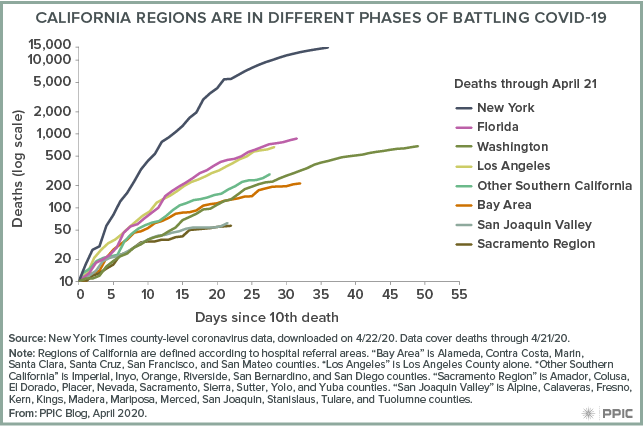
As of now, regions are in different phases of flattening the COVID-19 death curve. In Los Angeles County, the last week of data suggest the number of deaths doubles about every 8 days. That is a faster rate than Florida (12 days), but still far slower than New York in its deadliest week—when deaths doubled almost every day.

Other parts of Southern California also saw a spike, with deaths doubling every 8 days. Meanwhile, at 12 days, deaths in the Bay Area are doubling more slowly, as they are in the Sacramento region at 15 days. Both the San Joaquin Valley and other parts of the state have essentially plateaued at 19 and 32 days.

figure - California Regions Are in Different Phases of Battling COVID-19

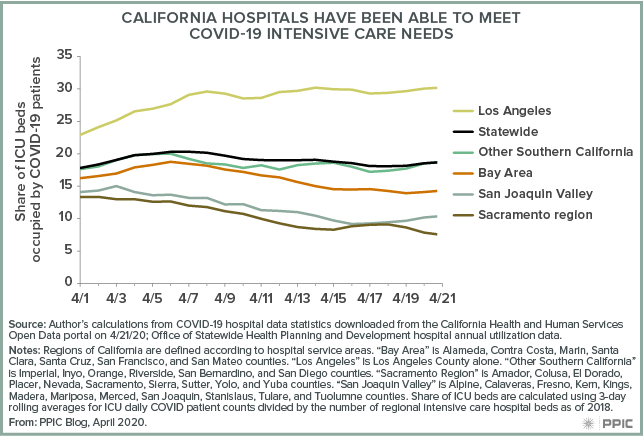
Local policies have also curbed demand for COVID-19 hospital care. Statewide, hospitalizations and ICU beds filled due to COVID-19 have been trending downward for two weeks, but have ticked up slightly the last few days. Certain counties—notably Los Angeles—have continued to see an upward trend in COVID-19 patients in intensive care, although it does seem to be plateauing.

In Los Angeles in recent weeks COVID-19 patients occupied about 30% of total ICU beds, compared to less than 15% in the Bay Area. The San Joaquin Valley and Sacramento regions also seem to be faring well, with about 10% of ICU beds filled due to the coronavirus. Regional estimates of ICU occupancy rates (as of 2018) suggest hospitals can manage current levels of COVID-19 patients while meeting other intensive care needs.

figure - California Hospitals Have Been Able To Meet COVID-19 Intensive Care Needs

Governor Newsom listed clear criteria for reopening the state’s economy in the midst of the global pandemic. All of California will meet certain benchmarks, such as data tracking and scientific advances in testing and treatment, on a single timeline. Others, such as plans for conducting business while social distancing and protecting vulnerable residents, will likely differ by region.

The state acknowledges that communities may reopen at different times based on circumstances. Recent experiences suggest that responsive local policies could help the state reopen while suppressing COVID-19 hospitalizations and deaths.

Will Mail-in Ballots Benefit One Party?

If coronavirus is still active during this November’s presidential election, the risk remains of spreading the virus among voters and poll workers. The best solution is to limit in-person options and rapidly expand the number of voters who submit ballots through the mail.

This is the right choice for public health. But a debate around the degree of change needed is reasonable: how many mail-in ballots and how many polling places are needed to both keep people safe and allow fair access? And lurking in the background are darker questions: does one party stand to benefit as vote by mail expands? Is this a partisan game masquerading as a question of public health?

The short answer to both questions is no. On the surface, there might seem to be a partisan angle. Many Democrats have pushed for expanding vote by mail, while President Trump has firmly stated it would hurt Republican candidates. States friendly to voting by mail tend to vote more Democratic, while some Republican-leaning states like Texas have resisted more voting by mail even in the pandemic. And Californians who vote by mail are older and more likely to be white, demographics that also vote more Republican on average.

But these scenarios describe the status quo; they don’t tell us how election results might change if vote by mail became more widely available. When election jurisdictions—including some California counties—have rapidly expanded vote by mail, neither major party has clearly benefited. Likewise, early evidence from experiments with heavy vote by mail in California suggests an increase in turnout among Latinos, Asian Americans, and young people of up to seven percent, though often with a fair amount of statistical uncertainty.

The same analysis suggests overall turnout increased about two to three percent, making it difficult to say that the composition of the electorate changed much in the end. Thus, while the greater convenience of vote by mail does seem to draw in a few more voters, these voters aren’t that different on average from the ones who show up already.

The demographic differences between in-person and by-mail voters are real, but should not be overstated. People from all backgrounds and political persuasions vote in person. All of them will be at risk in an election where coronavirus is still active. Expanding vote by mail is now a pure question of public health and administrative capacity. Neither party should worry that it will put them at a disadvantage.

The Coronavirus Pandemic Will Test the State’s Budget Reserves

As it grapples with the COVID-19 pandemic, California faces an uncertain fiscal future. This global crisis has caused a sharp decline in economic activity, exposing crucial sectors to heightened risk. As discussions continue about when and how to re-open the economy, it is clear that the state will have to respond to significant fiscal challenges.

The good news is that California has made important changes to its reserve policies since the Great Recession. The passage of Proposition 2 (2014) created the Budget Stabilization Account—the state’s rainy day fund—as well as the Public School System Stabilization Account, a separate reserve for K–12 districts and community colleges. In addition, Governor Brown and the legislature created the Safety Net Reserve Fund to shore up Medi-Cal and CalWORKs funding during downturns.

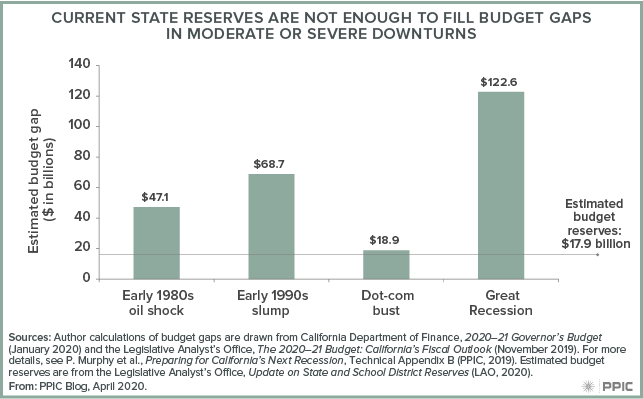
The bad news is that a severe recession is likely to pose significant budgetary challenges. Drawing from the state’s experience during several recent recessions, PPIC estimated the budget ramifications of mild, moderate, and severe recessions and the capacity of state reserves to fill gaps. We found that the state’s reserve balance—estimated to be $17.9 billion—is large enough to withstand a mild recession such as the dot-com bust in the early 2000s.

However, a long and/or severe recession like the early 1980s oil shock (which lasted four years), or the early 1990s slump and the Great Recession—both of which were much more severe and lasted five years—would create large budget gaps and require policymakers to make difficult decisions. (It is important to note that the estimated reserve balance relies on the 2019–20 enacted budget and that it will change when revenue estimates are updated in May.)

figure - Current State Reserves Are Not Enough To Fill Budget Gaps in Moderate or Severe Downturns

In the meantime, the federal government has stepped in. The Families First Coronavirus Response Act includes an increase in the federal share of Medicaid payments and reimbursements to states that are expanding public assistance programs. The Coronavirus Aid, Relief, and Economic Security (CARES) Act provides about $2.2 trillion; some aid goes directly to families, some goes to schools, and some to state and local governments. Additionally, two federal disaster declarations make many of California’s COVID-19 expenditures eligible for at least partial reimbursement.

Governor Newsom has requested additional federal assistance, including flexible aid to state and local governments, a further extension of unemployment insurance benefits, and expanded support for safety net programs, small businesses, K–12 and higher education systems, childcare, and broadband.

The state is also making significant changes to the 2020 budget process. The Department of Finance is drafting a “workload” budget for the May Revision that will set the baseline for the final budget to be enacted in June. This will limit spending increases while allowing for growth in programs—particularly safety net programs—that expect increased demand. The legislature will revisit the budget for an “August Revision” that reflects changes in the state’s financial condition. As these processes move forward, PPIC will continue to monitor California’s evolving fiscal challenges and steps being taken to address them.

Race, Health, and the Risk of COVID-19 Complications

For adults younger than 65, many underlying health conditions are emerging as risk factors that can lead to severe complications of COVID-19. Within this larger population, certain minority groups are under particular threat due to disproportionate rates of such conditions. While California’s overall share of nonelderly adults at risk is relatively low, disparities in health endanger some more than others during this health crisis.

Governor Newsom cited protecting individuals most at risk of COVID-19 complications as a necessary criterion for restarting California’s economy. Though we cannot yet draw conclusions from incomplete data—about one-third of cases and over a tenth of deaths do not have complete data on race and ethnicity—certain risk factors are more prevalent along racial and ethnic lines.

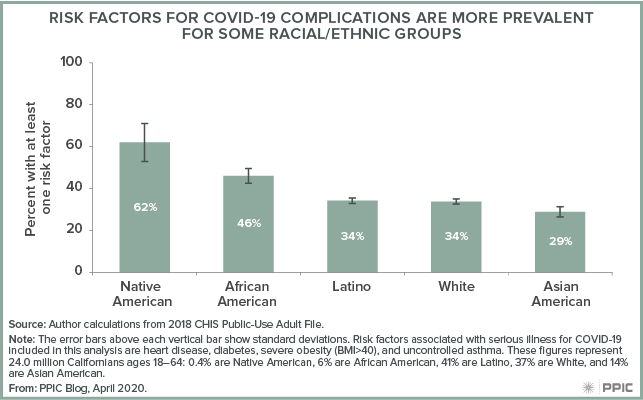
According to the Center for Disease Control, potential risk factors include heart disease, diabetes, severe obesity (BMI greater than 40), and uncontrolled asthma; smoking is also likely to increase risk. In California, over 60% of Native Americans and about 46% of African Americans have at least one of those health concerns. By comparison, roughly one-third of whites, Latinos, and Asian Americans have one or more of these health issues.

Native Americans are diagnosed with heart disease at rates almost four times that of whites (19% to 5%), have higher rates of smoking (51% to 14%), and double the uncontrolled asthma (12% to 6%). African Americans have much higher rates of diabetes (24% to 14%) and severe obesity (12% to 4%) than whites. Asian Americans and Latinos also have higher rates of diabetes (about 19%) compared to whites (14%).

figure - Risk Factors for COVID-19 Complications Are More Prevalent for Some Racial/Ethnic Groups

Due to higher poverty and uninsured rates, minority groups also face more difficulty accessing health care. At the same time, individuals in these populations may frequently hold jobs with a higher risk of exposure to coronavirus.

The California Department of Public Health has begun to publish data on cases and deaths by race/ethnicity. Some counties, such as San Francisco, are doing the same at the local level. While limited testing capacity and incomplete data prevent a true understanding of who is most impacted by the coronavirus, better knowledge of existing health disparities can help California protect and heal its most at-risk members as the state plans its next steps in responding to the public health crisis.

California’s Most Isolated Seniors

Seniors are especially vulnerable during the COVID-19 pandemic. First and foremost, of course, are health concerns. The latest data from the Centers for Disease Control and Prevention show that seniors are twenty times more likely to die of COVID-19 than are people younger than 65 (21 deaths per 100,000 compared to 1 death per 100,000 as of April 15). But seniors also face other significant challenges during this time of shelter-in-place, including social isolation. California’s efforts to support seniors through the pandemic can help counter these challenges.

Studies suggest that social isolation can lead to increased risk of mental and physical health conditions, including depression, cognitive decline, and elevated blood pressure.  Most immediately, isolated seniors might have an especially difficult time taking care of daily living tasks as they shelter at home.

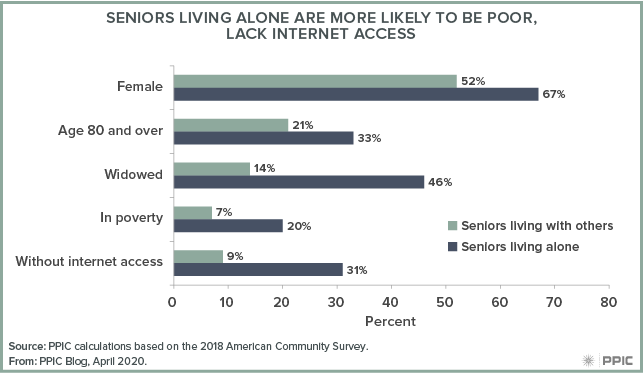
In California, 1.3 million seniors live alone (23% of 5.5 million seniors). They are disproportionately older, female, and widowed. Many have self-care limitations and a relatively large share live in poverty. Regionally, most live in the state’s large metropolitan areas, but many small rural areas of the state have very high shares of seniors living alone.

figure - Seniors Living Alone Are More Likely To Be Poor, Lack Internet Access

Of particular concern are those who do not have internet access. Among seniors who live alone, that’s 400,000 people. Another 40,000 have internet access but no smartphone, laptop, or tablet. They are perhaps the most socially isolated and vulnerable population in the state.

For these seniors, keeping up to date on the pandemic, ordering groceries and medicine from home, and connecting with others are all much more difficult. With libraries physically closed, a common access point to online services for many seniors is now unavailable, compounding the difficulty of overcoming social isolation.

Governor Newsom’s “Stay Home. Save Lives. Check In” campaign “urges all Californians to check in on vulnerable neighbors with a call, text or physically-distanced door knock” and is working with groups like AARP to reach out to older Californians. With many Californians now working from home, the time and opportunity to safely engage with older neighbors have never been greater—or the need more acute.

High School Graduation during the COVID-19 Crisis

With schools closed for in-person instruction in California through the end of the school year, the state has asked districts to implement distance learning. As a result, many students—particularly high school juniors and seniors—are concerned about falling behind or failing to graduate.

Nearly half of students from low-income families do not have broadband access at home. Given this reality, along with the uneven distribution of learning opportunities within and outside of schools across the state, it will be important to address the equity implications of the shift to distance learning during the coronavirus pandemic.

In response to school closures, the California Department of Education is allowing districts to request waivers that exempt individual students from the state’s minimum graduation requirements, which include three years of English, two years of math and two years of science.

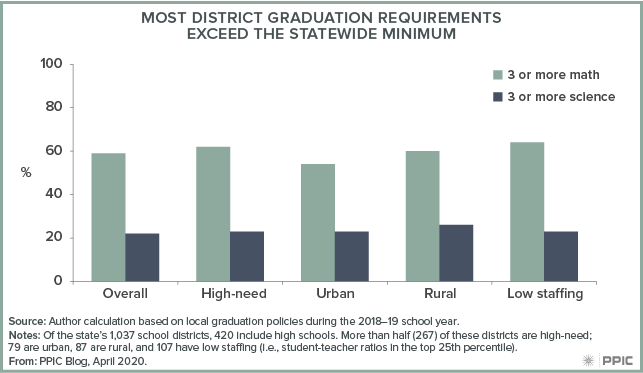
In addition, many districts have graduation requirements that exceed the state minimum. In the 2018–19 school year, 59% of districts required a third year of math, and 22% required a third year of science.

These requirements are prevalent across all types of districts—including high-need districts, in which more than 55% of students are low-income, English Learners, homeless, or foster youth; rural districts; and districts with high student-teacher ratios.

figure - Most District Graduation Requirements Exceed the Statewide Minimum

Moreover, students in six large districts—including Los Angeles Unified, San Diego Unified, San Jose Unified, and San Francisco Unified—must complete the entire A–G sequence required for admission to University of California (UC) or California State University (CSU) schools in order to graduate.

Districts with graduation requirements that exceed the state minimum will need to work with school boards to modify local policies. UC and CSU have already responded to school closures by temporarily suspending letter grade requirements for A–G courses completed in winter, spring, and summer 2020.

However, it will be challenging to help students stay on the A–G pathway. The waiver and temporary suspension of GPA requirements do not necessarily make it easier for students to take more A-G courses. PPIC research has shown that most students exit this pathway in the last two years of high school, and groups that are historically underrepresented in higher education are more likely to drop off at every stage. As districts develop distance learning plans and ways to provide flexibility to high school students, considerations of equity and access should be front and center.

How Will COVID-19 Affect Arrests in California?

The arrest rate in California is at its lowest level in decades, and as the COVID-19 crisis sends regions into economic and social disruption, further changes may emerge. Local law enforcement agencies are already adopting new arrest strategies to ensure public safety, to protect officers as well as to minimize jail crowding.

With some police departments starting to issue warnings or citations rather than make arrests, the number of misdemeanor arrests may fall. Departments are also delaying planned arrests unless doing so increases any risk to public safety, issuing summonses in the field rather than bringing detainees into a station for booking, and directing officers to take police reports online or over the phone instead of in person.

Measured as the incidence of arrests made per 100,000 in the population, the arrest rate in California had reached a peak of over 8,000 in 1989, and has since fallen fairly steadily, to under 3,500 in 2016. That 58% decline applies to rates of arrests made for felonies as well as for misdemeanors. This number reflects, in part, a parallel drop in crime rates, which are also at historic lows.

But it also reflects changes in legislation–in particular, the 2014 implementation of Proposition 47, which reclassified many lower-level property and drug offenses from felonies to misdemeanors, and the corresponding changes in law enforcement agencies’ priorities regarding the mix of offenses likely to be prosecuted.

Recommendations around arrests during the COVID-19 pandemic apply only to nonviolent misdemeanors and other lesser infractions. For instance, departments are advising officers to issue a ticket or citation for such crimes as vandalism, or low-level theft, rather than apprehend the perpetrator. Therefore, large-scale adoption of these recommendations would lead, all things being equal, to a larger share of arrests made for felonies, even if felony arrests themselves remained unchanged.

The share of arrests for felony offenses had been increasing gradually for decades, but fell dramatically after Proposition 47 was implemented. Felony offenses typically involve situations requiring immediate response, and officers have less discretion in deciding whether to make an arrest or take some other action. For example, an officer stopping a person for drug possession could issue a citation rather than make an arrest, but an officer responding to an aggravated assault is often obligated to take a suspect in for booking.

In these unprecedented times, however, all things are not likely to remain equal, and as the COVID-19 crisis evolves, changing social and economic circumstances will affect individual behavior, community responses, and law enforcement reactions.

Preliminary reports from four major California cities suggest that incidences of crime—property as well as violent—have dropped considerably since shelter-in-place orders went into effect. However, there is early evidence of an uptick in domestic violence. Monitoring the new approaches law enforcement is taking, and the outcomes of these interactions, will be key to determining which approaches are best suited to maintaining public health and safety.

Emergency Child Care for Essential Workers

Of the state’s estimated 5.1 million essential workers, about 1.9 million have children younger than 13. These parents may be having difficulty finding care for their children amid the COVID-19 crisis, with most schools closed and many child care providers shuttered.

To address this need, the California Department of Education issued guidelines last Thursday for temporarily restructuring state-provided child care services. Parents who are essential workers can apply for services during the pandemic even as the state continues to prioritize certain at-risk children regardless of parents’ occupations.

Child care programs that receive state funds are now encouraged to remain open—or to reopen—if they can safely do so in order to care for the children of essential workers. To be eligible, all parents in the household must be essential workers and require child care so they can continue working (for example, they do not have the option to work remotely).

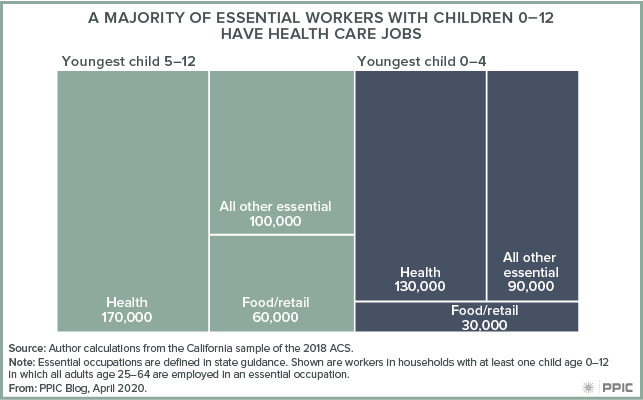
More than half a million essential workers with about 640,000 children younger than 13 could qualify. About 43% of these essential workers have a youngest child between 0 and 4 years old at home, while the rest have older children. Most of these parents work in health-related occupations, which are prioritized in the guidelines to receive child care services.

figure - A Majority of Essential Workers with Children 0-12 Have Health Care Jobs

On Monday, Governor Newsom announced that $100 million of the funds allocated in SB 89, emergency legislation to fight the coronavirus pandemic, will go toward funding up to 20,000 more short-term child care slots—and making child care programs safe for those children and their teachers. The CARES act provides federal funds to states for these purposes, so California will recoup these expenditures.

While we don’t know how many state-subsidized programs have remained open, even in the best of times the number of spaces is limited so most children—including those in low-income families—cannot access such care. However, demand for child care is indicated by the number of children in low-income, essential worker families. During this emergency, essential worker families do not need to show they are low income when they seek child care. However, programs are instructed to prioritize families.

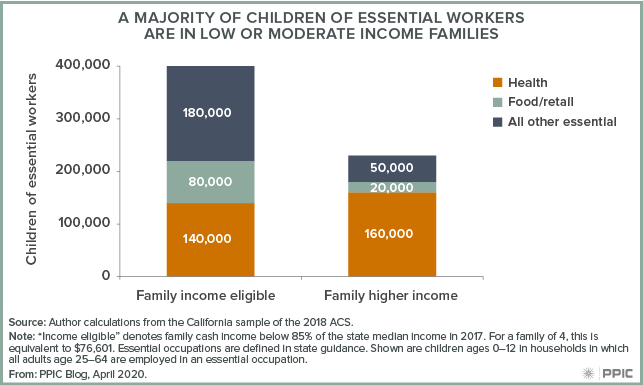
About 400,000 children in essential worker families live on incomes below 85% of the state median—the income cut-off for state preschool in normal times. While a majority of parents in essential jobs work in health occupations, most low-income children have parents working in other essential occupations. In other words, tension may arise between serving children of low-income essential workers and serving children of health workers.

figure - A Majority of Children of Essential Workers Are in Low or Moderate Income Families

In this time of uncertainty, the state has existing capacity to support child care, and it has shifted the goals of state-supported programs to help essential workers meet—and afford—their child care needs. By tracking the response, the state could gain insight into whether it is meeting the needs of essential workers in this difficult time, how to meet these needs in the longer term, and to what extent needs vary across the state.

Coping with COVID-19 in California’s Cities

California’s cities have been at the forefront of bold actions to manage the coronavirus pandemic. We talked to Carolyn Coleman, executive director of the League of California Cities, about the big challenges that the pandemic is bringing to cities across the state.

PPIC: How are cities coping with this unprecedented crisis?

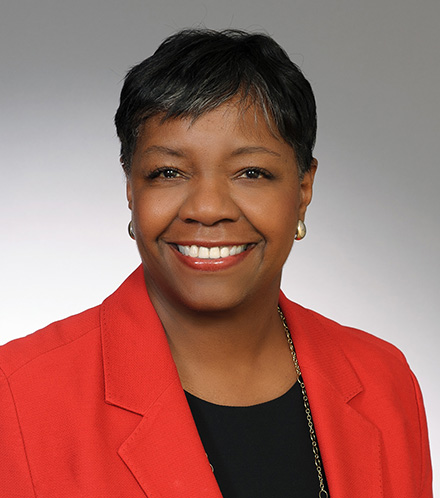
Photo of Carolyn ColemanCAROLYN COLEMAN: Local government leaders are some of the most pragmatic people I know. This comes from being on the front lines and hearing from your constituents everywhere you go—grocery stores, parks, and churches. Local officials are problem solvers, and they signed on to help their residents have a better quality of life. They have approached this crisis with the same dedication and commitment to serve that they brought to dealing with past crises, like the recent wildfires.

Across California, city leaders have stepped up with tools like eviction moratoriums and measures to prevent utility shutoffs or price gouging to protect their residents. Several are creating funds that will provide short-term financial assistance to help keep their small businesses afloat.

City officials are also working with public health entities, hospitals, schools and faith-based organizations to make sure medicines and meals are delivered to vulnerable populations.

Cities have also been very nimble in adapting government business to a virtual model. Council meetings, town halls, and public hearings have moved online with virtual tools that ensure public engagement. They are also using websites, social media, and new technology platforms to engage with their residents and make sure they have needed information.

Early orders by California cities to stay at home or restrict gatherings are being credited with flattening the curve. There was some pushback when these orders were announced, but they’re saving lives here in California, and that started with local government leaders who were out in front of the crisis.

The economic disruption this crisis is having on families, businesses and governments is devastating. While saving lives, stay-at-home orders have led to business closures, furloughs, and layoffs, as well as decreases in tax revenues that local governments use to fund essential services like police, fire, and code enforcement. At the same time, cities are experiencing increased expenses because of COVID-19. We’ll be working closely with federal and state partners to fill revenue gaps so we can continue to provide the services our communities need right now.

PPIC: Are there particular needs in rural communities?

CC: For years, we’ve known that access to high-quality broadband is not as widely available as it should be in our rural communities. With schools closed and some health services moving online, this crisis is a wake-up call to get more broadband deployed across the state.

Rural communities also tend to have smaller budgets with fewer resources to respond to economic disruption caused by this crisis. As they navigate the shortfall in revenues and increase in expenses, their need for fiscal assistance from the state and federal governments could be proportionately as large as our biggest cities.

The federal Coronavirus Aid, Relief, and Economic Security (CARES) Act targets cities with more than 500,000 residents. Most of California’s 482 cities are smaller than that, and yet they may end up with needs that are proportionally as large as those of big cities. That’s why the League will continue to advocate for fiscal assistance for all of our cities, to ensure that none are left behind—during either the pandemic or the financial recovery from it.

PPIC: Talk about the ongoing housing shortages and homelessness in the context of this emergency.

CC: I applaud the governor and local leaders who in recent weeks have partnered closely to safely house more Californians. Every day we hear about cities opening new emergency shelters, putting out more handwashing stations, passing out hand sanitizer in homeless encampments, and taking other steps to protect public health. The governor is sending more trailers to cities for emergency housing, and housing construction is continuing—it’s an essential service. Pandemic or not, we all know we have to increase housing production so more of our families have places to live.

We’re also seeing some new ways to streamline the housing production process, which could become mainstream once the health crisis is over.

PPIC: What gives you hope during these challenging times?

CC: I’m heartened by the public leadership we’re seeing. Local leaders, and leaders at all levels of government, are stepping up to save lives. And the selflessness that surfaces in times like these is a reminder that we’re all connected. People rise.