Who Lives in California’s Nursing Homes?

Seniors aged 65 and over are the age group most at risk of dying from the COVID-19 virus. As of May 6, according to the California Department of Public Health, seniors accounted for 79% of all COVID-19 deaths (1,894 out of 2,412) in the state. Seniors who live in nursing homes—skilled nursing facilities—are especially vulnerable. But state programs that allow seniors to remain living at home rather than entering nursing homes may help protect California’s most vulnerable population.

Residents of nursing homes make up less than 1% of the state’s population, but account for 39% (929 out of 2,412) of all COVID-19 deaths in the state and 10% (5,604 out of 56,212) of all confirmed COVID-19 cases. And at 78%, the vast majority of nursing home residents are seniors. Health care workers in the state’s nursing homes are also at risk. Seventeen have died and over 3,000 have contracted the disease.

Even as the senior population has grown with the aging of the baby boom cohort, the number of seniors in nursing homes has remained steady. According to the American Community Survey, about 88,300 seniors, or 1.7% of all seniors in California, live in nursing homes in 2018; that’s about the same number as in 2010 (87,500).

Figure - Little Change in Number of Seniors at California Nursing Homes

Women make up the majority of the seniors in California nursing homes (65%). Residents also tend to be very old—43% are age 85 or older—and not married. Similar to the overall senior population, the majority are white (58%). Even so, many residents (32%) speak a language other than English. Los Angeles County, the locus of the pandemic in California, has 35% of the state’s nursing home residents, but 26% of the state’s population.

Almost all nursing home residents have self-care limitations. That is, these seniors have a physical or mental health condition that has lasted at least six months and makes it difficult for them to attend to their own personal needs such as bathing, dressing, or getting around. And at least half (51%) are on Medi-Cal.

However, state and county programs have allowed more seniors to live at home. One such program, In-Home Supportive Services (IHSS), is intended to keep low-income seniors in their own homes rather than in nursing homes. IHSS offers services such as housecleaning, meal preparation, laundry, grocery shopping, personal care services—such as bathing, grooming, and paramedical services—and accompaniment to medical appointments.

Because of this arrangement, even seniors with self-care limitations are increasingly likely to stay in their own homes rather than move to a nursing home. Hundreds of thousands of California seniors receive care through IHSS.

The share of seniors in nursing homes across the rest of the country is about one-third higher than in California. A likely outcome of state efforts to keep seniors in their own homes has been to protect many seniors in this state from exposure to the pandemic.

Jail Bookings Down Significantly during COVID-19

In the midst of the coronavirus pandemic, California has sought to reduce county jail populations through a range of actions, including a “zero bail” emergency measure. This means that most misdemeanor and lower-level felonies currently have no bail amount associated with them, and that suspects are more likely to be cited and released instead of booked into jail. This new practice, along with decreases in crime and local directives to reduce arrests and bookings, appear to have drastically reduced the number of people sent to jail at this time.

A number of offenses—including felony burglary, driving under the influence, and the most serious sexual and violent crimes—can still receive a bail amount above zero.  And law enforcement can still book someone into jail even for a so-called zero bail offense—but the arresting law enforcement agency (or the district attorney) has to request to a judge to set a bail amount. If the court denies the request then the suspect has to be released.

To get a sense of the magnitude of zero bail’s effect on releases and bookings, we looked at data from the Monthly Arrest and Citations Register (from 2016, the most recent available). These data do not perfectly identify zero bail offenses or the offenses excluded from the zero bail list. But they do allow us to identify an upper bound of the impact on jail bookings.

Of the roughly 1,140,000 arrests that we analyzed, about 791,000 were booked into jail (about 69% of arrests). About 317,000 of these bookings (or 40%) were for offenses in which bail is still is an option today. The remaining 474,000 bookings (or 60%) were for zero bail offenses.

This suggests that today, if the arrest offense distribution is currently the same as it was in 2016 and there are practically no requests to set bail for zero bail offenses, then only about 28% of arrests in California would lead to a booking into jail.

In 2016, misdemeanors made up the majority of arrests booked into jail (about 77%) for what are now zero bail crimes. Of these, the most common offenses were drugs (almost 28%), failure to appear in court on a misdemeanor offense (about 21%), drunk and disorderly conduct (12%), and traffic and petty theft (each about 5%). The most common felony offense bookings now set at zero bail were drug offenses (almost 30%), theft (22%), and vehicle theft (roughly 14%).

While crime appears to be down since the COVID-19 outbreak, and the type of crimes committed during the pandemic almost surely have changed, our examination of 2016 arrest data suggests that the implementation of zero bail—in addition to the effects of local directives and fewer crimes—means that far fewer people are being booked into jail at this time.

Recent statewide data from the Board of State and Community Corrections supports this conclusion, as it reveals that weekly jail bookings have dropped from 17,140 the week of February 23 to 6,880 the week of April 12 (a decrease of about 60%, consistent with our data analysis).

These findings suggest that the zero bail measure is playing a significant role in reducing crowding in California’s county jails and helping to make social distancing more achievable. Going forward, it will be important to monitor other possible impacts this reduction in jail bookings might have, including on homelessness, public safety, and access to health care.

COVID-19 Alters College Admissions

[vc_row][vc_column][vc_column_text]Admissions may look different for students entering college in fall 2021. Social distancing to protect communities during the COVID-19 outbreak will impact where students attend classes and where they will live—and recent policy updates around standardized testing and GPA requirements will impact how colleges determine eligibility and placement in courses. But even as admissions become more flexible, some students still struggle to get on the path to college.

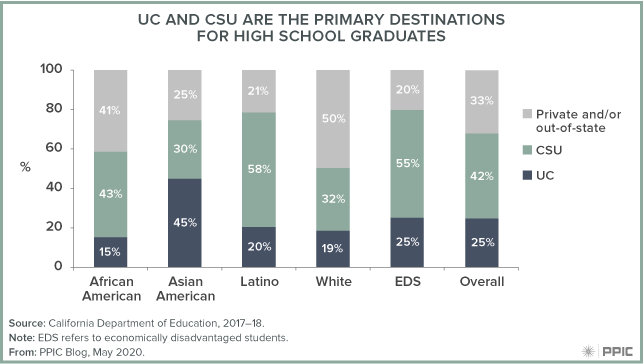
California’s public universities are the primary destination of the state’s high school graduates and community college transfers headed to a four-year college. In 2017–18, nearly 200,000 California high school graduates applied to the University of California (UC) or California State University (CSU), and 84,000 were enrolled.

figure - UC and CSU Are the Primary Destinations for High School Graduates

For students applying for admission to colleges in fall 2021, eligibility requirements and application processes are changing. Most standardized tests used for admission—such as SAT and ACT—and for placement purposes, such as the Smarter Balanced Assessment, are either postponed or cancelled.

In light of these cancellations, UC and CSU temporarily suspended testing requirements for fall 2021 applicants, meaning students do not need to include a test score on their application. In addition, UC and CSU systems are temporarily accepting pass/fail in lieu of a letter grade for courses completed in winter, spring, and summer 2020, as more K–12 districts and community colleges choose not to assign letter grades while students adjust to distance learning during the pandemic.

These adjustments are meant to ease anxiety over college admissions in a time of crisis, and there is some evidence that eliminating high stakes standardized tests could lead to more underrepresented students being placed in college-level courses and being eligible for college.

However, when high schools and community colleges lack sufficient resources, even with flexible grading in place, remote education may fail disadvantaged students. More than half of K–12 students from low-income households do not have broadband access at home. Notably, PPIC research found that online courses at community colleges exacerbated achievement gaps.

During their junior and senior years, high school students are more likely to fall off the college pathway, and disadvantaged students are even more likely to do so. And until recently, disadvantaged students were also more vulnerable to being diverted away from community college courses necessary for transfer admissions.

All students must cope with the changing college application process. But first-generation college applicants come from families who are new to the process; those with less internet/technology access may also be less familiar with how to apply. These students may see less support in the college application process than they would if they were still in school.

Now, more than ever, targeted outreach efforts and collaborations between K–12 and higher education will be critical to ensuring equitable access to a college education and economic mobility.[/vc_column_text][/vc_column][/vc_row]

Lessons from the Pandemic for Addressing Climate Change

Clear skies and less air pollution. Dramatic drops in harmful greenhouse gases. What can these environmental “silver lining” aspects of the COVID-19 pandemic teach us about addressing climate change? We talked to Louise Bedsworth—executive director of the California Strategic Growth Council, a state agency that brings together multiple agencies to support sustainable communities and strong economies—about the issue.

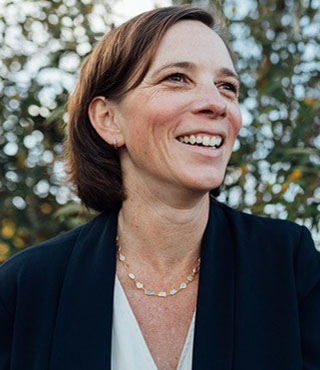
photo - Louise Bedsworth

PPIC: What has the COVID-19 pandemic taught us about our efforts to tackle climate change?

LOUISE BEDSWORTH: The pandemic has caused us to make a lot of changes quickly, some of which we know are also necessary to tackle climate change—such as the dramatic reductions in travel by car and air. Businesses have implemented telework policies at a scale we’ve never seen before, and meetings that would have taken place in person are now remote. We’ve seen that these sorts of changes can rapidly reduce air pollution and greenhouse gas emissions. Looking ahead, we can think about how to incorporate some of these changes into how we work.

In addition to changes that reduce emissions, we have also seen a number of actions that are important for building resilience. We’re seeing more people out in their communities, walking, biking, and getting outside. And we see people checking in on vulnerable residents, neighbors coming outside to talk to each other, and growing movements to shop at local businesses.

These social connections are really important for building a resilient California—one able to withstand the shocks to come. In the face of a changing climate, we have to reduce emissions, but also ensure that that our people, economies, and ecosystems are resilient in responding to  shocks and stresses. And that means building robust equitable communities that can weather these changes together.

We need to think about how we incorporate these lessons going forward—not just in our efforts to reduce emissions but also in how we’re thinking about building resilience in our communities.

PPIC: Do you see any long-term effects arising from the pandemic’s drop in emissions?

LB: We’ve seen what’s possible. We can make changes that have immediate impacts on air quality and emissions. That’s a really valuable lesson. The next step is figuring out how to make some level of these positive changes stick as we come out of the pandemic. For example, what policies do we need to encourage telework, or to encourage people to continue to drive less and walk more? Enabling just one day a week of telework could reduce commuter travel and associated emissions by 20%.

We also have to focus on how we rebuild our public transit systems, which have suffered steep declines in revenue and ridership. I think we have to be honest about the challenges facing transit systems, not just because of the financial hit they’ve taken but also to address people’s fear of being on crowded transit. How can we maintain these important systems even as we encourage more telework, biking, and walking?

PPIC: What are the economic implications of COVID-19 on the state’s climate change efforts?

LB: The pandemic has highlighted California’s equity challenges. Communities with high levels of poverty, joblessness, pollution, and poor health are bearing the brunt of this illness. We have to address the underlying causes of these inequities. The pandemic underscores the need for stronger efforts to reduce pollution and mitigate the effects of climate change—and for solutions that reduce these inequities.

We have to pay attention to how we rebuild our economy. Let’s put people to work to build more resilient infrastructure and a cleaner economy. Our long-term recovery must include investments that are in line with our goals on climate change and the environment, housing production, and quality job creation.

PPIC: What opportunities should we take from the coronavirus crisis to help address the climate crisis?

LB: We need to continue to focus on building a sustainable, equitable California. This includes building resilience in the state’s physical infrastructure as well as in our social and economic systems. If we don’t remain committed to our environmental goals as we recover from this, it will be harder and more costly to fix these problems down the road. In addition to working to maintain some new workplace practices, we need to prioritize actions that promote equity and sustainability. We must redouble our efforts to build safe and affordable housing located near jobs, schools, and transit and create high quality jobs and job training opportunities.

California can set an example for the world. The state is a leader in addressing climate change, but these changes have to happen globally. California must continue to lead by successfully demonstrating how we can emerge from the pandemic fully committed to sustainability and equity.


Students Prepare for AP Exams during COVID-19

In response to disruptions from COVID-19, the 2020 AP exams will be open book/open note format and taken online at home, according to the College Board. The new exams are scheduled May 11–22. At 45 minutes each, the exams will be much shorter and cover less material—focusing on content covered prior to March school closures.

An increasing number of colleges, including those in the University of California system, have affirmed they will award college credit for 2020 AP exams that score a 3, 4, or 5. While these changes give flexibility to students still hoping to earn college credits, all students may not benefit equally.

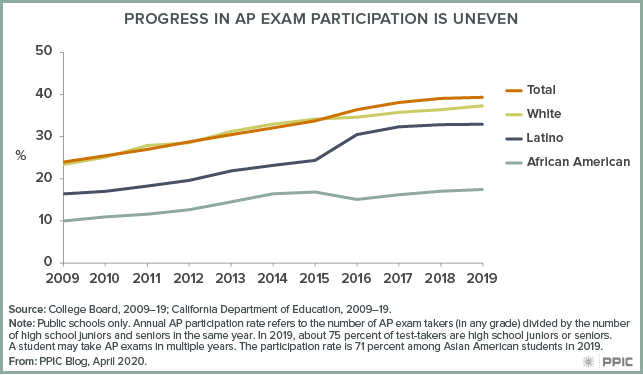
Nearly 380,000 students in California public schools took an AP exam in 2019, up 63% from a decade ago. Participation among Latino students grew from 16% in 2009 to 33% in 2019. However, participation by African American students plateaued in 2015.

figure - Progress in AP Exam Participation Is Uneven

For disadvantaged and vulnerable students, limited access to learning options at home may cause a dip in participation and performance. Nearly half of students from low-income families do not have broadband access at home; neither do a third of Latino or African American students. And broadband access remains problematic in rural areas, where 41% of school-aged children do not have access.

Students with special educational needs may face additional challenges. The pandemic and resulting school closures have had a disproportionate impact on this student population, with many losing access to special education support professionals and services.

Efforts to close these gaps are underway: the state Superintendent recently formed a new task force to close the digital divide, and the governor announced several cross-sector partnerships to support distance learning. The California School Board Association just announced its effort to push for a $2 billion broadband bond on the November ballot to address rural connectivity.

AP assessments begin in just a few weeks. The College Board has suggested that students without internet or a device contact them for assistance, but the scope of the organization’s ability to respond is untested. In addition, test preparation and participation may be difficult for students who are also caregivers at home and lack separate, quiet testing space.

It is unclear how many California students will take the 2020 AP exams, but they are still being encouraged to do so. In an April webinar, the College Board noted that 86% of AP teachers across the nation will still assign a letter grade to their courses during this school closure, with bonus points for completing an AP exam.

At 91%, the vast majority of AP enrollees still want to earn college credits. Schools and teachers across the state are helping students navigate the new system. As the state ramps up efforts to implement distance learning and maintain continuity of learning amid school closures, AP results should be closely monitored so that we understand the impact on socioeconomically disadvantaged students and special education students.

Lessons from the Great Recession Can Protect College Students Today

[vc_row][vc_column][vc_column_text]Budget cuts for state services are likely on the horizon due to the economic disruption of COVID-19. This means state funding for public higher education may well be reduced—leading to restrictions in access and lowered enrollments. California went through this very scenario during the Great Recession, with thousands of students turning to for-profit colleges in lieu of public colleges.

figure - Enrollments Spiked for California For-Profit Colleges during the Recession

While some students at for-profit colleges earned a degree, many did not graduate and ended up with large amounts of debt. State and federal government subsequently put restrictions around for-profit colleges, but upcoming changes at the federal level could weaken the federal rules.

The recently announced federal Education Stabilization Fund will disproportionately provide emergency relief funds to private for-profit colleges. In California, only 5% of the state’s undergraduates attend for-profit colleges, but these schools will receive 10% of federal funds.

In contrast, 55% of undergraduates attend the state’s community colleges, which will receive only 34% of federal aid. (That’s because many low-income students who attend community college rely on state aid rather than federal financial aid: these students are not counted in the federal emergency funding formula.)

During the Great Recession in 2008, higher education faced deeper cuts than other state services. With escalating tuition, fewer instructional staff, and a narrow application window, students had less access to the state’s public colleges, especially community colleges.

At the same time, some for-profit colleges began to market heavily, and thousands of students enrolled in expensive programs. By several measures—graduation rates, student debt, loan default rates, and employment outcomes—private for-profit institutions often have poor outcomes. Of course, some colleges have a better track record than others.

People hurt most by the recession—and lack of access to college—were saddled with debt they couldn’t pay back. In response, California and the federal government both instituted new regulations requiring for-profit colleges to be more transparent and accountable.

California went a step further than the federal government. The state required colleges to meet minimum standards of graduation and loan default rates to be eligible for Cal Grants, the state’s financial aid program for low-income students. Enrollments in for-profit colleges in California declined, and some of the largest for-profit institutions, like Corinthian and ITT Technical Institute, declared bankruptcy as the economy improved and funding to public higher education was restored.

California policymakers should seek to avoid the mistakes of the last recession by ensuring that access to public higher education is not restricted during this recession. The key is to find ways to limit budget cuts so that public higher education remains accessible to all Californians looking to advance their knowledge and improve their economic well-being.[/vc_column_text][/vc_column][/vc_row]

Video: Californians and Education

In the era of COVID-19, about eight in ten adults fear getting sick, and 80% expect bad economic times ahead. At a virtual briefing on Thursday, PPIC researcher Alyssa Dykman said the drop in consumer confidence “is unprecedented in the history of the PPIC survey.”

The event featured Dykman, who presented attitudes on K–12 education, funding, and policy preferences along with concerns over the coronavirus pandemic in the latest PPIC statewide survey. PPIC President and CEO Mark Baldassare supplied deeper context for key findings and responded to online questions.

Approval ratings have hit rare numbers: at 78%, approval has surged for Governor Newsom’s handling of K-12 education, and at 92%, public school parents express overwhelming support for school district handling of school closures. COVID-19, however, has shaken support for school bonds, with about half or fewer adults and likely voters saying it’s a good idea now for state government to fund school construction projects.

Baldassare underscored Californians’ concerns around health and finances, stating that two-thirds of adults are worried about both. Many say their lives are disrupted and about half say the stress is affecting mental health.

What do these concerns mean for California schools? “People are giving state leadership and local leadership a lot of leeway in how they respond to the public health and economic crisis,” Baldassare said. But the state will see its first test of this extraordinary support in May, when the governor submits a revised budget that will reflect revenue loss from a sharp economic downturn.

That may also lead to roadblocks for state and local school funding in November. In the March primary, “the defeat of most of the local school bond measures really caught a lot of people by surprise,” Baldassare said. “It was difficult to pass school funding measures.” At the moment Californians are hesitant to commit more funding to schools, which may impact voting on the split-roll property bond measure and others in the November election.

The survey offers several takeaways around planning for California public education. “We’ve never had anything like the school closures that are taking place,” Baldassare said. He reflected that Californians may reconsider the value of teachers going forward, including whether “teachers have the resources they need in order to do the job,” and noted that the public may have “a new understanding of the important and difficult role teachers play every day in the lives of public school children.”

Californians also may now recognize the struggles of vulnerable students, especially in terms of online access.

“It is going to be a test of Californians’ political will,” Baldassare said, “the degree to which we are committed to improving student outcomes, particularly among the large numbers of English language learners and low income students across the state.”

School Funding, COVID-19, and the 2020 Election Year

This post is excerpted from Mark Baldassare’s prepared remarks for the PPIC Statewide Survey virtual briefing on April 23, 2020.

State funding for K–12 public schools will take center stage when Governor Newsom unveils revisions to the state budget in a few weeks. The growing fiscal toll of the COVID-19 crisis is likely to affect school funding plans as a deep economic recession looms. K–12 schools have the largest share of the state General Fund, and many Californians say it is their top priority for state spending. Still, California voters seem to be pulling back their support for school funding on ballot measures.

One of the biggest surprises in the March 3 primary was the defeat of the Proposition 13 state school bond (53% voted no). The last time a state school bond failed to pass was back in 1994. Proponents have tried to explain away this loss as confusion caused by the number 13—the same as the notorious anti-tax initiative that passed in 1978.

However, outcomes of local school bond measures point to a different story. Bucking recent trends, 63% of local school bonds on the March primary ballot failed to reach the 55% threshold needed to pass. It may be that early anxieties about COVID-19 resulted in voter caution about extending debt. In the absence of exit polls to validate this theory, the April PPIC Statewide Survey sheds light on what may have happened. It also offers sobering news for efforts to convince voters to support school funding measures in the November election.

First, though, let’s dispense with the notion that views about school funding have fundamentally shifted. Today, 55% of California likely voters say that state funding for their local public schools is not enough. And 53% would vote yes on a state school bond while 50% would vote yes on a local school bond. Moreover, 53% percent would vote yes on a split roll property tax to fund local public schools—a measure that appears headed for the November ballot. All of these results today are similar to those last April, suggesting that basic attitudes about school funding are fairly stable.

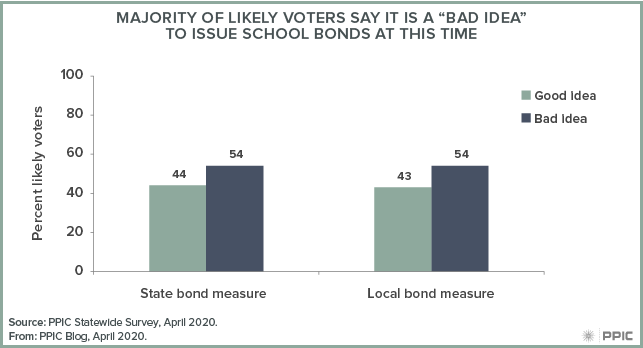
But current conditions appear to be having a strong effect on the timeframe for public support. Our survey was conducted from April 1 to 9—roughly a month from the primary and a few weeks into stay-at-home orders. We find that most likely voters say it is a “bad idea” to issue state (54%) or local (54%) school bonds at this time. Majorities of Californians without children in public school agree (bad idea: state 56%, local 57%). Fewer than half across the state’s regions say it is a good idea to issue these bonds now. Only those with children in public school think that it is a good time to issue state (57%) or local school bonds (58%).

figure - Majority of Likely Voters Say it is a “Bad Idea” To Issue School Bonds at this Time

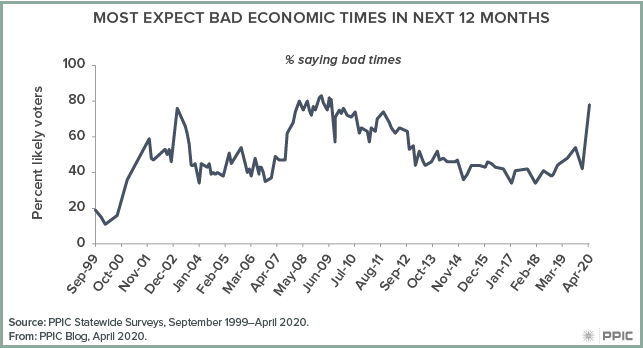
Why? Californians have had their world shaken by the COVID-19 crisis. Since January there has been a 36-point increase in expectations for bad economic times in California over the next 12 months (42% to 78%)—sending us to depths of consumer pessimism not seen since the Great Recession. And right now, 74% percent are worried about negative impacts of the coronavirus on their personal finances.

figure - Most Expect Bad Economic Times in Next 12 Months

This pessimism is likely to have profound implications for school funding measures on the November ballot. The state’s fiscal and economic problems will weigh heavily on voters’ minds when they are asked to make decisions on spending, taxes, and bonds. Many may be reluctant to ask taxpayers (like themselves) to foot the bill, or to increase commercial property taxes, to make up for shortfalls in school funding.

We can also expect a rocky road ahead for the governor and state legislature. Although our April survey found a steep rise in the governor’s and legislature’s approval ratings around handling K–12 public education, state leaders now face the prospect of having to cut back on popular plans to increase school funding. During the Great Recession, we saw the governor’s and legislature’s approval ratings tumble with state budget cuts to local schools.

Our surveys will be closely monitoring all of these dynamics as California heads toward a much-anticipated November presidential election.

How Is the Pandemic Affecting Wildfire Preparedness?

A new report on the benefits of managing headwater forests to reduce wildfire risks is available here. Join us on April 30 for an online event featuring a panel of experts discussing this topic.

California has experienced catastrophic wildfires and widespread tree death in recent years that have accelerated its efforts to reduce wildfire threats to communities and improve forest health. Fortunately, the COVID-19 pandemic is not deterring these efforts—though it could complicate the work. Activities must be carried out in ways that limit the risk of infection to workers, which can be difficult when managing fire and working with ground crews over days or weeks. Here we explore the impact of the pandemic on wildfire risk reduction.

Could COVID-19 affect the state’s ability to respond to wildfires this year?

Fighting wildfires is an essential service and the state’s ability to respond to wildfires this year will not be compromised by the pandemic. The California Department of Forestry and Fire Protection (CAL FIRE), the agency responsible for the bulk of the state’s wildfire response, is gearing up for the season by hiring seasonal staff and training crews for the fire line.

“Our staffing levels will be the same as last year to meet the demands of the upcoming wildfire season,” said CAL FIRE communication officer Christine McMorrow. To prevent firefighters from contracting and spreading the virus, CAL FIRE is integrating social distancing guidelines into training exercises. The agency is also considering options for making fire camps—where firefighters eat and sleep while battling blazes—less conducive to virus spread.

Could it affect vegetation management efforts?

Most vegetation management efforts have been designated as essential services and are expected to continue throughout the pandemic. Over the past year, private landowners, nonprofit organizations, local governments, water and electric utilities, CAL FIRE, and federal agencies did significant vegetation management in preparation for the upcoming wildfire season. Work on private, local government, and state lands is largely continuing as planned. Implementing entities are encouraging social distancing measures to protect crews from infection.

“We haven’t heard of major setbacks to forest health projects yet, but it is still early,” said Brittany Covich, policy and outreach manager for the Sierra Nevada Conservancy, a state partner on many forest health projects in the region.

One major exception is national forests, which account for more than half of Sierra Nevada forestlands. On March 20, burns were suspended by the US Forest Service to avoid the spread of smoke (which can increase virus risk in nearby communities) and prevent crews from contracting and spreading the virus.

What are the potential long-term implications of the pandemic for forest management?

The economic fallout from the pandemic is forcing the state to reassess its spending priorities. This is generating uncertainty for many programs, including wildfire risk reduction. Spending in this area is one of three priorities for this year. However, it is not clear how much funding will be available for specific programs. In January, the Governor’s proposed budget included $165 million in state Greenhouse Gas Reduction Fund (GGRF) money and an additional $250 million in funding for forest health projects from a Climate Resilience Bond intended for the November 2020 ballot.

Potential recipients of forest health funds are cautiously optimistic that some GGRF funds will remain on the table, but it remains to be seen whether the legislature and voters will be willing approve new bonds in the future.

The financial condition of state partners in fire prevention and forest health—including nonprofit organizations, local governments, and the US Forest Service—is also uncertain. “Frankly, we’re all in a wait-and-see mode, but we’re hopeful that forest management will remain a high priority,” said Covich.

Many Low-Income Families Left Out of Federal Stimulus Benefits

As part of the federal response to COVID-19, the IRS has started issuing stimulus checks—to boost consumer confidence—directly to millions of families. For the record number of Californians who have lost jobs, hours, and certainty around their incomes, these payments could come just in time.

We estimate that about 81% of Californians live in a family that will receive an “economic impact payment,” with the typical family receiving around $2,200. In total, Californians could receive about $26 billion through the program.

However, nearly 20% of families are unlikely to receive a stimulus check. Because the payments phase out as incomes rise, most of these families are above the income cutoff ($99,000 for single tax filers and $198,000 for joint filers without children). But nearly a third are among the state’s lowest income families. In part, this reflects the fact that only people who have filed taxes recently, or who receive either supplemental security income (SSI) or social security, will receive a check.

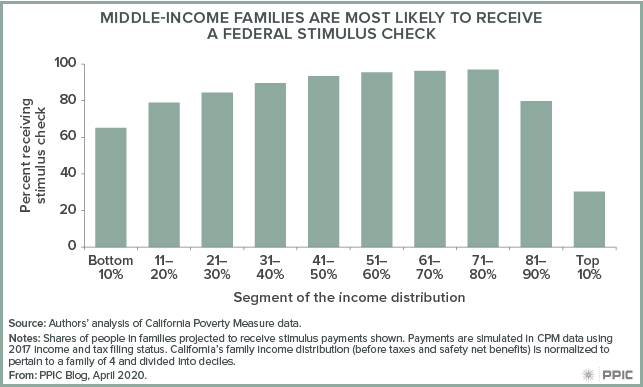
People with very low incomes are not required to file taxes, and they will not receive stimulus checks unless they actively share their banking details with the IRS. Partly for this reason, our estimates indicate that just 65% of people in families with the lowest 10% of incomes—less than about $22,000 a year for a family of four—are likely to receive a check.

By comparison, 90% to 97% of those in middle-income families—with annual incomes of $52,000 to $176,000—are likely to receive a check.

figure - Middle-Income Families Are Most Likely To Receive a Federal Stimulus Check

Yet even if all Californians who do not file taxes submit their information to the IRS, people in low-income families will still receive checks at lower rates than middle-income families. Because many low-income families include undocumented residents, the entire family is ineligible for these federal payments. If families with undocumented members were eligible, all families from the 11th to 80th percentiles of the income distribution could potentially receive a check.

To help Californians during this crisis, the state’s safety net will need to reach those most affected economically. The temporary expansion of unemployment insurance will provide much more aid to certain low-income families than the federal stimulus payments. And California’s recently announced Disaster Relief Fund, which will use public and private funds to provide up to $1,000 per household to families of some undocumented immigrants, will help to fill in certain gaps. But while replacing wages is important, a response focused only on wages would skip many people in need.

Food assistance programs like CalFresh and school meals are also critical safety net supports because of their wide reach, and expansions are also underway. Along with the federal stimulus payments, these are important steps, but—depending on the length and the depth of the crisis—more remains to be done.