Californians and Congress

The recent announcement of Speaker Boehner’s resignation comes at a time when national approval ratings of the US Congress are in the teens (14% in September Gallup Poll). With the early talk of majority leader Kevin McCarthy stepping into the Speaker position, what are Californians saying about the powerful federal institution that the congressman from Bakersfield is well-positioned to lead?

In the latest PPIC Statewide Survey, we asked Californians to rate eight state and federal elected leaders and legislative bodies—interviewing was completed just before Pope Francis’ speech to Congress and Speaker Boehner’s surprise announcement. California likely voters give their lowest approval by far to the US Congress. Just 17 percent say they approve of the way the US Congress is handling its job.

Surprisingly, there is overwhelming consensus about Congress even in this era of hyper-partisanship. In the recent PPIC Statewide Survey, California likely voters of different political stripes are united in their low approval of Congress. By contrast, other political figures in Washington elicit highly partisan responses—including President Obama, Senator Boxer, and Senator Feinstein. Remarkably, approval among Republican likely voters of President Obama (13%) and Senator Boxer (15%)—both Democrats—is about the same as approval of Congress (17%), while Republican approval of Senator Feinstein (27%) and Governor Brown (29%) is higher than approval of Congress. It’s also noteworthy that Republicans (36%) are less likely than Democrats (62%) and independents (50%) to approve of their own House representatives—this may be related to their low approval of a Congress controlled by their party.

The 53 members of the California House delegation may take some solace in the fact that Californians are much more approving of their own representatives to the US House than of the Congress as a whole. And California’s US senators have approval ratings around 50 percent. Still, the California State Legislature has recovered from several years of low approval ratings while the US Congress has not. Moreover, the members of the California congressional delegation are working in an institution that is mostly seen as not doing its job. This raises doubts about their political futures, especially given the top-two primary—which takes away the certainty that candidates from both major parties will appear on the November ballot—and more competitive elections through independent legislative redistricting.

Low approval ratings of the US Congress have been a consistent feature in PPIC Statewide Surveys throughout this decade. Approval ratings of Congress among California’s likely voters have been in the mid-teens each September since the Republicans (and Speaker Boehner) took control of the House in January 2011. Under Democratic control (and Speaker Nancy Pelosi’s leadership, beginning in January 2007), approval ratings were somewhat higher. This could be partly because the California electorate leans Democratic, but it is worth noting that approval ratings of Congress under Republican leadership 10 years ago were higher than they are today.

Clearly, low approval of Congress is a national phenomenon tied to intense media focus on legislative gridlock and government shutdowns. But Californians do have fundamental policy disagreements with the current Congress that also affect their views of its job performance. Specifically, the recent PPIC Statewide Survey finds that Californians are more likely than people nationwide to express support for immigration reform, abortion rights, and stricter gun laws. The actions of Congress in recent years are at odds with California public opinion in all three of these controversial policy domains.

In the California context, immigration reform stands out as a special case. Sixty-nine percent of California likely voters—compared to 60 percent of adults in a national ABC News/Washington Post Poll in July—say that undocumented immigrants currently living in the United States should be allowed to live and work here legally if they pay a fine and meet other requirements. Moreover, majorities of likely voters across party groups (83% Democrats, 66% independents, 51% Republicans) support a way for undocumented immigrants to stay in the US legally. Importantly, 68 percent of those likely voters disapprove of Congress want there to be a way for undocumented immigrants to stay in the US legally. And among likely voters who support a way for undocumented immigrants to state in the US legally, 77 percent disapprove of Congress.

The next Speaker will face the major challenge—critical to the nation’s future—of restoring public trust and confidence in Congress. Our poll sheds light on the need for Congress to show leadership in addressing the complex problem of immigration, which is surfacing early and often as the defining issue for the Republican presidential candidates. The view from California is that the path to higher approval of Congress runs through immigration reform. It won’t be easy, but there is a way forward for a new leader who seeks to improve perceptions of the way that the Congress handles its job.

Video: PPIC Statewide Survey Briefing

As discussions continue in Sacramento about drought relief, funding for higher education and transportation projects, and an extension of Proposition 30 tax increases, PPIC surveyed public opinion on these and many other topics. At a briefing last week in the capital, PPIC researcher Jui Shrestha provided the survey findings. Among the key points:

  • Two-thirds of Californians say the regional water supply is a big problem, and two-thirds say people in their part of the state are not doing enough to respond to the drought.
  • While most adults say that spending money on the maintenance of California roads, highways, and bridges is very important, there is little support for increasing the gasoline tax or vehicle registration fees to do so.
  • Half of Californians favor extending the Proposition 30 tax increases, and about a third favor making them permanent.

Californians and Immigration

While the courts, and perhaps Congress, decide the future of President Obama’s actions on immigration, the most recent PPIC Statewide Survey shows how Californians view the issue. Most Californians (69%) supported the president’s executive order protecting as many as 4 million undocumented immigrants from deportation; while 30 percent were opposed. Californians are much more likely to support executive action on immigration than adults nationwide (52% support, 44% oppose).

Across California’s political, regional, and demographic groups, support falls short of a majority only among Republicans (35%). By comparison, most Democrats (83%) and independents (63%) support the president’s actions.

Looking more closely at the January survey findings, we see results consistent with California’s reputation as a blue state. More than 60 percent of Californians across regions and gender, age, education, and income groups support the administrative action on immigration. Considering that Latinos are by far the largest group affected by the executive order, it’s not surprising that nearly all Latinos (89%) support presidential action on immigration; however, 55 percent of whites also voice support.

Support for the president’s action is consistent with favorable opinions on recent reform proposals that have been debated but not enacted by Congress. The Senate passed a plan in 2013 that would have provided a path to citizenship for undocumented immigrants if they met certain requirements. Our September 2014 survey showed that a strong majority—82 percent—including more than 55 percent across parties supported this plan. In fact, more than 65 percent across regional, age, education, income, and racial/ethnic groups were in support.

Beneath Californians’ support of both the president’s executive action and the Senate’s comprehensive immigration plan is a generally favorable view of immigrants. In our January survey, a majority of Californians (63%)—as they have in past surveys dating back to 2000—viewed immigrants as a benefit to California because of their hard work and job skills; 32 percent viewed them as a burden because they use public services. Most Californians across political, regional, and demographic groups view immigrants as a benefit—Republicans (27%) and adults age 55 and older (49%) are the exceptions.

Our survey results help explain why California hasn’t waited for Congress to act on immigration reform. The state has passed a number of laws in the last two years that pave the way for undocumented immigrants to get student loans and financial aid, professional licenses, and, most recently, driver’s licenses. Home to the largest share of immigrants in the nation, California has the most at stake in immigration debate and has consistent views on it.

Video: January PPIC Statewide Survey Briefing

State residents are feeling more optimistic than they have in years—about California’s elected leaders, the direction of the state, and their own economic futures. Dean Bonner, associate survey director, presented these and other key findings at a briefing last week in Sacramento. In addition to asking about government and fiscal issues, the January survey gauged opinions on four important issues being debated at the state and federal level. Among the findings:

  • Crime, police, and race relations. A solid majority of Californians say the police are doing either an excellent job or good job controlling crime in their communities. But blacks are much less likely than others to hold this view.
  • Water and drought. A majority of Californians say the supply of water is a big problem in their region, and most say the state and local governments are not doing enough to respond to the current drought.
  • Health care reform. A record-high 51 percent of Californians have a generally favorable view of the 2010 health care reform law, while 41 percent have an unfavorable view.
  • Immigration reform. A solid majority of residents support President Obama’s executive action to shield as many as 4 million immigrants from deportation, while about a third are opposed.

Undocumented Immigrants and Health Care

On the heels of President Obama’s recent executive actions on immigration, state senator Ricardo Lara has reintroduced legislation (SB 4) to provide access to affordable health coverage and care to all Californians, regardless of immigration status. The details of SB 4 have not been spelled out, but Senator Lara’s previous bill called for the state to offer the coverage available under the Affordable Care Act (ACA) to undocumented immigrants: Medi-Cal coverage to those below 138% of the federal poverty level (annual income of about $16,000 for a single person) and subsidies to purchase coverage to individuals earning up to 400% of the poverty level (about $46,700 annually).

As PPIC pointed out in a recent blog post, while the ACA excludes undocumented immigrants from the coverage expansions, President Obama’s executive order could pave the way for immigrants in California who are eligible for the Deferred Action for Parental Accountability program (and who meet income eligibility requirements) to get Medi-Cal coverage. Under current Medi-Cal eligibility rules, immigrants with deferred action status—meaning that their presence is known to the government and there are no plans to deport them—can receive full coverage under a benefit category known as PRUCOL (Persons Residing Under Color of Law). Some states, including California and New York, provide full Medicaid coverage for the PRUCOL group. This coverage is financed entirely by the states—the federal government funds only emergency medical treatment for undocumented immigrants.

The president’s action could also have implications for county programs that are required by state law to provide medical care to indigent residents. Currently, counties have considerable latitude in determining eligibility criteria for their indigent care programs, and many exclude undocumented immigrants. When state officials decided to expand Medi-Cal eligibility under the ACA, they reduced the funding provided to county indigent care programs because many of the people served by these programs would become eligible for Medi-Cal. The legislation (AB 85) that redirected state funds for county health programs included a provision to review this funding shift if there was federal action on immigration reform, but it’s not clear if that will happen in this case.

What is clear is that options for providing access to insurance coverage and health care for the more than 2.5 million undocumented immigrants in the state is a policy topic under consideration by policymakers at local and state levels.

Immigration: What’s Next in California?

More than one million Californians could be affected by President Obama’s executive order on immigration. Undocumented immigrants who have resided continuously in the U.S. for the past five years and are parents of children who are either U.S. citizens or legal permanent residents will be eligible for work permits. They will also be relieved from the threat of deportation. In addition, the executive order increases the number of people eligible to register as “Dreamers” because they were brought to the U.S. as children.

Undocumented immigrants who qualify under the president’s order will likely be able to provide more stable homes and increase their connection to their communities. Californians have already demonstrated that this is what they want for undocumented immigrants. More than 80% of Californians favor providing undocumented immigrants with a pathway to citizenship if they meet background checks, pay back taxes and penalties, and learn English—according to each of the three PPIC Statewide Surveys that asked about this issue in 2014.

California legislators have been leaders in setting policy that helps integrate the undocumented immigrants already in our communities by passing legislation that allows undocumented immigrant youth to pay in-state tuition at our colleges and universities, qualify for state financial aid, and obtain driver’s licenses. Low-income Californians registered as “Dreamers” also qualify for state Medi-Cal.

What happens next depends in large part on the reaction of state and local governments. Knowing where qualified undocumented immigrants live is essential to realizing the potential gains both to the state and to the immigrants themselves. This is challenging. Surveys don’t generally ask about immigration status, so most of what we know about this population derives from complicated estimates of immigration status.

Here, we present counts of undocumented immigrants who have filed federal tax returns without social security numbers (instead using Individual Taxpayer Identification Numbers, or ITINs) and with wage forms (W-2s) attached. We believe this is a reasonable way to broadly determine who will be affected by President Obama’s executive order. Undocumented immigrant tax payers are more likely to have been in the U.S. longer and are likely to be the most intent on making the U.S. their permanent home. By filing taxes, they have already taken steps to identify themselves as contributing members of their communities and the economy.

A few caveats—while we are certain that each of the immigrants we identify in this fashion are undocumented, this method probably does not count all undocumented immigrants who may be eligible for the order. Probably not all undocumented immigrant tax payers use ITIN numbers, and not all undocumented immigrants file tax returns. Further, not all undocumented immigrants using ITIN numbers will be eligible for the order.

We find that California has over 900,000 undocumented immigrants filing federal tax returns for the 2012 tax year, the most recent year data is available. These undocumented immigrants live in 55 of our 58 counties, with large numbers in Los Angeles, the Bay Area, the Sacramento region, the Central Valley, coastal California, and the Inland Empire. This information can be useful to local legal service providers and local governments to help plan for the registration of eligible undocumented immigrants, the most critical first step in implementing the president’s order.

Of course, county populations are not homogeneous—a closer look reveals sharp differences in the number of ITIN filings by zip code, even within counties. The map below shows high numbers of undocumented immigrants in rural regions (large-area zip codes), as well as in city and suburban centers (small-area zip codes). In Riverside County, for instance, undocumented workers are found in high numbers in the urban areas in the west, as well as in the agricultural region around the Coachella Valley.

President Obama has made it clear that those eligible for deportation relief under this new executive order are ineligible for health care subsidies under the Affordable Care Act. But, as in the past, California may wish to do more—for example, providing Medi-Cal coverage to qualifying adults and doing more to reach out to their already eligible children. In addition, upward mobility is most likely for immigrants obtaining work permits if they make investments in English language acquisition. NGOs, community college districts, and school districts that still provide adult education could use the information about where undocumented immigrants live to plan course offerings in the years to come.
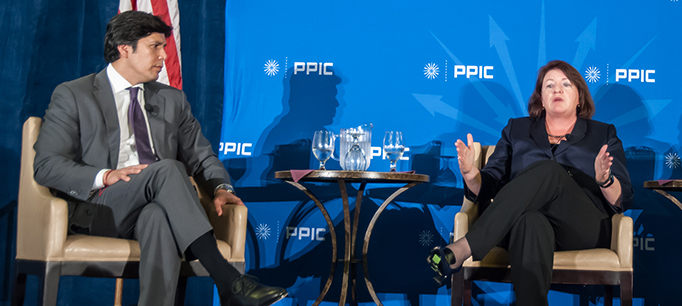
California’s New Leaders Focus on Poverty

Assembly Speaker Toni Atkins and Senator Kevin de León, who will take over as senate president pro tem later this month, each told a Sacramento audience about growing up in poverty and the role it has played in their shared view of the state’s responsibility to those in need.

“We share similar values and similar stories that have made us care about the values and the issues that we’re talking about today,” said Atkins, who was raised in a poor, rural Virginia family and now represents the San Diego area. De León, who was born in San Diego and represents Los Angeles, said he is the youngest child of a single immigrant mother and the only family member to graduate from high school. Atkins and de León, both Democrats, were elected by their respective legislative chambers earlier this year to serve as leaders.

Both lawmakers cited a recent PPIC report — Child Poverty and the Social Safety Net in California by Caroline Danielson and Sarah Bohn — that said about 50% of California children live in poverty or near-poverty. The remarks, part of the PPIC 2014 Speaker Series, were made to a capacity audience of about 400 in the ballroom of the Sheraton Grand Hotel. The discussion was moderated by PPIC President Mark Baldassare and streamed live to hundreds more.

The wide-ranging conversation touched on a number of major issues—including health care, the drought, immigration, and taxes. Both leaders said that they believe the state should talk about changes to the state tax structure and consider whether to extend the temporary taxes that voters passed in Proposition 30. Atkins cautioned that it will be difficult to gain support from voters for an extension of the taxes.

De León expressed strong support for affirmative action, which he credited for his ability to attend college and become a legislator. He also said California should continue to lead on immigration issues because the federal government has been unable to pass a reform plan. And he noted that polls suggest Californians support health coverage for undocumented residents.

Atkins, meanwhile, encouraged more cities to follow San Francisco and San Jose, which recently increased the minimum wage. Both leaders also said they have worked together in the past and believe they will have a good working relationship going forward.

Briefing Focuses on Survey Election Findings

Less than two months before the election, PPIC’s latest survey looked at Californians’ views on the governor’s race and four statewide ballot measures. Dean Bonner, associate survey director, presented the findings at a briefing in Sacramento on Wednesday. As most of the media coverage noted, the survey found that Governor Brown is doing well in his reelection bid and that the water bond he approved is fairly popular.

The survey found that Proposition 2, labeled the Budget Stabilization Act in the ballot statement but known elsewhere as the rainy day fund, does not currently have majority support among likely voters. Proposition 45, which would regulate health insurance premiums, has a similar level of support, but Proposition 47, which would reduce sentences for some crimes, is favored by 62 percent of likely voters. The survey also found high levels of concern about the drought and mixed feelings about the Affordable Care Act and immigration policy priorities.

Video Highlights New Survey’s Key Findings

The March PPIC Statewide Survey examines several major issues in California, including water, high-speed rail, marijuana legalization, and taxes. The survey also finds that three months before the primary, Governor Jerry Brown remains a strong favorite for re-election this year.

The wide-ranging survey also looks at Californians’ views on national issues—such as immigration and health care reform, and abortion —and provides approval ratings on federal elected officials.

PPIC research associate Jui Shrestha presented the results of the survey at a luncheon briefing in Sacramento.

Survey Briefing Focuses on State Fiscal Policy

The January edition of the PPIC Statewide Survey is always a popular one—especially in an election year. It gauges Californians’ reaction to the governor’s annual budget proposal and their sense of the issues that will be most important in 2014. Media coverage and audience comments at the lunchtime briefing focused particularly on the governor’s high approval ratings and his debt reduction proposals. Findings on attitudes toward the public pension situation and health care reform also generated considerable interest.

Sonja Petek, PPIC research associate and project manager for the survey, talked about these and other key findings—from Californians’ views on how the state should use the budget surplus to opinions about President Obama, Congress, and immigration policy.