Good Budget News for Higher Education

The California State Legislature and Governor Brown recently reached a $200 billion budget deal that includes just over a billion dollars in new funding for the state’s public higher education systems. This funding forestalls proposed tuition increases at UC and CSU and allows each system to support increasing student access and success. Moreover, the governor and legislature’s work to maximize the state’s rainy day fund should help to reduce the likelihood of drastic tuition increases in the future, should an economic downturn threaten higher education funding.

The new funding will allow UC and CSU to enroll an additional 1,500 and 3,641 undergraduates, respectively, next fall.  These enrollment increases—coupled with more dollars allocated to improve time-to-degree, boost graduation rates, and close achievement gaps—will help each system to do their part to provide much-needed growth in the number of college graduates in the state.

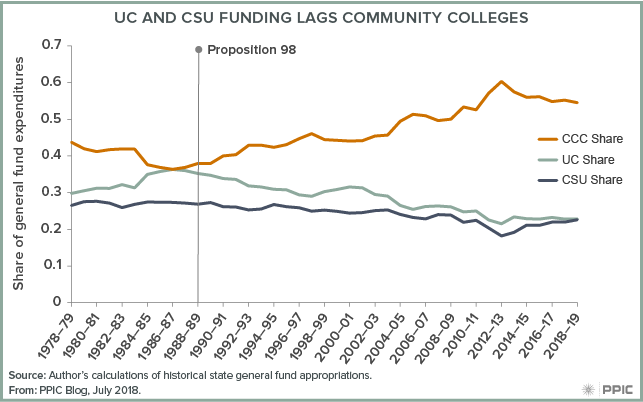
The budget deal also includes the governor’s top two higher education priorities: the creation of an online-only community college and the introduction of a new community college funding formula. This year, community college funding per full-time student will exceed $8,000—the highest level in the systems’ hundred-year history. (Mainly this is because community college funding falls under Proposition 98, the K–12 funding guarantee passed by voters in 1988.)
The online community college will be launched with $100 million and receive $20 million per year going forward. The goal? To provide opportunities to earn short-term credentials to California’s “stranded workforce” (workers stuck in low paying jobs or jobs that are likely to be automated soon), to help such workers to better compete in today’s labor market. The online college will offer credential programs that have demonstrated labor market value and are not already offered at brick-and-mortar community colleges.

The establishment of a community college funding formula will be phased in over three years. It will provide funding for low-income and underrepresented minority students, reward colleges for improved student outcomes, and reduce reliance on increased enrollment to secure state funding. This approach represents the ongoing emphasis on improving student outcomes at the community colleges.

This is Jerry Brown’s final budget deal—it will be up to the next governor to work with the legislature to ensure the ongoing health of the public higher education system. California’s future economy depends on it.

Remaking Flood Management to Support Salmon

California’s aquatic ecosystems and the species that depend on them are in trouble. Dramatic changes in water and land use over the past 150 years have transformed the state’s freshwater landscape, and the latest drought brought additional stress. We talked with Lewis Bair, general manager of Reclamation District No. 108, about where we need to go from here.

PPIC: What needs to change to reverse the crisis in the state’s aquatic ecosystems?

Lewis Bair: California’s water infrastructure was designed to manage floods and provide water for crops, and when it was built we didn’t really understand how this system might affect fish and other species. Now we know that the state’s flood management system cuts off rivers from their floodplains, which provide important habitat for aquatic creatures. We’re starving our ecosystem. We’ve removed 90% of the floodplains and lost 80% of the fish.

There used to be 25 salmon canneries on the Sacramento River. Between 1910 and 1930 the canneries lost 80% of their harvest. California hadn’t yet built its big reservoirs when this happened, but we had completely separated rivers from their floodplains, which were the main source of food for the fish. There are plenty of challenges for struggling species in California, but the floodplain issue is one we haven’t addressed and I think it could make a significant difference, especially for salmon.

Going forward, we need a fundamental change in our mindset, from the current focus on regulatory or mitigation approaches for habitat work to an emphasis on recovery. We need to get steady funding for recovery efforts and build the relationships required to be successful. That requires a lot of big changes—and also requires people to get out of their silos. We need better-coordinated science. And we need to review what we’ve learned and build on it.

PPIC: What does the condition of California’s salmon tell us about what is happening in aquatic ecosystems?

LB: Salmon are struggling, and it’s not a surprise. But there are things we can do to help. I’ve been fortunate enough to work on projects to restore parts of the floodplain to help salmon in the Sacramento Valley. There’s no question that floodplain restoration is the most important thing we can do for salmon right now. Our current flood management system tries to drain land quickly, but salmon and other creatures need the water to say in place awhile. The natural floodplain used to spread flood waters over a few weeks. Now the water comes and goes in just a few days. We’re working on a project that spreads water out and allows “fish food” to grow. You need 3‒4 weeks for that process to be really productive.

These floodplain efforts take place during winter, an off season for farming, which makes it a complementary practice to farming. The fish are essentially a third crop for these lands—rice is grown in summer, and the flooded rice fields support waterfowl in fall and winter.

PPIC: What’s needed to take recovery to the next level?

LB: We’re working with some environmental NGOs now to draft ideas on how to modernize the state’s water infrastructure to improve water for ecosystems. I truly believe that we have broad agreement on at least 90% of what is needed for our environment. Instead of arguing about the 10% where we don’t agree, we need to get the 90% done. The state may need something like a resources department with the authority and vision to oversee multiple agencies. The governor’s EcoRestore program for the Delta is one model for providing that leadership. Success will depend on having the locals and NGOs in key roles on the ground.

I’m very excited about the direction things are going right now. We have great NGO partners wanting to get past the perception that water users are the bad guys―now it’s all about how to move forward as partners.

Watch a panel discussion on partnerships for healthy ecosystems (with Lewis Bair)

Video: 2020 Census: What’s at Stake for California?

The decennial census plays an essential role in American democracy. The stakes are huge for California—the state stands to lose political representation and federal funding if there is a significant undercount—and 2020 is fast approaching. At a time when straightforward facts are in short supply, PPIC is providing essential, objective information about the importance of an accurate census count in California.

In this video, PPIC research director Sarah Bohn explains why the census is of particular importance to the Golden State this time around.

Primary Takeaways: Democracy Is Alive and Well in California

With the release of the official Statement of the Vote, the final tally is in for the 2018 California primary. The election outcomes are encouraging news for California’s democracy—especially in light of criticisms of the top-two primary system by the national media. Several important statewide trends stand out:

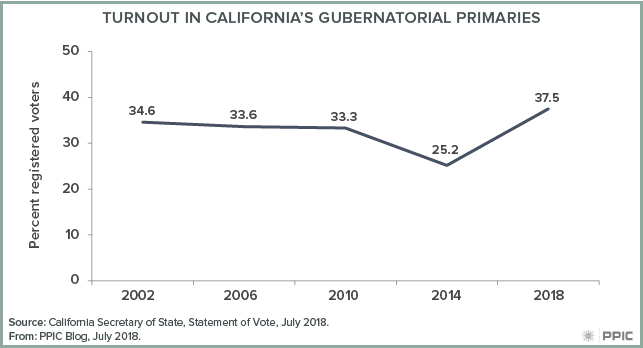
  • Strong political participation. A record-setting 19 million Californians—75.7% of eligible adults—were registered to vote in the gubernatorial primary. This threshold has not been reached since the middle of the 20th century. Moreover, the 7.14 million voters who cast ballots is an all-time high for a gubernatorial primary and, at 37.5% of registered voters and 28.4% of eligible adults, the turnout rates are the highest reported in the five gubernatorial primaries since 2000. Since his election four years ago, California Secretary of State Alex Padilla has been on a mission to make it easier for Californians to register to vote and cast ballots, and the efforts seem to be working. The May PPIC survey found that likely voters’ attention to election news was relatively high, so credit also goes to the media for stoking interest in political participation.

  • More independent voters. Many Californians are responding to the hyper-partisanship of national politics by eschewing the major parties and registering as independents (also known as NPP for “No Party Preference”). In June’s election, for the first time in the state’s history, NPP voters outnumbered Republican voters (25.5% to 25.1%). In the past four years, the number of NPP voters increased (+1,103,602) more than the number of Democratic voters (+745,598), while Republican ranks shrunk (-267,311). The makeup of the June ballot reflected the political clout of NPP voters. Four of the statewide races included NPP candidates, giving voters some nonpartisan choices they did not have under the previous primary system. And in a first for the general election, the top two candidates for insurance commissioner are a Democrat and an NPP candidate (formerly a member of the Republican Party).
  • Diverse statewide candidates. After much consternation about the likelihood of a single-party race at the top of the ticket, five of the eight partisan races—including the governor’s—feature a Democrat running against a Republican. Except for the governor’s race, the top-two primary results offer a diverse pool of candidates to choose from in the fall, at least among Democratic options. The US Senate election and the seven down-ticket races include five Latinos, four women, two Asian Americans, and one African American. Also, eight of the nine statewide races—including the governor’s—are contests between Northern and Southern Californians. While many Republicans are likely to skip voting in a US Senate race with two Democratic candidates, as they did in November 2016, a Democratic-only race for the open lieutenant governor seat will be closely watched for signs of cross-party voting.
  • Popular state ballot measures. Four of the five state propositions placed on the June primary ballot by the legislature passed. This is consistent with the historically high pass rate for legislative ballot measures. With the legislature’s approval holding steady and at a relatively high level in the May PPIC survey, the four state propositions each passed by healthy margins—including a 58% “yes” vote for the state water and parks bond. The latter results bode well for the state housing bonds passed by the legislature and placed on the November ballot. (Citizens’ initiatives appear only on the November general ballot.)

The main takeaway from the June primary is that the vital signs of California’s democracy are healthy. In the wake of California’s many election reforms, records may be shattered in the numbers of registered voters and ballots cast this fall—and throughout the 2020s. The top-two primary system may have its quirks, but it is well suited for the burgeoning number of NPP voters. NPP candidates have found a home in the top-two primary, an NPP will be on the fall ballot, and there will likely be NPP statewide officeholders in the future. The fears about major party voters feeling left out of the fall election were overblown, and most top two candidates reflect the state’s diversity. Positive responses to the June ballot measures suggest an easy time for the state propositions from the legislature this fall; the fate of the nine citizens’ initiatives—including a repeal of the recent gas tax increase—is currently less clear.

At PPIC, the race for governor, US senator, and superintendent of public instruction stand out as uniquely worthy of public attention. We have invited the two candidates in each race to participate in conversations with me about the future of California. Stay tuned for more information about these public events. Meanwhile, throughout the fall the PPIC Statewide Survey will focus on the governor’s race, the US Senate election, and the congressional races—as well as the gas tax repeal and other state propositions that impact our future. We look forward to informing discussions and raising awareness about the importance of this consequential election for the state and nation.

What Does the Repeal of Net Neutrality Mean for California Schools?

As the Federal Communications Commission’s (FCC) repeal of net neutrality phases in, concerns that Internet service providers (ISPs) could speed up or slow down traffic from certain websites or prioritize certain content loom large. Changes to Internet service, if any, will probably be slow and gradual; however, the repeal has potentially important implications for the digital divide in and outside of California’s schools.

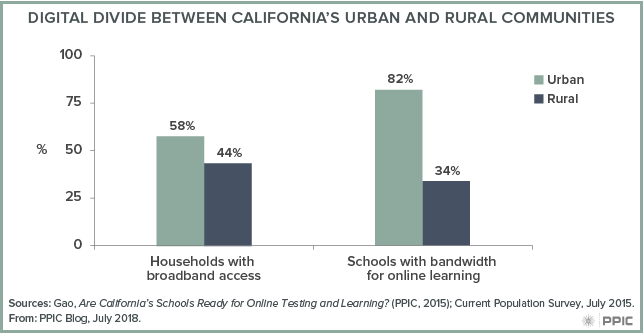
K‒12 schools rely increasingly on online content and management systems to deliver instruction (e.g., blended learning), administer standardized tests (e.g., Smarter Balanced assessments), and manage educational data (e.g., cloud computing). As online learning becomes ubiquitous, access to high-speed Internet is no longer optional—it’s a necessity. Most schools receive discounted Internet services through the federal E-rate program, but if providers decide to introduce tiered pricing based on content, students and educators could lose access to quality education programs. Tiered pricing could also exacerbate the digital divide between urban and rural districts. PPIC research shows that close to 70% of rural districts lack sufficient bandwidth for digital learning, compared to 18% of urban districts. If this gap persists or widens, students in rural areas may be left behind in the digital race.

Another concern is the homework gap. The FCC reports that 70% of teachers assign homework that requires access to broadband, while an estimated 860,000 (22%) households with school-age children in California do not have home Internet service. For many of these households, the cost is too high. Low-income families may get government subsidies (e.g., the Lifeline program) or discounts from ISPs. However, if providers create a fast lane for customers who pay premiums and a slow lane for those who don’t, the homework gap may widen. Rural residents may be particularly affected by these changes, because they tend to have more limited Internet access and fewer ISPs.

Federal and state policymakers have placed net neutrality near the top of their agendas. A major legislative effort to restore net neutrality fell short in the US House of Representatives. In California, two Senate bills (SB 822 and SB 460) that would establish a stringent net neutrality regime are being considered in the state legislature. Other states, including Montana, New York, and Oregon, are taking similar legislative or executive action

Paying for Water’s “Fiscal Orphans”

California’s water system is generally well funded and adequately maintained, but there are a few areas that lack a steady funding source. The most prominent of these “fiscal orphans” are safe drinking water for disadvantaged rural communities, flood management, stormwater management, and water for the environment. We talked to Dean Misczynski, an expert in infrastructure financing and an adjunct fellow with the PPIC Water Policy Center, about how to create a more reliable funding stream to address these problems.

PPIC: Are there better ways to pay for California’s underfunded “fiscal orphans”?

Dean Misczynski: Water is one of the easier things in government to pay for, because you can sell it. Local water fees and local taxes pay for most spending on water in California. State voter-approved general obligation bonds also play a pretty big role. But our thinking about how to use state bond acts developed sometime around the Civil War, and we could do a better job using bonds to fund 21st-century realities.

We currently use bond acts to raise the capital needed to build projects. But funding for the operation and maintenance costs of those projects is expected to come from somewhere else―or nowhere. No sensible business thinks this way; capital funding and operations and maintenance should be part of a unified financing plan. In addition to authorizing borrowing money for specified purposes, a state bond act could easily include ongoing expenses by appropriating money from the General Fund to pay for the operation and maintenance needed to make the project work. This approach would offer a more business-like, coherent financing plan and give voters a more honest look at what the undertaking would really cost.

To be clear, the operations and maintenance budget would not be part of the borrowing authorized by the bond act, because that would be an expensive way to pay for ongoing costs. But the funding would be earmarked and committed for the long term. And note that this doesn’t call for a new tax or fee; it just requires an ongoing commitment to use some General Fund dollars to cover the ongoing costs. In this way it’s similar to the bond itself—repayment comes from the General Fund, which ultimately comes from existing taxes.

PPIC: What types of issues would this approach be especially appropriate for?

DM: It’s best in situations where there aren’t good ways to cover operations and maintenance for projects funded by the bond. If we were to take this idea seriously, we’d want to do some careful thinking to identify the most legitimate uses of this new authority and to caution against using it for unnecessary or unwise purposes.

So, for example, a relatively well-off community getting a bond-funded project wouldn’t need state money for ongoing expenses. But for a water system in a very poor community, this type of funding mechanism could be very useful. There are a number of small, disadvantaged communities in the Central Valley that can’t afford to upgrade or maintain parts of their water system and that lack safe drinking water as a result. They might be good candidates.

These types of appropriations could also pay for ongoing expenses for projects that are important and have political support, but are easy targets for cuts during the state’s inevitable next recession. Two examples that come to mind are maintaining watershed areas, and data collection and analysis to improve water management.

This approach wouldn’t just be useful in the context of water—it could help with the transportation sector, low-income housing, and other statewide challenges. And it could be used as a model for local bond funding as well.

The Federal Farm Bill Could Affect CalFresh

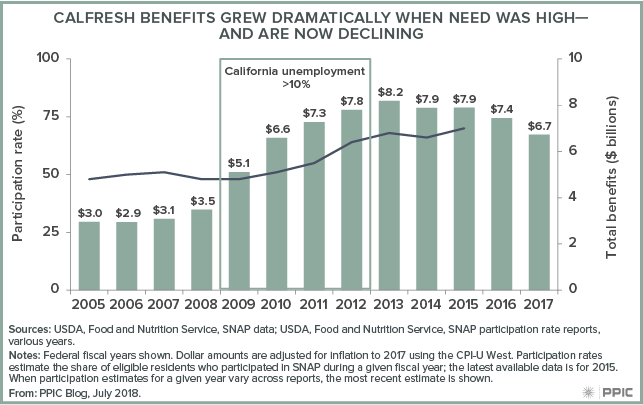
The federal Farm Bill is due for reauthorization in Congress, but its fate is still uncertain—Senate and House versions differ substantially. The largest share of spending in—and the most contentious aspect of—the bill is the Supplemental Nutrition Assistance Program (SNAP), known as CalFresh in California. CalFresh is the state’s main food assistance program, helping nearly 4 million Californians afford groceries each month. The Senate bill leaves net SNAP funding largely unchanged. The House bill would trim costs significantly, in part by revamping work requirements and limiting state flexibility in setting eligibility guidelines. These changes, which would reduce the number of program recipients, are being proposed at a time when the SNAP caseload is declining nationwide, after growing substantially during and after the Great Recession.

In California, policymakers have focused in recent years on getting more eligible Californians enrolled in CalFresh—the state had the lowest participation rate in the nation for a number of years. The share of those eligible who received benefits grew from about 50% to 70% between 2009 and 2015 (the most recent estimate)—but this improved participation rate is still near the bottom. Nonetheless, the California Poverty Measure estimates that CalFresh benefits kept more than 800,000 residents out of poverty in 2015.

Even as participation rates have been rising, decreases in demand are causing CalFresh benefit costs to fall—from $7.4 billion to $6.7 between 2016 and 2017 alone. Whether or not federal policies change, program costs are likely to continue to fall in the next year—unless the state enters a recession and the need for food assistance rises.

PPIC Celebrates Two New Endowed Chairs

PPIC has established the John and Louise Bryson Chair in Policy Research. Made possible by a gift from PPIC board member emeritus John Bryson and current board member Louise Bryson, the chair confers much-deserved recognition of—and support for—the leader of the research group at PPIC. The first Bryson chair is Sarah Bohn, who becomes director of research today.
PPIC has also established the Thomas and Marilyn Sutton Chair in Higher Education Policy with a gift from the Pacific Life Foundation. Tom Sutton is a former PPIC board member, and the Sutton Family Fund is a core supporter of the PPIC Higher Education Center, which launched in 2016. This new chair—held by Hans Johnson, the center’s director—recognizes and supports leadership in higher education research.

The generosity of these visionary leaders is motivated by a shared concern—and hope—for California’s future. Their support is vital to our ability to provide high-quality research and analysis, encourage productive dialogue, and inform the search for sustainable policy solutions in Sacramento and around the state.

Trends in Math Reforms at Community Colleges

The landscape of developmental (also known as remedial) math at California’s community colleges has changed dramatically in recent years. With the passage of Assembly Bill 705, community colleges will be required to maximize entering students’ likelihood of completing college-level math and English within a year. This is a critical goal. Our research has shown that developmental course sequences are lengthy, delaying students’ academic careers and sometimes affecting their ability to advance to college-level coursework.

The new law goes into effect in fall 2019, but many colleges have already started implementing reforms to improve the accuracy of placement into developmental education and to shorten developmental sequences while making them more relevant to students. In the 2017–18 school year, 83% of community colleges offered new developmental math courses in addition to or in place of traditional courses. Example course reforms include:

  • Offering statistics pathways for students in majors that only require statistics (e.g., liberal arts and humanities fields)
  • Compressing the traditional multi-course developmental sequence into a single course
  • Providing lab time or supplemental instruction in a co-requisite course while allowing students to enroll directly into college-level math
  • Designing curricula aligned with students’ programs of study
  • Dividing courses into modules that represent discrete math competencies

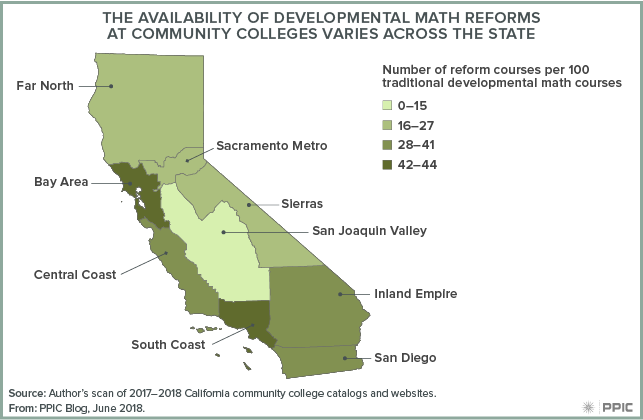
However, the availability of these new courses varies greatly within colleges and across the state. As illustrated in the map below, for every 100 traditional math courses offered in each region of California, less than 50 reform courses are offered, indicating that on the whole reform courses are still not as available as traditional courses. Moreover, reform courses tend to have fewer sections, which further limits enrollment.

Colleges that are adopting course reforms are mostly concentrated in highly populated regions such as the Bay Area and South Coast, which collectively serve about 56% of full-time community college students in the state. In contrast, the San Joaquin Valley stands out as having the smallest ratio of reform to traditional developmental math courses, while serving roughly 10% of full-time community college students in the state. Only six out of the thirteen colleges located in the San Joaquin Valley offer at least one course-level reform.

Although some California community colleges have already implemented developmental math reforms, overall, these efforts have reached only a small fraction of the students that could potentially benefit. Math guidelines for AB 705 are still pending, but the legislation may offer the leverage needed to implement effective reforms at scale and dramatically improve student completion of college-level math courses.

Emergency Departments and the Affordable Care Act

Coverage expansions under the Affordable Care Act (ACA) have resulted in a dramatic decline in the uninsured population in California. Much of the coverage gains have been driven by expanded eligibility for Medi-Cal, the state’s Medicaid program, which has seen a nearly 60% increase in enrollment since January 2014. With this large Medi-Cal expansion comes concerns about controlling costs, ensuring adequate access to care, and supporting the state’s health care safety net.

Monitoring how often people seek care in California’s emergency departments offers important insights—in part because frequent use can signal poor access to other medical care options. Hospitals in some parts of the state have reported growing demand for emergency care services in recent years. In a new study published this month in the journal Health Affairs, we examined emergency department use to understand how things have changed since the implementation of the ACA.

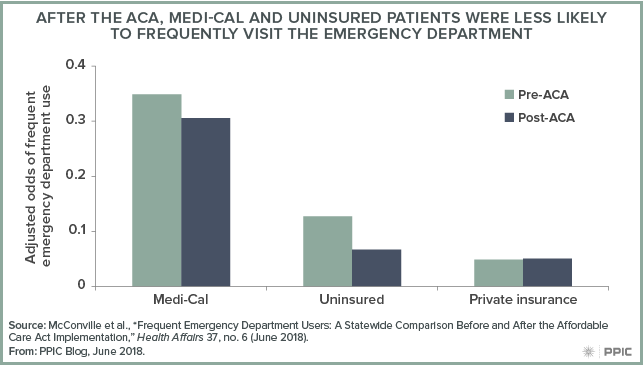
After controlling for factors such as patient age and health status, we found the odds of being a frequent emergency department user—with four or more annual emergency department visits—were significantly lower for Medi-Cal patients after the ACA. The odds of frequent use among the uninsured declined even more, while those with private insurance experienced little change. At the same time, however, there has been an overall increase in both the share and the absolute number of emergency department patients who are frequent users—despite the lower odds of frequent emergency department use after the ACA. We found that frequent users accounted for 7.9% of emergency department patients in the two years before the ACA, compared to 8.5% in the two years after.

Both before and after the ACA, the largest predictors of frequent emergency department use were having a diagnosed mental health condition or substance use disorder. This finding suggests state efforts to better integrate physical and behavioral health services for Medi-Cal enrollees could help lower frequent emergency department visits. Given that Medi-Cal is now the primary coverage source for more than two-thirds of frequent emergency department users, care plans managed by Medi-Cal will be a key player in efforts to manage emergency care moving forward.

In future work, we will be studying in more depth how changes in insurance coverage affected emergency department use across the state—with a particular focus on regions that saw the largest declines in their uninsured rates.