Yesterday’s Dams Face Tomorrow’s Floods

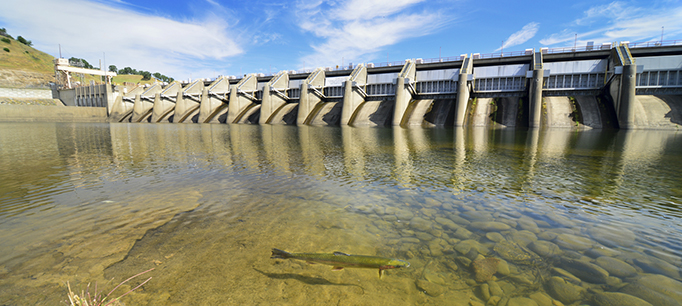
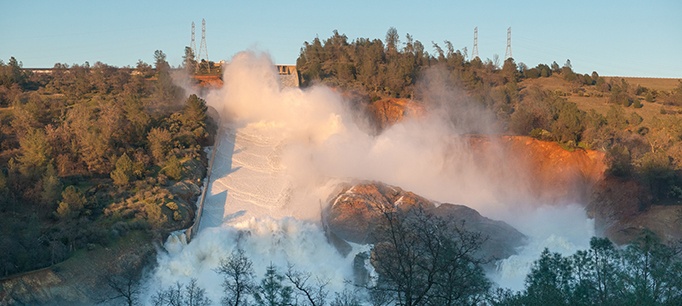
The crisis at Oroville Dam on the Feather River eased yesterday as state officials gained control over the damaged spillway and allowed the more than 180,000 evacuees to return home. Prospects are good that dam operators will be able to control releases through the remainder of the wet season. Now that the immediate crisis is past, we should take the opportunity to review how we manage California’s big dams—and what changes would help us do so more effectively in future.

Water—whether too much or too little—has a way of revealing weaknesses in design and decision making. For Oroville Dam—the tallest dam in the nation—the crisis began with poor maintenance of its main spillway compounded by wholly inadequate design of the emergency spillway, a known problem. But the crisis at Oroville also raise five broader concerns that California will have to reckon with:

  • Aging dams. Most of the state’s 1,400 large dams were designed using slide rules and based on simplistic assumptions about hydrology and earthquakes. These dams are marvels of engineering considering when they were built, but many are in need of major upgrades in infrastructure and operations. California needs a comprehensive plan for evaluating and modernizing these structures.
  • A changing climate. California’s dams must be adapted to address new risks from a changing climate. These dams were built to respond to early- to mid-20th century conditions. The climate has shifted since that time, and the bulk of climate simulations point to significant changes in the near future. Our dry periods are getting both drier and warmer, and our wet periods are getting wetter with more precipitation falling as rain rather than snow. Part of the problem at Oroville is that the warm temperatures have meant there’s more water to manage right now than usual because less of it is staying in the snowpack. The past seven years—which included five years of record warm, dry conditions bracketed by extremely wet ones—is a glimpse into our future. It is time to rethink how we are going to operate and maintain our dams to respond to these changes.
  • Conflicting goals. We may be asking too much of our dams. For example, Oroville Dam provides water supply, hydropower, flood management, recreation, and ecosystem flows for rivers and the Delta. Flood management is in tension with the other services because a mostly empty reservoir—bad for the other services—is the best hedge against floods. By design, Oroville was relatively full when the latest floods arrived, reflecting its top priority (water supply) and compounding flood risk. It may be time to rethink the balance of objectives for all of our large, multipurpose dams.
  • Rigid rules. Adjusting course on dams—whether by changing the infrastructure or the way they are operated—is difficult. Licenses for non-federal dams like Oroville—administered by the Federal Energy Regulatory Commission—last for 30–50 years. These lock in place all aspects of dam operation for several generations and require herculean efforts to overcome. Moreover, flood operations on all dams are mandated by the US Army Corps of Engineers and require an act of Congress to change. When it comes to changing course on dams, institutional inertia is a powerful countervailing force.
  • High cost of improvements. Any change in course is likely to be very expensive. California relied heavily on federal support for construction of many of its large, multipurpose dams. Support ended decades ago and is unlikely to resume in the future. California is going to need a comprehensive funding plan for modernizing its dams and other flood management systems that does not rely on extensive federal support.

Most water crises have a silver lining. The recent drought spurred changes to the way we manage water scarcity in the state, resulting in one of the most important pieces of water legislation—the Sustainable Groundwater Management Act—in many decades. The crisis at Oroville should spur Californians to rethink how we manage our network of large dams. New management approaches, new technology, and new investments to modernize dams will be necessary to adapt to changing conditions, both today and tomorrow.

Learn more

Visit the PPIC Water Policy Center flood resources page
Read California’s Water: Climate Change and Water (from California’s Water briefing kit, October 2016)
Governor’s Funding Plan for Climate, Drought

Governor Brown has released a proposed budget that reaffirms the state’s commitment to boosting drought resiliency and battling climate change. While specifics are likely to change before the budget is finalized in June, here is a summary of key proposals.

  • Cap and trade. California’s recent efforts to combat climate change have been funded from its cap-and-trade program. The program faces an uncertain future because its statutory authority is set to expire in 2020. Partly due to this uncertainty, 2016 cap-and-trade auctions raised a fraction of the money raised in previous years. At the governor’s budget press conference, he announced legislation that would extend the program beyond 2020. Appropriation of cap-and-trade funds in the new budget is dependent on the passage of this bill—which will require a two-thirds vote in both the senate and the assembly. Should it pass, the governor proposes appropriating $2.2 billion for cap and trade, a decrease from last year’s $3.1 billion. As in past years, 60 percent of the proceeds would be for ongoing funding of public transit, affordable housing, sustainable communities, and high-speed rail. The rest is split among one-time investments. This year, the largest sum in the one-time investment pot ($863 million) is for public transit improvements aimed at increasing ridership and decreasing greenhouse gas emissions. Smaller sums include $142 million to fund local climate actions in the state’s most disadvantaged communities and $128 million for projects in forests and urban and agricultural landscapes that remove carbon dioxide from the atmosphere and store it in vegetation or soils.
  • Emergency drought spending. While recent rains have drenched California, the governor’s emergency drought declaration is still in effect, and the new budget appropriates an additional $188 million in one-time resources for drought relief. Roughly half ($91 million) is allocated to CAL FIRE—the agency dedicated to fire protection and stewardship of the state’s forests—to enhance its firefighting capacities and support the removal of dead trees. The drought has contributed to widespread tree mortality, which has raised concerns that the dead trees might fuel future destructive wildfires.
  • Water bond updates. Nearly 80 percent of Proposition 1 water bond funding has already been appropriated (though far less has been awarded for spending). This year, the governor proposes appropriating $248 million from the bond for an Integrated Regional Water Management grant program. These funds are meant to incentivize regional cooperation with the goal of resolving complex water management challenges at a broad scale while balancing social, environmental, and economic objectives. For instance, these funds could foster a regional approach to helping water systems adapt to climate change. An additional $3.8 million would enable the State Water Resources Control Board to enforce the implementation of California’s groundwater law.

Although state money represent only a fraction of California’s total water sector spending (13%—the rest is mostly locally funded), it is an important piece of the funding pie. While the governor’s proposed budget would bring welcome funding to a number of critically important areas, key water challenges continue to experience long-term funding gaps—especially safe water for small rural communities, flood control systems, stormwater management, and ecosystem management.

Learn more

Read California’s Water: Paying for Water (from California’s Water briefing kit, October 2016)

Visit the PPIC Water Policy Center

Video: Legislative Leaders Look Ahead

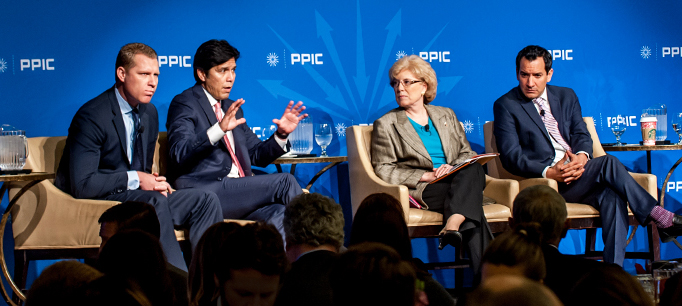
Despite their political differences, California’s legislative leaders have similar views of the state’s most pressing challenges. In a conversation facilitated by PPIC this week in Sacramento, the two top legislators from both major parties provided a preview of the issues they expect to tackle this session. With the impact of federal policy changes still unclear, the legislative leaders focused on longstanding challenges.

Asked to list the top issues the legislature and governor need to work on this session, Anthony Rendon, the Democratic speaker of the state assembly, named housing and transportation—topics he heard about repeatedly as he campaigned around the state. He said he saw the impact of a housing and transportation crisis first hand when walking precincts in the Inland Empire. “If you knock on someone’s door at 7:00, 7:30 p.m., they’re not home yet. They’re still on the freeway.”

Jean Fuller, the Republican leader of the state senate, sees the top issues as affordability in California generally and jobs. “We are concerned about housing, but we are also very concerned about jobs.” She noted that in her district, which stretches from Visalia to Twenty-Nine Palms, there is double-digit unemployment.

Kevin de León, the Democratic state senate president pro tem, said the past legislative session had been particularly productive; he highlighted minimum wage, gun safety, and climate change legislation. In this session, he said, “we have to deliver on the issues of housing and transportation and the issue of economic growth.”

For Chad Mayes, Republican leader of the assembly, poverty is the number one issue in the state, which has the highest poverty rate in the nation. “If you use that as a performance measure for how well our board of directors—the state legislature—is doing, I think you’d have to say we have been failing.” He added: “We’re failing, in large part because of housing costs.”

The speakers acknowledged major policy differences. But they pointed to past successes in bridging them as a sign that they can do so again.

“Things are not broken here, in comparison to DC,” said de León.

A Water Sector Energy Hog

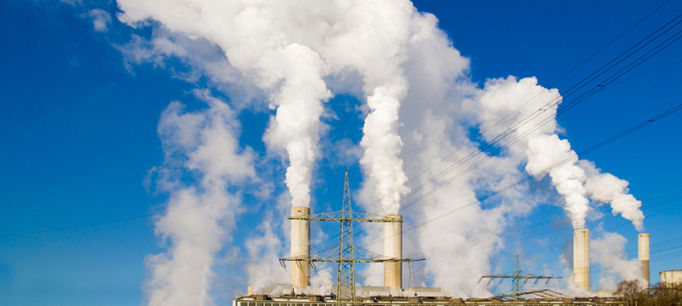
When we use water, we’re also using energy—sometimes a little, sometimes a lot. Overall, water use accounts for about 20 percent of California’s electricity use and 30 percent of natural gas used by businesses and homes. This energy is used to supply, convey, treat, and heat water.

Where does it all go, and more importantly, how can we best save both water and energy?

You might guess that our long-distance transport of water through the state’s network of canals and pumping stations is a big energy hog. The federal and state water projects combined move about a quarter of all water used in California. The State Water Project—which conveys water from the Sacramento–San Joaquin Delta to cities and farms in the San Joaquin Valley, the Central Coast, and Southern California—is the largest single user of electricity. But even so, the state’s water conveyance system is something of an energy sipper, accounting for just 4 percent of the sector’s total energy use.

Or maybe you’d assume that California farmers—who use about four times more water than the state’s urban areas—use the most water-related energy. But even though farmers pump some 10 million acre-feet of water in an average year, they use just 5 percent of California’s water-related energy.

Have you guessed it yet? Hint: The state’s cities, especially California households and industries, use by far the most water-related energy—and much of it goes down the drain.

Heating water is the most energy-intensive water-related activity. Some residential “end uses” of water—faucets, showers, and clothes washers—are energy hogs, accounting for 42 percent of all energy used in the water cycle. And in total, the residential, industrial, and commercial end uses of water account for more than 85 percent of energy used in the water sector. By comparison, supplying, pumping, and treating urban water make up about 5 percent. 

Reducing the energy footprint of the state’s water cycle will require more reductions in hot water use.

A recent study, which looked at the energy use of supplying, pumping, and treating water, estimated that the energy savings resulting from drought-related urban water conservation to date has equaled the combined savings of all energy efficiency programs offered by the state’s major energy utilities. The study did not account for water heating or other energy-intensive uses of water.

California has been a leader in energy efficiency for many years. Its efforts include reducing energy use of washing machines and dishwashers—which together still use less energy than showers. Last year, the state’s energy commission adopted new standards (which went into effect this summer) that will cut water flow in showerheads by 20 percent. The move is expected to save more than 2.4 billion gallons a year in the first year—and enough energy to power more than 200,000 homes for a year.

To further reduce the energy footprint of the state’s water cycle, it would be most effective to continue to target reductions in hot water use. This can be done by changing our habits (such as decreasing water heater temperatures), improving water-heating efficiency, and reducing the energy intensity of some industrial processes.

Saving energy in the water sector also reduces greenhouse gas emissions—nearly 10 percent of the state’s emissions are directly associated with water use. California plans to reduce its emissions 40 percent below 1990 levels by 2030, and the water sector can provide some of the most cost-effective ways to meet that goal.

But as always in California’s water management, there is no one-size-fits-all solution. Local assessments—with state agencies’ support—are needed to evaluate cost-effectiveness of various solutions locally and across regions. The state could then use these assessments to devise a statewide plan for reducing the water sector’s energy consumption and greenhouse gas emissions.

Learn more

Read California’s Water: Energy and Water (from the California’s Water briefing kit, October 2016)
Visit the PPIC Water Policy Center

California’s Changing Headwaters

Much of the state’s water supply originates in forested headwaters high in the mountains. Yufang Jin is a UC Davis professor specializing in ecosystem change and remote sensing (gathering aerial images of the earth). She is also a member of the PPIC Water Policy Center’s research network. She talked to us about how a warming climate and extreme wildfires are changing these crucial ecosystems.

PPIC: How are large wildfires changing our watersheds?

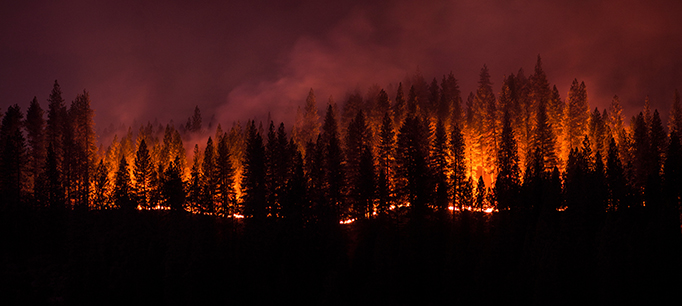
Yufang Jin: We’re seeing intensifying wildfires in California, especially in the headwater regions where our rivers originate. More intense fires have significantly changed the composition and structure of forest ecosystems, affecting both water quality and quantity—though not always for the worse. For example, large fires can significantly reduce the amount of vegetation covering the land, which reduces the amount of water consumed by plants. Burned areas also have much less water circulating in the soil. Both of these post-fire processes have a positive impact on streamflow, as more water works its way into the water table and streams. But the loss of groundcover plants from intense fires also increases surface erosion, which can cause landslides in the rainy season. Ashes and sediments flowing into streams harm water quality.

PPIC: What are catastrophic fires teaching us about managing forests, wildfires, and water in California?

YJ: They’re pushing us to use management strategies that recognize the relationships between forests, fires, and water supply. In the past most forest management focused on wildfire suppression. There’s now recognition that solely focusing on suppression led to unnaturally dense forests, which in turn led to larger and catastrophic fires. So now there’s a growing effort to use forest thinning and prescribed fires to reduce fire hazards. Some pilot projects indicate that allowing natural fire to thin forests can lead to increases in water quantity in the watershed as well. A lot of federal and state agencies are now emphasizing watershed restoration strategies that bring multiple benefits. They are paying more attention to approaches that reduce fire hazards and may also increase water yields.

PPIC: How will climate change affect the severity of wildfires in California?

YJ: All climate models predict that the warming trend will continue in coming decades, and will often be accompanied by drier conditions. There is consensus that with these conditions, we can expect more severe wildfires across California and in the West more generally. One of our recent studies showed that the average area burned in Southern California could increase 70 percent by mid-century. Another effect of climate change is that forests in the western US will become more vulnerable to drought stress, making them more prone to diseases and beetles, leading to greater tree mortality and more fires.

PPIC: What kinds of technological advances can help us improve watershed management in the state?

YJ: There are two technologies that can provide more informed water management. One is obtaining images from satellites with remote sensors to learn about ecological and hydrological conditions on the ground. The other is using big data analytics and cloud computing, which can help us interpret the huge amount of data you get from remote sensors and translate it into information that farmers and water managers can use and act upon.

Basically, remote sensors can be used to monitor factors like water temperatures, the range of particular plant types, or the amount of water being released from plants. You can observe relatively large areas over time in a cost-effective way. For example, remote sensors can help detect algal blooms and invasive aquatic species throughout the watershed. Water managers can use remote sensing to estimate how much water is being used by crops or by natural vegetation, and how that water use changes from season to season or year to year. It can also help figure out how ecosystems will respond to a changing climate or how changing land use can affect water use. For fire management, remote sensing can track when and where fires occur, how effective fuel treatment projects are in reducing fire severity, and how vegetation recovers after fires.

While there are no simple technological solutions for managing the effect of a changing climate, having tools like these will make it much easier to get the quantitative information that we need to develop adaptive forest and watershed management strategies.

Learn more

Read California’s Water: Protecting Headwaters (from California’s Water briefing kit, October 2016)
Read “Managing Wildfires Requires New Strategies” (PPIC Blog, September 23, 2015)
Visit the PPIC Water Policy Center’s drought resource page

Uncertain Future for Cap-and-Trade

To date, California’s actions to combat climate change have been funded mostly through its cap-and-trade program, which allows the state to collect funds from greenhouse gas emitting sources. California was the first state to institute a cap-and-trade program. To date it has collected more than $4 billion in auctions of permits to companies and significantly reduced greenhouse gas emissions through the program. But the state program has been challenged in the courts, and its statutory authority is set to expire in 2020. At least in part due to the program’s uncertain future, there has been a drastically reduced collection of revenues this year.

The program is an interesting blend of regulation and free-market practices. The Air Resources Board—the agency in charge of the program—sets a cap on state’s greenhouse gas emissions and allocates emission permits for each company that releases them. Usually the permitted amount of emissions is lower than the company’s current level of emissions. To make up the difference, companies have the option to buy more permits from the state or from other companies that can reduce their emissions at lower cost. These permits, both private and public, are auctioned quarterly in a public online market. This market-based mechanism enables the state to promote technological innovation and brings flexibility to the effort to reduce emissions.

The funds collected also serve to pay for mitigation and adaptation programs. Under the current law, 60 percent of cap-and-trade proceeds are continuously appropriated to public transit, affordable housing, sustainable communities, and high-speed rail. The remaining funds are appropriated on a one-time basis each year to programs for disadvantaged communities, clean transportation and the environment. As of this September nearly $2.3 billion had been appropriated, including more than $700 million for high speed rail, almost $500 million for affordable housing and sustainable communities programs, $325 million for low carbon transportation, more than $200 million for transit programs, and the remaining for a variety of other programs including energy efficiency, agriculture, forests, and other environmental programs.

This year’s one-time investment will go to support programs that reduce greenhouse gases while benefiting disadvantaged communities, support clean transportation, and help protect ecosystems. The legislature and governor were unable to come to an agreement to spend all of the discretionary funding, and reserved an additional $462 million for future appropriations. This decision may have been motivated by uncertainties surrounding the future of the cap-and-trade program.

Virtually all allowances that were offered for sale in cap-and-trade auctions in 2015 by the Air Resources Board were sold. However, that has not been the case in 2016. The February 2016 auction saw a small amount of allowances go unsold. In the May and August 2016 auctions, the Air Resources Board sold less than 2 percent of the allowances offered. As a result, the May 2016 auction brought in only $10 million, and the August auction brought in $8 million—compared to $517 million from the February auction.

If the state does not address these uncertainties, revenues may continue to be small, forcing the state to cut spending on programs funded by cap-and-trade or look for other ways to meet its ambitious actions to address climate change.

California’s Snow Drought

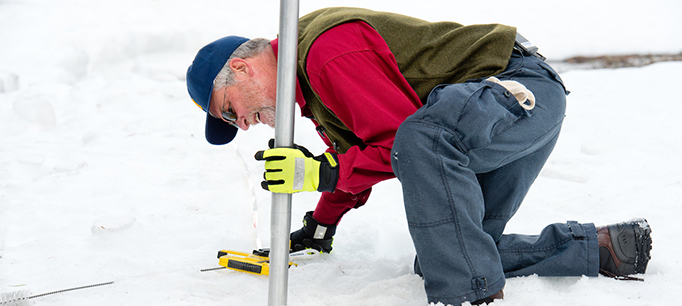
Snow—or the lack of it—has been making headlines lately. California has had unusually low snowpack for the past several years, and the winter of 2015 was the all-time lowest snowpack in recorded history. Low snowpack brought major challenges to water managers.

Snow plays a disproportionately large role in water and environmental management in California. About a third of our average annual water supply starts out as snow. It flows into our major reservoirs in spring and early summer, when water demand on farms starts to ramp up.

“Snow droughts” typically coincide with reduced overall precipitation. This is always associated with a reduced number of large storms during winter (California relies on a handful of large storms every year to supply most of its water.) Snow droughts are also associated with unusually warm conditions.

Temperature affects snowpack in several ways. During warm winters, rain turns to snow at higher elevations than in colder years. This means that a smaller area is covered by snow, and there is less snowpack. Snow—like water—can also evaporate when conditions are warm. This process, known as sublimation, can dramatically reduce the snowpack. Finally, warm conditions cause early melting of the snowpack. The thinner the snowpack and the warmer the conditions, the sooner it will melt. In an average year, California’s snowpack starts to melt around April 1. During warm drought years, it can melt as much as a month or more earlier.

A good snowpack helps bolster our reservoirs precisely when the demand for water—principally for irrigation for farms—is highest. Many reservoirs are required to maintain space for capturing winter floods to protect downstream users. The spring snowmelt is critical for refilling these reservoirs to meet water supply needs. Snow droughts add special challenges to water management because changes in the timing and volume of runoff can have a big impact on reservoirs.

Environmental management is also complicated by snow droughts. State and federal laws require that many reservoir operators release cold water to support downstream habitat for steelhead and salmon. During the warm days of summer, managers tap into the pool of cold water that accumulates at the bottom of a reservoir (cold water is denser, so it sinks). Snowmelt runoff lowers the temperature and increases the volume of a reservoir’s cold water pool. This gives greater flexibility to managers for meeting both water supply and habitat needs, which are often in competition.

Snowpack is also the source of most of the state’s hydropower generation. A small or early snowmelt can cause significant reductions in hydropower, forcing utilities to make up the difference with other sources (most typically, fossil fuels).

Finally, snow droughts may be increasing in frequency and intensity. Recent studies throughout the West are showing that temperature—rather than reductions in precipitation—may have the most significant influence on drought conditions. And most climate projections suggest that this trend will likely worsen over the course of this century. The 2012–15 snow drought—along with all its water management challenges—may become much more common in the future.

There are no simple solutions to the loss of snowpack. To adapt, California will have to shift from its historic reliance on snowpack for storing water. This will require more flexible operation of our surface reservoirs to accommodate changes in timing and volume of snowmelt runoff. We’ll have to shift more water into aquifers to support flexible operation of dams, particularly those that need to make space to capture winter floods. And environmental managers will have to find innovative ways to conserve cold water to sustain salmon and steelhead populations, especially as the climate warms.

All of these adaptations are doable and need not represent major increases in costs or disruptions to water supplies. But we’ll need new policies, changes in the traditional ways we manage water, and a willingness to act to address the snow drought challenge.


Learn more

Read California’s Water: Climate Change and Water (from the California’s Water briefing kit, October 2016)

Watch “California’s Water Challenges: Water Supply”
Visit the PPIC Water Policy Center drought resource page

Acting Locally to Address Sea Level Rise


The author is a member of the PPIC Water Policy Center research network.

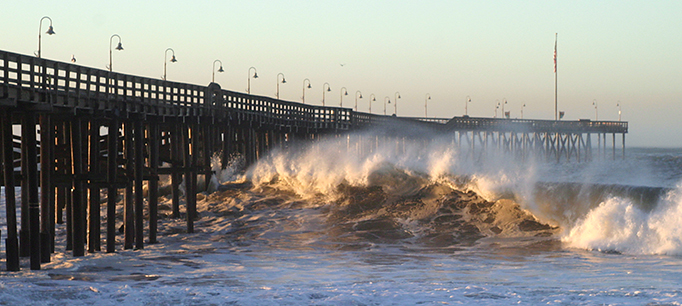
October brought a preview of some of the climate risks that coastal regions face. Hurricane Matthew wreaked havoc from Haiti to the eastern seaboard and the West Coast’s first “atmospheric river” storm brought flood warnings in some areas. The risk of coastal flooding is growing as a warming climate causes more intense precipitation and a gradual rise in sea level from Earth’s melting ice sheets. Both worsen the effect of high tides and large storms.

We have a few decades and perhaps up to a century to adjust to sea levels that are at least three feet higher than they are today. Coastal communities can expect a host of costly and dangerous problems from storms, including flooded wastewater treatment plants, shoreline erosion, industrial facilities spilling chemicals into waterways, and water supply systems inundated by seawater. The effects of floods are projected to be the most costly part of climate change. Some estimates put the global losses at $1 trillion a year by 2050, or roughly two percent of global GDP.

Although seas are rising relatively slowly, change will not be gradual at the community level. A series of strong winter storms that combine high tides, large waves, and intense rainfall can radically reshape a community in a matter of days.

For California to adapt, every coastal community will need a plan that envisions a future with higher sea levels and greater risk of coastal erosion and flooding. The plans will need to outline specific projects needed to weather changing conditions over coming decades. Communities will need to figure out how to raise roads, buildings, and critical infrastructure, and ways to enhance natural protective systems, such as beaches. Some combination of building codes and assistance programs is likely to be necessary. So far, most California communities are in the early stages of planning to adapt to rising seas.

Research shows that increasing awareness and knowledge of hazards is not enough to head off losses from disaster. A complicating factor in adaptation planning is how to make the scientific information actionable at the local level.

One new approach shows promise. A UC Irvine program called FloodRISE is bringing together experts in flood disasters, engineering, and the social sciences with local experts and community members in a number of Southern California communities and Tijuana, Mexico. As part of that program, we’re working with decision makers, community groups, NGOs, and personnel from key departments such as public works, city planning, emergency management, and environmental resources. The teams work together to create advanced visualizations of flooding. Using the latest climate science and data, local knowledge and flood modeling technology, they focus on addressing specific issues that communities care about the most.

How well we manage the problem of rising seas will to some degree depend on funding choices we make now. My FloodRISE collaborator Richard Matthew, a political scientist and disaster expert at UCI’s Blum Center for Poverty Alleviation, notes that funding for planning and preventing disaster risks is dwarfed by the resources that pour into communities after disaster strikes. In the chaos of emergency management, decisions must be made quickly and with very limited information, which too often leads to wasteful spending. Allocating more funds to climate-risk planning efforts would not only help local communities prepare for a rising sea and coastal flooding—it could help reduce wasteful spending later.

Learn more

Read California’s Water: Preparing for Floods (from California’s Water briefing kit, October 2016)
Read “Floods in California” (PPIC Water Policy Center fact sheet, February 2016)
Visit the PPIC Water Policy Center’s floods resource page

Video: John Chiang Looks to the Future

What are the top three issues that will make a difference to California’s future? That is the first question John Chiang—state treasurer and candidate for governor—was asked by PPIC’s president and CEO, Mark Baldassare.

Chiang’s response: education, economic security and opportunity, and the environment. He elaborated on these themes in the conversation before a San Francisco audience last week.

As treasurer, Chiang is the state’s banker, whose responsibilities include selling California’s bonds, investing its money, and managing its cash. He served two terms as state controller and was also on the Board of Equalization.

Baldassare said that he would sum up Governor Brown’s philosophy about taxes and spending as “fiscal restraint” and asked Chiang to sum up his own fiscal philosophy.

“Smart financial investment,” Chiang said.

“If you have the money, you invest it in education, you invest it in safety, you invest in infrastructure, make sure that you do the core issues correctly,” he elaborated.

PPIC invited Chiang as part of PPIC’s Speaker Series on the Future, which brings thought leaders from across the political and geographic spectrum to California audiences for conversations about the state’s pressing challenges. PPIC does not endorse, support, or oppose candidates for public office.

California’s Ecosystems in Perpetual Drought

Freshwater species—especially fish—are in trouble, and it’s not just the latest drought that put them there. We talked to Ted Grantham, a river scientist at UC Berkeley and a member of the PPIC Water Policy Center’s research network, about the status of the state’s freshwater ecosystems.

PPIC: Drought has really hurt populations of native fishes. Aren’t these fishes adapted to drought?

Ted Grantham: California’s native fish have been in steady decline for at least 50 years—in part due to dams, habitat degradation, and the introduction of non-native species. Drought is an added stressor. California has a highly variable climate, with dramatic changes in rainfall and stream flow from year to year. Native fishes have developed several strategies to cope, but key to their long-term survival is their ability to recover from drought during wet years. It’s a “boom and bust” ecosystem. The problem is that we capture and divert a significant portion of available water in wet years, making it harder for the fishes to recover. Since 1975 the state has had about 15 years that were above-normal or wet years. But in the Delta, for example, the ecosystem only experienced about half that many wet years because of water diversions. During this same period, California has had fewer than five extreme dry years, but the Delta experienced about 20 from the ecosystem’s perspective. Essentially, our freshwater ecosystems are now experiencing a perpetual drought. The boom and bust ecology has lost its boom.

PPIC: A number of California fish populations hit new lows in this drought. What can we do to prevent extinctions?

TG: There are at least three strategies that would help us better manage our native freshwater fishes. First, we need to better define the amount of water needed to sustain healthy fish populations. The ability to protect flows for ecosystem benefits also depends on an accurate accounting system for tracking water availability and use; we have a long way to go on this. And we need to recognize that not all streams are created equal—some streams are disproportionately important for supporting biological diversity. Currently, the state doesn’t have a plan to identify and protect those areas. We need to be more strategic in conserving the places that matter most.

PPIC: What kinds of problems will climate change pose for California’s ecosystems, and what can we do about it?

TG: For many of our native fish species—especially salmon—California is the southern extent of their natural range. So we’re already at the limits of their tolerance for warm temperatures. As the climate gets warmer, life will be increasingly difficult for these species. We’re already seeing that species dependent on cold water are responding to climate warming by moving to cooler streams, such as those at higher elevations. The problem is we’ve constructed so many dams on our rivers that fish might not be able to migrate to these preferred locations—the dams act as barriers to fish movements. California has at least 1,400 large dams and thousands of smaller ones. We need to start identifying critical barriers to fish movement and take a closer look to determine if modifying these structures—or in some cases removing dams—is a feasible strategy to restore connectivity in our rivers and streams.

The second adaption strategy is protecting “climate refugia”—areas naturally buffered from climate change—to support cold-water species. Some rivers and streams appear to be more resilient to climate change and provide sustained, cool flows despite warming air temperatures—because they are fed by groundwater springs or have a northern exposure, for example. Identifying and protecting these kinds of refugia could help minimize the loss of species in a warmer future.

I am actually optimistic about the future. Although the drought has severely affected California’s freshwater ecosystems, it also has raised awareness about the need to improve water management and better prepare for climate change. We’ve begun to address longstanding problems, such as poor groundwater management. We’re also starting to realize that the health of our ecosystems is tied to the reliability and quality of our water supply, which is leading to creative and more integrated solutions that balance human and ecosystem needs.

Learn more

Read “How Much Water Does Nature Need?” (PPIC blog, June 29, 2016)
Read “Lessons on Sustaining the Environment During Drought” (PPIC blog, June 23, 2016)
Visit the PPIC Water Policy Center’s ecosystems resource page