The Changing Face of California’s Water Leadership

California’s water managers face many challenges—from a changing climate to a growing population. We spoke with Celeste Cantú, chair of the PPIC Water Policy Advisory Council. Cantú served for more than a decade as general manager of the Santa Ana Watershed Project Authority and is stepping down this month. She talked about how the profession must change to better address these issues.

PPIC: What does it mean to be a “water leader” in California today?

Celeste Cantú: Currently, our water leaders primarily draw from an engineering skill set; their goal has been to manage discrete problems with precisely targeted solutions. That approach has proven to be too piecemeal for the water challenges we face today. Going forward, water leaders will need to be change agents. Water leaders will need to step out of their silos and see how their work fits into the larger context of the watershed, and think about upstream and downstream impacts. They’ll need “soft skills” such as conflict management in addition to technical expertise, because key to addressing 21st century water problems will be the ability to collaborate and develop solutions that benefit the larger system or watershed.

How we think about water is also changing. For most of the 20th century we managed water as if it were fuel you burned until it was gone. But water constantly circulates. Every drop delivered goes somewhere else when we’re done with it—usually, it’s treated and returned to a river, where someone downstream is likely to use that drop again. Historically, we water managers haven’t seen ourselves as interacting in that cycle―we see ourselves more in the context of our discipline or local agency. By thinking about the entire water cycle, we can manage the drop to get more beneficial uses from it. We get as many as 10 or 20 uses in the Santa Ana watershed before we release it to the ocean. It’s been said that a drop of water in the Santa Ana River is the hardest working drop in California! Collaborating across boundaries to get more uses from that water drop is the defining challenge of a successful 21st century water strategy.

PPIC: How have the state’s water challenges changed?

CC: I’ve seen an upward spiral of progress over the course of my career. Early on, we mostly were thinking about how to reduce pollution from particular sources. After getting that pretty much taken care of, we moved on to addressing more diffuse pollution that doesn’t come from one place. We’ve made progress but still have quite a ways to go. I’ve also seen an evolution toward integrated water management, an important strategy that addresses multiple water issues more efficiently and synergistically. It means the water supply agencies work with the stormwater agencies and water quality people to get more functionality out of that water drop. We’ve made progress on this as well. Finally, thanks to California’s leadership, we have a much better understanding how much water we use and how to conserve it.

PPIC: Will the next generation of water leaders face new water challenges?

CC: They absolutely will, due to climate change, but they also come much better prepared to address these challenges. They bring a greater understanding of the linked qualities that exist in nature and which define water resource management. They come better prepared for collaboration and not only solving problems but creating a new vision of resiliency. I am optimistic, and committed to sharing knowledge with the new leadership. After I retire this month I’ll be working with Water Education for Latino Leaders (WELL), which helps cultivate water leaders among elected officials working in Latino communities.

The incoming generation of water leaders is much more diverse. California needs water leaders who reflect our demographics, or they will lack standing or legitimacy. We’ll need to make some difficult choices and substantial investments in water in the future. Since we don’t have sufficient revenue streams, water managers will have to have trusting relationships with their ratepayers. People from the community are better able to develop those relationships.

Learn more

Explore the California’s Water briefing kit
Visit the PPIC Water Policy Center’s water supply page

Video: Building Urban Drought Resilience

The recent drought was long, hot, and difficult, and it brought a host of challenges to the state’s water suppliers. Yet California’s urban areas came through the ordeal fairly well, thanks to preparations since the last major drought. Last week a panel of urban water experts explored the various tools California’s cities, suburbs, and the state used to manage water over the past five years. The lessons learned can help us prepare for future droughts.

The panelists at the Sacramento event were David Mitchell of M.Cubed and a co-author of the new PPIC report Building Drought Resilience in California’s Cities and Suburbs; Wade Crowfoot, CEO of the Water Foundation; Thomas Esqueda, public utilities director for the City of Fresno, and Rosemary Menard, water director for the City of Santa Cruz. The panel was moderated by Ellen Hanak, the PPIC Water Policy Center director.

“Water suppliers build resiliency through their water supply investments, which reduce the chance of shortages developing during a drought, as well as through drought contingency plans,” said Mitchell in his presentation on the new report’s key findings. “Both are key to understanding a region’s resiliency to drought.” Around $20 billion has been invested since 1992 in urban drought resiliency, he noted.

Some key takeaways from the event:

  • The state’s conservation mandate resulted in strong water savings. But it threw a wrench into local drought planning and created uncertainty about state and local roles in managing drought going forward.
  • While the urban economy performed well over the course of the drought, most water suppliers were not prepared for the fiscal impacts.
  • Regular communication with water users is essential to get support for conservation, new investments, and changes to rates.
  • Regional cooperation is much more common among the state’s water utilities than it was in past droughts, which has helped make urban areas more resilient.
  • Smaller, rural communities are still struggling to recover from the drought’s effects. It will take a concerted effort to improve their ability to withstand drought and address water quality problems.

Learn more

Read the report Building Drought Resilience in California’s Cities and Suburbs (June 2017)
Read California’s Water: Water for Cities (from the California’s Water briefing kit, October 2016)
Visit the PPIC Water Policy Center’s drought resource page

Video: Attorney General Becerra on the Issues

The Trump administration has clashed with California on a range of issues, and the state’s new attorney general, Xavier Becerra, is at the forefront of the legal battles with Washington. Before a large crowd in Sacramento, Becerra talked about his views and what he has done so far on a range of issues. He spoke with Mark Baldassare, PPIC president and CEO.

Some key highlights:

  • Environment: Becerra said he has been most active so far on this issue and vowed to continue to be aggressive, whether it is initiating lawsuits, joining other suits, or moving forward with the Paris climate agreement, to the extent the state can do so. “I’ve got the governor’s back on anything he wants to do on the environment,” he said.
  • Immigration: Becerra said he favors legislation to make California a sanctuary state as long as it does not undermine the ability of local law enforcement to protect public safety by, for example, combating drug and sex trafficking.
  • Health care: Becerra said that single-payer health care is ultimately the right approach to coverage. “I hope California gets further along in recognizing that affordability only comes when you have universality,” he said.

How Unhealthy Forests Affect Water Supply

California’s mountain forests have been badly stressed by years of drought and fire suppression practices that encourage overly dense stands of trees. We talked to Scott Stephens―a forestry and wildfire expert at UC Berkeley and a member of the PPIC Water Policy Center research network―about how unhealthy forests affect the watershed.

PPIC: What is the status of the state’s forests?

Scott Stephens: California now has more than 100 million dead trees, mostly in the central and southern Sierra. This has implications for water supply, wildfire management, local economies, and many other issues. The die-off is a symptom of unsustainable forest conditions. Drought is part of the California landscape, but why are we seeing such profound mortality? The drought caused more trees to compete for less water and increased infestations of bark beetles, which kill trees. Droughts are getting warmer, which stresses the trees more. But the underlying cause is unsustainably dense forests. Forest management in the past century increased forest density by removing the most common ecosystem process that once thinned the forest: fire. We need to reduce tree density in Sierra forests so they are more resilient to drought.

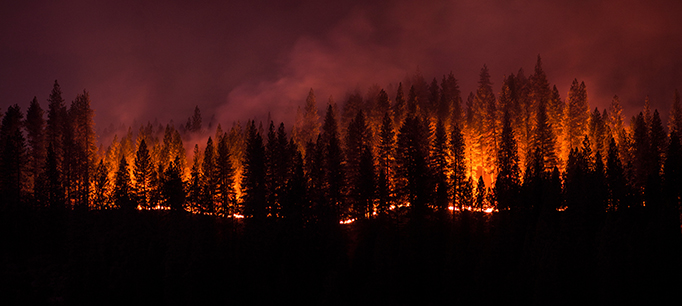
Fires start more easily in recently killed forests because embers have more dead foliage to land on. Fighting fires is much harder because there’s an increased risk that standing dead trees will fall and kill people. And since most of these dead trees will never be removed, in 10 to 15 years they’ll be on the ground. This will increase the fuel load substantially and make for hotter fires.

PPIC: What are the consequences to our water supply from dying or burning forests?

SS: It’s useful to compare the effects of a large uncontrolled wildfire—such as the 2013 Rim Fire in San Francisco’s Hetch Hetchy watershed—with what is going on in a part of Yosemite that has had regular fires over the past 40 years. In the Rim Fire zone, trees were killed over a vast area, and sediment and fire debris has moved into streams and reservoirs. By comparison, there’s an area in Yosemite called Illiloutte Creek basin, where small natural fires have been allowed to burn—unlike in most forests, where all fires are extinguished as quickly as possible. We’ve seen a jigsaw puzzle of fire-changed landscapes develop in Illiloutte basin over this time and a change in forest density. For example, an area that was once a solid pine forest is now a wetland after fire cleared about 10 acres of trees. Now we’re doing research to see if water in that basin is increasing. One thing is certain: fewer trees use less water. Also, in denser forests some snow stays in the canopy and is more likely to go back into the atmosphere rather than seep into the ground.

PPIC: Given the scope of the problem, what are our management options?

SS: There are three potential options that would improve on current practices. The first is to manage lightning fires in some areas—such as the remote upper watersheds―so we can naturally reduce forest density. This option can be scaled up relatively fast. We’d need to monitor these fires carefully and allow them to work―just as they’ve done in Yosemite for the past 40 years. Three national forests have proposed allowing managed lightning fires on about two-thirds of their land―Inyo, Sierra, and Sequoia. A second option is to do more prescribed burns. These will be smaller in scale than lightning fires. Lastly, we can use ecologically based mechanical thinning of forests, which can be combined with prescribed burns.

These fixes will be expensive in some areas. But fire suppression currently costs us about $2.5 billion a year just on federal lands—and these methods can help bring down that cost. Shifting the federal firefighting budget so more money goes for forest management could help.

Learn more

Read California’s Water: Protecting Headwaters (from California’s Water briefing kit, October 2016)
Watch our 3-minute video “Headwaters”
Read “Managing Wildfires Requires New Strategies” (PPIC Blog, September 23, 2015)
Visit the PPIC Water Policy Center’s drought resource page

The Myth of Water Wasted to the Sea

A common lament is that water is wasted when it flows out to the sea rather than put to use irrigating crops or supplying water to cities. But when rivers flow to the sea the water brings benefits to people and ecosystems that are rarely acknowledged. We asked Jim Cloern―a scientist with the US Geological Survey and a member of the PPIC Water Policy Center research network—to explain.

photo of jim cloern

PPIC: What are some benefits that river’s provide when they make it to the sea?

Jim Cloern: Runoff from rivers brings many benefits to coastal communities, the Delta, and wetlands. For example, if you live in or around the Delta, river flows repel saltwater moving upstream. If the flow is too low, water in the Delta becomes too salty for growing crops or drinking.

Rivers also carry sediment, which is really important to the San Francisco Bay ecosystem, especially for sustaining tidal flats and marshes. We’ve invested hundreds of millions of dollars to convert salt ponds back to wetlands. Collectively, the restoration of wetlands in the Bay Delta is the largest such effort west of Rockies. We’ve breeched levees and seen these areas become colonized by wetland plants and transformed into habitats for birds and fish. The soils that form the base for these habitats have a natural inclination to sink and need continuous replenishment. Rivers also carry sand beyond the bay to the ocean, which is essential to keep California’s beaches intact. Without river sediment our beaches would disappear from natural erosion.

A third benefit is to the Bay-Delta. San Francisco Bay is an estuary that sustains plant and animal communities not found in other ecosystems. These communities are an important part of California’s remarkable biodiversity. We’ve learned from other estuaries around the world that these communities can disappear if river inflow falls below levels required to sustain them.

River flows also flush pollutants out of the bay. San Francisco Bay has been called an urbanized estuary. Sewage effluents, industries, and urban runoff carry nutrients, toxic pollutants, pharmaceuticals, and micro-plastics into the bay. Large river flows like we’ve seen this year dilute and carry those contaminants out of the bay.

PPIC: What might happen if more water is diverted from flowing to the sea?

JC: The essential question for managing the Delta is, what is an appropriate amount to divert? It’s question #1 for the State Water Board. If we divert more, particularly during dry periods, we run the risk of increasing salinity of the Delta and the bay. The bay could become saltier than the ocean—this happened in the 1976–77 drought. A hypersaline bay would affect what kinds of organisms could live in it, including microorganisms―the largest component of life in the bay. We don’t know a lot about them, but we do know that some microorganisms provide really valuable services to us. For example, bacteria in bay sediments convert nitrogen from agricultural runoff and sewage into nitrogen gas, removing an important pollutant out of the water. This process is used in some sewage treatment plants. We don’t know how increased salinity would affect these “pollutant scrubbers.”

We also have to think in terms of how higher temperatures in a warming world would interact with lower flows. This combination, coupled with nutrient pollution, could be a perfect storm for generating harmful algal blooms. We also need to consider the potential loss of new wetlands we have invested so much to restore―they might not be sustainable if river sediment flows are reduced at a time when seas are rising. And how might the function of the bay as nursery habitat for species such as Dungeness crab and English sole change? What would be the effect on the livelihoods of those who fish these species? These are big issues to consider. They also remind us that there are many downstream benefits of fresh water flowing from the Delta into San Francisco Bay.

Video: Tom Steyer on the Issues

Tom Steyer—business leader, philanthropist, and possible Democratic candidate for governor—has invested his money and time in activism since leaving the private sector. Moving beyond his initial environmental advocacy, Steyer supported candidates and causes across the state and nation in both the 2014 and 2016 elections.

He sat down to talk to Mark Baldassare, PPIC president and CEO, about his views on policies that will affect the future of California. Steyer would not say whether or not he’s running for governor. But he had a lot to say about the current political climate.

Asked to name three issues that will affect California’s future, Steyer listed priorities that he said are inextricably linked and cut across traditional policy areas:

  • Addressing income inequality: The state has rebounded economically since 2008, Steyer noted, but it is the top 1% of residents who have benefited. While income inequality is a critical issue across the nation, its impact is heightened in California, Steyer said, affecting housing, transportation, education, and incarceration.
  • Investing in our state to rebuild the way we live together: California needs to create a more sustainable way of living that preserves the beauty of the state. “We’ve build the state around the internal combustion engine,” Steyer said. “We have to rebuild the way we live.”
  • Protecting and strengthening our democracy: “California citizens are basically losing a silent fight with special interests,” he said, noting his support for ballot measures that were “direct contests” with special interests, including oil and tobacco companies. “I think the threat to democracy that we’re seeing coming out of Washington, DC, is as profound as I’ve seen in my lifetime.”

Commentary: What Did We Learn from the Drought?


This commentary was published in the Sacramento Bee on April 13, 2017.

Governor Jerry Brown has declared the drought over. What did we learn over five years of drought that that could help us better manage the next one? The drought brought some hard lessons and gave us a glimpse into a challenging future. Record warm temperatures—comparable to those predicted by many climate scientists for later this century—made drought management harder. Improving drought resilience in this increasingly challenging climate will require a number of policy improvements. These six policy changes could help.

Read the full commentary on sacbee.com.

Californians Favor State Action on Climate, Immigration

The Trump administration has set a new course on two issues that have deep roots in California politics and policy: climate change and immigration. As state policymakers consider responses to the federal government on these issues, our most recent PPIC Statewide Survey finds that Californians are broadly supportive of the state taking its own action.

In PPIC surveys dating back to 2005, strong majorities of Californians have said that global warming is a threat to the state’s future economy and quality of life. Over the same period, majorities have said that they favor the state government making its own policies to address the issue of global warming: 63% said so in the January survey. When it comes to specific action the state has taken on climate change at least two-thirds have said since 2006 that they favor AB 32, the state’s landmark law limiting greenhouse gas emissions.

Many Californians also want to see state action on immigration. When asked the most important issue for the governor and legislature to work on this year, immigration was the most common response (tied with jobs and the economy). Furthermore, 65% of Californians favored state and local governments making their own policies and taking action to protect the legal rights of the undocumented. This is the first time we’ve asked about state and local action on immigration, so we don’t know how Californians might have answered under previous presidential administrations. We can, however, look to some longstanding attitudes toward immigrants in the state.

Consistent with what we saw in PPIC surveys over the previous year, an overwhelming majority (85%) said in January that there should be a way for undocumented immigrants to stay in the country legally if certain requirements are met. In surveys since 2013, we have also found at least 60% of Californians saying that immigrants are a benefit to California because of their hard work and job skills, rather than a burden because they use public services.

On climate change and immigration, we find wide differences between the parties, with Democrats and independents far more likely than Republicans to be in favor of independent state action. Among Trump voters, few want state action on either issue, but they are more likely to favor state policymakers acting on global warming (26%) than to protect the rights of the undocumented (16%). On both issues, majorities of Californians across regions of the state want independent action, though residents of the Central Valley are among the least likely to be in favor.

While President Trump has been in office for just over a month, he already has state and local policymakers in California considering responses to his early actions. We currently find widespread support for state action on climate change and immigration, and we will continue to monitor public opinion on these issues as federal policy changes and California responses unfold.

Learn more

Read the January PPIC Statewide Survey: Californians and Their Government
Find out more about PPIC Statewide Survey

Video: Feinstein on Her Role in a New World

Senator Dianne Feinstein was clear about the challenges ahead for a California Democrat in contentious times.

“Here we are: outnumbered, outvoted, in the West, fairly liberal,” she said.

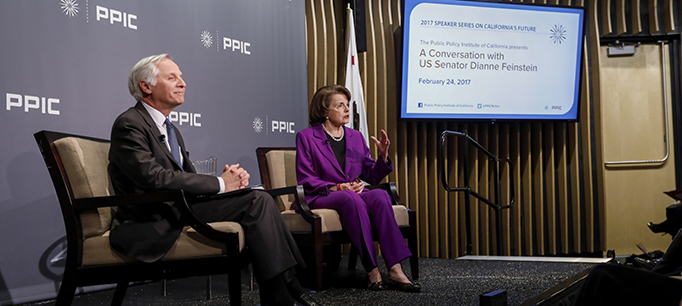
Speaking before an energetic capacity crowd in San Francisco, Feinstein said her office had received more than a million phone calls about Trump’s cabinet nominees. She described her approach to them: careful evaluation, rather than blanket opposition—an approach too conciliatory for some sign-carrying audience members. Feinstein said that in her role on the Senate Judiciary Committee, she needed to work with the administration officials in charge of national security and felt she could work with Trump appointees James Mattis, defense secretary; John Kelley, secretary of homeland security; and Mike Pompeo, CIA director. But she opposed other nominees because they lacked credentials for the job or they aren’t right for the county, she said. Nevertheless, they went on to win approval.

“The key for me is to figure out how we can begin to win some of these battles.”

Asked about Trump’s nominee to the Supreme Court, Neil Gorsuch, Feinstein wouldn’t say how she would vote. She said she will be particularly interested in his views on gun laws and on women’s reproductive rights.

Feinstein’s visit was greeted by dozens of protesters who marched outside, upset that she had not hosted a traditional town hall. Inside, Feinstein touched on a range of issues from climate change to immigration to health care, in a wide-ranging conversation with Mark Baldassare, PPIC president and CEO. His questions included a number that PPIC solicited online in advance of the event.

Video: An Early Look at Views of President Trump

The January PPIC Statewide Survey asked Californians for to assess their new leaders in Washington and found that just a third of Californians, or 30%, approve of the way President Trump is doing his job. Californians gave Congress a similar rating.

Dean Bonner, associate survey director, presented these and other key findings at a briefing in Sacramento. The survey also examined contentious issues that are the focus of national debate.

  • Solid majorities of Californians favor state action—independent of the federal government—to protect the rights of undocumented immigrants and to address global warming.
  • About half of Californians have favorable opinions of the Affordable Care Act, and a slight majority oppose repealing it.
  • Most Californians—across political parties—say the government should not interfere with a woman’s access to abortion.

The survey also looked at views of Governor Brown’s job performance and his proposed budget. The governor job approval rating is at a record-high 66%. But his budget proposal and his plan to fund maintenance of the state’s roads, highways, and bridges fares less well. Just under half of residents support his budget plan and 41 percent support his transportation proposal.

Learn more

Read the January PPIC Statewide Survey
Learn more about the PPIC Statewide Survey