
Reforming developmental, or remedial, education is essential to improving student outcomes in community colleges. Why? Developmental education is supposed to help underprepared students, but currently it may be one of the largest impediments to success. As PPIC research has shown, 80 percent of incoming California community college students—and a disproportionate share of students of color—enroll in at least one developmental course, but relatively few successfully move on to complete a college-level course. The good news is that over the last few years, there has been a tremendous amount of support for reform.
Reforming Assessment and Placement
Assessment and placement reforms generally involve moving away from the traditional reliance on standardized tests and toward a more holistic measure of prior achievement such as high school course grades. Research finds that test-based assessment and placement policies assign many students into remediation unnecessarily. Indeed, students’ high school performance as measured by GPA and course grades—even when self-reported by students—is a much more accurate indication of student readiness. A recent report by the California Acceleration Project shows that the use of high school measures has dramatically broadened access to and completion of college-level math and English courses, significantly reduced equity gaps, and has had little impact on course success rates.
But implementation is key. Several decisions will determine the impact of new policies in increasing access to college-level courses and reducing unnecessary remediation: What GPA or course grades will qualify a student for access to college-level courses? If a college uses multiple measures, how will they be combined into a single placement decision? Will colleges accept students’ self-reports of their GPA and grades? Furthermore, as campuses expand access to college-level courses, it is critical that they provide supports to students who need to brush up on their math or English skills. Guidance provided by the Multiple Measures Assessment Project, the California Acceleration Project, and others will be central to helping colleges make these important decisions.
Reforming Developmental Courses
Changes to developmental coursework can also help more students progress to college-level courses. Some colleges are transforming traditional developmental education into accelerated pathways that are relevant to students’ programs of study using the design principles of guided pathways introduced by Bailey, Jaggars, and Jenkins, which allow colleges to cluster hundreds of programs of study into a handful of broad areas (e.g., liberal arts, STEM, business, and health). For example, in math, there are statistics, quantitative reasoning, and STEM/precalculus pathways. In English, reforms often entail integrating reading and writing courses and contextualizing classes within broad fields of study. Additionally, colleges have shortened developmental pathways or offered concurrent support courses instead of requiring students to take prerequisites. This reduces the number of students who drop out because they fail to reenroll in long developmental course sequences, while providing just-in-time support to help students succeed in college-level work.
Across the state, PPIC has found that a growing number of developmental education reforms are underway—led by the California Acceleration Project and the Carnegie Foundation, among others. These initiatives are well positioned to implement reforms using the guided pathways framework. Emerging research suggests that providing accelerated math pathways that are more aligned with students’ programs of study helps improve early academic outcomes, including completion of college-level math. Less is known about the impact of developmental English reforms on student outcomes, but recent evidence on compressed and co-requisite English courses is encouraging.
Research and Policy Opportunities
Support for developmental education reform and guided pathways at community colleges has been spearheaded by the multimillion-dollar investments made through the Community College Chancellor’s Office, the governor’s annual budget, and legislative proposals, including AB 705 and SB 539. As colleges continue to adopt and scale placement and course reforms, it will be imperative to assess students’ perspectives and outcomes to determine if new policies improve student success and reduce equity gaps.
Read the report Preparing Students for Success in California’s Community Colleges
Visit the PPIC Higher Education Center

 One of the most important issues for Californians in the first year of the Trump administration is changing federal immigration policy. Immigrants are a significant presence in California, and even more so in Los Angeles County. Los Angeles, the state’s most populous county, is home to more than 10 million people, including more immigrants than any other California county.
 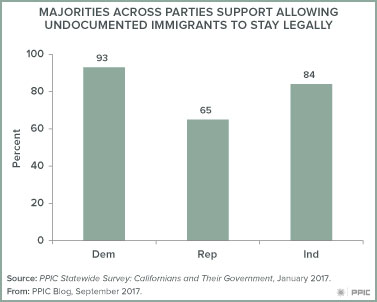 As the federal policy landscape shifted this year, PPIC Statewide Surveys continued to find majority support for a path to citizenship for undocumented immigrants who are living in the US: in our


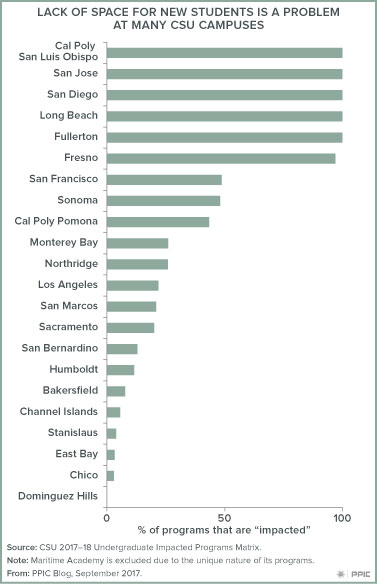 The state’s most recent budget aims to alleviate overcrowding at CSU, a problem that stems from an enrollment policy dating back to 2000. Under this policy, campuses established local admissions criteria that went beyond systemwide requirements for high-demand academic programs like nursing, business, and psychology. Currently, 6 of the 23 campuses are what CSU calls “fully impacted,” meaning that admissions requirements for local students in every major are significantly higher than those required systemwide. At Fresno State, 32 of its 33 programs are impacted. With higher admissions requirements, impacted programs often turn CSU-eligible students away. However, the rest of CSU campuses have fewer than half of their academic programs impacted. Six campuses—Bakersfield, Channel Islands, Stanislaus, East Bay, Chico, and Dominguez Hills—have less than 10% of their academic programs impacted. Unfortunately, unlike the University of California system where eligible applicants to an oversubscribed campus are referred to open campuses, CSU applicants who were eligible systemwide but did not meet the admissions criteria of their chosen impacted major or campus were denied admissions and not referred to a non-impacted campus.
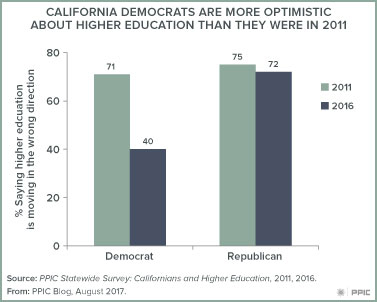 Is there a similar partisan divide over higher education in California?
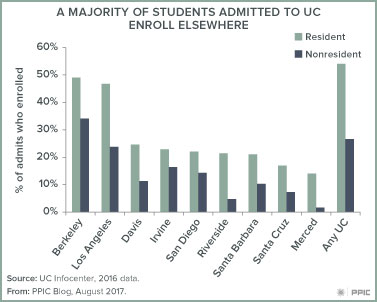 The proportion of admitted students who enroll is called the yield rate. The yield rate is a product many factors, including which campuses students are admitted to and whether they are California residents. UC’s systemwide yield rate was around 45% last year; at each campus, the yield rate for nonresidents (27%) is much lower than that for residents (54%). The Berkeley and LA campuses have the highest yield rates, with almost half of their admitted students enrolling. Only about one in five admitted students enroll at the other campuses.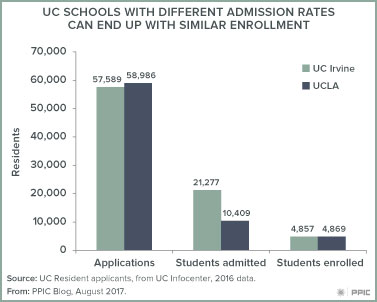

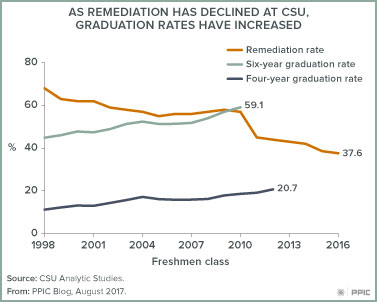 The general decline in remediation indicates that students have become better prepared over time, either in K–12 or through programs like Early Start. Though eliminating remediation will not affect how prepared students are when they start college, there is still reason to believe CSU could see an increase in graduation rates. As PPIC’s

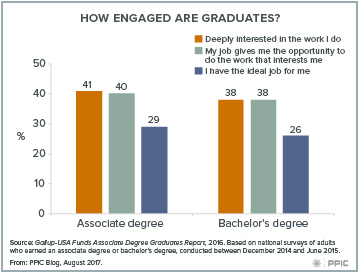 The good news is that most people who earn degrees believe their investment was worth it. According to
  Although having an “ideal job” may be a very high bar to achieve, these results suggest that a majority of degree earners are not terribly satisfied or engaged with their work. Indeed, in a wider-ranging