Majority Opposition to Drilling Includes Coastal Republicans

In yet another sign that the shifting federal policy landscape is at odds with California public opinion, the Trump administration is proposing new offshore oil and gas drilling across all of the nation’s coastal waters. The five-year leasing plan includes areas previously off limits to oil and gas exploration since the 1980s. It proposes to open up 90% of the nation’s offshore reserves through new federal leases. California’s governor, lieutenant governor, attorney general, and US senators—quick to voice their opposition to this proposal—are aligned with most Californians’ views on offshore oil drilling.

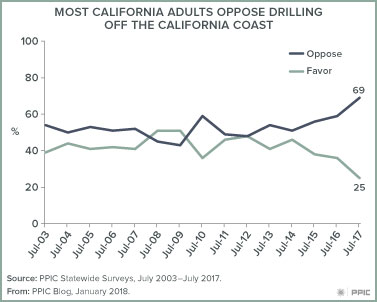
The PPIC Statewide Survey has asked the question, “Do you favor or oppose allowing more oil drilling off the California coast?” every July since 2003. In the 2017 PPIC survey, a record low 25% of California adults favored more oil drilling off the California coast while a record high 69% opposed it. What’s most remarkable is the agreement over time on the topic of offshore oil drilling. Since the early 2000s, a slim majority has been in favor of drilling only twice (51% in 2008 and 2009); in most years a majority has opposed it. Moreover, public consensus on this topic has grown. Since July 2012, support for more oil drilling has dropped by 23 points (48% to 25%) while opposition has grown by 21 points (48% to 69%).

In the 2017 PPIC Survey, a surprising level of agreement on the topic occurred across all major demographic categories of California residents. Majorities were opposed across age, education, gender, income, and racial/ethnic groups. Strong majorities across the state’s major regions opposed more drilling. That includes coastal Californians (23% favor, 72% oppose) and inland Californians (29% favor, 64% oppose) alike.

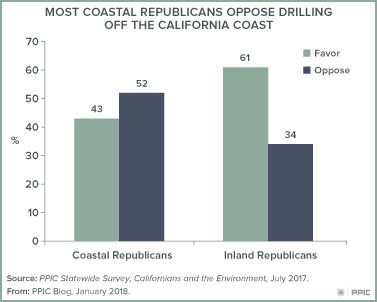
It is often said that the Trump administration is “playing to its base” in a polarized environment by proposing policies that are clearly at odds with Californians’ views. However, we found in the 2017 survey that majorities of conservatives, moderates, and liberals alike (55%, 71%, 83%, respectively) opposed more oil drilling off the coast. Democrats (14% favor, 81% opposed) and independents (30% favor, 68% opposed) were strongly opposed, while Republicans were divided (50% favor, 45% oppose). However, majorities of coastal Republicans joined with other regional and political groups in opposing more offshore oil drilling.

What’s behind the solid public opposition to more offshore oil drilling in California? In the 2017 PPIC Survey, 73% of California adults said that the condition of the ocean and beaches was very important to the economy and quality of life for California’s future. We found that those who held these views—and they were widely held across political, demographic, and regional groups—were overwhelmingly opposed to more offshore oil drilling.

Stay tuned as the PPIC Statewide Survey monitors this topic and other issues—such as the Affordable Care Act, climate change and energy, federal tax reform, marijuana legalization, and immigration—as changing federal policies may have big effects on California. We are planning for an interesting and important year for PPIC polling in 2018!

High Housing Costs Hurt College Affordability

A majority of Californians say affordability is a problem in the state’s public colleges and universities, according to the PPIC Statewide Survey. In addition, three-quarters of residents in the survey agree that the price of college prevents students who are qualified and motivated from going to college. Not surprisingly, state leaders are exploring new strategies to help students and families better cope with college costs. Most current approaches, such as state and institutional financial aid, focus primarily on tuition relief. This makes sense, as tuition more than doubled at California universities from 2006 to 2012—and is on the rise again.

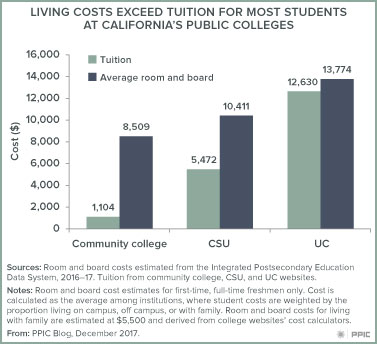
However, housing costs also play a significant role in the total cost of attending college. Californians are well aware of the issue: 85% of residents in the PPIC survey say colleges and universities should do more to make sure that all students have affordable housing options. Indeed, even with the rapid increases in tuition, living costs for many students exceed tuition at California’s public institutions—the state’s community colleges, California State University (CSU), and the University of California (UC). Average room and board costs also differ substantially across the three systems, from $8,509 per year at the community colleges to $13,774 at UC.

These differences in costs are related to whether students live on campus, off campus on their own, or off campus with family. Estimated average costs of housing and food for students living on campus top $13,000 per year, and those living off campus pay an average of $10,000 to $13,000 in room and board. The costs associated with living with family are not estimated in the available federal data, but most college websites suggest these costs range from $5,000 to $6,000—about half the cost of living on or off campus.

Students’ housing choices also partially depend on where they go to school. Only nine cities in California have UC campuses (excluding UCSF which only enrolls graduate students), and most UC freshmen live on campus in their first year. Historically, the 113 community colleges and 23 CSU campuses have been seen as local and low-cost options. Indeed, both systems show about 30% or more of freshmen living with their families, which helps keep average room and board costs lower than at UC. But it is worth noting that the share of CSU freshmen living on campus may grow. More dorms are being built on CSU campuses as administrators see on-campus housing as a strategy to increase graduation rates. Data on students’ living arrangements are based on institutional reporting on freshmen who receive some sort of federal financial aid, which includes more than 60% of students at most institutions.

As state leaders reexamine the goals in the 1960 Master Plan for Higher Education and consider changes to financial aid, they should take into account the role that living costs play in the total cost of education.

Learn moreRead the PPIC Statewide Survey: Californians and Higher Education
Visit the PPIC Higher Education Center

Video: Preview of the Statewide Election

Setting the stage for a year of crucial decisions, the December PPIC Statewide Survey took a first look at the 2018 governor’s race. Two Democrats—Gavin Newsom, the state’s lieutenant governor, and Antonio Villaraigosa, former mayor of Los Angeles—lead among likely voters. But the survey also underscored that it’s early in the campaign to replace retiring governor Jerry Brown. Among likely voters, a third are undecided and just a quarter are following news about the candidates fairly or very closely.

In the US Senate primary, incumbent Dianne Feinstein leads fellow Democrat Kevin de León, state senate president pro tempore, by a two-to-one margin in a matchup of the two candidates. A third of likely voters are undecided in this race, as well.

Dean Bonner, associate survey director at PPIC, presented the key findings at a Sacramento briefing last week. As he noted, the survey findings reflect a divided and unsettled electorate. Likely voters are split on what is more important in a candidate for statewide office: new ideas and a different approach (48%) or experience and a proven record (42%). Asked about how candidates for statewide office should interact with the federal government, half of likely voters (51%) prefer that candidates push back against the Trump administration and 41% prefer that candidates work with the administration.

College Graduates and California’s Future

The University of California Board of Regents invited Mark Baldassare, PPIC president and CEO, and Hans Johnson, PPIC senior fellow and director of the PPIC Higher Education Center, to present their perspectives on the role of higher education in California’s future, November 16, 2017. Here are their prepared remarks:

Good morning, I am Mark Baldassare, president and CEO of the Public Policy Institute of California (PPIC). I am here with my colleague and PPIC’s higher education center director Hans Johnson to present the institute’s research findings on the need for college graduates in California’s future economy. To kick off this session, I am going to make a few remarks about public opinion to place this issue in perspective.

The November PPIC Statewide Survey points to the importance of this topic for most Californians. Eighty percent of California adults say that the state’s higher education system is very important to the quality of life and economic vitality of the state, and another 14% say it is somewhat important. Strong majorities across political, regional, racial/ethnic, and demographic groups say that the state’s higher education system is very important. In fact, strong majorities of Californians have been saying that higher education is very important to the state’s future since we first asked this question in 2007.

In the context of the 2018 governor’s race, 63% of California adults say that candidate positions on higher education are very important, and another 28% say they are somewhat important to them. Majorities across political, regional, racial/ethnic, and demographic groups hold this view.

When asked about the current workforce, 83% of Californians say that a four-year degree from a college and university prepares someone very well (30%) and somewhat well (53%) for a well-paying job in today’s economy. Fifty percent of Californians think that a college education is necessary for a person to be successful in today’s work world, with majorities of Latinos (67%), Asian Americans (54%), and African Americans (51%) and fewer whites (35%) holding this view. Moreover, about half of Californians, with pluralities across the state’s major regions, say that California will not have the college-educated residents needed for the jobs and skills likely to be in demand 20 years from now.

In sum, the importance of a higher education and the need for college graduates are issues on the minds of many residents today. Hans will provide the demographic and workforce analysis that demonstrates why the state’s higher education system is essential for a better future for all Californians.

PPIC has produced a series of reports on California’s future population and economy. Our report Will California Run Out of College Graduates? provides projections of the demand for and supply of workers across all levels of educational attainment to 2030. Our primary finding is that California faces a shortage of highly educated workers. Specifically, economic projections to 2030 show that about two in five jobs will require at least a bachelor’s degree, while demographic projections suggest only about one in three Californians will have at least a bachelor’s degree. This shortfall equates to 1.1 million workers.


In this presentation, I first describe how California’s population and economy are changing and then identify how the state and its higher education institutions can increase college enrollment and completion to produce more college graduates.

California’s economy increasingly demands highly educated workers

To develop our economic projections, we apply trends in educational attainment levels to occupational projections developed by the California Employment Development Department. We examine changes in labor market demand that are occurring due to shifts both in occupational structure and changes in educational attainment within occupations. Our primary finding is that the state’s economy will continue along a well-established trajectory, with a growing share of jobs requiring at least a bachelor’s degree.
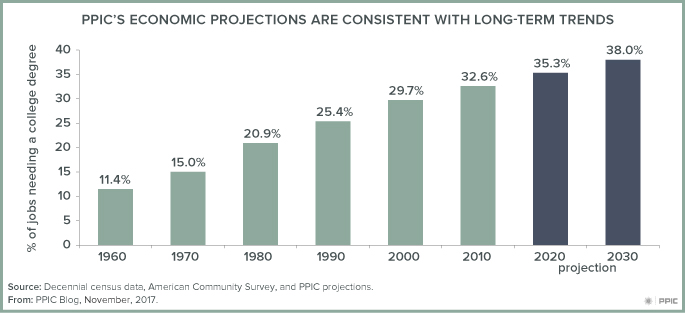

There are two key drivers of increasing demand for college graduates: (1) faster growth in occupations that commonly require a college degree (e.g., computer technology), and (2) increases in demand for highly educated workers within occupations (e.g., nursing). In recent years, most (74%) of the increased demand for highly educated workers has occurred because of faster job growth in occupations that commonly require a college degree. Among occupations with at least 100,000 full-time year-round workers, there have been especially rapid growth rates for software developers (56% increase between 2010 and 2015), computer scientists and systems analysts (42% increase), and managers (35% increase). These and other highly skilled occupations have experienced faster growth than most occupations that require lower levels of education.


That said, the increase in educational attainment within occupations has been significant. For example, the share of registered nurses with a bachelor’s degree has grown from 57% in 2000 to 68% in 2015. From 2010 to 2015, about 26% of the increase in jobs for college graduates was attributable to growing demand for highly educated workers within specific occupations.

Are college degrees really necessary for these jobs? To answer this question, we examined a number of labor market outcomes. Within and across occupations, we find that workers with bachelor’s degrees have higher labor force participation rates, lower unemployment rates, and higher wages than those without—and that, in general, as educational attainment increases, wages also increase. Overall, the wage premium for college graduates relative to less-educated workers has grown. By 2015, the average annual wage for full-time year-round workers was more than twice as high for workers with a bachelor’s degree than for those with only a high school diploma.
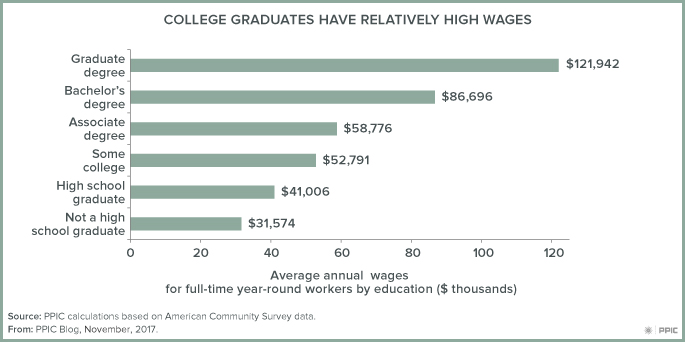
Within each of 51 occupational groupings we see higher wages for college graduates than for high school graduates. Among registered nurses, for example, those with a bachelor’s degree earned 12% more than those with an associate degree.

California’s educational institutions are not keeping up with demand

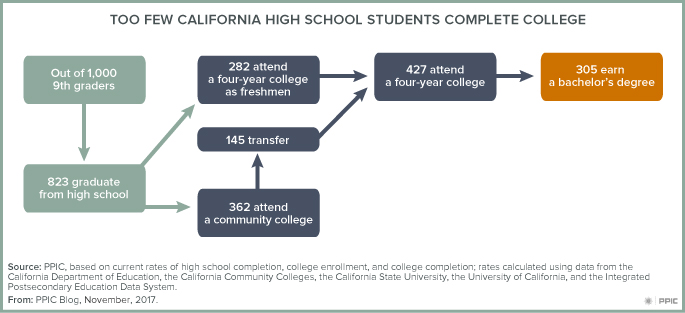
Too few Californians are graduating from college. At current college enrollment and completion rates, only 30.5% of 9th graders in California will eventually earn a bachelor’s degree either in California or elsewhere in the United States. Among all states, California ranks 47th in the share of high school graduates who enroll in four-year colleges and 5th in the share who go to community colleges. Low rates of transfer from community colleges to four-year colleges exacerbate the problem.

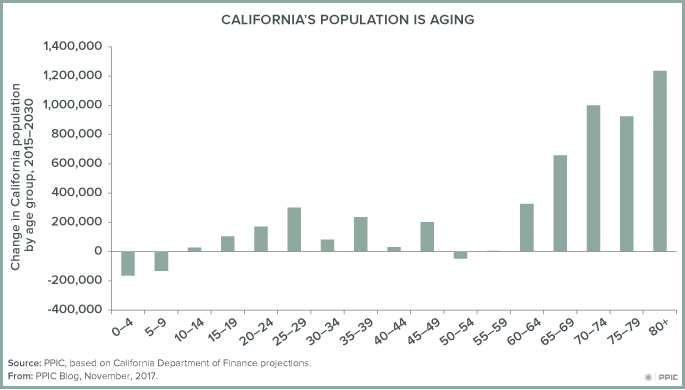
A critical challenge is the retirement of the baby boom generation. Called the “silver tsunami” by some, this is the first time in California’s history that such a large and well-educated group is exiting the labor force. In contrast, the number of young adults in California is projected to increase only modestly.

Not all degrees are equal

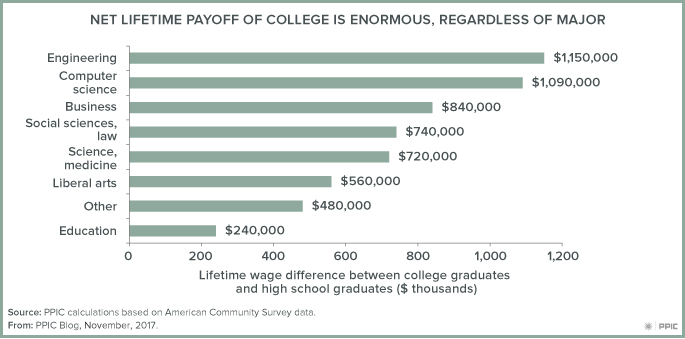
On average, college graduates have very strong labor market outcomes. At any point in time, some college graduates are working in jobs that do not necessarily require a college degree, but over the course of their careers the vast majority of college graduates will move into occupations that reward their educational training. Our estimates show that students who earn bachelor’s degrees in engineering and computer science fare very well in the labor market, but even those with less remunerative majors, such as education and the liberal arts, will earn far more in wages than less-educated workers, even after taking into account all the costs of going to college.

How to close the degree gap

To close the degree gap, California and its higher education institutions need to establish new policies and practices to enroll more students, especially in our four-year colleges and universities, and improve graduation rates among students already in college. In previous testimony, PPIC has identified targets for each of the state’s public systems with respect to admission, transfer (from community colleges to four-year colleges), and improved graduation rates.

The University of California (UC) will play a central role. In our scenario, UC would need to award approximately one-quarter of the additional degrees necessary to close the gap. This is an ambitious target, but the increase over current levels (and over the baseline projection) would not be without precedent. For example, between the 1999–2000 and 2016–17 academic years, the number of bachelor’s degrees awarded by UC increased 62% (from slightly more than 33,000 to almost 54,000). Our closing-the-gap scenario would require UC to award about 81,000 degrees by 2029–30, a 51% increase over current levels.
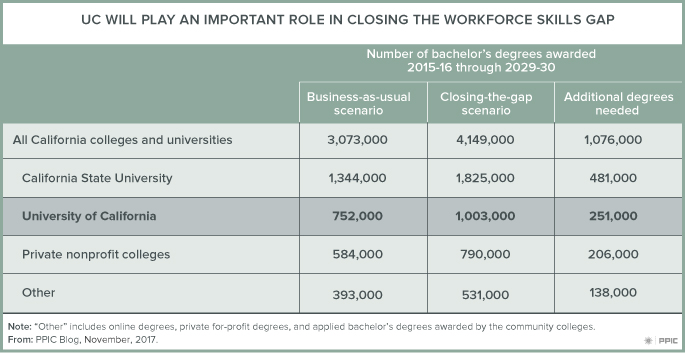

Improving access and success among groups historically underrepresented in higher education—including low-income students, first-generation college students, Latinos, and African Americans—is essential if we are to close the degree gap. Compared to other public research universities, UC has an impressive record in enrolling low-income and first-generation students.

The California State University (CSU) system and the California Community College system have adopted new goals that are entirely consistent with PPIC’s targets. New initiatives, including remediation reform at the community colleges and at CSU, have the potential to substantially improve student success rates. CSU’s new graduation initiative aims to increase graduation rates and eliminate gaps between groups of students. College preparation among the state’s high school graduates has also increased, with the share of students completing the college preparatory requirements of UC and CSU reaching an all-time high. Strong demand for UC is likely to continue as college preparation continues to improve and the transfer pathway is better articulated. UC has seen consistent increases in graduation rates for many years, and new efforts to improve on-time graduation are likely to continue this trend.

Finding ways to accommodate all these students remains a central challenge, but one we must meet in order to ensure a better future for all Californians.

Video: Californians Concerned about Cost but Give State’s Colleges Good Grades

Many Californians say the state’s public higher education system is going in the wrong direction, a new PPIC Statewide Survey shows. But they are more likely to say they are concerned about affordability than about the quality of the state’s colleges and universities. Just 18% of all adults say quality is a big problem, compared to 56% who call affordability a big problem.

Researcher Lunna Lopes presented the findings of PPIC’s annual survey on higher education to a Sacramento audience last week.

Among the survey findings underscoring Californians’ concerns about college affordability: 75% say the cost of college keeps students who are qualified and motivated from attending, 79% say students have to borrow too much money to pay for college, and 85% say colleges and universities should do more to make sure that all students have affordable housing options.

In contrast to Californians’ views on costs, solid majorities of residents give excellent or good ratings to the state’s community colleges, California State University, and the University of California.

Californians are divided on whether a college education is necessary to succeed in today’s work world, with half saying it is and 48% saying there are many ways to succeed without college. There are strong differences among demographic groups on this question. Two-thirds of Latinos say college is necessary, compared to just 35 percent of whites. And 59% of Californians with household incomes of $40,000 or less say college is necessary, compared to 42% of those whose incomes are $80,000 or more.

Despite this divide over whether college is necessary for success, 80% of Californians say the public higher education system is very important to the future quality of life and economic vitality of the state.

Video: How Californians View National Issues

With the nation focused on a range of contentious issues, the September PPIC Statewide Survey provides a California perspective. Dean Bonner, associate survey director, shared the key findings at a Sacramento briefing last week.

Among them:

  • A record-high share of Californians have a favorable opinion of the Affordable Care Act, and most want Republicans to work with Democrats to improve the law. While most Californians say it is the federal government’s responsibility to make sure that all Americans have health coverage, just a third favor a single-payer, government-run national health insurance system.
  • Three-fourths of Californians—also a PPIC record high—view immigrants as a benefit rather than a burden. There is broad and bipartisan support for protections provided by DACA, which shields from deportation some undocumented immigrants brought to the US as children and allows them to get a work permit if they pass a background check.
  • Half of Californians say they are very concerned about the possibility of North Korea having a nuclear missile that could reach the state.
  • Two-thirds of Californians view possible Russian interference in the 2016 as a serious issue.
  • Half of Californians say race relations have gotten worse in the United States over the last year. They are less pessimistic when it comes to race relations in the state.

California Millennials and Climate Change

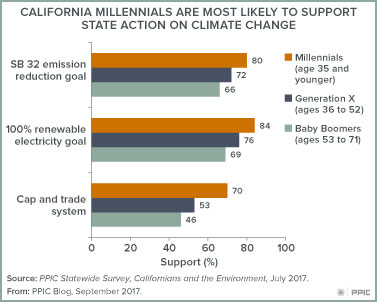
In our most recent PPIC Statewide Survey, we found a record-high share of adults (58%) saying that global warming is a very serious threat to the state’s economy and quality of life. This view is strongly related to Californians’ broad support for state climate change policies, and it is most commonly held among millennials—adults age 35 and younger. Millennials also stand out in their support for state actions to address climate change:

  • Seventy-five percent of millennials favor the state making its own policies, separate from the federal government, to address global warming.
  • Eighty percent support the new greenhouse gas emission reduction goal (SB 32) that updates California’s landmark climate change legislation, and 84% support a new target of 100% renewable electricity by 2045.
  • Seventy percent favor the state’s cap and trade system after hearing a brief description of it. In contrast, fewer than half of baby boomers (ages 53 to 71) favor the cap and trade system, in which the state enforces “caps” on greenhouse gas emissions by issuing permits that can be traded among companies.

Figure millennials and climate changeCalifornia millennials are about as likely as older adults to expect higher gas prices as a result of state climate change policies (52% millennials, 53% generation X, 55% baby boomers). But among those who expect higher gas prices, millennials are more likely than older adults to support the policies named above. Indeed, 73% of millennials expecting higher gas prices support SB 32, compared to 63% of gen Xers and 59% of baby boomers.

Also of note, majorities of younger adults support these policies, regardless of whether they call themselves liberals, moderates, or conservatives. For example, 61% of conservative millennials support cap and trade, compared to 25% of conservative baby boomers. Similarly, at least 7 in 10 millennials support SB 32, whether they are white or Latino, whether they have a college degree or not, and regardless of their income group.

Such broad support for the state’s climate change policies among younger Californians suggests that, if these opinions hold, Californians’ desire for state action on climate change is not likely to diminish in the years ahead.

Find out more about the PPIC Statewide Survey.

PPIC Polling and the Immigration Debate

This post is excerpted from a presentation to the PPIC Board of Directors and guests on September 12, 2017, in Los Angeles.

One of the most important issues for Californians in the first year of the Trump administration is changing federal immigration policy. Immigrants are a significant presence in California, and even more so in Los Angeles County. Los Angeles, the state’s most populous county, is home to more than 10 million people, including more immigrants than any other California county. Twenty-seven percent of California’s population is foreign born—about twice the US percentage—while 35% of Los Angeles County population is foreign born. Moreover, about 2.6 million undocumented immigrants—about a quarter of the total number in the US—live in California. More than 800,000 of these undocumented immigrants live in Los Angeles. Major shifts in federal immigration policy that are under way thus have profound impacts on California and Los Angeles.
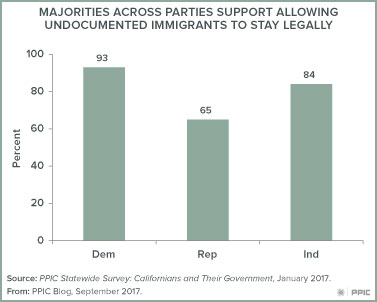
Since January, PPIC has been monitoring state and local responses to changing federal immigration policy through our public opinion polling. We have asked 11 questions about federal immigration policy in four monthly surveys, each involving 1,700 California adults, including more than 400 adults from Los Angeles County, interviewed by landline and cellphone in English or Spanish. The margin of error is +/-3% for California and +/-6% for Los Angeles. While the country is politically divided on immigration issues, we have found some bipartisan agreement in California. Here’s a sampling of our findings this year:

  • Undocumented immigrants living in the US: In our January PPIC Statewide Survey, 85% of Californians and 89% of Los Angeles residents agreed that undocumented immigrants who are living in the US should be allowed to stay legally. These results are consistent with earlier PPIC surveys. Moreover, solid majorities were in favor of state and local governments making their own policies and taking actions, separate from the federal government, to protect the legal rights of undocumented immigrants in California (65% California, 73% Los Angeles).
  • Border wall, travel ban on residents of six Muslim-majority nations: In our March PPIC survey, when asked about building a wall along the entire Mexico border, more than 7 in 10 were opposed (72% Californians, 76% Los Angeles). In the same survey, about 6 in 10 (58% California, 63% Los Angeles) opposed the president’s revised travel ban involving six Muslim countries.
  • Immigration enforcement and schools: In our April survey, 46% of Californians and 55% of Los Angeles residents said they are very concerned that increased federal immigration enforcement efforts will impact undocumented students and their families in their local public school districts. More than 6 in 10 (65% Californians, 73% Los Angeles) favored having their local public school district designated as a sanctuary safe zone in order to protect its undocumented students and their families from federal immigration enforcement efforts.
  • Worries about deportation, impact of enforcement on business and jobs: In our May PPIC survey, 30% of Californians and 34% of Los Angeles residents said they worry a lot that someone they know could be deported as a result of increased federal immigration enforcement. About half said that increased federal immigration enforcement will have a negative impact on businesses, jobs, and the economy in their part of California (49% California, 53% Los Angeles).

As the federal policy landscape shifted this year, PPIC Statewide Surveys continued to find majority support for a path to citizenship for undocumented immigrants who are living in the US: in our March survey, 68% of Californians and 71% of Los Angeles residents remained supportive. In contrast to the political divide in the rest of the nation, strong majorities across parties in California continue to agree that undocumented immigrants who are living in the US should be allowed to stay legally.

California’s path forward on immigration is a work in progress, as is the case in other areas that are undergoing federal and state policy changes. Moreover, there are uncertainties about federal actions such as the fate of the DACA program—which protects young undocumented immigrants brought to the US as children from deportation—the imposition of fiscal sanctions on sanctuary states and cities, the ban on travel from Muslim countries, and the construction of a wall along the US-Mexico border. As we have seen, California’s immigration policymaking is occurring in the context of strong public opposition to federal shifts, high levels of public concern about how these shifts are affecting undocumented immigrants and our regional economies, and strong support for actions by state and local governments to protect the legal rights of undocumented immigrants. At PPIC, we hope to foster conversations about immigration that lead to a better future for all Californians.

Learn more
Find out more about the PPIC Statewide Survey.

California’s Partisan Divide on Higher Education

New national polling shows a big divide has opened up between Democrats and Republicans on higher education. A Pew Research Center poll taken in June shows that a majority of Republicans and those who lean Republican (58%) think colleges and universities have a negative effect on the way things are going in the country, while a vast majority of Democrats and those who lean Democrat (72%) think colleges and universities have a positive impact. This is a big change from two years ago, when majorities in both parties said higher education institutions had a positive impact on the direction of the nation.

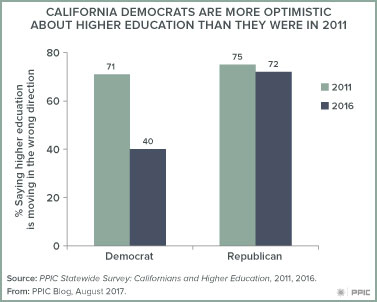
Is there a similar partisan divide over higher education in California? The PPIC Statewide Survey found a similar divergence over the past few years when we asked a different question: Is the state’s public higher education system generally going in the right or wrong direction? In 2016, California Republicans were far more likely than Democrats to say the system is headed in the wrong direction. This marked a change in the five years since we’d last asked this question. When we asked the question in 2011—toward the end of the recession and after large tuition increases—Californians in both parties overwhelmingly said higher education was moving in the wrong direction. Unlike national polling, which shows a shift in Republican opinion, PPIC surveys show a shift in the opinions of Democrats, who have become more positive, while Republicans have remained about the same.

Californians’ responses to other survey questions about higher education point to longer-term partisan divisions. Republicans have generally been more likely than Democrats to say that the overall quality of education in California’s public colleges and universities is a big problem or somewhat of a problem. Views about the direction and overall quality of public higher education are reflected in attitudes about California’s three public higher education systems. Currently about half of Republicans say that each of the systems—community colleges, California State University, and University of California—are doing an excellent or good job. More Democrats—about three-fourths—express this view.

Partisans have also historically differed on higher education funding. Compared to Republicans, Democrats are more likely to say that higher education does not receive enough funding, and Democrats are generally willing to pay higher taxes to support higher education.

Interestingly, there is some evidence that Californians’ views about the importance of college for individual success differ along party lines. A majority of Democrats (68%) say a college education is necessary for a person to be successful in today’s working world, while a majority of Republicans (72%) say there are other pathways to success. It is also true, however, that Californians in both parties have become more optimistic about the chances of success without a college degree since 2011—when the state was recovering from recession.

Finally, there are some areas of agreement. We find that members of both parties generally think that college affordability is a problem and students have to borrow too much money. Perhaps most significant is our finding that overwhelming majorities of both Republicans and Democrats say that the state’s system of higher education is important to California’s economic future and quality of life.

Learn more

Visit the PPIC Higher Education Center

Is College Worth it? What Graduates Say

As college registration deadlines approach, thousands of Californians are making important decisions to invest in their education and long-term career prospects. The vast majority of parents (85%) hope their child earns at least a bachelor’s degree, according to the PPIC Statewide Survey. But how do graduates see it? And how well-informed are their decisions?

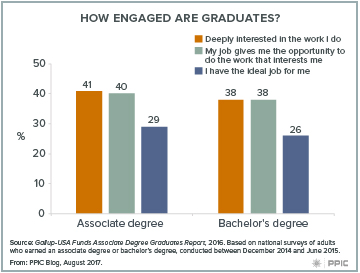
The good news is that most people who earn degrees believe their investment was worth it. According to national survey data, 71% of those who earned an associate degree and 73% of those with a bachelor’s degree agree their education was worth the cost. Going beyond the economic value, a large share also find engagement in the work they do. In fact, a sizeable share of associate- and bachelor’s-degree holders report deep interest in their work (41% and 38%, respectively) or say that they have the ideal job (29% and 26%, respectively).

Although having an “ideal job” may be a very high bar to achieve, these results suggest that a majority of degree earners are not terribly satisfied or engaged with their work. Indeed, in a wider-ranging national survey conducted recently, a majority of college graduates indicate that they would change their degree, their college, or their major if they could do it again. Among associate-degree holders, 23% would seek a different degree—more than double the share of bachelor’s-degree holders who say the same. But graduates with bachelor’s degrees are not entirely satisfied with their choices either: 40% would study a different major (compared to 36% among associate-degree holders). And the survey finds curiously similar responses regardless of a person’s income level. Though higher-income Americans are slightly less likely to regret their college choices, a large fraction of them (35–45% for those with income over $100,000) would still make a different choice.

These results confirm that while college pays off, there is room to improve how well-informed prospective students are about their colleges, majors, and degrees. On this blog, we’ve written about the economic value of college credentials and how it varies across fields of study. We’ve also highlighted the need for data to inform student choices, given the sizeable financial commitment entailed.

Among the state’s public colleges and universities, California’s community colleges are ahead of the curve in providing information online about institutional performance, future salary, and more. Other institutions should follow suit. However, the survey results above suggest it is perhaps equally important to design courses and programs that ensure students can efficiently and effectively identify the degrees and majors best suited to them. Indeed, this is one of the tenets of the guided pathways movement taking place at community colleges across the country and in California. To inform and improve the college decisions of Californians, it is critical that these practices expand beyond community colleges, so that K–12 schools and four-year universities are also working to ensure students have comprehensive information when choosing their pathway into a career.

Learn more

Visit the PPIC Higher Education Center