Video: Californians and Their Government

Californians are increasingly concerned about the cost of housing—a record-high share see affordability as a big problem in their region, and a majority support Governor Newsom’s proposal to put $1.8 billion toward increasing housing production. Dean Bonner outlined these and other key findings of the latest PPIC Statewide Survey at a Sacramento briefing last week.

This month’s survey gauges views on statewide challenges and the governor’s proposals for addressing them. For example, in the wake of last year’s historically destructive wildfires, an overwhelming majority of Californians support the governor’s plan to spend $415 million on wildfire preparedness and forest management. About two-thirds say the gap between rich and poor is widening in their part of the state, and a solid majority favor the governor’s proposal to allocate a billion to expand eligibility for the earned income tax credit.

Other survey highlights:

  • Slim majorities support the governor’s plan to scale back two major infrastructure projects: high-speed rail and the Sacramento–San Joaquin tunnels.
  • When asked whether the penalty for first-degree murder should be death or imprisonment for life with no chance of parole, a record-high 62% of Californians choose life imprisonment.
  • An overwhelming majority oppose President Trump’s declaration of a national emergency over the border wall—but support for the declaration is much higher among Republicans.
  • A majority of residents have a favorable view of the Affordable Care Act and most say that Covered California, the state’s health insurance exchange, has been working well.

Video: A Conversation with San Francisco Mayor London Breed

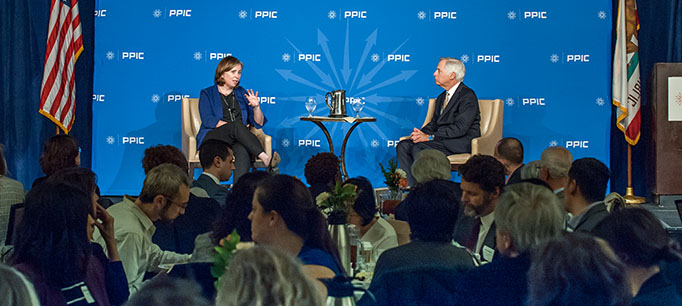
As part of our Speaker Series on California’s Future, PPIC invites elected leaders from across the political spectrum to participate in public conversations. The purpose is to give Californians a better understanding of how our leaders are addressing the challenges facing our state.

As a mayoral candidate, London Breed promised to focus on homelessness and affordable housing—two major challenges for San Francisco and for California as a whole. Not surprisingly, these issues took center stage in her conversation with PPIC president Mark Baldassare earlier this week.

“It is no secret that homelessness is one of the biggest challenges that’s facing our city, and that also comes with the need to build more housing,” said Breed. “I’ve been on a mission! I hired a housing delivery director—someone whose sole purpose is to cut back on bureaucratic red tape that gets in the way of building housing.”

Breed stressed the need for new approaches to behavioral health issues that complicate homelessness: “We have to think about this challenge differently and we have to make hard decisions.” For example, she favors strengthening conservatorship laws. She acknowledged that conservatorship for mentally ill adults is “very controversial.” But, she added, “our jails are being used as mental health facilities, and that’s not a solution.” She is also pushing for safe injection sites, which can provide substance abuse treatment when people are ready to seek it. “Treatment on demand is something we have to start looking at.”

The mayor is also committed to trying new strategies in other policy areas, such as police-community relations and education. “I do think we need to take some risks and propose some things that may make people uncomfortable but ultimately may help us to get the kind of results that will . . . make a difference.”

But Breed also emphasized accountability. Explaining why she wants to hire a mental health director, she said, “We’re a little bit all over the place right now and I want us to address those issues, organize things a lot better for the purposes of helping people.” In this and other areas, she said, “I want to see us make the right investments.”

Video: A Conversation with Chief of Staff Ann O’Leary

As the Newsom administration lays out its initial plans, PPIC invited chief of staff Ann O’Leary to discuss some of the governor’s top priorities. In a wide-ranging discussion with PPIC president Mark Baldassare last week, O’Leary identified the “cost crisis” in California as one of the main challenges that Governor Newsom plans to address.

“By ‘cost crisis,’ I mean how do we make sure that people in California can have affordability and the opportunity to really take advantage of the California dream?” O’Leary said. “I think too many people in California are really seeing that slip away. They’re not able to afford homes, they’re not able to afford child care, and they’re not able to pay for college for their children as they grow older.”

O’Leary pointed out that confronting this cost crisis would take many forms, such as taking on health care affordability, investing in “cradle to career” education, and addressing housing production and rising rents.

She underscored that the governor’s first proposed budget reflects his vision for promoting affordability and opportunity while ensuring the state’s long-term financial stability. Newsom’s plan includes a mix of one-time and ongoing funding as well as a robust rainy day fund, but “we also go further than that. We have a reserve fund for the safety net, and we also look at how we could use some of the surplus to pay down pension liabilities.”

The governor has also focused on other key challenges—for example, responding to wildfires and tackling the unmet need for safe drinking water in many parts of the state.

On wildfires, O’Leary noted that the governor wants to “make sure that we’re continuing with those recovery efforts to help communities that have been harmed, but also to prepare for future wildfires.” On drinking water, O’Leary said that the governor has already worked with the legislature to provide $20 million in emergency funding to address this issue.

Navigating the PG&E bankruptcy filing is another immediate priority. O’Leary said that over the next 60 days the governor’s team would be creating a roadmap for the state to “protect wildfire victims, protect employees who are out there every day trying to make sure we’re safe, and make sure fundamentally that we have safe and affordable power and that we’re meeting our clean-energy goals.”

O’Leary also discussed the federal-state relationship and how the governor plans to manage it. While pointing out that the state and federal governments need to work together as much as possible, O’Leary also underscored that California must stand up for its values when fundamental disagreements exist, especially on issues such as immigration and family planning. “These are differences of opinion. And it’s a needle we have to thread, but we’re going to do our best.”

Video: A Conversation with California’s Legislative Leadership

When Toni Atkins, President Pro Tem of the California State Senate, sat down to talk with PPIC president Mark Baldassare last week, she brought along a list of pressing issues. Asked to name the top two issues facing the state, she led off with housing: “The growing crisis around the lack of housing supply for all levels of Californians is one of our most critical issues.” Next came climate change and its effects across California. And then she added a third issue: water sustainability. In reality, she said, “there is always a list of issues and challenges that we are working on in California.”

Despite this long list, Atkins was optimistic about the legislature’s chances of working productively with Governor Newsom. “It’s early, but I would say that what I appreciate and enjoy about Governor Newsom is he really is a policy wonk at heart.” She added that while Jerry Brown and Gavin Newsom share many priorities, the two have very different styles. “Jerry Brown proposed a budget and he only wanted a few things,” while Governor Newsom “has thrown everything out there.”

After noting that it will be interesting to see how the legislature approaches this year’s budget process, Atkins highlighted the governor’s focus on homelessness and mental health issues and his commitment to early childhood education—which, she added, has been “a huge driving issue for the legislative women’s caucus.” She expressed particular interest in the governor’s proposal to “take juvenile justice offenders out of CDCR—the California Department of Corrections and Rehabilitation—and into more of a health/social services arena.”

Shifting from the state budget process to the ongoing drama over the budget—and border wall—at the federal level, Baldassare asked Atkins about the state government’s response to what is happening in Washington, DC. “You know, I’m so glad to be in California,” she replied. Citing the state’s diversity and the policies that foster it, she said that “to have that attacked in many ways at the federal level means all of a sudden you’ve got California really promoting state’s rights, to protect our policies, our values, and things that we hold dear.”

Atkins tended to be optimistic about even the thorniest issues—such as forestry management, building more housing, and water sustainability. Speaking about the cluster of issues related to climate change, she said, “Maybe the result of these catastrophic fires, and floods, and mudslides—maybe that is the way we’re now able to have a conversation we couldn’t have five years ago, before it was a crisis.” But she added that in order to move an agenda forward, “you’ve got to still have all the stakeholders at the table.”

More generally, Atkins stressed the importance of representing all Californians, regardless of party: “I think we have work to do together.”

Could Wildfires Affect the 2020 Census?

The decennial census plays an essential role in American democracy. The stakes are huge for California, and 2020 is fast approaching. This series of blog posts takes a detailed look at California communities that may be at risk of being undercounted.

Wildfires in California have burned millions of acres and destroyed or threatened thousands of homes, displacing families around the state. Among their many devastating long-term effects, disasters may elevate the risk of undercounting some communities in the upcoming census.

The Census Bureau’s goal is to “count everyone, only once, and in the right place.” In practice, this means that people are counted where they reside as of “Census Day” (April 1, 2020), even if this is not their permanent residence. Given that Californians who lose their homes in disasters must then find housing in a notoriously difficult market, housing conditions alone could pose a hurdle to accurately counting communities that have been displaced by wildfires.

Hurricane Katrina presented similar issues for the 2010 Census. While some people displaced from the Gulf Coast moved away permanently, many others were counted in counties or states they intended to leave once their homes were again habitable. Still others stayed in accommodations closer to home, which—depending on resources—were sometimes shared, non-standard, or even not yet considered habitable. These families proved difficult to reach by mail, with just 45% of New Orleans households returning forms at first (compared with 61% in 2000). On-the-ground staff were ultimately responsible for hand-delivering questionnaires to the majority of New Orleans homes. Even though the Census Bureau can request a funding contingency for such costly efforts, it will have many competing demands for resources in 2020.

In the aftermath of California’s recent fires, local areas face unique challenges to getting an accurate census count—particularly in terms of housing. Here we look at three of those areas across the state. Current estimates show that 20,000 residents were affected by the Carr fire (Redding, 2018) and that the Thomas fire (Ventura County, 2017) and the Tubbs fire (Santa Rosa, 2017) each affected about 40,000 residents. Before the fires, none of these areas stood out in terms of having large populations of hard-to-count residents, but the loss of housing could create new obstacles.

Even in normal times, housing plays a key role in getting an accurate census count. Rental units and mobile homes are less likely to appear on official census address lists. Moreover, their residents tend to move more often, making them hard to reach. Wildfire displacement heightens these challenges, especially in places where housing was already hard to count. For example, mobile homes made up 6% of housing in the Thomas fire area—double the statewide average. In the Carr fire area, they constituted 10%.

Before the fires, the share of renters in all three fire areas was lower than the statewide share, but the loss of homes likely changed this picture. CalFire reports that the Thomas fire destroyed 775 homes—and subsequent mudslides in the area demolished at least another 100. The Carr fire destroyed 1,079 homes, and the Tubbs fire razed 3,000. Displaced residents are more likely to rent, reside in non-standard arrangements, and/or struggle with poverty, creating new challenges for the census count.

Blog figure: Housing conditions in fire zones varied widely

In 2020, given the likelihood that families will continue to be displaced by wildfires or other natural disasters, it will be important for state and local leaders to coordinate with the Census Bureau to ensure that all Californians are counted accurately—regardless of their housing situation. For more on areas with hard-to-count housing and other challenges, visit PPIC’s interactive census maps.

Video: Preview of the California Primary

As California’s June 5 primary approaches, the latest PPIC survey finds Democrat Gavin Newsom gaining ground over Antonio Villaraigosa in the governor’s race, while support for Republican John Cox rises among likely voters. In the US Senate race, Dianne Feinstein holds her double-digit lead over fellow Democrat Kevin de León.

Dean Bonner, PPIC associate survey director, detailed the findings at a Sacramento briefing last week.

The survey shows Newsom (28%) as the top choice among likely voters, followed by Cox (14%), Democrat Villaraigosa (12%), Republican Travis Allen (10%), and Democrats John Chiang (6%) and Delaine Eastin (5%). Yet a quarter of likely voters are still undecided, which raises questions about what will happen in the top-two primary.

A few other highlights include:

  • Governor Jerry Brown’s approval rating (54%) has held steady, despite state-federal tension over immigration policy. The legislature’s approval rating (45%) has also stayed consistent, in spite of sexual misconduct reports last fall.
  • The top issue voters would like gubernatorial candidates to talk about before the June primary is immigration, followed by guns or school safety.
  • Nearly half of Republicans (48%) are now joining an overwhelming number of Democrats (87%) and independents (68%) in saying there should be stricter gun controls.
  • Bipartisan support emerged for a water bond measure, with two-thirds of likely voters saying they would vote yes. Partisans were more divided on affordable housing projects.

Video: John Chiang’s Priorities

John Chiang, the state’s treasurer and a candidate for governor this year, was asked last week to name the top three issues that will make the most difference for the state’s future. The question is the first one Mark Baldassare, PPIC president and CEO, asks of all gubernatorial candidates appearing before PPIC audiences. Chiang said his priorities are

  • Education
  • Housing
  • Jobs, climate change, health care—issues Chiang lumped together as the “things that are absolutely critical in everybody’s life.”

Chiang praised Governor Jerry Brown for the state’s K–12 finance formula that targets extra resources toward lower-income students, English Learners, and those in foster care. He said he would target more money toward students with special needs.

Referring to the state’s housing situation as an “extraordinary crisis,” Chiang said that even if an affordable housing bond measure passes in November, the state will need to return to the voters to get more money. He advocated reviving local redevelopment agencies, which the governor eliminated in 2011, to give local governments an economic tool to build housing.

Chiang referred to his background as treasurer, state controller, and member of the state Board of Equalization in emphasizing the need to ensure a way to pay for proposals such as single-payer health care—an idea he said he favors in concept. While describing the current system as inefficient, he said that the state can’t achieve single payer health care immediately. How long will it take? Chiang said more clarity from the federal government is crucial to understanding what the state can afford. “Let’s build what we can build. We don’t have to build a mansion at the beginning. Let’s build a starter house.” Chiang also said that the state needed to figure out how to insure an additional 2.9 million Californians who are currently uninsured.

The conversation with Chiang is part of the PPIC Speaker Series on California’s Future. PPIC is inviting all major candidates for governor to participate if they reach a certain threshold in the polls. The goal is to give Californians a better understanding of how the candidates intend to address the challenges facing our state.

Watch all candidate videos


Video: Legislative Leaders Address Sexual Misconduct

When Anthony Rendon was asked to name the biggest issues for the governor and state legislature to address this year, he prefaced his answer with a look back. “Last year was a banner year,” the California assembly speaker said, citing infrastructure, housing, and climate change efforts. Then he added a caveat:

“Some of that was obscured—and rightly so—by the sexual harassment crises that developed in the fall. This year we have to start with that.”

Rendon said the assembly is revising sexual harassment policies and procedures that have not been updated since 1993, and he acknowledged that this is only the start in a larger change needed in the way the institution conducts its business.

Rendon spoke as part of an annual event that brings together California’s legislative leaders from both parties in a conversation with Mark Baldassare, PPIC president and CEO. Rendon was the lone leader on stage for much of the event because the state senate was discussing the fate of a colleague accused of sexual harassment.  Patricia Bates, Republican state senate leader, and Kevin de León, president pro tem, later joined the assembly speaker on stage.

Bates said her top issue for 2018 is addressing the high cost of living in California. “Affordability affects every socioeconomic level in our state,” she said.

De León referred to California’s resistance to the direction of federal policies in describing his top priority: defending what he called “our incredible gains” in California—a higher minimum wage, gun safety and ammunition regulation, and extension of the Global Warming Solutions Act. He also emphasized protecting the state’s immigrants.

Both senate leaders described a bipartisan approach to addressing sexual harassment. Bates commended de León for quickly turning the investigation of allegations over to outside law firms independent of the senate. The leaders pointed to process changes in the works to address harassment, and both said that changing the culture is a much longer term goal. How does cultural change come about?

“You build in trust with the policies that are there—that they are responsive, they are fair, they give due process, and they have just consequences,” Bates said.

High Housing Costs Hurt College Affordability

A majority of Californians say affordability is a problem in the state’s public colleges and universities, according to the PPIC Statewide Survey. In addition, three-quarters of residents in the survey agree that the price of college prevents students who are qualified and motivated from going to college. Not surprisingly, state leaders are exploring new strategies to help students and families better cope with college costs. Most current approaches, such as state and institutional financial aid, focus primarily on tuition relief. This makes sense, as tuition more than doubled at California universities from 2006 to 2012—and is on the rise again.

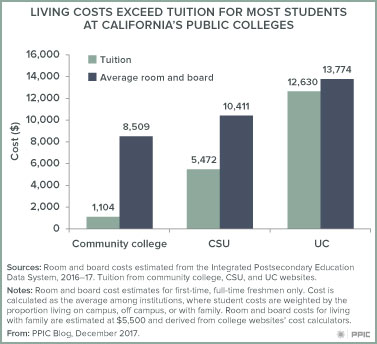
However, housing costs also play a significant role in the total cost of attending college. Californians are well aware of the issue: 85% of residents in the PPIC survey say colleges and universities should do more to make sure that all students have affordable housing options. Indeed, even with the rapid increases in tuition, living costs for many students exceed tuition at California’s public institutions—the state’s community colleges, California State University (CSU), and the University of California (UC). Average room and board costs also differ substantially across the three systems, from $8,509 per year at the community colleges to $13,774 at UC.

These differences in costs are related to whether students live on campus, off campus on their own, or off campus with family. Estimated average costs of housing and food for students living on campus top $13,000 per year, and those living off campus pay an average of $10,000 to $13,000 in room and board. The costs associated with living with family are not estimated in the available federal data, but most college websites suggest these costs range from $5,000 to $6,000—about half the cost of living on or off campus.

Students’ housing choices also partially depend on where they go to school. Only nine cities in California have UC campuses (excluding UCSF which only enrolls graduate students), and most UC freshmen live on campus in their first year. Historically, the 113 community colleges and 23 CSU campuses have been seen as local and low-cost options. Indeed, both systems show about 30% or more of freshmen living with their families, which helps keep average room and board costs lower than at UC. But it is worth noting that the share of CSU freshmen living on campus may grow. More dorms are being built on CSU campuses as administrators see on-campus housing as a strategy to increase graduation rates. Data on students’ living arrangements are based on institutional reporting on freshmen who receive some sort of federal financial aid, which includes more than 60% of students at most institutions.

As state leaders reexamine the goals in the 1960 Master Plan for Higher Education and consider changes to financial aid, they should take into account the role that living costs play in the total cost of education.

Learn moreRead the PPIC Statewide Survey: Californians and Higher Education
Visit the PPIC Higher Education Center

Housing Costs and Higher Education

Homeownership FigureOwning a home has long been part of the American dream. But with the state’s high housing costs, homeownership is difficult for many Californians to achieve. In a recent PPIC Statewide Survey, more than half of renters say the cost of housing is making them seriously consider moving away from the part of California they live in now, with most of those indicating that they are thinking of leaving the state.
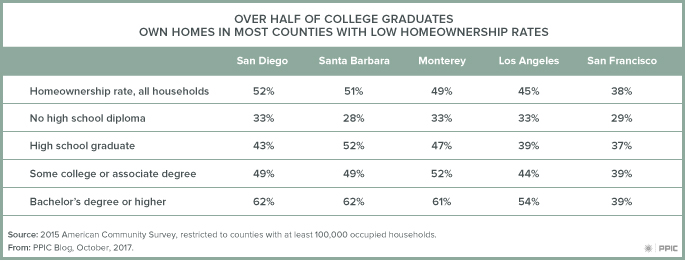
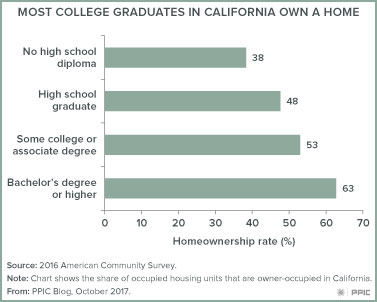
Homeownership rates are substantially lower in California than in the rest of the United States (54% vs. 63% in 2016, according to the American Community Survey). But one group in California fares relatively well with respect to homeownership: college graduates. Among heads of household with at least a bachelor’s degree, almost two-thirds own rather than rent, compared to less than half of high school graduates. The higher rates of homeownership among college graduates are a consequence of their economic success. As shown in other PPIC research, college graduates have much higher incomes and lower unemployment rates than other Californians, enabling many of them to purchase a home.  Owning a home, in turn, often leads to greater wealth. Indeed, the higher net worth of college graduates in California is strongly tied to homeownership.

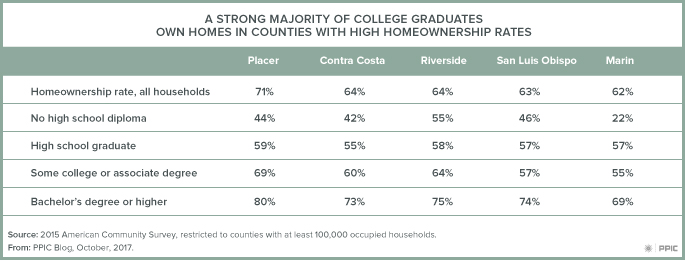
Of course, housing markets are regional, and the coastal areas of California are less affordable for everyone. The five counties with the lowest homeownership rates are all in coastal areas with high housing prices. But even in those counties—with the notable exception of San Francisco—over half of college graduates own a home. At the other extreme, counties with the highest homeownership rates are primarily suburban counties, including some with high housing costs. About 70% or more of college graduates in these areas own a home.


California policymakers have recently enacted a series of measures designed to increase the supply of housing, with a focus on affordable housing units. Certainly, the state’s housing crisis cannot be alleviated without building more housing. But while higher education is not often considered part of a housing agenda, it has played an important role in shielding many Californians from the state’s dramatic increases in housing costs. Because of the labor market advantages experienced by college graduates, many have been able to purchase a home, giving them more stability in their housing costs and allowing many of them to build wealth.