Voters More Optimistic, Less Engaged

A lot has changed since Californians cast ballots just four years ago.

Likely voters today are feeling much better about the direction and economic outlook of the state. In October 2010, most (77%) said that the state was headed in the wrong direction. In our latest survey, likely voters are much more positive about the state’s future—although they are still more likely to say wrong direction (54%) than right direction (40%). Similarly, in October 2010 less than a quarter of likely voters (20%) expected good economic times in the upcoming year and far more (65%) expected bad times. Today, the mood is decidedly different, with 42% expecting good times and 47% expecting bad times. In October 2010, most likely voters (59%) named jobs and the economy as the state’s most important issue. Today, just 30% name it as the top issue, which barely keeps it in first place, while 28% name water and the drought. Further, in September 2010 nearly all likely voters (90%) called the state budget situation a big problem—today, that number is 62%.

This year, likely voters are paying less attention to news about the candidates for governor than they did four years ago, when the race involved an open seat and a high-profile contest. In October 2010, an overwhelming majority were very (39%) or fairly closely (50%) paying attention to news about gubernatorial candidates. In our latest survey, just half of likely voters were doing so (18% very, 34% fairly). In addition, there is a big enthusiasm gap. Fewer voters today say they are “more enthusiastic about voting than usual” (53% 2010, 40% today).

In 2010, when many people were tuned into the top of the ticket race, nearly 60 percent of registered voters turned out to vote. With far fewer voters paying attention to the gubernatorial race—and with the lack of a Congressional senate race—what can we expect in 2014? Will concerns about the drought and the state budget drive people to the polls—and if so, how will this translate into votes on Proposition 1, the water bond, and Proposition 2, the establishment of a rainy day fund? Stay tuned to PPIC as we continue to follow the November 2014 election.

Video Highlights Survey’s Election Findings

The October PPIC Statewide Survey was the focus of a briefing last week in Sacramento, where research associate Jui Shrestha summarized the findings. After her presentation, David Lesher, PPIC’s director of government affairs, pointed to some survey findings to watch as the campaigns and election play out.

  • The governor’s race: Jerry Brown leads by 16 points among likely voters, but other findings are less overwhelmingly in his favor. Statewide, Brown has the support of just a slim majority of likely voters, 52 percent. And he trails Neel Kashkari among some groups of likely voters—those in Orange/San Diego Counties, for example.
  • Voter enthusiasm: Likely voters paid much more attention to news of the gubernatorial candidates in 2006—the last election in which there was an incumbent—than they are doing today. Likely voters overall are also showing lower levels of enthusiasm today than in the 2010 or 2012 elections. These findings suggest that low voter turnout is likely, which will color the results.
  • Proposition 2: Placed on the ballot in a bipartisan vote of the legislature and endorsed by both the California Republican Party and by Governor Brown, this constitutional amendment to create a rainy day fund is struggling for majority support. While support has increased since September, just 49 percent of likely voters favor it today. Less than half of those who live in the San Francisco Bay Area and of those with incomes of $80,000 or more say they would vote yes on Proposition 2.

Drought Watch: What’s in Proposition 1?

This is part of a continuing series on the impact of the drought.

California voters are deciding the fate of Proposition 1—a $7.5 billion water bond. If Prop 1 passes, the water sector will get a big boost in funding. Prop 1 contains $7.12 billion in new debt (the remaining $400 million dollars is money that would be re-authorized from previously passed bonds).

So what kind of water projects will be funded if Prop. 1 passes? The bond focuses mainly on water supply ($3.6 billion) with the majority ($2.7 billion) designated as matching funds for storage projects. These matching funds are intended to support up to half the costs of projects that store water either in surface reservoirs or underground aquifers, and they can only be used to fund “public benefits.” Public benefits include, among other things, better flood protection and recreation opportunities, as well as improved environmental conditions. For instance, expanding surface reservoirs makes it possible to store more cold water, which can be released during warm months to support salmon habitat. Likewise, expanding ponds to recharge groundwater basins can create bird habitat.

The California Water Commission will determine which storage projects receive these funds through a competitive process. The rest of the water supply dollars are mainly for matching funds for water recycling and desalination projects ($725 million), with $100 million each for water conservation and groundwater sustainability planning.

Proposition 1 also has funds for the five areas PPIC has identified as critically underfunded “fiscal orphans” in our recent study of water system finance: ecosystems, drinking water quality, flood protection, stormwater pollution management, and integrated water resources management. Of the funds designated for water quality improvements, $520 million is intended for disadvantaged communities and $800 million is for cleaning up groundwater basins that have been contaminated with industrial and agricultural chemicals. Just over half a billion dollars is designed to encourage agencies to collaborate on water management priorities, with funds going to different regions for priority projects in Integrated Regional Water Management plans. These projects would overlap with the previously mentioned categories, and they would need to improve regional self-reliance and help adapt to the effects of climate change.

Since 2000, California voters have approved six water bonds, totaling nearly $20 billion dollars. These bonds looked a little different than Prop 1. Ecosystem improvement and flood protection were the main priorities, with smaller amounts for drinking water quality, integrated management, stormwater, and water supply projects (these bonds also had large amounts for parks and public access). While these bonds provided welcome support to these areas, they also came with fiscal tradeoffs: bonds are repaid with general fund tax dollars that also support other state programs.

The current drought is likely helping the bond’s chances of passage: according to the most recent PPIC Statewide Survey a record-high 68% of all adults say that the supply of water is a big problem in their part of the state. In this context, it is important to keep in mind that while continued investments in our water system will help us be better prepared for future droughts, this bond is not designed to provide immediate relief from the current one. Most water projects take time to design and build. And, whether or not Proposition 1 passes, the state’s water system will face significant challenges that require funding sources more reliable than a bond can provide.

A Cautionary Tale for Fiscal Reformers

One of the biggest surprises in the PPIC Statewide Surveys this fall has been the inability of Proposition 2 (aka the rainy day fund) to garner majority support from voters. The measure—which was placed on the November ballot by the governor and a unanimous vote of the legislature—allows for annual transfers of revenues into an account to be used only for fiscal emergencies and to pay off state debt.

Support did rise from 43 percent in our September poll to 49 percent in October. This may be a sign that Proposition 2 can defy the conventional political wisdom about ballot measures starting out with less than 50 percent support being doomed to fail. Certainly, its supporters find this trend encouraging. But, given the widespread support for the idea of a rainy day fund in earlier PPIC polls, why is Proposition 2 struggling to achieve majority support? Further analysis of our survey results offers a cautionary tale about the political pitfalls of fiscal reforms.

We have been tracking a wide array of fiscal reforms in our polls, including the idea of a rainy day fund: “Do you favor or oppose increasing the size of the state’s rainy day fund and requiring above-average revenues to be deposited into it for use during economic downturns?” In the five times this question was asked before Proposition 2 was put on the ballot, likely voter support hovered around 70 percent. Today, support for the rainy day fund idea has fallen to 55 percent among likely voters. This suggests a strong link between supporting the rainy day fund concept and voting yes on Proposition 2—in fact, 7 in 10 of those who would vote yes on Proposition 2 express support for a rainy day fund. More important, why has a fiscal reform that was consistently and highly regarded fallen out of favor with so many voters?

We looked at the possibility that Californians are less inclined to support a rainy day fund because the state’s finances have been improving. But our tracking question on state budget perceptions found that slightly more likely voters say that the state budget situation is a big problem today (62%) than in January (56%). Moreover, those who see the state budget as a big problem are less likely to favor a rainy day fund today (48%) than they were in January (65%).

The steep decline in support for a highly popular idea seems to have political overtones. Since January, support for the rainy day fund idea has dropped from a solid majority to below 50 percent among several groups: Republicans (72% January, 47% October), conservatives (69% January, 47% October), those who disapprove of the job performance of both the governor (65% January, 42% October) and the legislature (65% January, 47% October), and those who say the state is going in the wrong direction (67% January, 48% October). Meanwhile, Democratic governor Jerry Brown has been touting the virtues of Proposition 2 on the campaign trail, and Republican leaders who supported it have been silent.

In an election context, the rainy day fund idea has thus become politically polarizing. The governor’s success in rallying his supporters around Proposition 2 is reflected in its recent rise in the polls. But the rainy day fund idea has lost favor among Republicans and conservatives who used to be loyal supporters. Today, support for idea is much higher among Brown voters (68%) than Kashkari voters (43%). Governor Brown may need to do more to reassure the Democratic base of the long-term benefits of a rainy day fund to prevent Proposition 2 from falling short of majority support.

In short, a rainy day fund that once had strong backing across party lines has become a divisive idea. This is a reminder that even a seemingly uncontroversial issue with unanimous support in the legislature is subject to political redefinition in the heat of an election. Future tax and spending reforms may face an even more challenging path if they can’t ride on the coattails of an incumbent governor with a 54 percent approval rating and 52 percent supporting his reelection.

The lesson is that the popularity of any given reform can fade unless voters know that it is supported by leaders who share their partisan views and reflect their political values.

Video: Making College Possible

At a time when California’s economy needs more college graduates, a new PPIC report examines the role of grants and scholarships in making higher education both accessible and helping students graduate. Hans Johnson, the report’s author and PPIC Bren Fellow, talked about his findings at a briefing last week in Sacramento.

He found that although total financial assistance available through federal grants, Cal Grants, institutional aid, and private scholarships has increased, it has not kept pace with the actual cost of attending California State University and community colleges. These are the California colleges that enroll most low-income students in California—a state in which nearly 60 percent of K–12 students qualify for free and reduced price lunch programs.

“If we want the economic ladder to success to work in California, we need more students to go to and complete college,” he said. “And given our student population, a lot of those students will be from very low-income families.”

He recommended strategies to make college more affordable and accessible. They include directing any additional aid to low-income students and helping more students complete financial aid forms.

Californians’ Views of Health Care Reform Shift—a Bit

Open enrollment for health insurance through Covered California or HealthCare.gov is set to begin in less than a month, and Californians have had one year of experience obtaining coverage. The Affordable Care Act has divided the state as well as the nation. Have those views shifted? Yes and no.

Before the health insurance marketplace opened, PPIC asked Californians about the law’s potential impact. There was no consensus. About a quarter of respondents in our September 2013 survey said they thought they and their family would be better off (26%) and another quarter thought they would be worse off (24%). More thought the health reform law would not make much difference (43%). Adults nationwide were slightly more negative (24% better off, 32% worse off, 37% no difference), according to a Kaiser Family Foundation poll taken the same month.

Californians were divided along party lines in their opinions of the law’s impact, with half of Democrats (51%) saying the law would not make a difference to them and six in 10 Republicans (61%) saying they would be worse off. Californians without insurance were much more likely than those with insurance to say they would be better off (36% to 23%). Looking more broadly, pluralities across regions and demographic groups said that they expected the health reform law would make no difference to them or their families.

A year later, Californians’ opinions of the health reform law’s impact have shifted. In our latest survey, we asked respondents if it had directly helped them and their family, directly hurt them and their family, or had no direct impact. Most Californians (58%) say the health reform law has had no direct impact. Similar proportions say either it directly helped (20%) or it directly hurt (19%). Adults nationwide are slightly more likely to say the law hurt them (56% no direct impact, 14% helped, 27% hurt), the latest Kaiser Family Foundation poll shows.

Looking across political groups, we see more change. Majorities across parties (55% Democrats, 56% Republicans, 63% independents) say the health reform law has not had a direct impact on them or their family. Similarly, among the insured and the uninsured, 58 percent say the law has not affected them. In fact, majorities across regions and all demographic groups say the law has had no impact.

Although most Californians say they have not felt the law’s effects, they still remain sharply divided along party lines in their general opinion of the law. Six in 10 Democrats have a favorable opinion of the health care law, while eight in 10 Republicans have an unfavorable opinion of the law–almost identical findings to those last December.

Of course, the story of health care reform is far from over. At PPIC, we will continue to monitor Californians’ views of this issue and its impact on their lives.

Drought Watch: California as a Testing Ground

This is part of a continuing series on the impact of the drought.

An international consortium of water economists gathered at the World Bank headquarters in Washington, D.C. earlier this fall for two days of meetings on water policy research. The timing was opportune, as the World Bank – which provides financial and technical assistance to developing economies around the globe – recently reorganized to provide a new emphasis on water resources. The conference theme was the economics of water conservation and efficiency, with researchers looking at the role of technology, pricing, and institutions to effectively and efficiently manage water resources under conditions of increasing scarcity. In light of the national and international attention to California’s ongoing drought, I was asked to give keynote remarks about lessons from California for other regions of the world.

I highlighted four central ideas. (My presentation is 22 minutes into this video.) First, urban areas the world over can improve drought resilience by diversifying their water portfolios, rather than relying on a single source of water. Second, although conservation is important, policymakers should be mindful that improved irrigation efficiency is not a panacea to cope with drought, because much of the water “saved” is already being reused by others downstream.

Third, sustainable groundwater basin management—the approach now called for under California’s historic groundwater legislation—is an invaluable drought management tool because it means more groundwater will be available to help get through dry times. But getting there can imply costly trade-offs in basins that rely heavily on groundwater, requiring institutional and financial support to help water users make the transition.

And fourth, like California, many regions can benefit from repurposing their storage and conveyance infrastructure to better cope with droughts and the growing water scarcity expected with climate change. In particular, storing more water for dry years in groundwater basins, and using surface reservoirs for seasonal storage and flood protection, can be cost-effective ways to adapt to an increasingly variable climate.

PPIC’s Role in a Changing State

California is changing quickly and in ways that touch the lives of all of its residents. The state has enrolled millions of people in health insurance under the federal Affordable Care Act. It is moving ahead to expand the cap-and-trade program that is a cornerstone of AB 32, the landmark law mandating a reduction in greenhouse gas emissions.

In K–12 education, California is implementing two sweeping policy changes at the same time. New English and math standards, called the Common Core, require big changes in what is taught in the classroom. A new school funding formula, the Local Control Funding Formula, gives districts increased flexibility over spending and provides extra money for disadvantaged students.

Historic changes are playing out in the corrections system as well. Realignment, which shifted responsibilities for many offenders from the state to the local level, has had a significant impact on the state, counties, and communities.

Amid these policy shifts, California is coping with a major drought that has focused attention on the state’s need to improve its water management.

These changes are also taking place in an election year—and California’s elections have also undergone major changes. This is the first election in which state constitutional officers, such as governor and controller, will be elected under the top-two primary system.

At PPIC we are focused on monitoring and analyzing the impact of these changes—both short and long term—and examining other steps the state can take to meet its critical challenges. In recent months, we have delivered objective, nonpartisan research on all of these topics. We plan to release many more publications in the months ahead. Our PPIC Statewide Survey will continue to give California residents a voice in the policy changes that affect them, as it has since 1998. The PPIC blog provides regular updates on the impact of the drought, as well as news and analysis on a range of policy topics from our experts.

Through our extensive outreach, we have hosted discussions on these important topics and more. We invited California’s two top legislative leaders to share their priorities for the upcoming session. At another recent event, the two secretary of state candidates talked about how they would improve elections and increase voter participation, if elected. Both of these events were webcast live to engage Californians from all over the state.

We encourage you to sign up for our announcements to learn about future events. We hope you’ll stay up to date with our publications and videos by signing up for our monthly e-bulletin, following us on social media, and subscribing to the PPIC blog.

As always, we welcome your comments and suggestions.

Drought Watch: Video Seminars

This is part of a continuing series on the impact of the drought.

A series of videos available online is a great resource for water wonks and newcomers alike. Researchers and cooperative extension specialists from the University of California’s Division of Agriculture and Natural Resources, with support from the California Department of Water Resources, have put together these video seminars on drought-related water management issues. You can bone up on topics ranging from drought impacts on wildlife and groundwater basins, to the latest research on California’s climate in centuries past (and the mega-drought we experienced in medieval times), to tips for managing crops and rangeland when water is in short supply.

I contributed to the series with an overview of how water marketing and groundwater banking can help mitigate the worst economic impacts of droughts, drawing on PPIC’s ongoing research on this issue. The series is being updated regularly with new videos.

California’s New Leaders Focus on Poverty

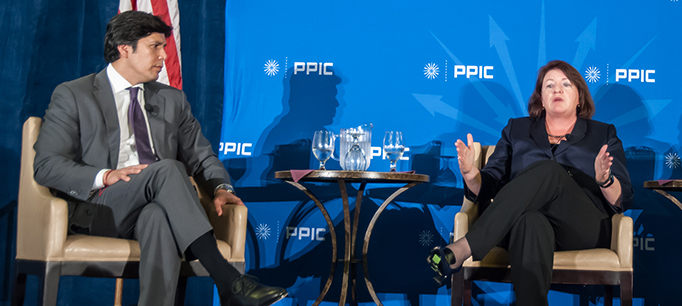
Assembly Speaker Toni Atkins and Senator Kevin de León, who will take over as senate president pro tem later this month, each told a Sacramento audience about growing up in poverty and the role it has played in their shared view of the state’s responsibility to those in need.

“We share similar values and similar stories that have made us care about the values and the issues that we’re talking about today,” said Atkins, who was raised in a poor, rural Virginia family and now represents the San Diego area. De León, who was born in San Diego and represents Los Angeles, said he is the youngest child of a single immigrant mother and the only family member to graduate from high school. Atkins and de León, both Democrats, were elected by their respective legislative chambers earlier this year to serve as leaders.

Both lawmakers cited a recent PPIC report — Child Poverty and the Social Safety Net in California by Caroline Danielson and Sarah Bohn — that said about 50% of California children live in poverty or near-poverty. The remarks, part of the PPIC 2014 Speaker Series, were made to a capacity audience of about 400 in the ballroom of the Sheraton Grand Hotel. The discussion was moderated by PPIC President Mark Baldassare and streamed live to hundreds more.

The wide-ranging conversation touched on a number of major issues—including health care, the drought, immigration, and taxes. Both leaders said that they believe the state should talk about changes to the state tax structure and consider whether to extend the temporary taxes that voters passed in Proposition 30. Atkins cautioned that it will be difficult to gain support from voters for an extension of the taxes.

De León expressed strong support for affirmative action, which he credited for his ability to attend college and become a legislator. He also said California should continue to lead on immigration issues because the federal government has been unable to pass a reform plan. And he noted that polls suggest Californians support health coverage for undocumented residents.

Atkins, meanwhile, encouraged more cities to follow San Francisco and San Jose, which recently increased the minimum wage. Both leaders also said they have worked together in the past and believe they will have a good working relationship going forward.