The Unintended Consequences of Indoor Water Conservation

High rates of water conservation helped California manage limited supplies during the 2012–16 drought. But conservation can have a downside. New research shows that indoor water conservation can reduce the quality and quantity of wastewater, making it harder for local agencies to use treated wastewater to augment their water supply.

We talked to two members of the research team about their findings: David Jassby, associate professor of civil and environmental engineering at UCLA; and Kurt Schwabe, professor of environmental economics and policy at UC Riverside and an adjunct fellow at the PPIC Water Policy Center.

Jassby summarized the problem: “In general, as people conserve water inside their homes, the concentration of contaminants in the wastewater goes up—organic matter, nitrogen, detergents, and more. All of these things have to be treated.”

Schwabe noted that in the past, recycled water was mostly used for irrigating nearby cropland and median strips—not drinking. But as treatment processes have improved and demand for water increased, recycled water has become an integral part of the drinking water supply in some areas, where it is used to replenish groundwater basins. In many communities, treated wastewater is discharged into rivers and streams and used by downstream entities that treat the water again.

Salinity is a particular challenge. “Most wastewater treatment plants can treat higher levels of nutrients, but they’re not designed to treat higher levels of salinity,” Schwabe said. “What this means is the water that is discharged into streams or to farms or into aquifers for groundwater recharge will be saltier, which reduces water quality and crop yields.”

Schwabe noted that while utilities can employ technical fixes to address drought-related wastewater quality issues, this doesn’t address the problem of quantity. Indoor conservation results in less treated water flowing into streams or available for reuse.

On average, only about 10% of municipal wastewater is reused in the US. Israel reuses 85–90% of its wastewater—perhaps the highest rate in the world, Schwabe said. California is adopting new rules on “direct potable reuse” of treated wastewater, which would enable cities to add treated wastewater directly into their water supply.

“Farmers in some parts of California are becoming increasingly reliant on treated municipal wastewater from neighboring urban areas. This is an effective strategy for dealing with water scarcity. But it also reveals that conservation—another effective drought strategy—might in some instances work at odds with wastewater reuse.”

Urban areas are also affected. For example, recycled wastewater is a significant portion of stream flow in the Santa Ana River in Southern California. Indoor conservation reduces water supply for communities in downstream reaches of the river.

Does this mean that people abandon conservation? The researchers say no. “Our results are intended to illustrate how different drought mitigation actions are related so agencies can plan, communicate, and coordinate in the most informed and cost-effective manner possible,” said Schwabe. “Conservation mandates that don’t recognize these linkages can have significant and negative consequences on the effort to reuse wastewater.”

Jassby noted that the place conservation happens is key: “When people are asked to conserve water, they should be encouraged to conserve water outside the home.”

More broadly, having water supply and wastewater treatment agencies cooperate in how they manage their systems can also help, Schwabe said.

Video: Strategies for Reducing Child Poverty

High housing costs and low-wage work make it hard for low-income Californians to meet their basic needs. The result? Nearly a quarter of California’s youngest residents live in poverty—a fact with profound educational, health, and economic repercussions now and in the future. Social safety net benefits help low-income families supplement their incomes but do not reach the working poor in high-cost areas and the very poor across the state.

A new PPIC report examines how high housing costs and low wages contribute to child poverty. It also looks at additional policy approaches: an expansion of the Earned Income Tax Credit, establishment of a state child credit, and an overhaul of the state renter’s credit. Each approach holds promise, and each involves trade-offs.

Researcher Caroline Danielson presented the report in Sacramento last week. She also demonstrated an interactive tool that allows for a deeper exploration of how policy changes could affect California’s diverse counties. It underscores the need for policymakers to be strategic in determining how best to help families in need throughout the state.

Explore the accompanying tool Interactive: Reducing Child Poverty in California.

Commentary: A New Approach to Protecting Rivers

This commentary was published in the Sacramento Bee on November 20, 2017.

California’s native freshwater fish—salmon, steelhead, sturgeon and others—continue to decline, and regulations to reverse this trend have fanned controversy. A new approach to environmental stewardship is needed. We should start by granting the environment a water right, as detailed in a new report by the PPIC Water Policy Center.

Read the full commentary on sacbee.com.

College Graduates and California’s Future

The University of California Board of Regents invited Mark Baldassare, PPIC president and CEO, and Hans Johnson, PPIC senior fellow and director of the PPIC Higher Education Center, to present their perspectives on the role of higher education in California’s future, November 16, 2017. Here are their prepared remarks:

Good morning, I am Mark Baldassare, president and CEO of the Public Policy Institute of California (PPIC). I am here with my colleague and PPIC’s higher education center director Hans Johnson to present the institute’s research findings on the need for college graduates in California’s future economy. To kick off this session, I am going to make a few remarks about public opinion to place this issue in perspective.

The November PPIC Statewide Survey points to the importance of this topic for most Californians. Eighty percent of California adults say that the state’s higher education system is very important to the quality of life and economic vitality of the state, and another 14% say it is somewhat important. Strong majorities across political, regional, racial/ethnic, and demographic groups say that the state’s higher education system is very important. In fact, strong majorities of Californians have been saying that higher education is very important to the state’s future since we first asked this question in 2007.

In the context of the 2018 governor’s race, 63% of California adults say that candidate positions on higher education are very important, and another 28% say they are somewhat important to them. Majorities across political, regional, racial/ethnic, and demographic groups hold this view.

When asked about the current workforce, 83% of Californians say that a four-year degree from a college and university prepares someone very well (30%) and somewhat well (53%) for a well-paying job in today’s economy. Fifty percent of Californians think that a college education is necessary for a person to be successful in today’s work world, with majorities of Latinos (67%), Asian Americans (54%), and African Americans (51%) and fewer whites (35%) holding this view. Moreover, about half of Californians, with pluralities across the state’s major regions, say that California will not have the college-educated residents needed for the jobs and skills likely to be in demand 20 years from now.

In sum, the importance of a higher education and the need for college graduates are issues on the minds of many residents today. Hans will provide the demographic and workforce analysis that demonstrates why the state’s higher education system is essential for a better future for all Californians.

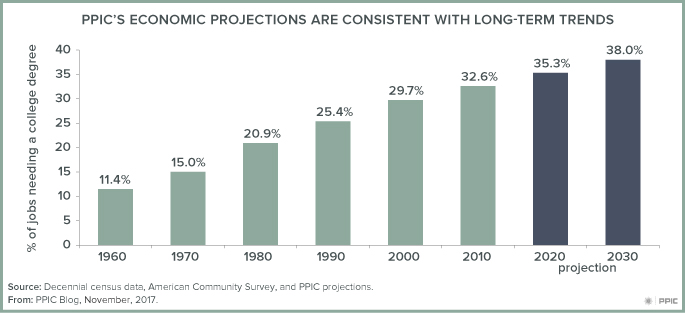
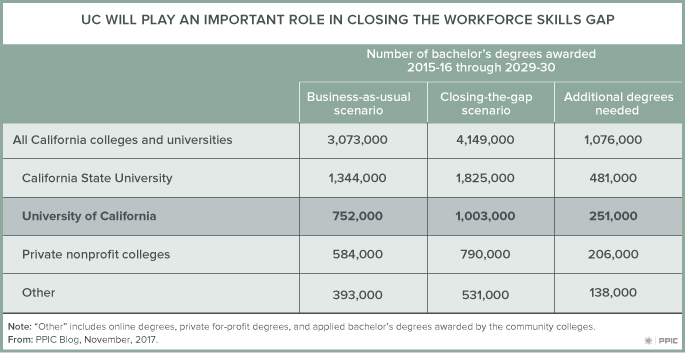
PPIC has produced a series of reports on California’s future population and economy. Our report Will California Run Out of College Graduates? provides projections of the demand for and supply of workers across all levels of educational attainment to 2030. Our primary finding is that California faces a shortage of highly educated workers. Specifically, economic projections to 2030 show that about two in five jobs will require at least a bachelor’s degree, while demographic projections suggest only about one in three Californians will have at least a bachelor’s degree. This shortfall equates to 1.1 million workers.


In this presentation, I first describe how California’s population and economy are changing and then identify how the state and its higher education institutions can increase college enrollment and completion to produce more college graduates.

California’s economy increasingly demands highly educated workers

To develop our economic projections, we apply trends in educational attainment levels to occupational projections developed by the California Employment Development Department. We examine changes in labor market demand that are occurring due to shifts both in occupational structure and changes in educational attainment within occupations. Our primary finding is that the state’s economy will continue along a well-established trajectory, with a growing share of jobs requiring at least a bachelor’s degree.

There are two key drivers of increasing demand for college graduates: (1) faster growth in occupations that commonly require a college degree (e.g., computer technology), and (2) increases in demand for highly educated workers within occupations (e.g., nursing). In recent years, most (74%) of the increased demand for highly educated workers has occurred because of faster job growth in occupations that commonly require a college degree. Among occupations with at least 100,000 full-time year-round workers, there have been especially rapid growth rates for software developers (56% increase between 2010 and 2015), computer scientists and systems analysts (42% increase), and managers (35% increase). These and other highly skilled occupations have experienced faster growth than most occupations that require lower levels of education.


That said, the increase in educational attainment within occupations has been significant. For example, the share of registered nurses with a bachelor’s degree has grown from 57% in 2000 to 68% in 2015. From 2010 to 2015, about 26% of the increase in jobs for college graduates was attributable to growing demand for highly educated workers within specific occupations.

Are college degrees really necessary for these jobs? To answer this question, we examined a number of labor market outcomes. Within and across occupations, we find that workers with bachelor’s degrees have higher labor force participation rates, lower unemployment rates, and higher wages than those without—and that, in general, as educational attainment increases, wages also increase. Overall, the wage premium for college graduates relative to less-educated workers has grown. By 2015, the average annual wage for full-time year-round workers was more than twice as high for workers with a bachelor’s degree than for those with only a high school diploma.
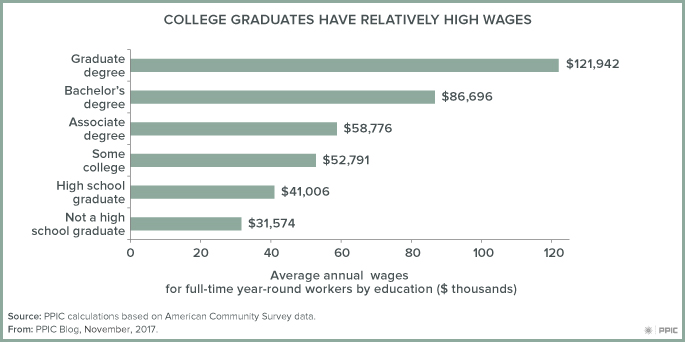
Within each of 51 occupational groupings we see higher wages for college graduates than for high school graduates. Among registered nurses, for example, those with a bachelor’s degree earned 12% more than those with an associate degree.

California’s educational institutions are not keeping up with demand

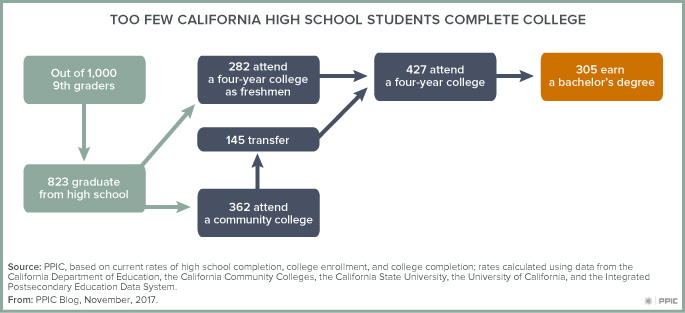
Too few Californians are graduating from college. At current college enrollment and completion rates, only 30.5% of 9th graders in California will eventually earn a bachelor’s degree either in California or elsewhere in the United States. Among all states, California ranks 47th in the share of high school graduates who enroll in four-year colleges and 5th in the share who go to community colleges. Low rates of transfer from community colleges to four-year colleges exacerbate the problem.

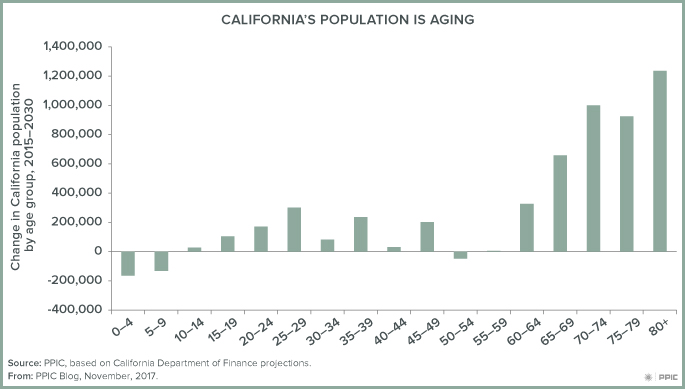
A critical challenge is the retirement of the baby boom generation. Called the “silver tsunami” by some, this is the first time in California’s history that such a large and well-educated group is exiting the labor force. In contrast, the number of young adults in California is projected to increase only modestly.

Not all degrees are equal

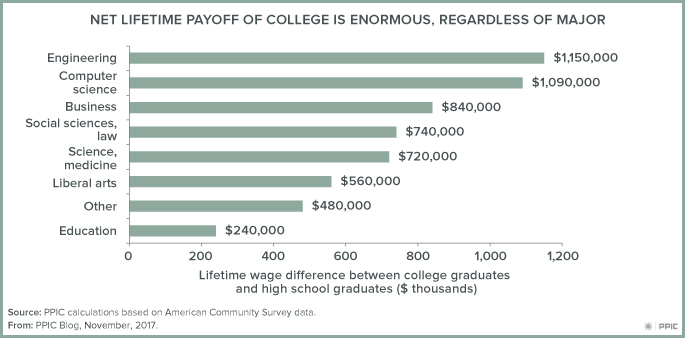
On average, college graduates have very strong labor market outcomes. At any point in time, some college graduates are working in jobs that do not necessarily require a college degree, but over the course of their careers the vast majority of college graduates will move into occupations that reward their educational training. Our estimates show that students who earn bachelor’s degrees in engineering and computer science fare very well in the labor market, but even those with less remunerative majors, such as education and the liberal arts, will earn far more in wages than less-educated workers, even after taking into account all the costs of going to college.

How to close the degree gap

To close the degree gap, California and its higher education institutions need to establish new policies and practices to enroll more students, especially in our four-year colleges and universities, and improve graduation rates among students already in college. In previous testimony, PPIC has identified targets for each of the state’s public systems with respect to admission, transfer (from community colleges to four-year colleges), and improved graduation rates.

The University of California (UC) will play a central role. In our scenario, UC would need to award approximately one-quarter of the additional degrees necessary to close the gap. This is an ambitious target, but the increase over current levels (and over the baseline projection) would not be without precedent. For example, between the 1999–2000 and 2016–17 academic years, the number of bachelor’s degrees awarded by UC increased 62% (from slightly more than 33,000 to almost 54,000). Our closing-the-gap scenario would require UC to award about 81,000 degrees by 2029–30, a 51% increase over current levels.

Improving access and success among groups historically underrepresented in higher education—including low-income students, first-generation college students, Latinos, and African Americans—is essential if we are to close the degree gap. Compared to other public research universities, UC has an impressive record in enrolling low-income and first-generation students.

The California State University (CSU) system and the California Community College system have adopted new goals that are entirely consistent with PPIC’s targets. New initiatives, including remediation reform at the community colleges and at CSU, have the potential to substantially improve student success rates. CSU’s new graduation initiative aims to increase graduation rates and eliminate gaps between groups of students. College preparation among the state’s high school graduates has also increased, with the share of students completing the college preparatory requirements of UC and CSU reaching an all-time high. Strong demand for UC is likely to continue as college preparation continues to improve and the transfer pathway is better articulated. UC has seen consistent increases in graduation rates for many years, and new efforts to improve on-time graduation are likely to continue this trend.

Finding ways to accommodate all these students remains a central challenge, but one we must meet in order to ensure a better future for all Californians.


Video: Gavin Newsom’s Priorities

Gavin Newsom, California’s lieutenant governor and a candidate for governor in 2018, was asked in a San Francisco forum last week to name the three issues that will make the biggest difference in California’s future. Newsom, who is also a former mayor of San Francisco, predicted that both California and the nation will be grappling with these issues over the next ten years:

  • Debt and demographics. With California’s population aging rapidly, the state and its cities face growing public employee pension and health care liabilities. “As a progressive Democrat, I’m not naïve about the commitments we’ve made and the commitments we must fulfill,” Newsom said. “Nor am I naïve, as a former mayor, about the challenge of meeting those commitments . . . Cities like Richmond are facing the prospect that by 2021, by one estimate, upwards of 40% of their general fund will go to retiree contributions.”
  • Energy and climate change. The state has set ambitious goals to reduce greenhouse gas emissions and increase energy efficiency. “The next governor has to deliver,” he said.
  • Information technology and globalization. “The issue that animates my anxiety: work, the future of work.” The days of having a job or career have given way to something radically different, forcing us to think in terms of portable benefits and retirement security, he said. Further, workers in retail, food and beverage, and clerical jobs—the top employment categories—are on the “edge of automation.” Displacement of these workers will require us to have a different conversation about skills, education, and social mobility, Newsom said.

The conversation with Newsom was part of the PPIC Speaker Series on California’s Future. PPIC is inviting all major candidates for governor to participate in a public event if they reach a certain threshold in the polls. The goal is to give Californians a better understanding of how the candidates intend to address the challenges facing our state.

Watch all candidate videos.

Reforming Water Management for the Environment

A longer version of this piece was recently published by Water Deeply.

It’s time for California to rethink how it manages water for the environment. Despite decades of effort, many of the state’s aquatic native species are in decline. Controversy over water for the environment remains high. The latest drought left lasting effects on already-stressed species and their ecosystems and highlighted the need for a change of course.

Our new research identifies shortcomings in current practices and lays out three reforms that could reduce conflict while improving freshwater ecosystems.

Better accounting. During the latest drought, state and federal agencies found their decision making hampered by information gaps on water availability and use and ecosystem conditions. For example, weaknesses in accounting and monitoring systems—and poor operational choices at Shasta Reservoir—pushed endangered winter-run Chinook salmon to the brink of extinction.

These management challenges were made more contentious by public perceptions about the uses of environmental water. The state lumps many things into the “environmental water” category, including flows required by regulations to maintain water quality for urban and agricultural uses. For example, during the drought, environmental water that flowed from the Delta into San Francisco Bay was widely criticized as “wasted to the sea.” Yet most of this water was needed to prevent high salinity in Delta water supplies.

We must do a better job of measuring and tracking water and ecosystem conditions—and make this information timely and transparent. The state also needs to clearly define what purposes “environmental water” serves, and separate water that benefits both water users and the environment from that used solely to support ecosystems. Better accounting will improve efficiency and provide a common understanding of water use for policy debates.

Better planning. The drought revealed major weaknesses in how California plans for and responds to water scarcity in ecosystems. While urban water managers routinely plan for drought, no such planning exists for ecosystems. With a few exceptions, fish and wildlife agencies react to—rather than plan for—severe drought.

California needs to shift from reacting to drought to anticipating and mitigating its effects on ecosystems. This can be achieved through the development of watershed ecosystem plans that set management goals and priorities for actions.

In addition, California needs annual contingency plans to prepare for uncertainty over how wet the winter and spring will be. A good model is that of Victoria, Australia, where water managers vet their plans and priorities with stakeholders. This allows water users to know what to expect, and tensions are reduced.

Ecosystem water budgets. California also needs a new way to allocate water to protect ecosystems. The over-reliance on minimum flow and water quality standards—often set for individual endangered species—limits the capacity of water managers to adapt to changing conditions.

A more nimble approach would also provide assurances to all interests about allocation of ecosystem water. This can be accomplished by granting the environment a water budget that can be flexibly managed, much as urban and agricultural water-right holders do. These ecosystem water budgets could be stored in reservoirs or groundwater basins, and even traded. The budget would be administered by a trustee guided by the watershed plan and good accounting systems. The trustee could manage the water budget to maximize benefit for ecosystem functions and, where possible, reduce impacts on other water users.

Management of California’s freshwater ecosystems—particularly during drought—is not working well for anyone. These reforms would improve conditions and reduce tensions over allocation of water–and enable freshwater ecosystems to adapt to a warmer and more variable climate.

Video: Reforming Remedial Math in Community College

Developmental—or remedial—education is one of the largest barriers to student success in California’s community colleges. The good news is that reforms are underway, and a new report by the Public Policy Institute of California (PPIC) looks at the effectiveness of some of these reforms in math. PPIC researcher Olga Rodriguez presented the report in Sacramento this week. One reform the researchers studied is an alternative to traditional algebra-based courses and is designed for students in majors—particularly those in the liberal arts and humanities—that require only statistics. The report finds that students in this statistics sequence substantially outperform their peers who take traditional developmental math.

In a discussion following the presentation, panelists addressed the issue of why this math alternative is not more widely available. Myra Snell, math professor at Los Medanos College and cofounder of the California Acceleration Project, said the reasons range from the logistical to the cultural. Most math professors are not trained in statistics. Further, there is a deeply held belief among faculty that intermediate algebra is essential. She said that this “gets in the way of them rethinking what might be best for students.”

Laura Metune, vice chancellor of external relations at the California Community Colleges Chancellor’s Office, noted the necessary shift in emphasis from encouraging campuses to try multiple interventions to investing in alternatives with the best chance of helping more students achieve their academic goals.

Nikki Edgecombe, senior research scientist at the Community College Research Center at Teachers College, Columbia University, noted: “If we know that students who are completing a statistics-level pathway are completing their transfer-level math at a significantly higher rate, but we hold on to the old system as well, it’s safe to say we’re doing a lot of students a disservice.”

She continued: “To be honest, there are a lot of bad ideas out there. We need to have the moral courage to identify what those are and fashion solutions for students.”

Learn more

Read the report Reforming Math Pathways at California Community Colleges
Visit the PPIC Higher Education Center

Partisan Gerrymandering and the Role of Social Science in the Courts

The US Supreme Court is considering a high-profile case that could change the way legislative maps are drawn and reshape elections. The court has invited social science to play an unusually significant role in its decision.

On October 3, the court heard oral arguments in Gill v Whitford, a Wisconsin case that could result in the first constitutional constraints on partisan gerrymandering. The case represents the culmination of decades of litigation on the subject. As someone who responded to the court’s call and provided a metric used in the case, I have an unusual perspective on the court’s relationship to social science and what it may say about the role of social science and the law more generally.

Partisan gerrymandering, broadly defined, is the practice of drawing the boundaries of representational districts to maximize the number of seats for one party. In 1986, the court declared this practice appropriate for judicial consideration. But the justices did not know how to define a partisan gerrymander so they could consistently identify one in a way that removed personal bias as much as possible. In the ensuing 30 years of litigation, the court has hardly strayed from this initial view—that the problem is real but difficult to define.

Partisan gerrymandering is a challenge to measure and describe because it represents the collision of two fundamental elements in American politics: geographic representation and party allegiance. Our district-based approach to elections presumes that geography trumps all other concerns. Each district is supposed to elect the best person to represent the needs of the people in that community, and each district’s needs are imagined to be distinct from the needs of other districts.

In reality, parties, not geography, drive our politics. Parties bring factions of voters in each district together into a broad, durable coalition that often has no relationship to geography at all. Voters will agree much more often with fellow partisans in other districts than they will with opposing partisans in their own district.

Parties therefore bind voters in different districts to each other. Voters who choose parties care about more than just the mechanical fact that someone has been elected to represent their district. They want their party to win, and they also want representatives from their party to be elected elsewhere.

But in our district-based system, a party that wins more votes does not necessarily win more seats. It has to win more votes in the right places: in districts where more votes will push the party over the threshold to victory.

Partisan gerrymandering exploits this fact by making sure that one party spends its votes in futile efforts: districts where it comes close to winning but will never quite get there, and districts that it will win by margins so large that victory is never in doubt. These outcomes “waste” votes because so much of the party’s support (the votes cast for losers and those cast in excess of the number required to win) do not contribute directly to victory. By playing with the number of votes each party wastes, a partisan gerrymander can manipulate the number of seats each party wins, even when the number of votes the parties receive does not change.

This leads to a real tension. One the one hand, our district-based political system suggests that parties are unnecessary and certainly not owed any particular level of representation.  On the other hand, if voters largely express their policy desires through parties, suppressing a party’s representation—as partisan gerrymandering does—seems like a serious violation of democratic norms. The court’s struggles in this area reflect this collision of ideas. The court believes the issue is real and potentially very serious, but it has trouble defining the harm within a system that does not take parties into account.

Rather than resolve this contradiction, the justices extended an open invitation to social scientists to solve it for them (or at least get them closer to a solution). This was a sensible step for the court to take. Social scientists add the most value when a clear, objective measurement is needed but the specifics of it are going to be nuanced and complex.

Moreover, social scientists have stepped up to the court’s challenge. In addition to the measure I have offered—the “efficiency gap”—social scientists have also presented several other approaches to the court. Each one measures a slightly different aspect of the concept of a partisan gerrymander, and each has its plusses and minuses. In the Whitford litigation, these quantitative options led to an unusually large amount of analysis. Graphs, tables, computer code, equations, and data all became important parts of the Whitford evidentiary record.

This is clearly a success for social science. But it also creates a problem for the court. Precisely because it takes social science to understand partisan gerrymandering, the solutions offered will be complex. The court balked at this complexity in the oral arguments, calling the social science “full of questions,” “gobbledygook,” and a “bunch of baloney.” Concerns were raised that reliance on social science would undermine the legitimacy of the court, since it might be difficult to explain the court’s decision in terms the average person could understand.

These concerns should be taken seriously, but they should not prevent the courts from addressing complex problems. As more data and computing power become available, social science will increasingly provide nuanced analyses that will be challenging to understand. These may not always be requested by the courts. In fact, it may be social science that invites the courts to get involved in issues that had once been considered untouchable—or that the courts were not even aware were problems.

The courts cannot just ignore this new evidence. Nor can they be expected to step in to defend something that they do not understand. Instead, we must find more effective ways to help the courts deal with the evidence that they see. There are a variety of options here, from staffing courts with social science experts to adding more social science analysis to law school curricula.  Perhaps we might even require judges, like doctors, to take short courses on the latest methods in order to be “re-certified” on a periodic basis.

Regardless of the solution, the struggles evident in the Whitford gerrymandering case are unlikely to get better without some change. Social science and the law are made for each other, but the marriage might need a little counseling to work itself out.

K–12 Test Scores Vary Widely across Student Groups

The 2017 test results for California’s public K–12 school students were essentially unchanged from 2016. But behind the overall results, there were significant differences among student groups. Economically disadvantaged students—mostly those who are eligible for free or reduced price school meals—continued to score far below students not in this category. Students with disabilities and English Learner (EL) students performed at levels significantly below those of low-income students. Gaps in achievement among these groups were essentially unchanged in 2017.

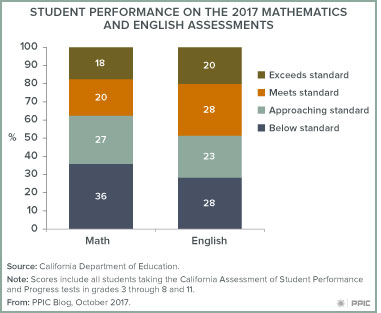
Known as the California Assessment of Student Performance and Progress (CAASPP), tests in English and mathematics are administered to virtually all K–12 students in grades 3 through 8 and in grade 11. Students take the computer-based assessments in late spring each year. The scores are reported across four performance levels. In English this year, 45% percent of students performed at the top two levels, which signal that they are working at or above the state’s standard for proficiency. About 28% of all tested students fell into the lowest performance level, “below standard.” In comparison, fewer students had mastered the mathematics skills needed to meet state standards, with 38% earning a proficient score. More than a third (36%) scored at the lowest performance level.
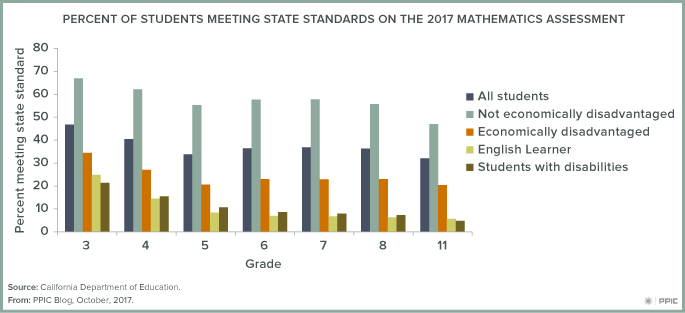
When we look at the proportion of students in each grade who scored at the two top performance levels on the mathematics test, we see that 47% of third graders meet the standard, while fewer students in subsequent grades meet state standards. By grade 11, only 34% are at the top two levels.


The state’s Local Control Funding Formula recognizes that family income is highly related to student success, and the test results reflect that relationship. Only 33% of economically disadvantaged students in third-grade and 20% in eleventh grade scored at proficient levels in mathematics. For students who are not economically disadvantaged, proficiency rates are more than twice as high—68% in third grade and 48% in eleventh grade. This divide is particularly important because 60% of students tested are economically disadvantaged.

Fewer than one-quarter of third grade students with disabilities or English Learners met the state’s mathematics standard. Performance is lower in the higher grades, and by grade 11 only about 5% of these groups are scoring at proficient levels. These data, however, understate the performance of these students. English Learner students who master English are reclassified as fluent, and are therefore no longer included in the EL group; the testing data show that reclassified students perform at higher levels than native English speakers. Also, newly arrived EL students in grades 3 through 11 tend to lower average EL test scores. These dynamics result in the data showing persistently low EL proficiency rates. A similar dynamic affects special education scores.

The new test scores reemphasize the need to boost outcomes for California’s low-income students. Students who are not considered low-income perform pretty well, yet even this group’s mathematics achievement lags in the higher grades. The data also underscore the need for better information on English Learners and students with disabilities. It is likely that the progress of these students is better than suggested by these scores. The state should consider using the individual student data to develop more accurate measures of progress for EL students and other groups.

New Laws Ease Funding and Improve Accounting for Water

This was a busy year for water policy in the California Legislature. Governor Jerry Brown signed more than a dozen bills affecting the way we manage water. The bills cover a wide range of issues, from funding water infrastructure to reporting on new groundwater wells in overdrafted basins.

Paying for water emerged as a major theme in this year’s crop of water bills. Here’s a summary of newly signed bills:

  • Stormwater: SB 231 gives the courts guidance on how to interpret Proposition 218, which requires that a majority of landowners or a two-thirds majority of all local voters approve new stormwater drainage fees—making it difficult for agencies to pay for needed improvements to their systems. SB 231 defines stormwater as part of the sewer system. This puts stormwater services on par with water, sewer, and trash collection, none of which are subject to direct voter approval of new fees. If the courts uphold SB 231’s interpretation, this will give stormwater agencies more flexibility to raise funds.
  • Safe drinking water: AB 560 and AB 339 expand funding options for projects that enhance drinking water quality in poor communities and meet emergency water supply needs. AB 560 will make it easier for some disadvantaged communities to access grants and get more affordable terms on loans for safe drinking water projects through the Drinking Water State Revolving Fund. And AB 339 makes permanent a temporary authorization to use the State Cleanup and Abatement Account for emergency drinking water supply problems such as shortages or impaired quality.
  • Water and parks bond: SB 5 (the California Drought, Water, Parks, Climate, Coastal Protection, and Outdoor Access for All Act of 2018) is a $4 billion general obligation bond for improving outdoor open spaces and parks, protecting rivers and coastlines, and supporting solutions to a range of other water management issues such as groundwater sustainability and flood protection. This will go before voters in June 2018.

Two bills improve water use accounting:

  • AB 589 creates standards for water use measurement techniques. This addresses the relatively recent requirement that surface water diverters measure and report water use to the state.
  • SB 252 specifies types of information that groundwater users must report to their local jurisdictions when they apply to dig new wells in critically overdrafted basins. Reporting includes characteristics such as well location and depth, distance from surface water areas, estimated volume to be pumped, and category of use. The bill, which sunsets on January 30, 2020, is aimed at filling a critical data gap until groundwater sustainability plans are adopted under the Sustainable Groundwater Management Act.

Other pending water policies that did not make it to the governor’s desk this year are likely to return in 2018. To pay for safe drinking water projects in disadvantaged communities, SB 623 would create a Safe and Affordable Drinking Water Fund, to be funded by fees on agricultural chemicals and urban water use. And AB 1668 (in conjunction with SB 606) would authorize state agencies to establish long-term urban water use efficiency standards. The bill also proposes additional components to agricultural water management planning and reporting. SB 606 proposes changes to urban water shortage planning policies.

The new laws are designed to improve access to funding and strengthen existing tools for improving the way California manages water. We will keep track of updates and new proposals in 2018.