Tackling Safe Drinking Water in the San Joaquin Valley

Unsafe drinking water is a significant problem in parts of California, especially in small, disadvantaged rural communities. We talked to Maria Herrera—a California water commissioner and community development manager at Self-Help Enterprises—about how to tackle this ongoing problem.
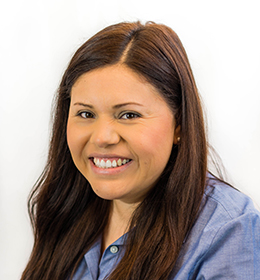
Maria HerreraPPIC: What’s behind California’s safe drinking water problem?

Maria Herrera: Too many California residents still lack access to safe drinking water. In the San Joaquin Valley, drinking water delivered by small water systems and private domestic wells is contaminated by many natural and manmade contaminates. Typical water quality issues for valley communities are contamination from nitrate, arsenic, uranium and a chemical called 1,2,3-TCP. Small community systems and private well owners often don’t have the resources to address these issues. They face a lot of challenges—for starters, they have little to no staff and lack the resources to maintain or upgrade aging infrastructure. Some rely on just one or two wells. Historically, these communities haven’t been prioritized for state funding or in planning processes.

PPIC: How should we be tackling this problem?

MH: I grew up in communities experiencing these problems and have worked on these issues for more than 10 years, and I’ve seen a big shift in visibility over safe drinking water in recent years. California has taken a number of steps to address the problem, especially with the passage of the human-right-to-water law (AB 685), which makes it state policy that every Californian should have safe and affordable drinking water. That was the biggest signal that this issue is now being prioritized. Also, Proposition 1 prioritized safe drinking water in disadvantaged communities by increasing technical assistance funding and giving communities an opportunity to hire consultants to develop shovel-ready projects and fund safe drinking water projects.

We need to continue on that path in order to make these communities less vulnerable to drought. We need to not only fund mitigation of contaminated wells and treatment plants, but also help communities develop redundant water sources, promote consolidation of small systems to larger ones, and help them with drought contingency planning. Communities need guidance and technical assistance in order to develop solutions and participate in water planning.

This year California came close to establishing a safe drinking water fund, which would have created an ongoing fund for disadvantaged communities to improve their water infrastructure and clean up contamination. A safe drinking water fund is still a priority for drinking water advocates going forward.

PPIC: How might the Sustainable Groundwater Management Act (SGMA) affect the safe drinking water effort?

MH: SGMA creates a good opportunity for people to come together and identify ways to protect and improve drinking water supplies. But achieving sustainability will bring some tough decisions and will have some impact on agriculture. We want farmers to thrive—and rural communities to have adequate water supplies. SGMA provides groundwater sustainability agencies (GSAs) an opportunity to play a very meaningful role in improving groundwater supplies. We’d like to work with GSAs and communities to develop joint solutions, improve coordination between GSAs and the agencies that work on water quality, and ensure that good information is available regarding groundwater supplies used by these communities. We’d like to encourage GSAs to look more closely at domestic wells. We’re trying to encourage them to develop more protections for vulnerable communities. Our ultimate objective is to ensure that rural communities have the information and resources they need to play a meaningful role in developing and implementing their groundwater sustainability plans.

PPIC: What gives you hope?

MH: I’m inspired by the interest of rural residents in building capacity and leadership skills to engage on water issues. There’s a new generation of young adults that know the issues, have lived in impacted communities, and are now ready to a make change in their communities by participating in water management and planning. I’m also energized by the partnerships we’ve helped establish between the communities, irrigation districts, cities, and agencies. It gives me hope that they are interested in finding common ground. And, I’m  encouraged by the attention the issue is getting at the state level—the legislature, governor, the voters have all shown interest in funding propositions and programs that will help bring safe water to these communities.

Watch a video with Maria Herrera and other panelists discussing managing drought in a changing climate.

Many Support Rent Control, but Prop 10 Lags

While most of California’s likely voters are satisfied with the way the initiative process is working in California, an overwhelming majority also think that the wording for citizens’ initiatives is often too complicated and confusing for voters to understand what happens if the initiative passes. This may be the case with Proposition 10, as our September survey findings suggest.

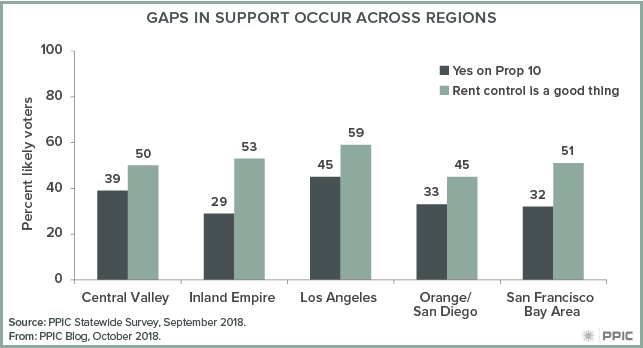
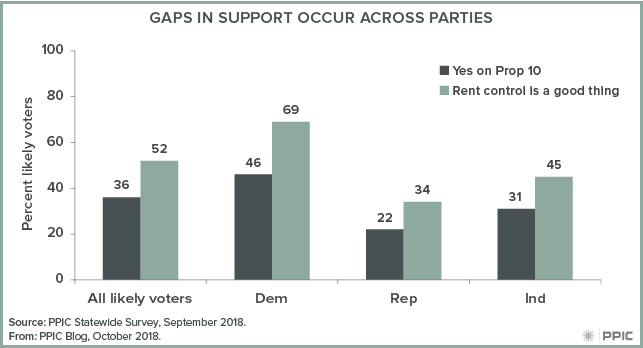
When read the ballot title and label of Proposition 10—which would expand the authority of local governments to enact rent control—about half of likely voters say they would vote no (48%) while far fewer (36%) would vote yes. However, when asked a general question about rent control by local governments, half of likely voters say it is a “good thing” (52%) while fewer (41%) say it is a “bad thing.” This translates to a 16-point gap between support for Prop 10 and support for the concept of rent control.

This gap widens when we dig a little deeper. For example, we find double digit differences in support for Prop 10 and for rent control in general across parties (Democrats 23 points, independents 14 points, Republicans 12 points).

Support for Prop 10 and for rent control in general varies across regions, but the gap in support remains.

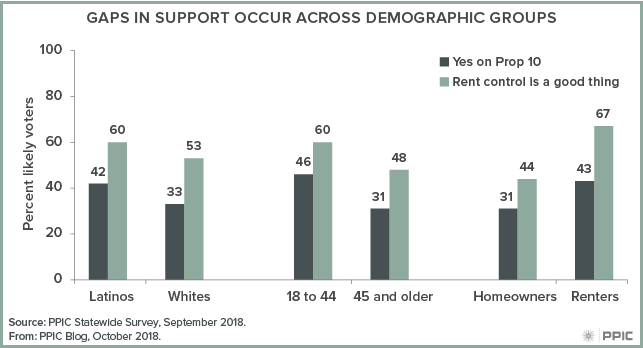
Gaps in support also occur across demographic groups: likely voters who are white (20 points) and Latino (18 points), those age 18 to 44 (14 points) and those age 45 and older (17 points), those making less than $80,000 annually (19 points) and those making $80,000 or more (14 points). Support for Proposition 10 is also lower than the share saying rent control is a good thing among renters (24 points) and homeowners (13 points).

It’s not entirely clear why these differences exist or why they are so pervasive. Perhaps the wording of Proposition 10 is having an impact. The ballot title and label—which are read to our survey participants—describe repealing the current state law that restricts the scope of rent-control policies. (This is the 1995 Costa-Hawkins Rental Housing Act.) It also mentions the potential net reduction of tens of millions of dollars in state and local revenues.

Proposition 10 Ballot Language
Proposition 10 is called the “Expands Local Governments’ Authority to Enact Rent Control on Residential Property. Initiative Statute.” It repeals state law that currently restricts the scope of rent-control policies that cities and other local jurisdictions may impose on residential property. The fiscal impact is potential net reduction in state and local revenues of tens of millions of dollars per year in the long term. Depending on actions by local communities, revenue losses could be less or considerably more. If the election were held today, would you vote yes or no on Proposition 10?

Is this a case of confusing ballot language? Or are voters simply not interested in this particular approach to rent control? As Californians learn more about the propositions during the run up to November it will be interesting to see the impact on Proposition 10. Stay tuned to the PPIC Statewide Survey for timely coverage of this year’s election.

Video: A Conversation with Candidates for US Senate

As part of our Speaker Series on California’s Future, PPIC is inviting all major candidates in selected statewide races to participate in public conversations. The purpose is to give Californians a better understanding of how candidates would approach the challenges facing our state.

To give Californians a chance to hear directly from the two candidates for California’s US Senate seat, PPIC invited California state senator Kevin de León and US senator Dianne Feinstein to San Francisco on Wednesday to talk about their visions for California and the nation. PPIC president Mark Baldassare moderated a lively discussion that covered a range of topics.

The candidates, both Democrats, were in agreement on many state and national issues—including gun regulations, the Delta tunnel proposal, and comprehensive immigration reform. Both would support revisiting the allegations against Supreme Court justice Brett Kavanaugh, and both feel that there are Republicans in Congress who want to reach across the aisle.

But while both candidates talked about the need for universal health care, they had different views on the way to proceed. As Feinstein put it, “I believe in universal health care. The question is how we get it.” She outlined an incremental approach—offering a public insurance option, lowering the age of eligibility for Medicare to 55, and allowing Medicare to negotiate drug prices. By contrast, de León characterized health care as a right: “I believe that health care is a human right. I believe in Medicare for all.” He also cited his leadership in creating the Covered California health care exchange, expanding access to the exchange to undocumented minors, and instituting drug price transparency in California.

The candidates’ views on health care epitomize their overall approaches to governing. For de León, the key is to bring his experience in California to Washington. Asked about the tensions between California and the federal government, he said, “California has been the leading voice for the entire nation. The world looks to California, not Washington, DC.” And he argued that Democrats in Congress need to elevate key issues, “even if we’re in the minority.” In response to a question about why he wants to be California’s US senator, de León said, “I’m running to give you a new voice, and a new approach.”

Feinstein often focused on what her years of experience in the Senate have taught her about the complexities and difficulties of governing. She reminded the audience more than once that Democrats are in the minority: “When you have both houses and the White House controlled by one party, it is extraordinarily difficult.” Explaining why she’s running in 2018, she focused on the work that needs to be done: “In terms of American public policy domestically, we can achieve a great deal . . . if we’re smart in how we go about it.”

The 2020 Census and Political Representation in California

California’s political representation will be affected by the 2020 Census—but an accurate count is far from guaranteed. Inadequate funding and fear in the state’s large immigrant population are heightening concern about an undercount. At a briefing in Sacramento last week, PPIC researcher Eric McGhee outlined a new report that draws on population trends and research on past undercounts to develop plausible scenarios for 2020.

“I think it’s fair to say that we are unlikely to lose a congressional seat if there is an accurate count,” said McGhee. However, California is more vulnerable to an undercount than most other states. Three in four Californians belong to at least one of the populations that are difficult to count: children, young men, Latinos, African Americans, immigrants, and renters.

An undercount could cause the state to lose one of its 53 seats in the House of Representatives. It could also have an impact on political representation within California. If the state does a poor job of reaching hard-to-count populations, it might end up drawing congressional and state legislative districts that shift representation from poorer areas with larger communities of color to areas that are wealthier and less diverse.

Privacy concerns have increased both the difficulty and the cost of conducting census surveys. The current political climate is likely to exacerbate these concerns, especially now that a question on citizenship status has been added to the 2020 survey. (The addition is being contested in the courts.) Moreover, the 2020 Census will be the first to collect a majority of responses online. The Census Bureau is testing the Internet survey but lacks the resources to test outreach and follow-up. Because California has a disproportionate share of historically undercounted residents, these challenges are of particular concern.

But, as McGhee pointed out, “California’s fate is still in its own hands.” This year’s state budget allocates about $90 million for census outreach, which should help community organizations and state and local governments educate residents about the importance of the census and the security of the information collected. Californians need to know that “a better count in California could make a big difference.”

1 in 4 Child Care Workers in California Lives in Poverty

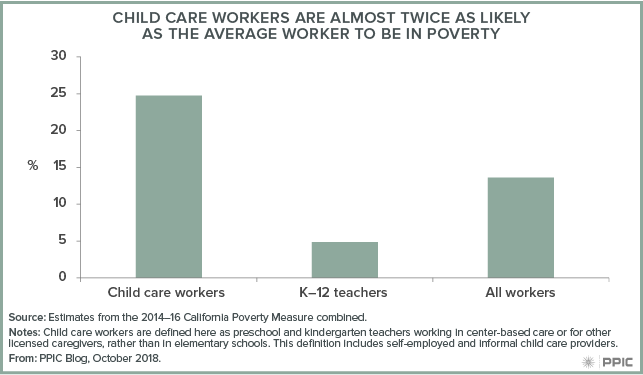
While preschools and child care providers in many parts of California are straining to fill a unmet need, the state’s child care workers are poorly paid and almost twice as likely to live in poverty than workers overall.

California’s child care workers earn significantly less than their school-based counterparts. Given that about 95% of child care workers not based in schools are women, and 53% are African American or Latina (compared with 43% of the overall workforce), women—particularly women of color—are most affected by low pay in the child care workforce.

UC Berkeley found that in 2017, the median hourly wage for child care workers in California was $12.29—just one-third the median wage for kindergarten teachers. Earnings among child care workers track more with low-wage workers across California (defined as those earning less than two-thirds of the median wage). These low wages translate to about a quarter of child care workers living in poverty as compared to 14% of all working adults (ages 18-64)—according to the California Poverty Measure, developed by PPIC and the Stanford Center on Poverty and Inequality.

Low wages are just one piece of the poverty puzzle. Relative to all working adults, child care workers are more likely to have only part-time work (more than a third, compared with less than a quarter of the overall workforce), which is associated with dramatically higher poverty rates than full-time employment. Many have completed some college credit or have an associate’s degree (44%), but just a fifth have a four-year degree, in a workforce where more than a third of working adults have four-year degrees. And while people working in child care are as likely to have children as the average working adult, those who do are more likely to be parenting alone (11%) than the average worker (6%).

The social safety net is an important part of helping child care workers make ends meet. Half of all child care workers benefit from at least one safety net program or tax credit, with the two largest being CalFresh (25%) and the federal Earned Income Tax Credit (37%). Without this assistance, poverty among child care workers would be even higher—2.5 points higher without the Earned Income Tax Credit, and 2.1 points without CalFresh. Minus all major safety net programs, one in three child care workers would live in poverty.

Recent policy changes could start to boost incomes for child care workers. Expanded eligibility for 18–24-year-olds for the state’s new Earned Income Tax Credit, starting in 2019, will specifically help the 20% of the workforce who are under 25. Steady increases in California’s minimum wage could improve earnings of child care workers employed by providers subject to minimum wage laws. Yet many workers are self-employed, providers often operate with limited incomes, and the cost of care itself is already high for low-income families. Minimum wage increases will likely result in a better-paid child care workforce only if they are accompanied by sector-wide changes aimed at making child care both affordable and accessible.

The needs of child care workers will affect efforts to improve and expand California’s complex child care system. While the state and federal governments have begun to increase access to child care with expanded programs and additional funding, improving living standards for child care workers will be a major challenge for California’s next governor.

The Connection between Groundwater and Surface Water

When the California Legislature created the “modern” water rights regulatory system more than a century ago, it focused exclusively on surface water, exempting groundwater from the permitting system. Yet in most watersheds, surface water and groundwater are closely linked. Actions that change one often have an impact on the other. The arbitrary legal divide has made it harder to manage the state’s water. But a recent law and a new court decision have done a better job of connecting surface water and groundwater.

When rain falls or snow melts in the foothills and mountains of California, water follows several pathways downhill and into rivers and streams. Some water moves across the land or through deep soils and weathered bedrock, arriving in rivers hours to weeks after rain or snowmelt. And some percolates deep into the ground, becoming groundwater.

As groundwater tables rise in winter and spring, they discharge water into rivers and streams, either directly through river beds and banks or indirectly through springs. This is why many of California’s rivers and streams flow long after the rain stops.

The exchange between surface water and groundwater continues when rivers emerge from mountains and flow across the state’s large valleys. Winter flooding, along with rainfall in the valleys, recharges groundwater during the winter. Some of that groundwater moves back into rivers and helps maintain flow in the dry season. Shallow groundwater also supports wetlands and riparian vegetation.

Groundwater pumping alters the exchange between surface water and groundwater. In many of the state’s large valleys, such as the Central Valley and valleys in the Central Coast and Southern California, streams and rivers that historically flowed all year are now intermittent due to lowered groundwater tables. In many cases, groundwater tables are so far below the surface that water only flows one way: from the river bed to the aquifer.

The arbitrary legal divide between surface water and groundwater has begun to change. A big step was the 2014 enactment of the Sustainable Groundwater Management Act (SGMA). SGMA requires water users in overdrafted groundwater basins to develop and implement groundwater sustainability plans to bring groundwater use and recharge into balance by 2040. SGMA mandates that these plans include measures to avoid undesirable effects from pumping, such as reduced stream flows and harm to groundwater-dependent ecosystems like wetlands. This is one of the few explicit legislative acknowledgements of the links between groundwater pumping and surface water flows.

Additionally, the California Court of Appeal recently added an important legal connection between groundwater pumping and surface water uses. In litigation to protect salmon and steelhead in the Scott River, the court ruled that the public trust doctrine―which protects the public’s right to use waterways for navigation, fishing, boating, natural habitat protection, and other activities―applies to groundwater pumping that adversely affects a navigable river or lake. The court also held that SGMA doesn’t override the public trust doctrine in groundwater cases.

These developments will have far-reaching implications for how California’s groundwater will be managed in the future. They also bring the law closer to hydrologic reality, which is likely to improve the effectiveness of both surface water and groundwater management.

A more extensive analysis of the Scott River decision by PPIC senior fellow Brian Gray was published on the California WaterBlog. Richard Frank, a UC Davis law professor and a member of the PPIC Water Policy Center’s research network, has also written a summary of the case.

Are K–12 Students Keeping Pace in Math?

The California Department of Education recently released 2018 SBAC test scores that showed very modest improvement. Since last year, the percent of students meeting or exceeding state standards grew 1.1 percentage points in math. But focusing only on these year-to-year comparisons means that we miss the longer-term picture. That is, we don’t see how the same group of students are progressing over time. When we look at SBAC math scores in this manner, we have some cause for concern—but there are bright spots, too.

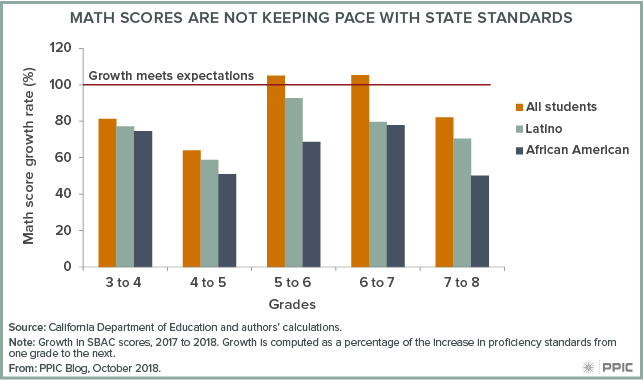
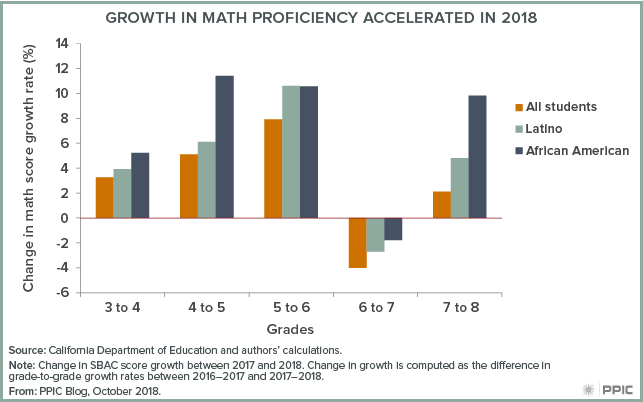
In the figure below, we show the growth in math test scores from grade to grade—that is, we can see how last year’s third graders performed in fourth grade, and so on.  If growth is less than 100 percent, students aren’t keeping up with grade-level standards. If it is greater than 100 percent, student growth is outpacing what is expected by the standards. For instance, fourth grade students gained roughly 80 percent of the increase needed to keep pace with the proficiency standards.

Across all grades student scores grew, but only in grades 6 and 7 did the average student growth keep pace with the growth in standards. In all other grades students fell behind, with fewer keeping pace with the growth in grade-level standards. Perhaps more discouraging, the math scores of African American and Latino students grew less than the average student across all grades, meaning that racial and ethnic disparities are growing as students progress through school. These results suggest that growth among low-income students also lags the standards, since African American and Latino students account for more than 75 percent of economically disadvantaged students.

There is a silver lining in the 2018 growth numbers. Across most grades, growth in math was higher in 2018 than it was in 2017, meaning that fewer students are falling behind as they progress through school. This can be seen in the figure below, which shows how math score growth has changed between 2017 and 2018. Growth did slow for seventh graders, yet as the previous figure shows they still managed enough growth to outpace state standards, despite the slowdown.

Also encouraging: racial disparities in growth rates are smaller in 2018 than they were in 2017, as African American and Latino student improvement in math was greater than average student improvement across every grade. For instance, among African American fifth graders math scores improved about 11 percent more in 2018 than their counterparts’ improved in 2017. Thus, while achievement gaps still grow as students advance, gaps in growth are shrinking, and these disparities are growing more slowly than in years prior.

Standardized Testing and College Eligibility

In California and across the nation, there has been a growing focus on increasing college access by improving college readiness for high school students and encouraging more eligible students to attend college. To this end, many states and educational institutions have changed how they use college entrance exams like the SAT and ACT.

One approach has been to have more students take the SAT or ACT in hopes of identifying those who are eligible for college but might not have taken a college entrance exam on their own. As of 2016–17, 25 states use the SAT or ACT as their standardized test for 11th graders.

Assemblymember O’Donnell (D-Long Beach) has proposed AB 1951, which would give districts the option to use the SAT or ACT in place of California’s 11th-grade standardized test. Though Governor Brown vetoed the bill at the end of the 2017–18 legislative session, O’Donnell promised to bring it back in the next session, when California has a new governor.

But even as many states are administering the SAT or ACT to all students, a growing number of colleges and universities are dropping these tests as an entrance requirement. Citing concerns about biases in the exams, as well as the extra financial or time constraints for students, liberal arts colleges like Mills College in California and prominent universities such as the University of Chicago have made submitting test scores optional. Currently, California State University (CSU) does not require students to submit an SAT score (though most still do) if they meet the high school GPA threshold of 3.0 or higher. Despite this trend, most four-year colleges continue to use college entrance exams in their admissions decisions and a growing share of high school graduates take either the SAT or ACT.

In his veto message, the governor suggested another possible way to expand eligibility. California universities could consider using the state’s standardized test (SBAC) as an eligibility measure. All California 11th graders in public schools take the SBAC, which is aligned with the Common Core State Standards and is already used as an early diagnostic of college readiness at CSU and many community colleges. New evidence suggests that the SBAC does as well as the SAT in predicting first-year performance at California’s public universities.

Any of these strategies could increase the number of students eligible for California’s universities—but not all of them would work well together. For example, the University of California and CSU are further scrutinizing the role of the SAT in the admissions process. If the systems decide to drop the SAT requirement, then AB 1951 might have less of an impact. Looking forward, as state policymakers and districts continue to craft policies to improve college access, they should first consider how California’s universities are using—or not using—standardized tests.


Partisan Loyalty Trumps Gender Solidarity in California

A month until the midterm elections, California’s voters are gearing up for decisions that will have ramifications across the nation. Much has been discussed of a potential “blue wave,” with Democrats eyeing to flip seven Republican congressional seats in California—nearly one-third of the 23 seats needed to shift party control in the US House of Representatives. Concurrently, there are a record number of women running for US Congress and statewide executive offices, including 37 in California. With women comprising 54% of the state’s likely voters, how large a role will they play in the upcoming election?

According to PPIC’s September Statewide Survey, 50% of female likely voters say the upcoming election is more important to them than past midterms; just 3% say it is less important and 46% say it is about the same. Yet when looking at the partisan breakdown among female likely voters there are notable differences: 63% of Democratic women say the upcoming election is more important while 37% of Republican women say the same (sample sizes for independent female likely voters are too small for separate analysis).

In the generic ballot for the US House of Representatives, California’s female likely voters prefer the Democratic candidate over the Republican candidate (58% to 34%). Nearly all partisan female likely voters say they would vote for their own party. When asked about qualities they prefer in a candidate, six in ten Democratic women (60%) prefer those who have experience in politics to those who are new at it, while Republican women are divided (41% experience, 41% new to politics).

Recent prominent events at the national level may impact women’s preferences and turnout in the midterms. Our September survey was fielded following the initial Senate confirmation hearings for Judge Brett Kavanaugh’s appointment to the Supreme Court but prior to the additional hearing on sexual abuse allegations featuring Dr. Christine Blasey Ford. Nonetheless, nearly all female likely voters in our September survey view the choice of the next Supreme Court justice as either very (74%) or somewhat (18%) important to them personally. Across parties, Democratic women are much more likely than Republican women to say the choice is personally very important (82% to 62%).

Meanwhile, President Trump’s approval rating reflects sizable partisan differences among California’s female likely voters: 91% of Democratic women disapprove of the way Donald Trump is handling his job as president, while 80% of Republican women approve.

With women poised to play a pivotal role in the upcoming election, we may see the emergence of a “pink wave” that rivals the “Year of the Woman” associated with the 1992 election. Stay tuned to the PPIC Statewide Survey as we continue to monitor the preferences and attitudes of Californians, with a particular interest in female likely voters, leading up to the midterm.

New Laws on Drought, Forests, and Safe Drinking Water

The legislative session that just wrapped up addressed a number of water and forest management issues. Progress was made in three major areas—urban drought management, forest health, and safe drinking water.

Urban water use efficiency and drought management: Assembly Bill (AB) 1668 requires the State Water Board and the Department of Water Resources to adopt long-term efficiency standards for residential water use and efficiency metrics for commercial, industrial, and institutional water use by June 2022. The law complements Senate Bill (SB) 606, which requires urban water suppliers to develop local water use budgets by November 2023. Progress toward those objectives will be overseen by state agencies. SB 606 also strengthens local drought planning requirements and increases transparency of information about drought risks and responses. The law requires suppliers to regularly analyze the risk of a five-year severe drought and report short-term water shortage risks and responses to the state each spring. Suppliers must also revamp their drought response plans to include new elements such as descriptions of supply forecasting procedures, new ways of reporting water shortage levels, and protocols for communicating with customers during droughts. AB 1668 also includes provisions to increase drought preparedness for small rural water systems and large agricultural water suppliers.

Wildfires and forest management: SB 901 takes substantive steps toward reducing wildfire risks by increasing the pace and scale of forest health improvements. Cal Fire will have access to new, stable funding from cap-and-trade revenues—$200 million per year for five years—to pay for forest management. The law also helps lower management cost barriers for family forest owners, which occupy about one-quarter of the state’s headwater forests. It relaxes some timber harvest regulations to make it easier for these owners to reduce wildfire risk. A provision that increases the size of trees owners can harvest should expand their ability to raise funds from selling timber. The law also allows multiple landowners to work under the same timber harvest permit. Finally, SB 901 includes provisions that apply to forests managed by the US Forest Service, which make up more than half of our headwater forests. In particular, it streamlines California’s environmental permitting process for collaborative fire risk reduction projects on federal lands that are approved under the federal National Environmental Policy Act.

Safe drinking water for vulnerable communities: Drinking water received significant attention this year, as lawmakers attempted to fill the funding gap for small disadvantaged communities facing water quality and quantity problems. Proposals to tap urban water customers and agricultural fertilizer users for safe drinking water funds ultimately failed in the legislature. However, new laws signed by the governor will strengthen tools for addressing drinking water quality issues. AB 2501 increases the State Water Board’s ability to require the consolidation of vulnerable water systems with larger, more reliable systems. The new law expands the board’s authority to require the consolidation of communities served by domestic wells. AB 2501 also extends the board’s authority over support services to help communities provide safe drinking water where consolidation is not an option. Another new law, AB 2541, gives severely disadvantaged communities expanded access to the Drinking Water State Revolving Fund for water infrastructure projects. The law makes it easier for the board to provide full grant funding in addition to low-interest loans.

The governor also signed more than a dozen other bills related to water, in areas such as sewer system consolidation, on-site treatment regulations and rules for the reuse of non-potable water, and the establishment of an office within the State Water Board to help address water-rights matters.

We will keep track of updates and new proposals in 2019.