Income and Inequality Vary Widely Across California

Income inequality has been growing for decades and—despite the recovery from the Great Recession—remains historically high. Today, the low end of the income spectrum (the 10th percentile) in California is 19% lower than what it was in 1980, and the upper end of the spectrum (90th percentile) is 40% higher, according to our new report. As a result of these trends, the ratio of high to low incomes—a key measure of income inequality—is nearly twice the size it was three decades ago.

In Los Angeles County, high-income families have 15 times more income than low-income families.

Both income and income inequality vary substantially across California. Looking at after-tax family incomes, we find that, in 2014, the Bay Area had the highest incomes. However, the gap between high and low incomes was biggest in Los Angeles County, the Central Valley, and northern parts of the state—places where low incomes tend to be particularly low. For example, in Los Angeles County, high-income families have 15 times more income than low-income families. At the other end, the Inland Empire and Orange County have the lowest income inequality.

Why does the gap between families across the income spectrum matter? In part because low-income families may have insufficient resources to meet their basic needs. If family incomes are widely spread (inequality is high) but even families at the low end of the economic spectrum are able to attain a sufficient level of well-being (poverty is low), income inequality may not be a big problem. But that is not the case: one in five Californians live in poverty.

Inequality itself may also raise concerns for a host of social, cultural, and political reasons. One economic consequence of inequality is that the greater spread of incomes may inhibit upward mobility. Recent research finds a correlation between income inequality in a region and the upward mobility of its children. Low-income children who grew up in areas with higher income inequality have, on average, lower incomes as adults than otherwise similar children who grew up in regions with less income inequality. In this and other ways, the consequences of growing income inequality may play out over generations, highlighting the need for policies that take this long-range view into account.

Source: Based on California Poverty Measure data, 2012–2013 (Bohn and Danielson 2016).
Notes: Dollar amounts are rounded to the nearest $1,000. Income shown includes cash from work and retirement sources net of federal and state income and payroll taxes; low-income tax credits are not included. Dollar amounts adjusted to represent a family of four. The inequality ratio shown is calculated as the ratio of the 90th percentile of income to the 10th percentile of income; higher numbers indicate greater income inequality. Regions defined as follows. Northern: Butte, Colusa, Del Norte, Glenn, Humboldt, Lake, Lassen, Mendocino, Modoc, Nevada, Plumas, Shasta, Sierra, Siskiyou, Tehama, and Trinity Counties; Sacramento area: El Dorado, Placer, Sacramento, Sutter, Yolo, and Yuba Counties; Bay Area: Alameda, Contra Costa, Marin, Napa, San Francisco, San Mateo, Santa Clara, Santa Cruz, Solano, and Sonoma Counties; Central Valley and Sierra: Alpine, Amador, Calaveras, Fresno, Inyo, Kern, Kings, Madera, Mariposa, Merced, Mono, San Joaquin, Stanislaus, Tulare, and Tuolumne Counties; Central Coast: Monterey, San Benito, San Luis Obispo, Santa Barbara, and Ventura Counties; Inland Empire: Imperial, Riverside, and San Bernardino Counties. Los Angeles, Orange, and San Diego Counties are shown separately.

Learn more

Read the report Income Inequality and the Safety Net in California

Video: 3 Cities Address Economic Challenges

When Uber officials announced the company was moving to Oakland, there was a wave of fear and anger that well-paid tech workers would push longtime residents out of the city. Fresno, with its high concentration of poverty, struggles to attract the kind of private investment that caused angst in Oakland. In South Gate, housing is relatively affordable, which should be good news. But there are few homes for residents to buy because most are rentals owned by outside investors.

These stories, told by leaders of these communities at a recent PPIC event, were different. But common across the agendas of all three leaders was an emphasis on education as a key part of the solutions they are working on to address income inequality and poverty.

Jorge Morales, councilmember and former mayor of South Gate, said business owners told him that city residents didn’t have the education needed to get jobs beyond the entry level. Now, thanks to a partnership with the Los Angeles Community College District, a new campus will open in South Gate. The focus will be on jobs that become careers, Morales said.

“One of the mistakes we made as policy makers is that when manufacturing jobs started to leave, we all got excited about the revenue—about the sales taxes size—and we started building shopping centers everywhere.””What did that do? That provided the jobs that didn’t provide a living for folks.”

Ashley Swearingen, mayor of Fresno, said that missing the dot com boom of the late 1990s was a wake-up call for her city.

“We were not as a city and a region prepared to ride that wave of expansion,” she said. “That tidal wave of prosperity hit the state, but not a drop hit the ground in the places I was living and working.” The city partnered with Fresno State University to “undo and redo everything about our community” from its public systems to its civic environment, and entrepreneurship education is woven through school curriculums beginning in elementary school.

Libby Schaaf, mayor of Oakland, said she is most passionate about a program she is raising money to start, the Oakland Promise. She said that among this year’s ninth-graders, only 10% will have a college degree by the time they are 23 years old. The Oakland Promise is a “cradle-to-career strategy to triple that number in 10 years.” Each baby born into poverty will get a $500 college savings account, and parents will get another $500 in direct support for home visits and literacy training. Every kindergartener will receive a $100 college savings account. Students will be connected with internships, mentors, peer support groups, and help with financing college.

“You have got to intervene at every moment, from birth until college completion,” she said.

Schaaf says she has raised $23 million for the program and needs $15 million more.

Learn more

Read the PPIC report Income Inequality and the Safety Net in California

Testimony: Closing California’s Workforce Skills Gap

Hans Johnson, director of the PPIC Higher Education Center and PPIC senior fellow, testified before the Assembly Budget Subcommittee Number 2 on Education Finance in Sacramento yesterday (May 17, 2016). Here are his prepared remarks.


The Public Policy Institute of California (PPIC) projects that between now and 2030 California will fall 1.1 million bachelor’s degrees short of workforce demand.1 Closing this gap will require substantial improvements in access to four-year colleges, transfer rates from community colleges, and completion rates among students who enroll in college. In this testimony, PPIC identifies specific goals for access, transfer, and completion at California’s public colleges and universities, and increases in private colleges that together could close the workforce skills gap.

Our work on this issue emphasizes that closing the workforce skills gap will require strong improvements in college enrollment and completion among underrepresented groups, including low-income students, first-generation college students, Latinos, and African Americans. California cannot succeed economically unless gaps in educational attainment are eliminated or at least substantially reduced. A forthcoming report from PPIC will show how new goals for access, completion, and transfer will improve equity in California.

In our baseline scenario, which is based on current practices and procedures, California’s public and private higher education institutions will produce 3.1 million bachelor’s degrees between 2015–16 and 2029–30. This baseline scenario assumes that the state’s college enrollment rates, completion rates, and transfer rates will remain at current levels.

Our “closing-the-gap” scenario charts a course to producing 4.2 million bachelor’s degrees over the next 15 years. In this scenario, the total number of bachelor’s degrees awarded in 2029–30 would be 60 percent higher than in the baseline scenario—and it would be 72 percent higher than the number of degrees awarded in 2014–15. Such dramatic increases are not entirely without precedent. Between 2002–03 and 2014–15, the annual number of bachelor’s degrees awarded by California’s public and private universities increased almost 50 percent. Gains in earlier periods were even more impressive. For example, between 1964–65 and 1979–80 the number of bachelor’s degrees awarded at CSU increased 95 percent.

In the recent past, growth in the number of bachelor’s degrees awarded at UC and CSU was fueled primarily by increases in the number of students who enrolled in college and secondarily by increases in completion rates. Even though the share of high school graduates entering UC and CSU did not change appreciably, enrollment increased as the number of high school graduates grew.

The California Department of Finance projects that the number of high school graduates will not change substantially over the next fifteen years. This means that increasing the number of bachelor’s degrees awarded will require changes in three key thresholds in the education pipeline from high school to college to degree.

  • First, the share of recent high school graduates eligible for and enrolling in four-year colleges will need to increase.
  • Second, persistence and completion rates for students enrolled in college must increase.
  • Third, the number of students who transfer from community colleges to four-year colleges (or return to college) must increase.

The exact mix of improvements in these three areas is not set in stone. Our closing-the-gap scenario is based on empirical trends, and our current focus is on public institutions. We assume that private colleges will keep pace with those in the public sector, continuing to produce about a third of all bachelor’s degrees awarded each year. Also, we have not incorporated applied bachelor’s degrees awarded by the state’s community colleges, as those numbers are still very small. This means that UC and CSU together would need to produce an additional 730,000 bachelor’s degrees over this period and private colleges would need to produce an additional 340,000 bachelor’s degrees (a total of 1.1 million) to fully close the degree gap by 2030. Private nonprofit colleges would account for the vast majority of the additional degrees awarded by the private sector.

Our initial closing-the-gap scenario sets the following targets for the state’s public colleges and universities:

  • Eligibility will increase 5 percentage points over current levels at UC (the top 17.5 percent of high school graduates will be eligible for UC, up from the 12.5 percent share set by California’s Master Plan for Higher Education) and 6.7 percentage points at CSU (the top 40 percent will be eligible for CSU, up from the top third). These new eligibility levels will be phased in over an eight-year period.
  • The number of transfer students will increase 35 percent over baseline levels. These increases will be phased in over a five-year period.
  • Completion rates will increase 9 percentage points at UC and 17 percentage points at CSU. At UC, completion rates for students who enroll as freshmen will increase incrementally from 83 percent in 2016 to 92 percent by 2026. Completion rates for freshmen at CSU will increase incrementally from 57 percent in 2016 to 74 percent by 2030. There will be similar increases in completion rates for transfer students at both institutions.

CSU will account for most of the increase in degrees awarded over the entire projection period—it will award 481,000 additional degrees, compared to UC’s increase of 251,000. This is both because CSU is a larger institution, enrolling many more students than UC, and because CSU has much more room for improvement in graduation rates. Private nonprofit colleges would also play an important role, adding an additional 206,000 degrees. Other additional sources, such as private for-profit colleges, online degree programs, and bachelor’s degrees awarded by community colleges, will also need to play a role (see Table 1).

Most of the projected increase in degrees awarded at CSU comes from improvements in completion, while increased eligibility accounts for almost half of UC’s increase. Increased transfer rates will also be necessary to close the gap (see Table 2).

Of course, this is just one scenario for closing the workforce skills gap (our interactive model is available upon request). In the future, we expect to develop alternative closing-the-gap scenarios; we will also examine the potential impact of shortening the time it takes students to get their degrees. Additional work should assess the role that private institutions might play. Other scenarios might involve different assumptions and targets. But, however it is accomplished, closing the gap will lead to better economic outcomes for all Californians, increased state revenues, and reduced social service demands.
1. Hans Johnson, Marisol Cuellar Mejia, and Sarah Bohn, Will California Run Out of College Graduates? (PPIC, 2015).
Figure note (middle): “Other” includes online degrees, private for-profit degrees, and applied bachelor’s degrees awarded by the community colleges.
Photo credit: Public Affairs/Sacramento State

California’s New Tax Credit

Starting this year, California tax filers with very low incomes from wages are now able to claim a tax credit that builds on the federal Earned Income Tax Credit (EITC). Californians without dependent children can claim the credit if their wages are less than about $7,000, and those with children can claim it if their wages are less than about $14,000.

California joins 25 other states that have their own EITCs. Since California’s credit is brand new, we do not yet know who will claim it. However, our research enables us to characterize the population of those likely eligible for the credit. These estimates are based on family characteristics and incomes reported for 2013.

About 3 million tax filers in California are eligible to claim the federal credit on behalf of themselves and their families. We project that roughly 600,000 filers will be eligible for the California EITC—or about a fifth of those eligible for the federal EITC. If we broaden the scope to include both filers and their family members who will also benefit from the credit, the number of Californians affected by the federal EITC increases to nearly 10 million and by the state credit to 2 million.

Single filers with dependents can generally claim the largest credit. Among those in this group who are eligible for the state EITC, we calculate that the state EITC amount is $932 on average and the federal EITC amount is $2,579, for a combined total of $3,511. This amounts to a 58% boost in earnings on average—20% from the state credit and 38% due to the federal credit. While these filers are working a substantial number of hours (29 hours per week on average), only 37% report working year round (48 weeks or more).

In contrast, single filers with dependents who are eligible only for the federal EITC because their earnings are too high to claim the state EITC see about a 16% increase in income. Compared to those who can claim the state EITC, those eligible only for the federal EITC typically work full time (40 hours a week on average) and year round (83% worked 48 weeks or more).

We know from the research literature that the federal EITC boosts family incomes both directly and indirectly by encouraging work. While it is still too early to assess the full impact of the new California EITC, this early glimpse suggests that the direct effects of the state EITC will be large, at least among a key group of filers eligible to claim the credit.

Video: Californians Weigh in on Presidential Race

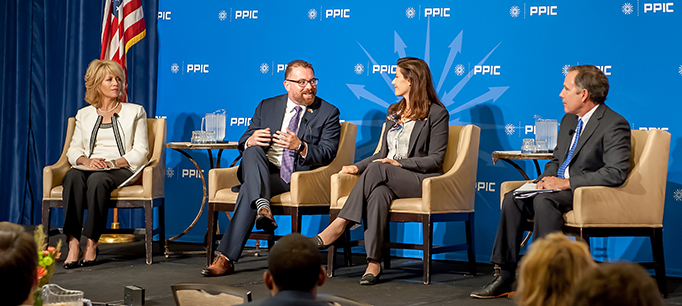
The strong partisan divisions prominent in the nation this election year are also evident in California, the latest PPIC Statewide Survey shows. As the primary nears, Democrats and Republicans are deeply divided in their views about the appropriate role and size of government. Dean Bonner, the PPIC survey’s associate director, presented these and other key survey findings in Sacramento last week.

Bonner noted that preferences among California’s likely voter in the upcoming presidential primary are similar to those seen in many states that have already voted. Among Democratic likely voters—including independents who say they will vote in the Democratic primary—48% support Hillary Clinton and 41% support Bernie Sanders. Most young voters support Sanders and most over age 45 support Clinton. Clinton leads among Latinos, women, and those who describe themselves as politically middle of the road, while Sanders leads among men and voters who describe themselves as very liberal.

Donald Trump leads the Republican field with 38%, followed by Ted Cruz with 27% and John Kasich with 14%. Bonner noted evidence in the survey of discontent with the status quo in the nation—signs that may have fueled the candidacies of “outsiders” in both major parties. A majority of likely voters—63%—say the nation is going in the wrong direction and 47% say the US will have bad times financially in the coming year. And Congress’ job performance gets a very low rating—across party lines. Notably, Republicans are more likely to approve of President Obama (20%) than they are to approve of the Republican-led Congress (11%).

Video: Congressman Kevin McCarthy in Conversation

The majority leader of the US House of Representatives ticked off the issues in an ambitious agenda that he and Congressman Paul Ryan, the House Speaker, are working on in Congress. Congressman Kevin McCarthy told a Sacramento audience that they include national security, the economy, tax reform, poverty, regulatory reform, innovation in government, and water.

McCarthy shares a sense of urgency with Senator Dianne Feinstein about getting a water bill through Congress this year. But he made clear in his conversation with Mark Baldassare, president and CEO of PPIC, that he and the senator—who spoke to a PPIC audience last month—differ in their policy priorities. His include building more water storage and pumping more water from the Sacramento-San Joaquin River Delta.

McCarthy said he thought a water bill could be passed this year, perhaps in a bill that addresses the water problem in Flint, Michigan.

“I think there’s a window of opportunity,” he said.

When the conversation turned to the presidential race, McCarthy was asked to compare two political outsiders—presidential candidate Donald Trump and former Governor Arnold Schwarzenegger. McCarthy said both tapped frustration in the electorate and both brought new voters to the process.

“When I went to the rallies with Arnold it was amazing,” he said. “There’d be 7,000 people in Bakersfield. Lived there my whole life, but I’d see people I’d never met before.”

Today, he said, “the country feels as though the government is not listening to them, they’re divided on all sides, and they’re just not going to take it anymore.”

“I don’t believe it’s a bad thing at all. I believe it’s good.”

Video: Senator Dianne Feinstein in Conversation

Underscoring her role in three contentious policy issues, California’s senior senator spoke to a Sacramento audience last week about filling the vacancy on the US Supreme Court, the dispute between Apple and the FBI, and drought relief.

Senator Dianne Feinstein urged speedy consideration of a nominee to replace the late Antonin Scalia on the court, saying that Senate can consider and confirm a new justice within 69 days—the average time for the process has taken in the past. She acknowledged that it would not be easy.

“I wish we could go back to the days when I first went to the Senate when the belief was that every president deserves his nominations,” she told Mark Baldassare, PPIC president and CEO, at the PPIC event.

Asked about the Apple controversy, she called on the company to reconsider its position and cooperate with the FBI to access data on a phone used by one of the San Bernardino killers. “Apple is not above the laws of the United States,” she said.

She said her position on the Senate Intelligence Committee—which occupies most of her time—gives her a perspective not shared by many on the dangers posed by terrorists.

Feinstein also detailed some of the provisions in her drought-relief bill, which would fund recycling, desalination, and water storage projects, as well as ease water trading.

She closed by describing her leadership style, saying she tries to “use the time to get things done. If I can’t do them through legislation, I’ll do them another way.”

Video: A Conversation with Legislative Leadership

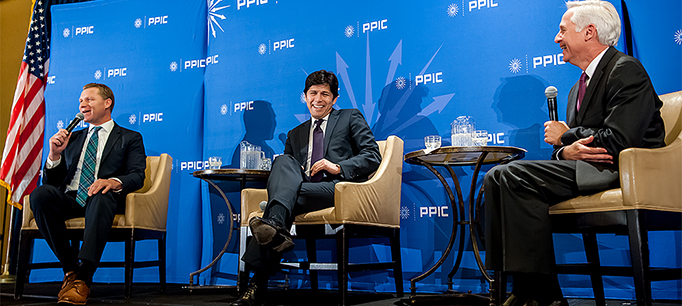
At a PPIC event last week, Kevin de León, senate leader pro tem, and Chad Mayes, the Assembly Republican leader, were asked to name the top three issues the legislature should work on with the governor. Though the leaders come from different sides of the aisle, the list of issues they named before a large Sacramento audience had a lot in common. De León’s priorities began with income inequality between the coastal and inland regions, a “tale of two states.” He also listed water and making targeted investments, particularly in higher education. He went on to list a fourth issue: climate change.

Mayes named water and a lack of water infrastructure, and the many Californians left behind in the state’s economic recovery. His third issue was transportation, the focus of an ongoing special legislative session.

“Everywhere that I go in California,” he said, “I’m stuck in traffic. So we know there’s a problem.”

The leaders’ top issues dovetail with findings from the latest PPIC Statewide Survey in which Californians identify water and the economy as the most important issues for the legislature and governor to work on in 2016. 

Though De León and Mayes named similar priorities, there was much less agreement on solutions. But the two maintained a collaborative tone throughout their conversation, denounced what Mayes termed “demagoguery on the national stage,” and repeated their commitment to working together productively.

De León said the legislature can avoid being mired in bitter national political debates if leaders continue to work cooperatively to “get some real tangible victories for Californians.”

“We’re doing things very differently in the state of California,” he said.

Video: PPIC Survey Examines Election Landscape

As California heads into an election year, the PPIC Statewide Survey looks at residents’ views on a broad range of issues that are already flashpoints in the presidential primary races and will likely surface in statewide campaigns next year.

PPIC research associate Lunna Lopes presented the survey’s key findings at a Sacramento briefing last week. She was joined by Mark Baldassare, PPIC president and CEO, for a question and answer session afterward. He noted a link between Californians’ “modestly optimistic view of the economy,” their belief that there is income inequality in the state, and their attitudes about which ballot issues are important. Twice as many residents say that increasing the state minimum wage is very important than say legalizing marijuana is very important.

“In California, the belief that this state is divided into the haves and have-nots—and the feeling among many Californians that they are among the have-nots—are going to be driving forces in the election,” he said. The survey briefing was held just after the mass shooting in San Bernardino, and the briefing touched on Californians’ views about gun laws. PPIC research associate David Kordus provided findings from the September survey on this issue: Compared to adults nationwide, Californians are more likely to favor stricter laws than we have now. Most also say that controlling gun ownership is more important than protecting the right of Americans to own guns.

Video: Survey Looks at Taxes and Pensions

As interest groups work to turn their ideas into initiatives for next year’s statewide ballot, the September PPIC Statewide Survey examined Californians’ views in two areas that may be put before voters in 2016: taxes and public employee pension reform.

Mark Baldassare, PPIC president and CEO, and Dean Bonner, associate survey director, presented the findings at a briefing in Sacramento last week.

Among the survey findings:

  • Half of likely voters favor extending the tax increases in Proposition 30 temporarily, but just a third favor making them permanent.
  • There is bipartisan support for raising taxes on cigarette purchases.
  • A majority of likely voters favor changing Proposition 13 to tax commercial properties according to their current market value.
  • Solid majorities of Californians see public pension spending as a problem, and most think voters should weigh in on changes to the system.
  • Most likely voters favor placing new public employees in a defined contribution system, similar to a 401(k) plan, rather than a defined benefits system.

The survey shows that Californians give their state leaders—the governor, legislature, and their own legislators—high approval ratings at the close of the legislative session. Baldassare offered his explanation at the briefing: there was little drama around the budget, the economy’s going well, and very few respondents in the survey mentioned fiscal issues as the most important ones.

Congress, on the other hand fares far less well in Californians’ eyes. Its 17% rating is not only much lower than the ratings likely voters give their state leaders, it is much lower than those of President Obama, Senators Barbara Boxer and Dianne Feinstein, and Californians’ own representative in the US House.

“Congress is a government institution that needs work, according to most Californians,” Baldassare said.