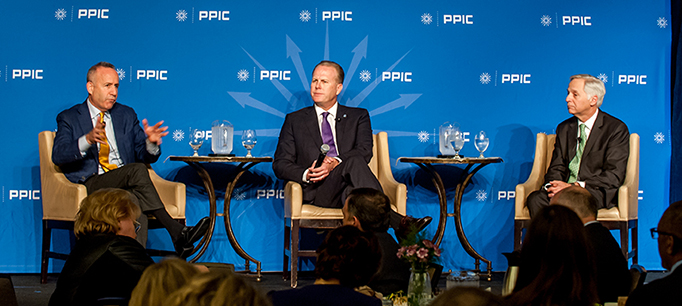
Video: Ending the Housing Crisis

Sacramento’s mayor and San Diego’s mayor have different political perspectives, clearly evident in PPIC’s “Building California’s Future” event last week. Their views diverged on issues from high-speed rail to the voting requirements for passage of local transportation tax measures. But the mayors reached some consensus on one issue: the need for more housing and the difficulty of building the political will to end the state’s housing crisis.

“I don’t see the political coalition around housing that I see around transportation,” said Darrell Steinberg, Sacramento’s Democratic mayor.

“I could not agree more,” said Kevin Faulconer, San Diego’s Republican mayor. “It has not gotten the attention it should.”

Asked the single biggest action the state can take this year to help with our housing crisis, both mentioned regulatory reform. Steinberg said robust reform needs to be combined with a source of funding for affordable housing. He said he hoped the state can “combine these two prongs to make it easier to site housing and at the same time provide real funding to be able to subsidize and build affordable housing.”

Faulconer said reform of the 40-year-old California Environmental Quality Act (CEQA) is essential. Those who share his views contend that CEQA lawsuits have been used to slow or stop housing developments, even those deemed environmentally friendly. Faulconer said the business and housing climate are important in attracting businesses to California communities.

“We have to have really clear rules of the road, we have to follow those rules of the road,” he said. “We have to get people through the process in a defined amount of time because time is money.”

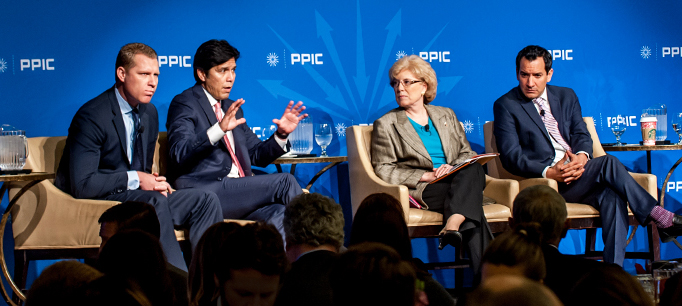
Housing was also an important part of the discussion in the panel that followed the mayors’ conversation at the PPIC event. Participants included two county supervisors, Kristin Olsen of Stanislaus County and Joe Simitian of Santa Clara County, as well as Lucy Dunn, president and CEO, Orange County Business Council. John Diaz, editorial page editor of the San Francisco Chronicle moderated.

Immigrants Are Key to the State’s High-Skilled Workforce

Immigrants are integral to California’s highly skilled workforce. As California’s demand for highly educated workers has outpaced the supply produced by its colleges and universities, immigrants have filled the gap. Immigrants now make up a substantial share of the state’s highly educated workers. Today, three of every ten highly educated workers in California is an immigrant, up from one in five in 1990. Immigrants are especially important in the state’s high tech sector, comprising 52% of college graduates who work in computer systems design and services and 57% of those in computer equipment and peripheral manufacturing (findings based on the 2013‒2015 American Community Survey).

Over time, the face of immigration to California has changed. Recent immigrants are more highly educated than immigrants who arrived earlier. In the past, most immigrants arrived from Latin America. But in recent years, most new immigrants to California are from Asia. Because many immigrants from Asia are highly educated, this regional shift has contributed to a change in immigrants’ education levels. Immigrants who have arrived in California in the past five years are among the most highly educated demographic group in the state, with more than half (52%) holding at least a bachelor’s degree, compared to 35% of US-born Californians.

Immigrants to California from the seven countries that are the focus of President Trump’s executive order —Iran, Iraq, Libya, Somalia, Sudan, Syria, and Yemen—also tend to be highly educated. According to the 2015 American Community Survey, California is home to 305,000 immigrants from these countries—35% of the total number of immigrants from these countries in the nation—with most (213,000) from Iran. Altogether, almost half (47%) of adult immigrants (ages 25‒64) from these countries have a bachelor’s or graduate degree, including 54% of those from Iran.

Given the contribution of highly educated immigrants to California’s economy, and especially to the state’s high tech sector, it is no wonder that many companies and state officials have raised concerns about the president’s executive order.

PPIC has projected that California faces a workforce skills gap and needs to increase the number of adults with a bachelor’s degree by an additional 1.1 million to meet workplace demands by 2030. These projections assume that the state will continue to attract substantial numbers of highly educated immigrants from abroad. Restrictions on the flow of those immigrants could exacerbate the projected workforce skills gap—and cause significant damage to the state’s economy.

Learn more

Visit the PPIC Higher Education Center

Video: Legislative Leaders Look Ahead

Despite their political differences, California’s legislative leaders have similar views of the state’s most pressing challenges. In a conversation facilitated by PPIC this week in Sacramento, the two top legislators from both major parties provided a preview of the issues they expect to tackle this session. With the impact of federal policy changes still unclear, the legislative leaders focused on longstanding challenges.

Asked to list the top issues the legislature and governor need to work on this session, Anthony Rendon, the Democratic speaker of the state assembly, named housing and transportation—topics he heard about repeatedly as he campaigned around the state. He said he saw the impact of a housing and transportation crisis first hand when walking precincts in the Inland Empire. “If you knock on someone’s door at 7:00, 7:30 p.m., they’re not home yet. They’re still on the freeway.”

Jean Fuller, the Republican leader of the state senate, sees the top issues as affordability in California generally and jobs. “We are concerned about housing, but we are also very concerned about jobs.” She noted that in her district, which stretches from Visalia to Twenty-Nine Palms, there is double-digit unemployment.

Kevin de León, the Democratic state senate president pro tem, said the past legislative session had been particularly productive; he highlighted minimum wage, gun safety, and climate change legislation. In this session, he said, “we have to deliver on the issues of housing and transportation and the issue of economic growth.”

For Chad Mayes, Republican leader of the assembly, poverty is the number one issue in the state, which has the highest poverty rate in the nation. “If you use that as a performance measure for how well our board of directors—the state legislature—is doing, I think you’d have to say we have been failing.” He added: “We’re failing, in large part because of housing costs.”

The speakers acknowledged major policy differences. But they pointed to past successes in bridging them as a sign that they can do so again.

“Things are not broken here, in comparison to DC,” said de León.

What’s Next for Legalized Marijuana?

The morning after Election Day, California appeared to be on a very different path than much of the nation. But in voting to legalize recreational marijuana, Californians were very much in step with the rest of the country. In addition to California’s Proposition 64—which passed relatively easily, with 56% of the vote—measures were passed in Nevada and Massachusetts that legalized recreational marijuana. Measures that legalized or expanded medical marijuana passed in Florida, Arkansas, North Dakota, and Montana. So far, Arizona is the only state to have rejected a recreational marijuana measure. Maine also passed a measure legalizing recreational use, though the vote was close and is subject to a recount.

While marijuana remains illegal under federal law and continues to be classified as a Schedule I drug (meaning it has a high risk for abuse and has no accepted medical value), 63% of Americans now reside in states that have medical or full legalized use, including 21% with legalized recreational use.

Now comes the difficult part. Proposition 64 sets in motion a number of steps and procedures designed to create a regulated market for recreational marijuana. Many of these can be modeled on last year’s legislation regulating California’s medical marijuana market. And the states that have legalized marijuana so far have created a competitive but regulated market structure. But regulatory experience—in California and other states—is in short supply. As one state regulator opined at a recent PPIC event, “Right now, science is lagging policy.”

Marijuana regulation cuts across many areas. Earlier this year, we outlined several key regulatory areas, including cultivation, production, and processing; sales, consumption, and possession; taxes and finance; and public health and safety. The challenge facing California and other states is to implement regulations that can achieve multiple, sometimes conflicting policy goals: limiting the impact of the illegal market, preventing youth drug use, reducing harm to public health and safety, preventing diversion of legal marijuana into illegal markets, and raising revenue. This requires a comprehensive regulatory approach that would document and control the cultivation, production, processing, and sale of legal marijuana.

Our report recommended that California err on the side of caution and adopt a relatively restrictive regulatory model for both the recreational and medical markets. We still maintain that a tight, single market will make marijuana laws easier to enforce and reduce diversion to under-age Californians and to other states. To be sure, a highly regulated legal market will be accompanied by a robust illegal market. But it will be easier to loosen a tight market than to tighten a loose one.

Given the apparent national interest in legalizing marijuana—and the lack of knowledge about this new industry—California is positioned to be a leader in answering difficult questions about how best to regulate it. To play a leadership role, California regulators should collect data on marijuana sales, prices, revenue, and use. Basic market information would play a significant role in closing this knowledge gap and inform better future policy for both our state, and the rest of the country.

Finally, we should note that there is some uncertainty about the future of marijuana regulation across the country. As noted above, federal law still classifies marijuana as an illegal substance. The relatively benign approach that the federal government has taken to enforcing federal law regarding marijuana has been based on three memos written by second-tier cabinet members and some language in an annual appropriation bill. Though President-elect Trump has not explicitly stated his policy on marijuana, it would be relatively simple for the new administration to alter the current federal approach.

Learn more

Read the report Regulating Marijuana in California

Video: John Chiang Looks to the Future

What are the top three issues that will make a difference to California’s future? That is the first question John Chiang—state treasurer and candidate for governor—was asked by PPIC’s president and CEO, Mark Baldassare.

Chiang’s response: education, economic security and opportunity, and the environment. He elaborated on these themes in the conversation before a San Francisco audience last week.

As treasurer, Chiang is the state’s banker, whose responsibilities include selling California’s bonds, investing its money, and managing its cash. He served two terms as state controller and was also on the Board of Equalization.

Baldassare said that he would sum up Governor Brown’s philosophy about taxes and spending as “fiscal restraint” and asked Chiang to sum up his own fiscal philosophy.

“Smart financial investment,” Chiang said.

“If you have the money, you invest it in education, you invest it in safety, you invest in infrastructure, make sure that you do the core issues correctly,” he elaborated.

PPIC invited Chiang as part of PPIC’s Speaker Series on the Future, which brings thought leaders from across the political and geographic spectrum to California audiences for conversations about the state’s pressing challenges. PPIC does not endorse, support, or oppose candidates for public office.

Video: Assessing California’s Global Warming Law

Ten years ago, California enacted a law to combat global warming that set an ambitious goal: reducing greenhouse gas emissions to 1990 levels by 2020. Today, the state is poised to reach this target, and policymakers are discussing aiming for a new one.

Each year since the law—AB 32—took effect, the PPIC Statewide Survey has examined Californians’ views on climate change and the state’s actions to address it. The survey has consistently found that most Californians believe that the effects of global warming have begun and that majorities support the state taking action to address it.

But a partisan split has emerged since the law took effect. AB 32’s goals no longer have the bipartisan support they did in 2006. Today, Democrats and independents are much more likely than Republicans to support the goals of AB 32. This divide is reflected in a number of findings in the 2016 Californians and the Environment Survey.

Research associate David Kordus presented the survey at a briefing in Sacramento last week.

Regional Higher Education Gap Grows

Just as income gaps have grown across California’s regions, so too have disparities in levels of education. Because higher education is a major contributor to economic opportunity, these disparities have significant implications for the future well-being of the state and its residents.

Since 1980, personal income has grown at vastly different rates across the state. Workers in the Bay Area and Orange County earn substantially more (on an aggregate, per capita basis) than the average Californian. Residents in the Central Valley and Sierras, the Inland Empire, and the far north earn substantially less than the statewide average. These disparities have grown over time. In 1980, per capita regional income ranged from 80% to 111% of statewide per capita income. Today, this range is wider, with the Inland Empire at 66% and the Bay Area at 138% of the statewide average.

Regional income differences are tied to the industries and occupations that make up regional economies, as well as broad economic drivers that have accelerated growth in some industries but not others. These same factors affect individual workers’ decisions about where to live.

Given the importance of post-secondary education to economic opportunity, it is not surprising that regional differences in the share of adults with college degrees are similar to differences in income. In the Bay Area as well as Orange and San Diego Counties, the share of adults with four-year college degrees is much larger than the statewide share. The Central Coast region, Sacramento metro area, and Los Angeles County have roughly similar concentrations of college degrees as the state overall; the Central Valley, Inland Empire, and far northern parts of the state have substantially smaller shares.

However, the value of post-secondary degrees has been increasing even in occupations that traditionally have not required college education—including the jobs that comprise a larger share of the economy in lower-income regions of the state. So we might expect regional disparities in college degree attainment to be narrower today. But this is not the case.

In fact, the distribution of higher education credentials across California has become more uneven over time. For example, in 1980 the share of Bay Area adults with college degrees was 128% of the statewide average; today, that share is 138%. Over the same period, the share of college graduates in the Central Valley has fallen from 65% of the statewide average to 56%.

These widening educational disparities are a warning sign for the state’s future. Narrowing regional gaps in educational attainment probably won’t eliminate differences in income, but it could increase competitiveness across all regions and expand economic opportunities for individual Californians.

Note (TOP CHART):The “far north” region includes Butte, Colusa, Del Norte, Glenn, Humboldt, Lake, Lassen, Mendocino, Modoc, Nevada, Plumas, Shasta, Sierra, Siskiyou, Tehama, and Trinity Counties.
Source (TOP CHART): Author calculations from Bureau of Economic Analysis data.

Note (BOTTOM CHART): Share of regional population with a bachelor’s degree or higher compared to statewide share in each year. Source (BOTTOM CHART):Author calculations from the 1980 and 2000 Decennial Censuses and the 2014 American Community Survey, age 25–64 in California.

Learn more

Will California Run Out of College Graduates?
Income Inequality and the Safety Net in California

The Employment Value of Higher Education

As of June, California’s unemployment rate was 5.4%, the lowest that it’s been in nearly nine years. Of course, in that nine years, California’s workers have seen drastic swings in employment opportunity. Higher education is a key determinant of how people fare when the economy slows.

Californians with education credentials beyond high school, from an associate’s degree up to a doctoral degree, have lower than average unemployment rates in general – and had smaller spikes in unemployment during the recession. Even workers with just some schooling beyond high school, but less than an associate’s or bachelor’s degree, fare systematically better than those without any college experience. The following figure shows how unemployment varied according to education levels since 2008. These estimates rely on detailed Census Bureau survey data, which is produced with a significant lag, so the most recent information we have pertains to calendar year 2014.

Although employment across all categories has recovered to its pre-recession levels (or nearly so), Californians with more education have had a smoother course. Unemployment among workers without a post-secondary degree jumped 5–7 points during the recession, but increased by only 2 points for those with advanced degrees.

In good times and in bad, the likelihood of employment is higher the more education Californians have. This—along with generally higher wages—contributes to the substantial gain in lifetime earnings for those who obtain post-secondary credentials. Despite widespread discussion about the value of a college education, the lifetime economic opportunity afforded by post-secondary credentials is not up for debate.

Chart source: Author calculations from American Community Survey data, age 25 and older.

Learn more

Will California Run out of College Graduates?
California’s Need for Skilled Workers
Student Debt and the Value of a College Degree

A Generational Challenge for Higher Education

Generational progress in educational attainment has long been a critical component of societal improvements in well-being and economic mobility. For many decades in California and the United States, the expectation has been that children will eventually attain a higher level of education than their parents. And for many decades, that is exactly what occurred.

In recent years, however, generational progress has stalled. The share of Californians ages 25–34 with at least a bachelor’s degree (33%) is only very slightly higher than the share of bachelor’s-degree holders among the 55–64 age group (31%). Compared to countries that are part of the Organisation for Economic Co-operation and Development (OECD), an international organization of 34 member countries that provides data on economic and education trends, California ranks 1st in the share of older adults holding at least a bachelor’s degree (or equivalent), but only 22nd among younger adults.

Unlike almost all OECD countries, California has seen very little generational progress (2 percentage points). In stark contrast, Korea, Poland, and Ireland witnessed gains of 23 or more percentage points in the share of bachelor’s-degree holders among younger adults, relative to older adults. Because educational attainment is the single most important determinant of employment and wages, this lack of progress has implications not only for individuals but also for the state’s economy.

Not all states share California’s lack of progress. Among the 30 largest states, California ranks 21st in generational gains. New York, Iowa, and Illinois have all seen some of the largest improvements (10 to 12 percentage points) in the share of bachelor’s-degree holders among younger adults, compared to older adults. In Massachusetts (not shown), half of all young adults have a bachelor’s degree, compared to 40% of older adults.

A few states, including Arizona, Colorado, and Oklahoma, actually saw generational regress, meaning older adults are more highly educated than younger adults. Despite the lack of generational progress, Colorado still has a relatively high share of young adults (37%) with at least a bachelor’s degree.

What is most worrisome for California is that the lack of generational progress is coupled with a relatively low share (33%) of young adults with college degrees. Connecticut (not shown) has not seen much generational progress either, but even so, over 40% of young adults in that state have a college degree.

These differences in generational progress (or lack thereof) are not necessarily attributable to differences in education systems across states. For example, in Colorado, many highly educated older adults have migrated to the state from elsewhere.

The tremendous challenge facing California and the key to improving economic well-being in the state is to increase educational attainment among young adults. PPIC has identified key strategies to do this:

  • Improve access to four-year colleges.
  • Increase transfers from community colleges to four-year colleges.
  • Raise graduation rates for those already in college.

By taking steps now, the state and higher education leaders can put California back on the path of strong generational progress.

Chart source: OECD and American Community Survey.
Figure notes: Charts display select countries or states, including those with the highest and lowest generational gains.

Learn more

Read Higher Education in California: Addressing California’s Skills Gap
Visit the PPIC Higher Education Center

Worlds Apart: California’s Partisan Divide and the 2016 Election

With the June 7 primary behind us, it’s time to reflect on what we have learned about California’s likely voters as we look ahead to the November 8 election.

The December 2015 PPIC Statewide Survey reported a profound schism between Republicans who wanted “new ideas and a different approach” and Democrats who favored “experience and a proven track record” in a presidential candidate. Last Tuesday’s election provided more evidence of these attitudes. Donald Trump, a businessman with no political experience, won the Republican primary while Hillary Clinton, with a long record of public service, won the Democratic primary. It is now obvious that Californians’ candidate preferences are just one example of a deep partisan fissure that has emerged in the 2016 PPIC Statewide Surveys.

We found another example of this divide when we asked about the mood of the California electorate in 2016. Most Republican likely voters (78%) said the state is going in the wrong direction while most Democratic likely voters (67%) said it is going in the right direction in our May PPIC Statewide Survey. We found a similar divide in views about the direction of the US and about whether California and the US are headed into good economic times or bad ones next year.

The job approval ratings of elected officeholders also largely depend on one’s partisan stripes. President Obama has an 84% approval rating among Democratic likely voters and an 85% disapproval rating among Republican likely voters. This party split is also clear in the approval ratings of the US Supreme Court, California US Senators Barbara Boxer and Dianne Feinstein, Governor Jerry Brown, the California Legislature, and even local House members and state legislators. The only area of consensus is the overwhelming disapproval of the US Congress (84% Republican, 81% Democrat).

There are also large and consistent partisan divides over the role of government. The vast majority of Republicans—83%— want a smaller government with fewer services, while a strong majority—69%—of Democrats say they prefer a bigger government with more services.

Similar partisan differences are evident when Californians are asked about gun laws, government regulation, and economic inequality. While 64% of Republicans say the government goes too far regulating guns, 79% of Democrats say it does not do enough. A majority of Republicans—66%—say government regulation does more harm than good, while 76% of Democrats say government regulation is necessary to protect the public. And 68% of Republicans say the government should not be doing more to reduce the gap between the rich and poor, while 79% of Democrats say it should be.

Last but not least is the partisan gulf on immigration and race. There are also different perspectives on the proposal to build a wall along the entire Mexico border (60% Republicans favor; 87% Democrats oppose) and whether immigrants are a burden (66% Republicans) or a benefit (78% Democrats) to California. Most Republican likely voters (58%) say there is equal treatment in the criminal justice system while most Democratic likely voters (80%) say that blacks and minorities do not get equal treatment.

Looking ahead to the November ballot, there are starkly different views on extending a temporary income tax on the wealthy, with 68% of Republicans opposing the extension of this Proposition 30 tax and 80% of Democrats in favor of it. The results are similar when our survey asked about a state school bond (50% Republicans no, 82% Democrats yes) and marijuana legalization (56% Republicans oppose, 69% Democrats favor).

How will California’s partisan divide impact the November election? Democrats now have an 18-point edge over Republicans in voter registration (45% to 27%).The PPIC Statewide Surveys this year also indicate that independent voters are leaning in the same direction as Democratic voters in their presidential, US Senate, and ballot choices, and their overall outlook, approval ratings, and policy preferences. In this context, the May PPIC Statewide Survey found that the state’s likely voters favor the presidential candidate who stands for experience and a proven track record over the presidential candidate who stands for new ideas and a different approach. Still, Republicans overwhelmingly support their party’s standard bearer and appear to be aligned with his perspectives and policies.

California seems poised to maintain its blue status this fall. However, the geo-political segregation of the state —with Republican pockets of strength in California’s northern, inland, and rural regions—means that federal and state legislators will be elected to represent the views of voters who are worlds apart. Indeed, the political polarization and antipathy of this year’s election may result in a California Congressional delegation that will contribute to Washington gridlock and a California Legislature that will struggle to find common ground on solutions to the many challenges facing California’s future.