Undocumented Immigrants and Health Care

On the heels of President Obama’s recent executive actions on immigration, state senator Ricardo Lara has reintroduced legislation (SB 4) to provide access to affordable health coverage and care to all Californians, regardless of immigration status. The details of SB 4 have not been spelled out, but Senator Lara’s previous bill called for the state to offer the coverage available under the Affordable Care Act (ACA) to undocumented immigrants: Medi-Cal coverage to those below 138% of the federal poverty level (annual income of about $16,000 for a single person) and subsidies to purchase coverage to individuals earning up to 400% of the poverty level (about $46,700 annually).

As PPIC pointed out in a recent blog post, while the ACA excludes undocumented immigrants from the coverage expansions, President Obama’s executive order could pave the way for immigrants in California who are eligible for the Deferred Action for Parental Accountability program (and who meet income eligibility requirements) to get Medi-Cal coverage. Under current Medi-Cal eligibility rules, immigrants with deferred action status—meaning that their presence is known to the government and there are no plans to deport them—can receive full coverage under a benefit category known as PRUCOL (Persons Residing Under Color of Law). Some states, including California and New York, provide full Medicaid coverage for the PRUCOL group. This coverage is financed entirely by the states—the federal government funds only emergency medical treatment for undocumented immigrants.

The president’s action could also have implications for county programs that are required by state law to provide medical care to indigent residents. Currently, counties have considerable latitude in determining eligibility criteria for their indigent care programs, and many exclude undocumented immigrants. When state officials decided to expand Medi-Cal eligibility under the ACA, they reduced the funding provided to county indigent care programs because many of the people served by these programs would become eligible for Medi-Cal. The legislation (AB 85) that redirected state funds for county health programs included a provision to review this funding shift if there was federal action on immigration reform, but it’s not clear if that will happen in this case.

What is clear is that options for providing access to insurance coverage and health care for the more than 2.5 million undocumented immigrants in the state is a policy topic under consideration by policymakers at local and state levels.

Health Care Reform in California: An Update

Beginning tomorrow, many Californians will be able to enroll in or switch health insurance plans through the state’s insurance exchange, Covered California. In its first six months, Covered California enrolled 1.1 million people in private insurance plans and 2.2 million in Medi-Cal. This year the goal is to further expand enrollment and reduce the number of uninsured in the state. The open enrollment period will last for three months, although people will have to enroll in private plans by December 15 for coverage to kick in on January 1, 2015, and those who are eligible for Medi-Cal can enroll year-round.

What has happened so far?

  • California was one of the first states to implement the Affordable Care Act and set up its own exchange. Although there were some bumps along the way, the rollout was relatively smooth, and enrollment numbers were strong.
  • Of the 1.1 million people who enrolled in private insurance plans, approximately 88% were eligible for federal subsidies to offset their out-of-pocket costs.

What’s different this year?

  • In 2015, insurers and policymakers are hoping to enroll a large number of the estimated 3-5 million California residents with no insurance. A recent survey estimated that 30% of the remaining uninsured are undocumented immigrants, who are ineligible for ACA coverage.
  • Covered California is trying to make enrollment easier by increasing staffing and hiring more workers who speak more than one language.
  • Covered California monthly premiums will increase modestly—by around 4.2 percent, on average. Some premiums may increase by more than that, and some plans may become less expensive.
  • The tax penalty for uninsured individuals will be considerably higher:
    • In 2014, the penalty was 1.0% of household income or $95 per adult and $47.50 per child, whichever is greater.
    • In 2015, it will be 2.0% of household income or $325 per adult and $162.50 per child, whichever is greater.
  • Small businesses (with fewer than 50 employees) will be able to offer plans in two tiers through the Small Business Health Options Program (SHOP); they can also offer separate adult dental plans.
  • The tax penalty for firms with 50 to 100 employees that do not offer insurance coverage has been delayed until 2016.

What to look for in the months ahead?

  • Covered California is expecting to enroll around 500,000 people of all ages in private plans over the next few months. Policymakers are eager to enroll young adults (under 35) in insurance plans, because they are likely to be healthy, which will help keep premiums low and encourage insurers to enter the marketplace. Covered California has also allocated more than $100 million for Latino outreach.
  • There is currently a backlog of Medi-Cal applications waiting for approval from the Department of Health Care Services. A big influx of new enrollees could create longer wait times. Department officials are working to improve the system that processes applications; to clear the backlog, it will begin granting temporary approval to applicants younger than 19 to speed up their enrollment.
  • The U.S. Supreme Court will hear a challenge to the Affordable Care Act’s federal subsidy provisions next year. Because California does not participate in the federal insurance marketplace, it will not be directly affected by the court’s decision. But there could be significant implications for the program as a whole.

The Kaiser Family Foundation is a reliable source of information about enrollment specifics.

Californians’ Views of Health Care Reform Shift—a Bit

Open enrollment for health insurance through Covered California or HealthCare.gov is set to begin in less than a month, and Californians have had one year of experience obtaining coverage. The Affordable Care Act has divided the state as well as the nation. Have those views shifted? Yes and no.

Before the health insurance marketplace opened, PPIC asked Californians about the law’s potential impact. There was no consensus. About a quarter of respondents in our September 2013 survey said they thought they and their family would be better off (26%) and another quarter thought they would be worse off (24%). More thought the health reform law would not make much difference (43%). Adults nationwide were slightly more negative (24% better off, 32% worse off, 37% no difference), according to a Kaiser Family Foundation poll taken the same month.

Californians were divided along party lines in their opinions of the law’s impact, with half of Democrats (51%) saying the law would not make a difference to them and six in 10 Republicans (61%) saying they would be worse off. Californians without insurance were much more likely than those with insurance to say they would be better off (36% to 23%). Looking more broadly, pluralities across regions and demographic groups said that they expected the health reform law would make no difference to them or their families.

A year later, Californians’ opinions of the health reform law’s impact have shifted. In our latest survey, we asked respondents if it had directly helped them and their family, directly hurt them and their family, or had no direct impact. Most Californians (58%) say the health reform law has had no direct impact. Similar proportions say either it directly helped (20%) or it directly hurt (19%). Adults nationwide are slightly more likely to say the law hurt them (56% no direct impact, 14% helped, 27% hurt), the latest Kaiser Family Foundation poll shows.

Looking across political groups, we see more change. Majorities across parties (55% Democrats, 56% Republicans, 63% independents) say the health reform law has not had a direct impact on them or their family. Similarly, among the insured and the uninsured, 58 percent say the law has not affected them. In fact, majorities across regions and all demographic groups say the law has had no impact.

Although most Californians say they have not felt the law’s effects, they still remain sharply divided along party lines in their general opinion of the law. Six in 10 Democrats have a favorable opinion of the health care law, while eight in 10 Republicans have an unfavorable opinion of the law–almost identical findings to those last December.

Of course, the story of health care reform is far from over. At PPIC, we will continue to monitor Californians’ views of this issue and its impact on their lives.

PPIC’s Role in a Changing State

California is changing quickly and in ways that touch the lives of all of its residents. The state has enrolled millions of people in health insurance under the federal Affordable Care Act. It is moving ahead to expand the cap-and-trade program that is a cornerstone of AB 32, the landmark law mandating a reduction in greenhouse gas emissions.

In K–12 education, California is implementing two sweeping policy changes at the same time. New English and math standards, called the Common Core, require big changes in what is taught in the classroom. A new school funding formula, the Local Control Funding Formula, gives districts increased flexibility over spending and provides extra money for disadvantaged students.

Historic changes are playing out in the corrections system as well. Realignment, which shifted responsibilities for many offenders from the state to the local level, has had a significant impact on the state, counties, and communities.

Amid these policy shifts, California is coping with a major drought that has focused attention on the state’s need to improve its water management.

These changes are also taking place in an election year—and California’s elections have also undergone major changes. This is the first election in which state constitutional officers, such as governor and controller, will be elected under the top-two primary system.

At PPIC we are focused on monitoring and analyzing the impact of these changes—both short and long term—and examining other steps the state can take to meet its critical challenges. In recent months, we have delivered objective, nonpartisan research on all of these topics. We plan to release many more publications in the months ahead. Our PPIC Statewide Survey will continue to give California residents a voice in the policy changes that affect them, as it has since 1998. The PPIC blog provides regular updates on the impact of the drought, as well as news and analysis on a range of policy topics from our experts.

Through our extensive outreach, we have hosted discussions on these important topics and more. We invited California’s two top legislative leaders to share their priorities for the upcoming session. At another recent event, the two secretary of state candidates talked about how they would improve elections and increase voter participation, if elected. Both of these events were webcast live to engage Californians from all over the state.

We encourage you to sign up for our announcements to learn about future events. We hope you’ll stay up to date with our publications and videos by signing up for our monthly e-bulletin, following us on social media, and subscribing to the PPIC blog.

As always, we welcome your comments and suggestions.

California’s New Leaders Focus on Poverty

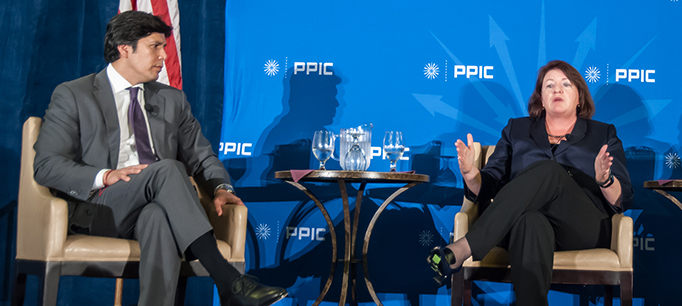
Assembly Speaker Toni Atkins and Senator Kevin de León, who will take over as senate president pro tem later this month, each told a Sacramento audience about growing up in poverty and the role it has played in their shared view of the state’s responsibility to those in need.

“We share similar values and similar stories that have made us care about the values and the issues that we’re talking about today,” said Atkins, who was raised in a poor, rural Virginia family and now represents the San Diego area. De León, who was born in San Diego and represents Los Angeles, said he is the youngest child of a single immigrant mother and the only family member to graduate from high school. Atkins and de León, both Democrats, were elected by their respective legislative chambers earlier this year to serve as leaders.

Both lawmakers cited a recent PPIC report — Child Poverty and the Social Safety Net in California by Caroline Danielson and Sarah Bohn — that said about 50% of California children live in poverty or near-poverty. The remarks, part of the PPIC 2014 Speaker Series, were made to a capacity audience of about 400 in the ballroom of the Sheraton Grand Hotel. The discussion was moderated by PPIC President Mark Baldassare and streamed live to hundreds more.

The wide-ranging conversation touched on a number of major issues—including health care, the drought, immigration, and taxes. Both leaders said that they believe the state should talk about changes to the state tax structure and consider whether to extend the temporary taxes that voters passed in Proposition 30. Atkins cautioned that it will be difficult to gain support from voters for an extension of the taxes.

De León expressed strong support for affirmative action, which he credited for his ability to attend college and become a legislator. He also said California should continue to lead on immigration issues because the federal government has been unable to pass a reform plan. And he noted that polls suggest Californians support health coverage for undocumented residents.

Atkins, meanwhile, encouraged more cities to follow San Francisco and San Jose, which recently increased the minimum wage. Both leaders also said they have worked together in the past and believe they will have a good working relationship going forward.

Measuring Child Poverty

At a well-attended briefing in Sacramento this week, PPIC research fellow Sarah Bohn described the findings in a newly released report, Child Poverty and the Social Safety Net in California, that she co-authored with PPIC research fellow Caroline Danielson, who also attended.

The authors found that about a quarter of California children live in poverty and an additional 26% live in “near poverty,” a threshold defined by incomes between 100 and 150% of the official poverty threshold (up to $46,000 annually for a family of four on average). The poverty analysis was based on the California Poverty Measure, developed by researchers at PPIC and the Stanford Center on Poverty and Inequality. Unlike the traditional federal measure, the new analysis considers regional cost-of-living differences, as well as assistance from government social programs, in measuring poverty.

Bohn also talked about the report and related issues today at an event titled Attacking Poverty by Connecting College Education & Workforce Development, hosted in Los Angeles by state senator Holly Mitchell.

Is California the Poorest State?

In September and October of each year the Census releases estimates of poverty in the U.S. and in each state. Earlier this month “official” poverty estimates for 2013 showed 14.9% of all Californians in poverty and 20.3% of California children in poverty.

In October we expect to see the Census calculations for the “research supplemental poverty measure.” These estimates will represent three-year averages for states (2011-2013) and will likely show that more than 20% of all Californians are in poverty. In past years, this supplemental measure ranked California as the poorest state in the U.S. But according to the latest official estimates, 16 states had higher poverty rates than California. How do we make sense of this?

Some basic information on measuring poverty should help clarify the statistics:

    • The “official” poverty measure. This is based in a 1960s-era formula that is meant to provide a consistent measure across a long timeframe. Rates developed using this measure tell us what share of families lack enough cash to meet a simplistic budget. The rates compare pre-tax cash income (from work, investments, child support, social security, unemployment, and the like) to an estimate of resources needed built from a 1950s food budget and updated for inflation. This budget does not vary according to where a family lives.


    • Supplemental Poverty Measure. This is based on a more comprehensive set of resources and an up-to-date estimate of what it takes to make ends meet. Rates developed using this measure tell us what share of families lack enough total resources to meet basic needs. It adds together a family’s cash income (after taxes) and any in-kind benefits received (like food stamps and housing assistance), then subtracts key out-of-pocket expenses (like child care and medical costs). The resulting total is compared to an estimate of resources needed to meet basic living expenses for food, housing, clothing, and utilities. That estimate varies according to housing costs, so it is different within and across states.


In our view, the official measure is useful for tracking long-term trends in poverty. But the other measures better capture the full set of resources families have on hand and more accurately gauge current costs of living. Based on these measures, California is indeed one of the poorest states in the country.

This finding is largely driven by California’s high cost of living, rather than by sharply limited resources among its families. Using the California Poverty Measure we find that California’s housing costs loom large. Were these costs closer to the U.S. median, California’s poverty rate by either supplemental measure would be much closer to the official rate, and child poverty would be lower than the official rate.

Nonetheless, we also find that safety net resources substantially moderate poverty for many California families: according to the California Poverty Measure, the state’s poverty rate would be as much as 8 points higher were it not for these programs.

Poverty rates also vary widely across the state. PPIC just released a publication that examines this variation—as measured by the California Poverty Measure for 2011—with a focus on children and the role of the social safety net in mitigating poverty.

Briefing Focuses on Survey Election Findings

Less than two months before the election, PPIC’s latest survey looked at Californians’ views on the governor’s race and four statewide ballot measures. Dean Bonner, associate survey director, presented the findings at a briefing in Sacramento on Wednesday. As most of the media coverage noted, the survey found that Governor Brown is doing well in his reelection bid and that the water bond he approved is fairly popular.

The survey found that Proposition 2, labeled the Budget Stabilization Act in the ballot statement but known elsewhere as the rainy day fund, does not currently have majority support among likely voters. Proposition 45, which would regulate health insurance premiums, has a similar level of support, but Proposition 47, which would reduce sentences for some crimes, is favored by 62 percent of likely voters. The survey also found high levels of concern about the drought and mixed feelings about the Affordable Care Act and immigration policy priorities.

Now Hiring: Skilled Health Workers

Changing medical technology, an aging population, and new health care policies have raised important questions about the workforce that will be needed to care for patients in the future. These issues were featured in a new report from PPIC—California’s Healthcare Workforce Needs: Training Allied Workers—and discussed at a luncheon in Sacramento on Friday that included a briefing by coauthor Shannon McConville, PPIC research associate.

The report notes that California will have to add 450,000 jobs to its health workforce over the next decade. With nearly 40 percent of these additional health jobs expected to require some college training below a bachelor’s degree, training programs at California’s community colleges and private two-year institutions will play an important role.

Participating in the panel discussion were Dr. Jocelyn Freeman Garrick, director of the Alameda County Health Pipeline Partnership; Catherine Martin, vice president of the California Hospital Association; and PPIC research fellow Sarah Bohn, a report coauthor. The panel, which was moderated by PPIC research director Patrick Murphy, explored the challenges faced by both public and private higher education institutions in keeping up with rapidly advancing skills requirements in the health care industry. Topics included differences between public and private schools and programs and partnerships that can train Californians for health workforce needs.

Expanding Health Insurance—to Jail Inmates

The federal Affordable Care Act provides an opportunity for local governments to enroll jail inmates in health insurance programs that could lower costs and improve health conditions. Moreover, California has recently passed legislation that facilitates the use of jails as sites of health care enrollment.

PPIC researchers Mia Bird and Shannon McConville address this topic in a recent report titled Health Care for California’s Jail Population. The report, presented at a public event this week in Sacramento, finds that nearly 2.3 million health care visits were recorded in county jails statewide in 2012. Inmates have disproportionately high health needs and typically have had little access to health care prior to incarceration. Connecting inmates to health coverage before they are released from custody may help to reduce county costs, lower recidivism, and improve public health.