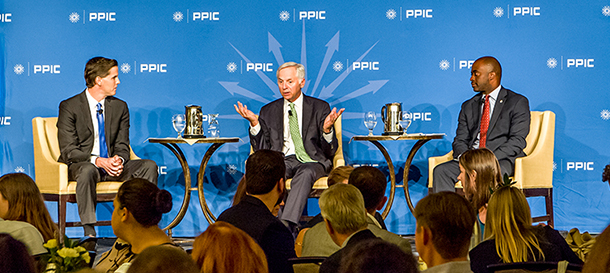
Video: A Conversation with Candidates for State Superintendent of Public Instruction

As part of our Speaker Series on California’s Future, PPIC is inviting all major candidates in selected statewide races to participate in public conversations. The purpose is to give Californians a better understanding of how candidates would approach the challenges facing our state.

In November, Californians will elect a new superintendent of public education. Education is by far the largest state spending area, and California’s public K–12 system—which educates more than 6 million children—is critical to the state’s future. What are the top priorities of the two candidates and what are their visions for California’s schools? PPIC president Mark Baldassare talked to Tony Thurmond, a member of the state assembly, and Marshall Tuck, a school improvement director, about how they would approach the job.

The candidates largely agreed on the need to increase state education funding and the importance of improving outcomes for low-income students, English Learners, and foster youth. Both are strong advocates for universal preschool. And both stressed the need to prepare all students not just for college and careers but also for civic engagement.

After noting that California currently ranks near the bottom among all states in per pupil funding, Tony Thurmond promised to prioritize moving the state into the top ten within his first four years—and to “take us to number one within eight years.” To help close achievement gaps, he would expand successful local approaches. He cited the Freedom School, an Afro-centric literacy program, and Footsteps to Brilliance, which focuses on immigrant families, as models.

Marshall Tuck emphasized the need to “start with equity.” His first priority would be to change the current funding policies to make sure state funding gets to kids with the greatest need. He would also work to streamline the state education code in order to “unlock the creativity of teachers and principals.”

While they agreed on many issues, Thurmond and Tuck emphasized differences in their backgrounds, each arguing that his experience makes him the better candidate.

Tuck argued that, while money is important, “implementation is key,” and cited his experience implementing successful policies in Los Angeles. After noting that the system has not been working, he argued that the next superintendent should be an education professional who can “fundamentally change the way we are approaching public education.”

Thurmond noted that the superintendent needs to be able to work with the county superintendents, the legislature, and the governor. He outlined his experience as an elected official and educator, as well as his “lived experience” as a student in California public schools—an experience, he said, that demonstrates how “education can save lives.”

Video: 2020 Census: What’s at Stake for California?

The decennial census plays an essential role in American democracy. The stakes are huge for California—the state stands to lose political representation and federal funding if there is a significant undercount—and 2020 is fast approaching. At a time when straightforward facts are in short supply, PPIC is providing essential, objective information about the importance of an accurate census count in California.

In this video, PPIC research director Sarah Bohn explains why the census is of particular importance to the Golden State this time around.

What Does the Repeal of Net Neutrality Mean for California Schools?

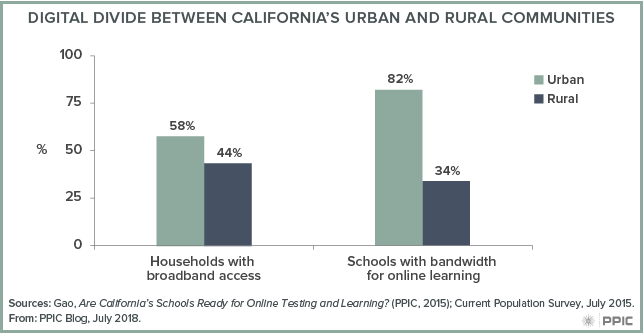
As the Federal Communications Commission’s (FCC) repeal of net neutrality phases in, concerns that Internet service providers (ISPs) could speed up or slow down traffic from certain websites or prioritize certain content loom large. Changes to Internet service, if any, will probably be slow and gradual; however, the repeal has potentially important implications for the digital divide in and outside of California’s schools.

K‒12 schools rely increasingly on online content and management systems to deliver instruction (e.g., blended learning), administer standardized tests (e.g., Smarter Balanced assessments), and manage educational data (e.g., cloud computing). As online learning becomes ubiquitous, access to high-speed Internet is no longer optional—it’s a necessity. Most schools receive discounted Internet services through the federal E-rate program, but if providers decide to introduce tiered pricing based on content, students and educators could lose access to quality education programs. Tiered pricing could also exacerbate the digital divide between urban and rural districts. PPIC research shows that close to 70% of rural districts lack sufficient bandwidth for digital learning, compared to 18% of urban districts. If this gap persists or widens, students in rural areas may be left behind in the digital race.

Another concern is the homework gap. The FCC reports that 70% of teachers assign homework that requires access to broadband, while an estimated 860,000 (22%) households with school-age children in California do not have home Internet service. For many of these households, the cost is too high. Low-income families may get government subsidies (e.g., the Lifeline program) or discounts from ISPs. However, if providers create a fast lane for customers who pay premiums and a slow lane for those who don’t, the homework gap may widen. Rural residents may be particularly affected by these changes, because they tend to have more limited Internet access and fewer ISPs.

Federal and state policymakers have placed net neutrality near the top of their agendas. A major legislative effort to restore net neutrality fell short in the US House of Representatives. In California, two Senate bills (SB 822 and SB 460) that would establish a stringent net neutrality regime are being considered in the state legislature. Other states, including Montana, New York, and Oregon, are taking similar legislative or executive action

Funding Measures and the June Ballot

Last week’s primary election garnered considerable statewide and national attention, with much of the focus on the governor’s race and contested congressional seats. Further down the ballot, however, voters were asked to decide on millions of dollars of local tax, bond, and fee initiatives. On the whole, these measures enjoyed considerable success across the state.

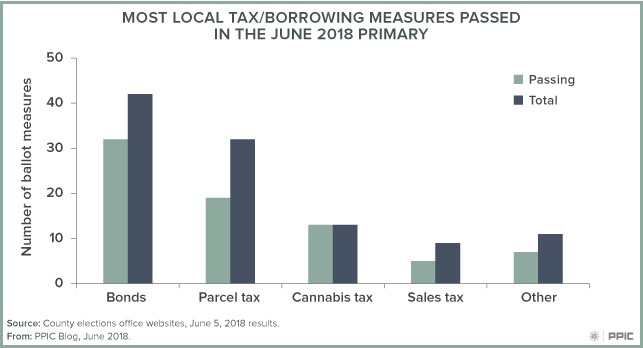
We found that Californians voted on 107 local tax, bond, and fee measures, representing the range of fiscal tools that local jurisdictions can use to raise revenue and borrow funds. Bond measures were the most popular, with 42 different local governments seeking voter approval (37 K–12 school districts; 2 community college districts; 3 cities). There were also 32 parcel tax measures; those related to K–12 schools (12) and fire/public safety (10) were most common. Ballots also included proposals to impose or increase taxes on cannabis (13) general sales (9), gross business receipts (2), and hotel stays (3). And there were proposals to raise utility fees (3), business license fees (1), and bridge tolls (1).

Most of the long list of funding proposals passed—but just putting a measure on the ballot did not guarantee success. Although counties are still counting some ballots, which could affect a race or two, at this time, we observe the following:

  • Overall, voters passed 76 of the 107 measures.
  • Of the 39 school bond measures, 30 passed. Proposition 39, passed in 2000, lowered the threshold for passing school bonds from a two-thirds majority to 55%. Had these measures been subjected to the previous standard, only 11 would have passed. The 19 measures approved under the current standard increased borrowing for investment in public schools by $1.8 billion.
  • On the heels of one of the states’ worst seasons of wildfires on record, California voters held the line on parcel taxes intended to support fire protection, with only 3 of the 9 measures passing.
  • All 13 of the cannabis tax proposals passed overwhelmingly.

California touched off a revolt against taxes 40 years ago. Primary voters in 2018 generally voted for increases but were relatively discriminating in their support, depending upon the type of tax and its intended purpose. This discernment comes at a time when the state’s economy is growing and unemployment is low. It will be interesting to see what happens in November, when we expect to see even more funding measures on the ballot.

Video: Improving Outcomes for English Learners

An important aim of California’s recent K–12 reforms is to change how the state funds, assesses, and holds districts accountable for the education of English Learners (ELs). These policies are beginning to have an impact, and more reforms are on the horizon. At a recent event in Sacramento, PPIC senior fellow Laura Hill outlined the effects of these reforms on ELs and an expert panel delved into the issues from state and local perspectives.

As Hill pointed out, in many ways English Learners are the future in California. A key group in the state’s K‒12 system, ELs currently make up about 21% of the public school population. English Learner status is meant to be temporary—indeed, reclassified ELs (who are deemed proficient enough in English to succeed academically without language support) are among the best performing students in the state. But students who remain ELs for longer periods have poor outcomes.

The panel covered a range of issues, from the aims of reform and the challenges of implementation to the impact of recent immigration enforcement efforts on teachers and students. Panelists agreed that integrating English language development into the academic curriculum is a key aspect of the reforms.

Hilda Maldonado, executive director of the Multilingual and Multicultural Education Department of the Los Angeles Unified School District, said that in LAUSD, “the priority should be to value our students’ home languages as we look at how we can ensure that they succeed.” She also emphasized early intervention: “Focusing on intervening for students in the later grades is a lot harder than focusing on K–3 literacy instruction.”

Veronica Aguila, director of the English Learner Support Division at the California Department of Education, said that the state prioritized the translation of the new academic standards into Spanish. This means that the vast majority of ELs have full access to academic content while they are gaining proficiency in English.

The panelists agreed that the reforms require many teachers to modify their approach so that language development is intertwined with academic content. WestEd’s Robert Linquanti—who works with states and districts on EL assessment, evaluation, and accountability—explained that “teachers need support in order to create the conditions in classrooms where kids really have those rich language opportunities every day.” For example, instead of asking a question that only one student answers, a teacher could set up “situations where students have to work together to solve problems.”

Although there are still many challenges to be addressed, the reforms mark an important shift toward seeing the bilingualism of ELs as an asset. As Aguila put it, “Multilingual education is for all students, not just ELs.”

New Admission Requirements at the University of California?

The University of California (UC) is considering revising its eligibility standards for admission, focusing on requirements for science education. California changed its K–12 standards in this area five years ago, when the State Board of Education adopted the Next Generation Science Standards (NGSS). UC must decide whether and how to align the NGSS with the a–g requirements—a set of courses students must complete in order to be considered eligible for admission to UC. A change in science requirements was proposed by the UC Board of Admissions and Relations with Schools and was approved by the UC Academic Senate earlier this year.

The NGSS has profound implications for science curriculum and instruction in high schools. Currently, to meet the a–g requirements, students must take two science courses from three core disciplines: biology, chemistry, and physics. But the NGSS includes four science categories: physical sciences; life sciences; earth and space sciences; and engineering, technology, and applications of science.

Changes approved by the UC Academic Senate include increasing the minimum science requirement from two to three years. UC would continue to require two years of work in at least two of three disciplines: biology, chemistry, and physics. Students may take a third course within these disciplines or in other science disciplines identified by the NGSS.

If the UC Regents vote on and approve the recommendations of the UC Academic Senate, the change will take effect in the fall of 2023—meaning that students entering high school in the 2019–20 school year will be subject to the new requirements. (CSU is in the process of updating its science requirements—which are currently similar to those of UC—and may follow UC’s guidelines.)

Some high schools would need to make changes to align their curriculum with the NGSS. One area of concern is the relatively low number of course-offerings in science among small and rural schools. PPIC’s work has shown that not every high school offered the entire a–g sequence in science in 2016–17; small and rural schools were much less likely to do so. Another area of concern is staffing, as a teacher shortage has left California schools struggling with large class sizes for years. Finally, ensuring awareness of these changes will be important. Parents and students should be informed of the new requirements with adequate time and detail to be able to plan accordingly.

Under NGSS, science course sequencing in high school may affect whether and how students meet the proposed a–g requirements. PPIC researchers are examining early implementation of the NGSS in the K-12 system and will discuss findings in an upcoming report. Moving forward, more research is needed to understand the implications of any new a–g requirements for high school graduates’ eligibility for UC and CSU.

Federal Spending Bill Boosts Education Funds in California

Congress recently agreed on a $1.3 trillion spending bill to keep the federal government operating through September 2018. Nearly six months behind schedule, the omnibus spending bill includes a $3.9 billion increase for the US Department of Education (DOE), even though the president had proposed a $9 billion (13%) budget cut that involved scaling back or eliminating more than 30 DOE programs. Since funding for most of these programs is based on student headcounts, California is expected to receive more federal money this year.

One contentious issue in the president’s budget was a $1.4 billion increase for public and private school alternatives. Congress rejected increases for the new Furthering Options for Children to Unlock Success grants—the president’s signature proposal—and the Education Innovation and Research program. Instead, it increased funding for the charter schools grant program by $58 million, a much smaller amount than the president—and Secretary DeVos—had proposed.

The spending bill also excluded a proposed 15% funding cut for Perkins grants and the elimination of the Preschool Development grants. In the previous school year, California received $113 million for Perkins grants, which support career technical education programs in high schools and community colleges. California is also expected to receive more money from the Department of Health and Human Services for programs such as the Child Care Development Block Grant and Head Start.

Congress voted to maintain funding for Supporting Effective Instruction State Grants, which the president also wanted to eliminate. Commonly referred to as Title II, this program supports the recruitment and development of high-quality teachers and principals, with a particular focus on serving students from low-income families. Title II is the third-largest DOE program, and California schools received more than $200 million Title II funds in the most recent school year.

At the postsecondary level, Congress increased funding for the Federal Supplemental Educational Opportunity Grant by $107 million. The president proposed eliminating this $732 million program, which provides need-based grants to help low-income undergraduate students with college costs. The spending bill also increased funding for the federal work-study program by 14%, reversing the president’s proposal to cut it by almost half.

Historically, federal funds have been a small fraction of school district revenues, but they have become an increasingly important funding source, particularly for high-need schools. All in all, the new spending bill will support California’s ongoing efforts to improve educational outcomes for all of its students.

Parents Have High Educational Hopes for Their Children—Can California Keep Up?

The most recent PPIC Statewide Survey on Californians’ views on education finds that the vast majority of parents (83%) hope their children will obtain at least a bachelor degree—in fact, nearly half (48%) want their children to earn a graduate degree. These parental aspirations are relatively constant across race/ethnicity, political ideology, and income. They are also fairly consistent across regions—although, among the regions represented in the survey, parents in the Central Valley are the least likely (77%) and San Francisco Bay Area parents are the most likely (96%) to want their children to earn college or graduate degrees. These parental aspirations may be linked to student course taking and performance in high school. Over the past decade, there has been a 48% increase in completion of the coursework that makes California high school graduates eligible for UC or CSU; in 2015, 43% of the state’s graduating class met this eligibility requirement.

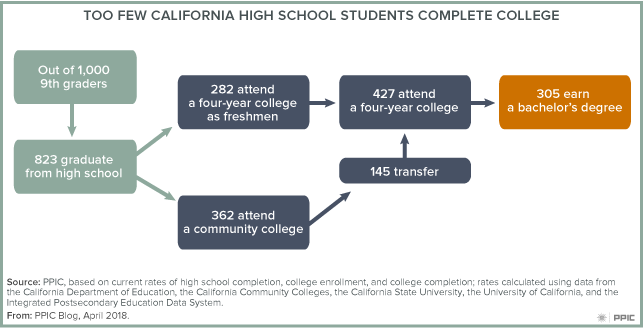
Moreover, these aspirations are aligned with urgent state needs. If current economic and educational trends persist, California will fall 1.1 million bachelor’s degrees short of economic demand by 2030. The state economy is increasingly reliant on high-skill workers, but most K–12 students do not stay on track to obtain a bachelor’s degree, let alone a graduate degree. Previous PPIC research has shown that for every 1,000 9th graders in California, only 305 will earn a bachelor’s degree at UC or CSU.

Parental Aspiration Figure

California has a long way to go in meeting demand for higher education, but there are signs of progress. The state has been reinvesting in public higher education, increasing undergraduate enrollment, and improving student outcomes—and the public education systems are increasingly willing to work together to streamline the higher education pipeline. California will need continued innovation and significant investment in facilities and faculty in order to accommodate the kind of enrollment growth that can keep up with economic demand and individual aspirations. Moreover, given the large share of Californians who see advanced degrees as important, the state may want to begin a more robust discussion about graduate school, along the lines of its recent focus on career technical education.

California’s K–12 Educational Progress: Good News and Bad News

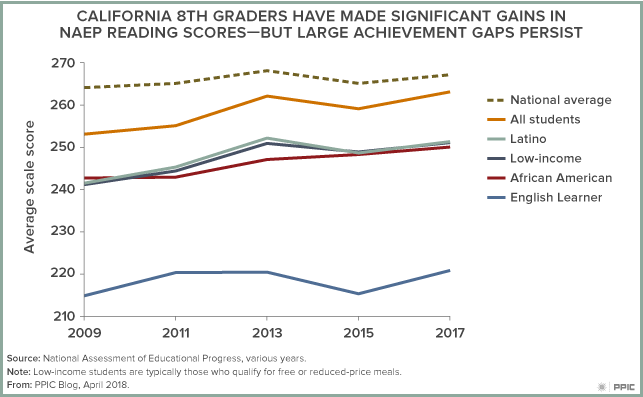
New data on the educational progress of California’s K–12 students offers a mixed picture: there have been sizable gains in grade 8 reading scores, but more work is needed to close achievement gaps for English Learner, low-income, and African American and Latino students.

The data comes from the 2017 National Assessment of Educational Progress (NAEP), commonly referred to as the nation’s report card. Administered periodically in grades 4, 8, and 12, NAEP serves as a common yardstick for states and informs many national policy decisions.

The NAEP results show that the average reading score for California 8th graders has risen from 259 to 263. While the latest score is still below the national average (267), it marks a significant improvement, and the state’s 4 point gain is larger than the 1 point increase at the national level. The increase is driven by improvement at both ends performance scale: fewer students performed at the lowest level and more students performed at the advanced level.

However, there were no significant improvements in grade 8 math and no gains in either subject in grade 4. Also, California did not see any significant narrowing of its student achievement gaps. For instance, the average reading score for Latino students in grade 8 was 27 points lower than that of white students; this gap is not significantly different from the 30 point gap in 1998. Similarly, the average score for low-income students was 28 points lower than that of other students, and that gap is not different than it was as in 1998 (32 points).

Naep Score Figure

The NAEP results provide a useful benchmark of student performance; this is especially important in light of the sea changes under way in California’s public K–12 system. The state revamped its school finance and accountability systems with a focus on improving outcomes among English Learners and other “high-need” students. It also adopted new educational standards in math, English language arts, science, and English language development, and implemented a new assessment system.

A recent PPIC survey finds that a solid majority of adults believe that the financial reforms, in particular, will improve the achievement of English Learners and low-income students. As the reforms take hold, PPIC will continue to monitor their impact.

Video: Californians and Education

In the wake of the Parkland, Florida, killings, the latest PPIC survey finds an overwhelming majority of Californians are concerned about a possible shooting in their local schools. But most oppose having teachers carry guns in school facilities.

Lunna Lopes, PPIC researcher, detailed these and other key findings at a Sacramento briefing last week.

When asked about school shootings, 73 percent of California adults and 82 percent of public school parents say they are very or somewhat concerned. Yet two-thirds of adults (67%) and public school parents (68%) oppose allowing more teachers and school officials to carry guns in schools. Strong partisan differences emerge on this issue. An overwhelming majority of Democrats (86%) and a strong majority of independents (69%) are opposed to arming teachers and school officials, while a solid majority of Republicans (60%) favor the idea.

A few other survey highlights include:

  • Californians (65%) support having local school districts declared sanctuary safe zones for undocumented students, but there are deep partisan divisions.
  • California adults and likely voters continue to see the state’s K–12 funding as inadequate. Solid majorities (60%) of likely voters favor local school bonds, while fewer (48%) support local parcel taxes for schools.
  • Across parties, majorities of likely voters agree that gubernatorial candidates’ positions on K–12 education are very important.
  • Among likely voters in the gubernatorial race, Democrat Gavin Newsom maintains his lead (26%), followed by Republican John Cox (15%) and Antonio Villaraigosa (13%). Nearly a quarter of likely voters (22%) remain undecided.