California Politics and the Future

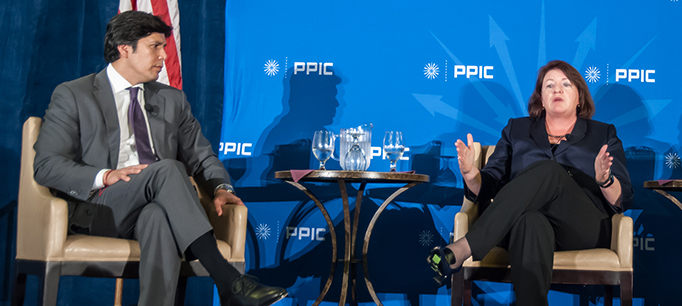
Jim Brulte, chair of the California Republican Party, says Governor Brown is “clearly the master of Sacramento.”

Jennifer Medina, national correspondent for the New York Times, says the governor hasn’t talked much about poverty or income inequality— an issue his Republican opponent used in the election this year.

And Garry South, longtime Democratic strategist, says the governor needs to take on the tough issue of fiscal reform because this can only be done by a Democrat.

These are a sample of comments from a panel of experts speaking at a briefing hosted by PPIC in Sacramento this week. The discussion focused on the challenges and opportunities ahead for the governor and legislature. The event began with a presentation of the results of the new PPIC Statewide Survey by Dean Bonner, associate survey director. The survey included a wide range of topics, including tax reform, health care, climate change, and the approval ratings of state leaders.


California’s Future Challenges and Opportunities

PPIC hosted a day-long series of conversations this week about creating a better future for our state and highlighting the choices we need to make today to do so. After a keynote address by Nancy McFadden from the governor’s office, panelists from government, business, and philanthropy discussed California’s challenges and opportunities before a large audience in Sacramento and online. They tackled difficult topics, such as improving economic opportunity and increasing citizen engagement in government. And they discussed ways the state can build on its strengths—an improving economy, a diverse population, and a history of reform and innovation.

We will post videos of all of the sessions soon. In the meantime, we want to share the opening remarks prepared by PPIC researchers. They set the context each session:

We hope their insights will pique your interest and inspire you to watch the conference videos when they become available.

Timely Talk About California’s Future

Californians are feeling more optimistic about the state’s immediate economic future than they have in years, our December PPIC Statewide Survey shows. Today, 52 percent expect California to have good times financially for the next year. The last time more than half of residents expressed this view was in January 2001. But when Californians are asked to take the longer view, worries about their own economic futures emerge. Most residents—55 percent—think that when California’s children grow up they will be worse off financially than their parents.

The time is right to both build on Californians’ new optimism and address the nagging concerns about the future. After years of economic turmoil, the state has entered a period of reform and reinvention. How can we Californians ensure that the changes will bring about a better future for the state?

With the new legislature sworn in and state leaders developing policy agendas for the months ahead, PPIC is hosting a wide-ranging conversation tomorrow about the choices we need to make today to create a future that benefits all Californians. Registration for the conference, California—State of Change, is closed, but I invite you to watch the live webcast of this full-day event.

Event panels will cover a variety of topics, including the economic, political, and demographic trends driving change in the state; how leaders can best respond to them; and how government can be a partner in the kind of innovation that has made our state a leader in so many areas.

Please join us for a series of timely discussions about our future.

Drought Watch: Video Seminars

This is part of a continuing series on the impact of the drought.

A series of videos available online is a great resource for water wonks and newcomers alike. Researchers and cooperative extension specialists from the University of California’s Division of Agriculture and Natural Resources, with support from the California Department of Water Resources, have put together these video seminars on drought-related water management issues. You can bone up on topics ranging from drought impacts on wildlife and groundwater basins, to the latest research on California’s climate in centuries past (and the mega-drought we experienced in medieval times), to tips for managing crops and rangeland when water is in short supply.

I contributed to the series with an overview of how water marketing and groundwater banking can help mitigate the worst economic impacts of droughts, drawing on PPIC’s ongoing research on this issue. The series is being updated regularly with new videos.

California’s New Leaders Focus on Poverty

Assembly Speaker Toni Atkins and Senator Kevin de León, who will take over as senate president pro tem later this month, each told a Sacramento audience about growing up in poverty and the role it has played in their shared view of the state’s responsibility to those in need.

“We share similar values and similar stories that have made us care about the values and the issues that we’re talking about today,” said Atkins, who was raised in a poor, rural Virginia family and now represents the San Diego area. De León, who was born in San Diego and represents Los Angeles, said he is the youngest child of a single immigrant mother and the only family member to graduate from high school. Atkins and de León, both Democrats, were elected by their respective legislative chambers earlier this year to serve as leaders.

Both lawmakers cited a recent PPIC report — Child Poverty and the Social Safety Net in California by Caroline Danielson and Sarah Bohn — that said about 50% of California children live in poverty or near-poverty. The remarks, part of the PPIC 2014 Speaker Series, were made to a capacity audience of about 400 in the ballroom of the Sheraton Grand Hotel. The discussion was moderated by PPIC President Mark Baldassare and streamed live to hundreds more.

The wide-ranging conversation touched on a number of major issues—including health care, the drought, immigration, and taxes. Both leaders said that they believe the state should talk about changes to the state tax structure and consider whether to extend the temporary taxes that voters passed in Proposition 30. Atkins cautioned that it will be difficult to gain support from voters for an extension of the taxes.

De León expressed strong support for affirmative action, which he credited for his ability to attend college and become a legislator. He also said California should continue to lead on immigration issues because the federal government has been unable to pass a reform plan. And he noted that polls suggest Californians support health coverage for undocumented residents.

Atkins, meanwhile, encouraged more cities to follow San Francisco and San Jose, which recently increased the minimum wage. Both leaders also said they have worked together in the past and believe they will have a good working relationship going forward.

Measuring Child Poverty

At a well-attended briefing in Sacramento this week, PPIC research fellow Sarah Bohn described the findings in a newly released report, Child Poverty and the Social Safety Net in California, that she co-authored with PPIC research fellow Caroline Danielson, who also attended.

The authors found that about a quarter of California children live in poverty and an additional 26% live in “near poverty,” a threshold defined by incomes between 100 and 150% of the official poverty threshold (up to $46,000 annually for a family of four on average). The poverty analysis was based on the California Poverty Measure, developed by researchers at PPIC and the Stanford Center on Poverty and Inequality. Unlike the traditional federal measure, the new analysis considers regional cost-of-living differences, as well as assistance from government social programs, in measuring poverty.

Bohn also talked about the report and related issues today at an event titled Attacking Poverty by Connecting College Education & Workforce Development, hosted in Los Angeles by state senator Holly Mitchell.

Now Hiring: Skilled Health Workers

Changing medical technology, an aging population, and new health care policies have raised important questions about the workforce that will be needed to care for patients in the future. These issues were featured in a new report from PPIC—California’s Healthcare Workforce Needs: Training Allied Workers—and discussed at a luncheon in Sacramento on Friday that included a briefing by coauthor Shannon McConville, PPIC research associate.

The report notes that California will have to add 450,000 jobs to its health workforce over the next decade. With nearly 40 percent of these additional health jobs expected to require some college training below a bachelor’s degree, training programs at California’s community colleges and private two-year institutions will play an important role.

Participating in the panel discussion were Dr. Jocelyn Freeman Garrick, director of the Alameda County Health Pipeline Partnership; Catherine Martin, vice president of the California Hospital Association; and PPIC research fellow Sarah Bohn, a report coauthor. The panel, which was moderated by PPIC research director Patrick Murphy, explored the challenges faced by both public and private higher education institutions in keeping up with rapidly advancing skills requirements in the health care industry. Topics included differences between public and private schools and programs and partnerships that can train Californians for health workforce needs.

The Decline of the Homeowner

Homeownership is on the wane in California. Between 2006 and 2012, the number of owner-occupied housing units in California declined by more than 320,000, while the number of renter-occupied housing units increased by more than 720,000. Never before has the state seen such dramatic declines in the number of owner-occupied houses. As a result, homeownership rates in California are at their lowest levels in more than 50 years.

The decline in owning and the rise in renting are largely a result of the housing bust between 2007 and 2011. Single-family housing units, long the primary domain of the homeowner in California, were the most likely to be lost to foreclosure. Thousands of owner-occupied homes were sold or foreclosed upon, and many became rentals.

However, even during the bust, housing prices remained relatively high in the state’s heavily populated coastal areas, which meant that ownership continued to be unaffordable for many renters who might prefer to buy. It may come as no surprise that states with low housing prices tend to have the highest homeownership rates. For example, median home values in West Virginia and Michigan are among the lowest in the nation—less than $120,000 in 2012—and rates of homeownership in those states are above 70 percent—among the highest in the nation. In contrast, in New York, California, and Hawaii, housing values are high and homeownership rates are among the lowest in the nation.

Housing construction in California reflects the increase in demand for rentals. In recent years, most new construction has consisted of large multi-unit buildings, most of which are rentals. This focus on multi-unit construction also reflects a shift among planners and local officials toward encouraging high-density in-fill development. This shift is especially apparent in expensive coastal housing markets where there is not a lot of room for new housing. In Los Angeles County, multi-unit buildings accounted for 86 percent of the increase in occupied housing units between 2010 and 2014. In the Bay Area, 60 percent of net new occupied housing units were in multi-unit buildings. By contrast, in inland areas such as Sacramento County and the Inland Empire, three of every four newly occupied housing units were single-family dwellings.

These newly constructed multi-family units make up just a fraction of the recent growth in renter households. Conversions of owner-occupied single-family homes to rentals have captured a large portion of growth in renter-occupied units. Between 2006 and 2012, 60 percent of the increase in rented occupied units occurred in single-family units (about 436,000 units). In 2006, before the bust, only 21 percent of occupied single-family houses were rented; by 2012, the share of houses occupied by renters had increased to 26.0 percent.

Will the trend toward renting reverse as the state’s economy continues to recover? A key consideration is whether the rise in renting represents a long-term shift in preferences. High home prices and past volatility in the housing market may have led many to conclude that owning a home is simply not worth the risk. On the other hand, rapidly rising rents have made homeownership relatively more attractive. And all this is happening as large numbers of young adults are reaching prime ages for starting a household and buying a first home. If historic trends are any indication, these demographic forces—along with low interest rates and improved labor markets—should lead to increases in homeownership rates.

Chart sources: (top and bottom) Authors’ calculations based on American Community Survey data; (middle) SOCDS Building Permits Database.

May Survey Looks at Views on Budget, Drought

The May edition of the PPIC Statewide Survey, Californians and their Government, explores attitudes toward the governor’s latest proposed budget and gauges preferences in the gubernatorial primary. It also examines opinions on health care reform, the drought, poverty, and climate change.

PPIC research associate Dean Bonner presented the results of this wide-ranging survey at a lunch briefing in Sacramento last week.

Trouble Ahead for Local School Ballot Measures?

This commentary first appeared on EdSource.org on April 30, 2014.

The elections this year offer the first statewide look at Californians’ willingness to raise revenue for their local schools since passage of Proposition 30, the tax initiative to benefit education that voters passed in November 2012. While it’s too early to know how many local school districts will test the waters by placing a construction bond or parcel tax on the ballot, there are undercurrents in our new survey that spell trouble ahead for local school ballot measures. In short, the public’s sense that schools are in crisis has diminished.

Our annual PPIC Statewide Survey on Californians and Education shows that likely voters view fiscal conditions in education as generally improving. The proportion who say that the state budget situation is a “big problem” for California’s K–12 public education has dropped by 10 points—from 72 percent to 62 percent—between April 2012 and today. More importantly, the proportion of likely voters saying that the level of current state funding for their local public schools is “not enough” has also dropped by 10 points between April 2012 and today—from 59 percent to 49 percent. In other words, the likely voters who currently view state funding of their local schools as problematic now make up less than a majority.

In our recent poll, 55 percent of likely voters would vote yes if there was a local school bond on the ballot—just barely meeting the minimum passage level. By contrast, 48 percent of likely voters would vote yes on a local school parcel tax—falling far short of the two thirds needed to pass.

It is important to note that likely voters who are public school parents are bucking these statewide trends: a majority of them view state funding for their local public school as inadequate, and over 60 percent say they would support a local school bond and a local school parcel tax this year. But our poll finds that public school parents make up less than 30 percent of the likely voters who will determine the ballot outcomes.

Since 2001, the statewide passage rate for local school bonds has been 81 percent and for local school parcel taxes, 60 percent, as noted by CaliforniaCityFinance.com and EdSource. This year, those rates may fall. Alternatively, there may be fewer local school ballot measures this year as funding proponents focus on a smaller set of school districts with voter profiles that offer favorable odds for passing these measures. For instance, our poll finds majority support for local school bonds and local school parcel taxes among Democratic, Latino, lower-income, and Bay Area likely voters.

Meanwhile, some legislators have proposed lowering the vote threshold needed to pass these taxes from two-thirds to 55 percent, which requires changing Proposition 13. But since the Democrats lost their supermajority when three of their senators were suspended, the legislature is much less likely to send this change to the voters for approval. Californians are not inclined to make this change anyway. The proportion of likely voters who say that this change to Proposition 13 is a good idea has declined—from 46 percent in April 2011 to just 39 percent today.

It is possible that voter concern about school funding needs will surface later this year, as school districts implement two dramatic changes: the Common Core Standards in the classroom and the Local Control Funding Formula, which provides more money for districts with higher proportions of English Learners and lower-income students. These changes could offer two new avenues to engage voters about the need for local school funding. For now, though, we will be watching for signs that Proposition 30’s passage will make it harder for local school ballot measures to succeed in 2014.