Californians’ Views of Health Care Reform Shift—a Bit

Open enrollment for health insurance through Covered California or HealthCare.gov is set to begin in less than a month, and Californians have had one year of experience obtaining coverage. The Affordable Care Act has divided the state as well as the nation. Have those views shifted? Yes and no.

Before the health insurance marketplace opened, PPIC asked Californians about the law’s potential impact. There was no consensus. About a quarter of respondents in our September 2013 survey said they thought they and their family would be better off (26%) and another quarter thought they would be worse off (24%). More thought the health reform law would not make much difference (43%). Adults nationwide were slightly more negative (24% better off, 32% worse off, 37% no difference), according to a Kaiser Family Foundation poll taken the same month.

Californians were divided along party lines in their opinions of the law’s impact, with half of Democrats (51%) saying the law would not make a difference to them and six in 10 Republicans (61%) saying they would be worse off. Californians without insurance were much more likely than those with insurance to say they would be better off (36% to 23%). Looking more broadly, pluralities across regions and demographic groups said that they expected the health reform law would make no difference to them or their families.

A year later, Californians’ opinions of the health reform law’s impact have shifted. In our latest survey, we asked respondents if it had directly helped them and their family, directly hurt them and their family, or had no direct impact. Most Californians (58%) say the health reform law has had no direct impact. Similar proportions say either it directly helped (20%) or it directly hurt (19%). Adults nationwide are slightly more likely to say the law hurt them (56% no direct impact, 14% helped, 27% hurt), the latest Kaiser Family Foundation poll shows.

Looking across political groups, we see more change. Majorities across parties (55% Democrats, 56% Republicans, 63% independents) say the health reform law has not had a direct impact on them or their family. Similarly, among the insured and the uninsured, 58 percent say the law has not affected them. In fact, majorities across regions and all demographic groups say the law has had no impact.

Although most Californians say they have not felt the law’s effects, they still remain sharply divided along party lines in their general opinion of the law. Six in 10 Democrats have a favorable opinion of the health care law, while eight in 10 Republicans have an unfavorable opinion of the law–almost identical findings to those last December.

Of course, the story of health care reform is far from over. At PPIC, we will continue to monitor Californians’ views of this issue and its impact on their lives.

Drought Watch: California as a Testing Ground

This is part of a continuing series on the impact of the drought.

An international consortium of water economists gathered at the World Bank headquarters in Washington, D.C. earlier this fall for two days of meetings on water policy research. The timing was opportune, as the World Bank – which provides financial and technical assistance to developing economies around the globe – recently reorganized to provide a new emphasis on water resources. The conference theme was the economics of water conservation and efficiency, with researchers looking at the role of technology, pricing, and institutions to effectively and efficiently manage water resources under conditions of increasing scarcity. In light of the national and international attention to California’s ongoing drought, I was asked to give keynote remarks about lessons from California for other regions of the world.

I highlighted four central ideas. (My presentation is 22 minutes into this video.) First, urban areas the world over can improve drought resilience by diversifying their water portfolios, rather than relying on a single source of water. Second, although conservation is important, policymakers should be mindful that improved irrigation efficiency is not a panacea to cope with drought, because much of the water “saved” is already being reused by others downstream.

Third, sustainable groundwater basin management—the approach now called for under California’s historic groundwater legislation—is an invaluable drought management tool because it means more groundwater will be available to help get through dry times. But getting there can imply costly trade-offs in basins that rely heavily on groundwater, requiring institutional and financial support to help water users make the transition.

And fourth, like California, many regions can benefit from repurposing their storage and conveyance infrastructure to better cope with droughts and the growing water scarcity expected with climate change. In particular, storing more water for dry years in groundwater basins, and using surface reservoirs for seasonal storage and flood protection, can be cost-effective ways to adapt to an increasingly variable climate.

PPIC’s Role in a Changing State

California is changing quickly and in ways that touch the lives of all of its residents. The state has enrolled millions of people in health insurance under the federal Affordable Care Act. It is moving ahead to expand the cap-and-trade program that is a cornerstone of AB 32, the landmark law mandating a reduction in greenhouse gas emissions.

In K–12 education, California is implementing two sweeping policy changes at the same time. New English and math standards, called the Common Core, require big changes in what is taught in the classroom. A new school funding formula, the Local Control Funding Formula, gives districts increased flexibility over spending and provides extra money for disadvantaged students.

Historic changes are playing out in the corrections system as well. Realignment, which shifted responsibilities for many offenders from the state to the local level, has had a significant impact on the state, counties, and communities.

Amid these policy shifts, California is coping with a major drought that has focused attention on the state’s need to improve its water management.

These changes are also taking place in an election year—and California’s elections have also undergone major changes. This is the first election in which state constitutional officers, such as governor and controller, will be elected under the top-two primary system.

At PPIC we are focused on monitoring and analyzing the impact of these changes—both short and long term—and examining other steps the state can take to meet its critical challenges. In recent months, we have delivered objective, nonpartisan research on all of these topics. We plan to release many more publications in the months ahead. Our PPIC Statewide Survey will continue to give California residents a voice in the policy changes that affect them, as it has since 1998. The PPIC blog provides regular updates on the impact of the drought, as well as news and analysis on a range of policy topics from our experts.

Through our extensive outreach, we have hosted discussions on these important topics and more. We invited California’s two top legislative leaders to share their priorities for the upcoming session. At another recent event, the two secretary of state candidates talked about how they would improve elections and increase voter participation, if elected. Both of these events were webcast live to engage Californians from all over the state.

We encourage you to sign up for our announcements to learn about future events. We hope you’ll stay up to date with our publications and videos by signing up for our monthly e-bulletin, following us on social media, and subscribing to the PPIC blog.

As always, we welcome your comments and suggestions.

Drought Watch: Video Seminars

This is part of a continuing series on the impact of the drought.

A series of videos available online is a great resource for water wonks and newcomers alike. Researchers and cooperative extension specialists from the University of California’s Division of Agriculture and Natural Resources, with support from the California Department of Water Resources, have put together these video seminars on drought-related water management issues. You can bone up on topics ranging from drought impacts on wildlife and groundwater basins, to the latest research on California’s climate in centuries past (and the mega-drought we experienced in medieval times), to tips for managing crops and rangeland when water is in short supply.

I contributed to the series with an overview of how water marketing and groundwater banking can help mitigate the worst economic impacts of droughts, drawing on PPIC’s ongoing research on this issue. The series is being updated regularly with new videos.

California’s New Leaders Focus on Poverty

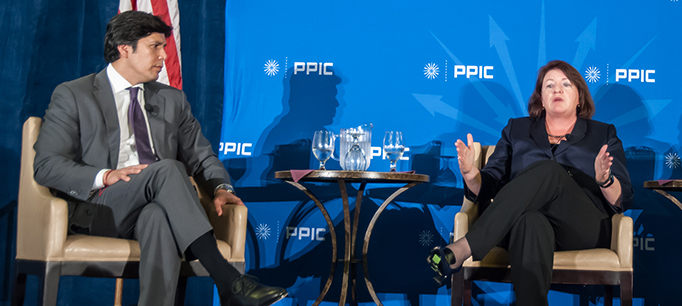
Assembly Speaker Toni Atkins and Senator Kevin de León, who will take over as senate president pro tem later this month, each told a Sacramento audience about growing up in poverty and the role it has played in their shared view of the state’s responsibility to those in need.

“We share similar values and similar stories that have made us care about the values and the issues that we’re talking about today,” said Atkins, who was raised in a poor, rural Virginia family and now represents the San Diego area. De León, who was born in San Diego and represents Los Angeles, said he is the youngest child of a single immigrant mother and the only family member to graduate from high school. Atkins and de León, both Democrats, were elected by their respective legislative chambers earlier this year to serve as leaders.

Both lawmakers cited a recent PPIC report — Child Poverty and the Social Safety Net in California by Caroline Danielson and Sarah Bohn — that said about 50% of California children live in poverty or near-poverty. The remarks, part of the PPIC 2014 Speaker Series, were made to a capacity audience of about 400 in the ballroom of the Sheraton Grand Hotel. The discussion was moderated by PPIC President Mark Baldassare and streamed live to hundreds more.

The wide-ranging conversation touched on a number of major issues—including health care, the drought, immigration, and taxes. Both leaders said that they believe the state should talk about changes to the state tax structure and consider whether to extend the temporary taxes that voters passed in Proposition 30. Atkins cautioned that it will be difficult to gain support from voters for an extension of the taxes.

De León expressed strong support for affirmative action, which he credited for his ability to attend college and become a legislator. He also said California should continue to lead on immigration issues because the federal government has been unable to pass a reform plan. And he noted that polls suggest Californians support health coverage for undocumented residents.

Atkins, meanwhile, encouraged more cities to follow San Francisco and San Jose, which recently increased the minimum wage. Both leaders also said they have worked together in the past and believe they will have a good working relationship going forward.

Measuring Child Poverty

At a well-attended briefing in Sacramento this week, PPIC research fellow Sarah Bohn described the findings in a newly released report, Child Poverty and the Social Safety Net in California, that she co-authored with PPIC research fellow Caroline Danielson, who also attended.

The authors found that about a quarter of California children live in poverty and an additional 26% live in “near poverty,” a threshold defined by incomes between 100 and 150% of the official poverty threshold (up to $46,000 annually for a family of four on average). The poverty analysis was based on the California Poverty Measure, developed by researchers at PPIC and the Stanford Center on Poverty and Inequality. Unlike the traditional federal measure, the new analysis considers regional cost-of-living differences, as well as assistance from government social programs, in measuring poverty.

Bohn also talked about the report and related issues today at an event titled Attacking Poverty by Connecting College Education & Workforce Development, hosted in Los Angeles by state senator Holly Mitchell.

Majorities Favor State Government Downsizing

The recent PPIC Statewide Survey offers an early snapshot of voters’ choices as we enter the November election cycle. The majority support for Governor Jerry Brown’s reelection and the Proposition 1 state water bond was widely cited in the media last week. But the poll also reveals surprising news about the voters’ overall mood this year: by a wide margin, likely voters would rather pay lower taxes and have a state government that provides fewer services (53%) than pay higher taxes and have a state government that provides more services (41%).

What is so special about this finding? We have been observing a slow but steady rise in the preference for lower taxes and fewer services since November 2012—when voters approved the Proposition 30 tax increase. In the 24 times since we first asked this question in our February 2003 poll, the preference for lower taxes and fewer services has usually been below 50 percent. Moreover, this preference has never exceeded 55 percent, placing the current reading close to the historic high.

This finding seems to run counter to the strong support we found for the Democratic governor and the multi-billion dollar state water bond on the November ballot. It is also seems at odds with another Golden State mega-trend: the steady decline in the number of Republican voters. The secretary of state recently reported that Republicans now account for just 28 percent of the electorate.

While a preference for smaller government has long been expressed by Republicans, the 53 percent of California likely voters who want lower taxes and fewer services are a politically mixed group. Forty- eight percent are registered Republicans and 55 percent are self-described conservatives—which means that many who hold this view are Democratic and independent voters, and see themselves as political moderates. They are predominantly homeowners (81%), and most are white (66%). But only a slight majority are age 55 and older (54%), and less than half are college graduates (41%) or have annual household incomes above $80,000 (44%). So, this likely voter group has a diverse demographic profile.

What do they have in common? Seven in 10 say the state is headed in the wrong direction. Three in four say that the state budget situation—that is, the balance between government spending and revenues—is a big problem for the people of California. Eight in 10 say that major changes are needed in the state budget process in terms of both revenues and spending. In sum, they are the core audience for fiscal restraint and reform.

Governor Brown’s emphasis on fiscal prudence, including the downsizing of the state water bond, seems to have struck a chord here. Among those who prefer a smaller role for state government, one in three are supporting Jerry Brown in the governor’s race. This trend helps to explain the Democratic candidate’s sizable 21-point lead over Republican challenger Neel Kashkari. This group is also leaning toward support for the Proposition 1 state water bond (46% yes, 37% no), helping this multi-billion dollar spending measure to now have a commanding two-to-one lead.

This likely voter group may be a major hurdle for a Democratic Party seeking to regain a supermajority in the state legislature. Seven in 10 of these likely voters say they disapprove of the way that the state legislature is handling its job. Six in 10 say it would be a “bad thing” for the Democrats to gain a two-thirds majority in the legislature in the November election. Only 18 percent say that this would be a “good thing.”

Our poll’s findings on the preferred role of state government suggest that the election is unlikely to result in a mandate for expanding services and raising taxes—they also point to an opening next year to discuss fiscal reforms that the state needs for the 21st century economy.

Is California the Poorest State?

In September and October of each year the Census releases estimates of poverty in the U.S. and in each state. Earlier this month “official” poverty estimates for 2013 showed 14.9% of all Californians in poverty and 20.3% of California children in poverty.

In October we expect to see the Census calculations for the “research supplemental poverty measure.” These estimates will represent three-year averages for states (2011-2013) and will likely show that more than 20% of all Californians are in poverty. In past years, this supplemental measure ranked California as the poorest state in the U.S. But according to the latest official estimates, 16 states had higher poverty rates than California. How do we make sense of this?

Some basic information on measuring poverty should help clarify the statistics:

    • The “official” poverty measure. This is based in a 1960s-era formula that is meant to provide a consistent measure across a long timeframe. Rates developed using this measure tell us what share of families lack enough cash to meet a simplistic budget. The rates compare pre-tax cash income (from work, investments, child support, social security, unemployment, and the like) to an estimate of resources needed built from a 1950s food budget and updated for inflation. This budget does not vary according to where a family lives.


    • Supplemental Poverty Measure. This is based on a more comprehensive set of resources and an up-to-date estimate of what it takes to make ends meet. Rates developed using this measure tell us what share of families lack enough total resources to meet basic needs. It adds together a family’s cash income (after taxes) and any in-kind benefits received (like food stamps and housing assistance), then subtracts key out-of-pocket expenses (like child care and medical costs). The resulting total is compared to an estimate of resources needed to meet basic living expenses for food, housing, clothing, and utilities. That estimate varies according to housing costs, so it is different within and across states.


In our view, the official measure is useful for tracking long-term trends in poverty. But the other measures better capture the full set of resources families have on hand and more accurately gauge current costs of living. Based on these measures, California is indeed one of the poorest states in the country.

This finding is largely driven by California’s high cost of living, rather than by sharply limited resources among its families. Using the California Poverty Measure we find that California’s housing costs loom large. Were these costs closer to the U.S. median, California’s poverty rate by either supplemental measure would be much closer to the official rate, and child poverty would be lower than the official rate.

Nonetheless, we also find that safety net resources substantially moderate poverty for many California families: according to the California Poverty Measure, the state’s poverty rate would be as much as 8 points higher were it not for these programs.

Poverty rates also vary widely across the state. PPIC just released a publication that examines this variation—as measured by the California Poverty Measure for 2011—with a focus on children and the role of the social safety net in mitigating poverty.

Briefing Focuses on Survey Election Findings

Less than two months before the election, PPIC’s latest survey looked at Californians’ views on the governor’s race and four statewide ballot measures. Dean Bonner, associate survey director, presented the findings at a briefing in Sacramento on Wednesday. As most of the media coverage noted, the survey found that Governor Brown is doing well in his reelection bid and that the water bond he approved is fairly popular.

The survey found that Proposition 2, labeled the Budget Stabilization Act in the ballot statement but known elsewhere as the rainy day fund, does not currently have majority support among likely voters. Proposition 45, which would regulate health insurance premiums, has a similar level of support, but Proposition 47, which would reduce sentences for some crimes, is favored by 62 percent of likely voters. The survey also found high levels of concern about the drought and mixed feelings about the Affordable Care Act and immigration policy priorities.

The High School Exit Exam: What’s Next?

The California High School Exit Examination (CAHSEE) is likely to be a topic of discussion in the next legislative session. Enacted in 1999, the CAHSEE involves tests in English and mathematics that high school students must pass in order to graduate. Testing started in 2001, but the graduation requirement was held up for several years by legal challenges that resulted in an exemption for special education students.

The immediate issue for the legislature has to do with the adoption of the Common Core State Standards, which take effect this school year. The state overhauled its testing program in 2013, eliminating most testing in high school except grade 11 English and math tests in that are aligned to the new standards. Because CAHSEE is based on the previous standards, the question is whether to update it so that it aligns better with Common Core, find an alternative measure, or eliminate the requirement altogether. For now, passing the CAHSEE continues to be a requirement for graduation.

The question of the CAHSEE’s impact on students and schools is also an important discussion item. The proportion of 10th graders who pass the test has increased significantly, suggesting that students are better prepared in math and English. The chart below shows that 10th grade pass rates on the math test by students in the four largest racial/ethnic groups has increased each year since 2004. Gains made by Latino and black students are especially significant—their passage rates have increased 18 percent and 20 percent, respectively.

Despite these gains, recent research suggests that exit examinations do little to boost student achievement but create costs in the form of lower graduation rates. In total, 95.5 percent of 12th graders in California passed both the English and math sections of the test, meaning that 4.5 percent of students did not graduate on time at least in part because they did not pass the test. This has a bigger impact on black and Latino students, whose 12th grade pass rates remain about 5 percent below those of white and Asian students. Moreover, because these rates do not include students who dropped out of school, they may understate the impact of the CAHSEE requirement on lower-performing students.

In a 2013 report, state education superintendent Tom Torlakson recommended a number of alternatives to the CAHSEE, including successful completion of specific high school courses, new tests that would be given at the conclusion of specific English and math courses, or the new Common Core tests given in 11th grade. Any discussion of updating the requirement would raise the question of the skills students should be expected to demonstrate. The current exam tests students at an 8th or 9th grade level; making the test more difficult would put more students at risk of finishing high school without a diploma. Thus, instead of focusing on aligning the exit exam to the new standards, the legislative discussion may revolve around the benefits and costs of minimum graduation standards to schools, students, and society.