New Water Rules for Marijuana Growers

Marijuana growers who plan on growing cannabis on private land next season will encounter new state requirements to address the crop’s impact on California’s creeks and streams. The success of the policy will be tested by the state’s ability to bring growers into the legal cannabis sector. Currently, an estimated 80% of the state’s cannabis crop is grown for the black market.

The CalCannabis cultivation licensing system is a new program by the California Department of Food and Agriculture (CDFA) for permitting the crop to be grown legally on private land. The State Water Board recently adopted interim policies that will affect the license, including checks on a grower’s water rights, restrictions on the diversion of water for irrigating cannabis crops, and site-specific requirements to control runoff into local streams from growing operations. Many elements of the new statewide requirements are based on pioneering regional efforts to regulate cannabis cultivation in the North Coast.

As a prerequisite for the cultivation license, growers relying on water from local tributaries must have valid water rights or apply for a new surface water right that allows them to divert and store water. This requirement is critical to the State Water Board’s new policies that compel growers to divert surface water to storage in winter for irrigating cannabis during the dry months when streams are low. Diversions are allowed to resume in winter once a stream’s minimum flow target is met. Many growers will need to obtain necessary permits and capital for constructing water storage on site. Water measuring and recording requirements will also compel growers to install devices to track their stream diversions and usage.

The new statewide requirements also seek to reduce the risk of contamination to tributaries from cannabis farm runoff. For example, licensed growers across the state will be required to provide adequate distance between cultivation operations and streams and wetlands. The requirements also establish rules for reducing erosion from access roads, increasing irrigation efficiency, minimizing runoff, and handling fertilizers, pesticides, and herbicides safely.

These new requirements will result in additional costs to many growers looking to enter the legal market, on top of new compliance costs, taxes, and reduced revenues that legalization could bring. Some experts suggest that the high cost of “going legal” could jeopardize the state’s ability to enroll enough growers to make the policies effective.

Van Butsic, an assistant cooperative extension specialist at UC Berkeley and a member of the PPIC Water Policy Center research network, conducts research on cannabis cultivation in the state. “The State Water Board’s interim policy may have a better chance of achieving desired environmental outcomes if compliance can be obtained at a reasonable price,” Butsic says. He suggests that small growers—the majority of cannabis operations in the state—will especially find it difficult to absorb the costs of compliance.

This raises difficult public policy questions on how to reduce the cost of compliance while continuing to protect water quality and the environment, how to encourage small farmers to join the legal sector, and how to effectively enforce the new rules in a sector dominated by very small farms. Resolving these issues will be vital to meeting water quality objectives in the emerging legal cannabis sector.

Learn more
Read “California Streams Going to Pot from Marijuana Boom” (PPIC Blog)
Read the report Regulating Marijuana in California (PPIC, April 2016)
Visit the PPIC Water Policy Center

Video: Strategies for Reducing Child Poverty

High housing costs and low-wage work make it hard for low-income Californians to meet their basic needs. The result? Nearly a quarter of California’s youngest residents live in poverty—a fact with profound educational, health, and economic repercussions now and in the future. Social safety net benefits help low-income families supplement their incomes but do not reach the working poor in high-cost areas and the very poor across the state.

A new PPIC report examines how high housing costs and low wages contribute to child poverty. It also looks at additional policy approaches: an expansion of the Earned Income Tax Credit, establishment of a state child credit, and an overhaul of the state renter’s credit. Each approach holds promise, and each involves trade-offs.

Researcher Caroline Danielson presented the report in Sacramento last week. She also demonstrated an interactive tool that allows for a deeper exploration of how policy changes could affect California’s diverse counties. It underscores the need for policymakers to be strategic in determining how best to help families in need throughout the state.

Explore the accompanying tool Interactive: Reducing Child Poverty in California.

Video: Gavin Newsom’s Priorities

Gavin Newsom, California’s lieutenant governor and a candidate for governor in 2018, was asked in a San Francisco forum last week to name the three issues that will make the biggest difference in California’s future. Newsom, who is also a former mayor of San Francisco, predicted that both California and the nation will be grappling with these issues over the next ten years:

  • Debt and demographics. With California’s population aging rapidly, the state and its cities face growing public employee pension and health care liabilities. “As a progressive Democrat, I’m not naïve about the commitments we’ve made and the commitments we must fulfill,” Newsom said. “Nor am I naïve, as a former mayor, about the challenge of meeting those commitments . . . Cities like Richmond are facing the prospect that by 2021, by one estimate, upwards of 40% of their general fund will go to retiree contributions.”
  • Energy and climate change. The state has set ambitious goals to reduce greenhouse gas emissions and increase energy efficiency. “The next governor has to deliver,” he said.
  • Information technology and globalization. “The issue that animates my anxiety: work, the future of work.” The days of having a job or career have given way to something radically different, forcing us to think in terms of portable benefits and retirement security, he said. Further, workers in retail, food and beverage, and clerical jobs—the top employment categories—are on the “edge of automation.” Displacement of these workers will require us to have a different conversation about skills, education, and social mobility, Newsom said.

The conversation with Newsom was part of the PPIC Speaker Series on California’s Future. PPIC is inviting all major candidates for governor to participate in a public event if they reach a certain threshold in the polls. The goal is to give Californians a better understanding of how the candidates intend to address the challenges facing our state.

Watch all candidate videos.

Video: How Californians View National Issues

With the nation focused on a range of contentious issues, the September PPIC Statewide Survey provides a California perspective. Dean Bonner, associate survey director, shared the key findings at a Sacramento briefing last week.

Among them:

  • A record-high share of Californians have a favorable opinion of the Affordable Care Act, and most want Republicans to work with Democrats to improve the law. While most Californians say it is the federal government’s responsibility to make sure that all Americans have health coverage, just a third favor a single-payer, government-run national health insurance system.
  • Three-fourths of Californians—also a PPIC record high—view immigrants as a benefit rather than a burden. There is broad and bipartisan support for protections provided by DACA, which shields from deportation some undocumented immigrants brought to the US as children and allows them to get a work permit if they pass a background check.
  • Half of Californians say they are very concerned about the possibility of North Korea having a nuclear missile that could reach the state.
  • Two-thirds of Californians view possible Russian interference in the 2016 as a serious issue.
  • Half of Californians say race relations have gotten worse in the United States over the last year. They are less pessimistic when it comes to race relations in the state.

Proposition 57’s Impact on Prisons

Proposition 57 creates opportunities for the release of thousands of state prisoners through the expansion of parole eligibility and good conduct and programming credits. When 64% of voters approved the measure in November 2016, there were few details about how it would be implemented. During the 2017–18 budget process, the California Department of Corrections and Rehabilitation (CDCR) outlined implementation plans and population estimates, and now we have a better sense of the potential impact of this measure on the prison population.

Proposition 57 will significantly reduce the number of prison inmates—and, in combination with other statewide criminal justice reforms over the past six years, it will enable the system to keep its inmate population below the court-ordered cap of 137.5% of design capacity. Overall, Proposition 57 is expected to reduce the population by more than 2,600 inmates in 2017‒18, with a net cost savings of nearly $40 million. Long-term estimates put the population impact at 11,500 by 2020–21, for an annual savings of more than $180 million.

CDCR’s new parole regulations exclude prisoners who are serving a term for a violent felony (as defined by Penal Code 667.5), required to register as sex offenders under Penal Code 290, serving life sentences, or on death row. Eligible offenders receive parole consideration after serving full sentences for their primary offenses (their longest sentences). These offenders are no longer required to serve sentence enhancements for gang activity or prior prison terms. The state estimates that this new process—which went into effect on July 1—will reduce the prison population by almost 500 offenders in fiscal year 2017–18.

CDCR has also created additional educational and rehabilitative programming and increased the amount of credits inmates can earn for both good behavior and program completion. For example, in 2015 there were 95 career technical education programs (including training in auto repair, home construction and maintenance, and office technology); now there are 197 programs, with new classes in almost every career tech area.

Good behavior credits were expanded for almost all eligible inmates on May 1, 2017. The expanded programming credits will take effect August 1, 2017. The state estimates that these additional credit earning opportunities will reduce the prison population by more than 2,100 in the 2017–18 fiscal year.

State officials believe that Proposition 57 will allow them to keep the prison population below the cap while maintaining public safety. In addition to monitoring Proposition 57’s effect on public safety, recidivism, and costs, corrections officials and policymakers should pay close attention to the supply, demand, and—most importantly—effectiveness of the education and rehabilitation programs offered to inmates to ensure that the measure’s goals are realized.

UC’s Experiment in Measuring Costs

When it comes to government budgets, the focus is usually on who gets how much. But that’s only part of the story of the California state budget, which usually includes a host of provisions that specify how the money is to be used. This year’s budget is no exception—and one relatively obscure provision could help University of California (UC) campuses optimize their budgetary decision-making.

A lot of attention has been paid to the budget provision that withholds $50 million from UC until the university’s Office of the President (UCOP) implements the recommendations contained in an unflattering state audit. Our focus, however, is on another, little-noticed provision that requires UCOP to complete an experiment in “activity-based costing”—a detailed way of tracking and measuring university expenditures.

As we noted in a recent report, it is challenging to track dollars as they flow through higher education systems. Public universities typically have multiple funding sources and several missions and activities, all of which combine to create an intricate web of dollars. Activity-based costing focuses on an institution’s expenditures to identify where money is going. In a pilot program at UC Riverside, administrators have combined data on students, faculty, courses, and finances to create a detailed picture of the costs associated with instruction. The information enables administrators to estimate costs at various levels—from how much it spends to run a department down to the cost of teaching a single class section. The enacted budget requires UCOP to expand UC Riverside’s activity-based costing to three departments on each of two additional campuses.

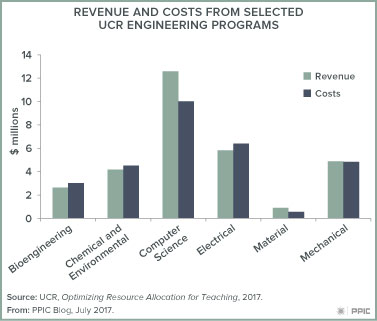
Activity-based costing has the potential to inform conversations among campus administrators about the trade-offs involved in using resources to improve student outcomes. For example, the conventional wisdom is that it is expensive to increase enrollment in STEM (science, technology, engineering, and math) programs. By applying activity-based costing, UCR budget and planning officials found that expanding the biology and computer science departments would not necessarily be costly. Because of the size of enrollment and the way courses are taught and faculty are assigned, the revenue generated by those departments exceeds the cost of expansion. The cost of expanding programs in electrical engineering and bioengineering, on the other hand, is currently higher than the revenue generated from enrollment.

The takeaway is that if administrators feel that expanding the electrical engineering program is a priority, they should pursue it knowing that they will need to find additional sources of revenue.

The UCR pilot has also enabled the university to understand the costs of instruction at a high level of detail. Our report calculated the changes in the cost per degree over time for both the UC and California State University systems. UCR was able to break down the cost per degree by type. For example, producing an engineering degree costs, on average, 16% more than a degree in social science. The cost of a humanities degree falls between the two. A significant portion of that cost difference could be attributed to the fact that it takes longer for engineering students to complete their degree requirements.

Activity-based costing isn’t a substitute for goal-setting and planning. It is a tool that can help an institution better align its resources with its goals. Another takeaway from the UCR pilot is that implementing activity-based costing is a complicated endeavor that requires a broad commitment from the institution. The process of expanding this pilot—and what administrators learn from it—bears watching.

Learn more

Video: California’s Voter Turnout Challenge

California has a voter turnout problem with two distinct elements. Registration is falling compared to other states, and turnout among those who are registered in midterm elections is down. A new PPIC report examines the state’s challenge and suggests some solutions. Report author and PPIC research fellow Eric McGhee presented it at a briefing in Sacramento last week. He found that each element of the state’s turnout has a different origin in the state’s demographics:

  • Registration. The composition of California’s electorate has been changing quickly. Latino and Asian American communities have become eligible to vote at faster rates in California than in other states. But these groups register to vote at lower rates than other Californians, leading to an overall decline in California’s registration rate relative to other states.
  • Turnout. One group of the state’s registered voters has become less likely to turn out in midterm elections: young people. The issue here is one of consistency, McGhee said. “Young people are showing up for presidential elections—they’re just not voting in the following midterm,” he said.

What are the solutions? McGhee said that while the state has passed a number of laws to ease voter registration, changes to the process will not necessarily solve the problem. He said these reforms will need to be coupled with aggressive outreach targeting each group—Latinos, Asian Americans, and young voters—to inspire them to participate in elections.

Read the report California’s Missing Voters: Who is Not Voting and Why.

Next Steps in Implementing California Marijuana Law

Despite uncertainty at the federal level, California is making steady progress toward creating a system to regulate the legal use of marijuana. In many ways, the most interesting activity in marijuana policy is taking place at the local level, as counties and towns wrestle with how to define the role of the industry in their communities.

This year’s state budget includes a trailer bill designed to address a number of implementation issues raised by the passage of the Medical Cannabis Regulation and Safety Act in 2015 and Proposition 64 last fall. The biggest challenge was reconciling the two laws to create a single regulatory framework for both medical and recreational marijuana, a recommendation put forth in a recent PPIC report. The trailer bill also includes other provisions that aim to clarify and fill in details around implementation. For example, the bill:

  • Enhances environmental protections and specifies organic standards.
  • Makes it possible for smaller growers to form co-ops to enable them to compete with larger producers.
  • Allows for the designation of appellations, similar to the wine industry.
  • Supports a study of driving under the influence and creates a task force to make recommendations about enforcement. It also creates a new “open container” definition for cannabis and driving, making it an offense (with a $100 fine) to have in a car marijuana that is loose or in a container that is open or has a broken seal.
  • Establishes a method to collect the cultivation and excise taxes imposed by Proposition 64.

Although Californians have supported the legalization of both medical and recreational marijuana, possession of the substance remains illegal under federal law. In past years, Congress has passed legislation that makes enforcement of federal marijuana law a low priority. However, Attorney General Jeff Sessions, who has opposed relaxing restrictions on marijuana, has reportedly sent a letter to Congress asking that it rescind that directive. Like so many federal-state issues at that moment, it is very difficult to predict future decisions concerning enforcement of federal marijuana law.

The relationship between the state and local jurisdictions is clearer. One section of the trailer bill reaffirmed that the new regulatory structure does not limit the authority of cities, towns, and counties. But the clarity of that relationship doesn’t mean that there isn’t controversy. Conflicts have emerged within communities as they try to balance different local interests.

For example, Proposition 64 allowed for the cultivation of up to six plants per individual. In January, the city of Fontana passed an ordinance requiring any resident who wanted to grow up to six plants purchase a $411 permit. Getting a permit required that the applicant have no prior drug convictions or overdue fines. The ACLU (American Civil Liberties Union) and the advocacy group Drug Policy Alliance have joined together to file a lawsuit claiming the ordinance is too restrictive.

Calaveras County also illustrates the challenges of implementing marijuana regulations at the local level. At the same time that Proposition 64 received support statewide, 67% of Calaveras voters approved a county tax on marijuana production. The tax vote appeared to signal the county’s support for the marijuana industry. This past spring, however, after four of the five seats on the county board turned over, that body began considering a ban on commercial cultivation. With more than 1,000 registered growers (who each paid $5,000 in fees to operate) in a county of 45,000 people, the proposed ban is controversial.

Findings from the PPIC Statewide Survey support the idea that cannabis becomes divisive when the issue moves closer to home. When asked about the federal role, 60% of California adults and 66% of likely voters in our May survey said that the federal government should not enforce federal marijuana law in states that have decided to allow marijuana use. And though a majority of California adults (56%) say marijuana should be legal, state residents are divided when it comes to retail sales of marijuana in their communities. While 48% favor retail sales of recreational marijuana in their city or community, a similar proportion (47%) are opposed. Regionally, opposition to retail sales is highest in Orange/San Diego Counties (53% oppose). As cities across the state determine the regulatory standards for marijuana sales, they may find divergent views within their communities.

Federal, state, and local governments all have a say in marijuana regulation. It is clear from the issues yet to be resolved that the statewide election was just the beginning of a complex process to build the regulated, legal market for cannabis that California voters supported.

Video: Attorney General Becerra on the Issues

The Trump administration has clashed with California on a range of issues, and the state’s new attorney general, Xavier Becerra, is at the forefront of the legal battles with Washington. Before a large crowd in Sacramento, Becerra talked about his views and what he has done so far on a range of issues. He spoke with Mark Baldassare, PPIC president and CEO.

Some key highlights:

  • Environment: Becerra said he has been most active so far on this issue and vowed to continue to be aggressive, whether it is initiating lawsuits, joining other suits, or moving forward with the Paris climate agreement, to the extent the state can do so. “I’ve got the governor’s back on anything he wants to do on the environment,” he said.
  • Immigration: Becerra said he favors legislation to make California a sanctuary state as long as it does not undermine the ability of local law enforcement to protect public safety by, for example, combating drug and sex trafficking.
  • Health care: Becerra said that single-payer health care is ultimately the right approach to coverage. “I hope California gets further along in recognizing that affordability only comes when you have universality,” he said.

Grants Awarded to Combat Recidivism

Proposition 47, passed by voters in November 2014, reclassified a number of drug and property offenses from felonies to misdemeanors. Backers of Proposition 47 argued that spending on prisons should be reserved for only the most violent and serious offenders, with more resources directed toward prevention and support programs.

Sentences were immediately reduced after the measure passed, and both the state prison and county jail populations declined. Between October 2014 and December 2016, the overall prison population dropped by 6,664 inmates (4.9%) and the jail population by 8,545 (10.4%). Although all of that decline cannot be attributed to the initiative, both populations have decreased as intended.

Proposition 47 requires any net state savings from the measure—coming from a decrease in the prison population—to go toward grants and programs for K‒12 schools (25% of savings), victim services (10%), and mental health and substance use disorder treatment (65%). It should be noted that the measure did not require counties to report or redirect any local savings that may come from the change in sentencing.

The measure required that the first transfer of savings occur by August 2016. This first transfer totaled more than $67 million and went to the three agencies tasked with distributing the grants (Table 1). The first grants were awarded this month. It’s estimated that nearly $46 million in savings will be transferred for fiscal year 2017–18. By 2019–20, long-term savings will be $75 million annually.

Administration of grants for those with mental health and substance use disorders is the responsibility of the Board of State and Community Corrections (BSCC). This independent state agency already oversees statewide regulations, inspections, and new construction funding for local jails and juvenile facilities. I focus on the BSCC grant program below because it is the largest category of Proposition 47 savings and is the only grant program that will help current offenders in the criminal justice system. However, it’s important to note that the California Department of Education has recently awarded its first year of grant funding.

All projects funded through the BSCC are required to include some combination of mental health services, substance use disorder treatment, and efforts to work with individuals before arrest or booking into jail. Priority is given to projects that also provide housing-related support and/or other community-based supportive services. At least half of the funds have to go to non-governmental community based organizations.

The BSCC is using the Proposition 47 funds to provide three-year grants, with an estimated $104 million available in funding from June 2017 to August 2020. Fifty-eight public agencies—including superior courts; school districts; district and city attorneys; health and human services; and police, probation, sheriff, and county education offices—submitted proposals. In the end, the BSCC is funding 23 projects across 17 counties, totaling $103.7 million in funding.

Projects are considered small or large depending on their funding level. Fifteen large scale projects (more than $1 million) received funding, including $6 million for the Los Angeles City Attorney’s Office to implement a health-focused drug intervention and pre-booking diversion program in five South Los Angeles locations. Eight small scale projects ($1 million) received funding, including $960,667 for Merced County Probation Department to provide mental health and substance treatment for men up to 24 years old in the Los Banos region.

The goals of these programs are twofold: showing successful outcomes for participants, and giving criminal justice practitioners and policymakers more information on effective tools for evidence-based programming. PPIC will continue to describe and follow these projects in the months and years to come.