Californians and DACA

In September, the Trump administration announced an end to the DACA (Deferred Action for Childhood Arrivals) program, which includes protections for some undocumented immigrants who were brought to the United States as children. Under DACA, those who qualify and pass a background check can receive protection from deportation and a work permit. California is home to about 223,000 DACA recipients—more than one-fourth of the national total.

The administration and Congress have been negotiating a potential compromise that would preserve DACA protections for qualifying individuals. In January, the PPIC Statewide Survey found that 85% of adults and 81% of likely voters in California favor the protections offered by DACA. Recent surveys by ABC/Washington Post and CNN have found similarly high levels of support for DACA among adults nationwide. In California, support has increased slightly since September, when three-quarters of adults and likely voters were in favor of DACA protections.
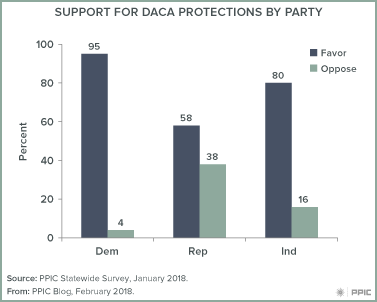
In today’s politically polarized environment, it is notable that majorities of California Democrats, Republicans, and independents support the DACA program. In PPIC’s January survey, we find that while Republicans are less likely than Democrats and independents to support DACA protections, a solid majority (58%) are in favor. Indeed, DACA has a high level of support across the state’s regions and demographic groups, with at least three in four adults in favor. Results were similar in September, when strong majorities across parties and at least seven in ten across demographic and regional groups expressed support.
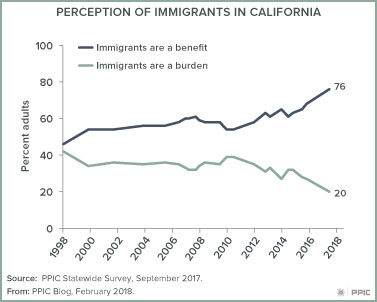
The high levels of support for DACA are perhaps unsurprising given Californians’ shifting attitudes toward immigrants. In PPIC’s September survey, three in four Californians (76%) said that immigrants are a benefit to the state because of their hard work and job skills—a high mark in PPIC surveys. Only 20% said immigrants are a burden because they use public services. Indeed, Californians are now far more likely to see immigrants as a benefit than they were in April 1998 when we first asked this question (46% benefit, 42% burden).

Interestingly, this shift in attitudes is not unique to California. In a June 2017 survey of adults nationwide, the Pew Research Center found that 65% of adults thought immigrants strengthened the country, while 26% felt immigrants burdened the country. This is a stark contrast to 1994, when only 31% of adults nationwide felt immigrants strengthened the country and 63% said they were a burden. As the debate on DACA and immigration policy continues, looking at changes in public attitudes on this issue can highlight areas of potential compromise for policymakers.


Video: Countdown to the Primary

Less than four months before the June primary, Democrats Gavin Newsom and Antonio Villaraigosa are in a virtual tie among likely voters in the gubernatorial race. But a quarter of likely voters are undecided—as many as support either of the front-runners in the top-two contest. In the US Senate race, Dianne Feinstein continues to lead fellow Democrat Kevin de León by double digits, with a third of likely voters undecided.

These are among the key findings in the January PPIC Statewide Survey, presented by researcher Lunna Lopes at a Sacramento briefing last week.

Among other highlights of the survey:

  • Likely voters are divided on two ideas that may be on the fall ballot: repeal of the recently passed increase in the state gasoline tax and a change in the strict limits on commercial property taxes imposed by Proposition 13. Under the property tax proposal, commercial properties would be taxed according to their fair market value but limits on residential property taxes would remain in place.
  • Most Californians favor the governor’s proposed budget and believe the governor and legislature will be able to work together and accomplish a lot. However, expectations of cooperation are low for the president and Congress.
  • Many Californians closely following news about sexual misconduct in the state legislature, and they are divided about how Democratic leaders are handling this issue so far.
  • Californians are most likely to name immigration as the top issue facing the state today, and majorities across parties favor the DACA protections.

Learn moreRead the January PPIC Statewide Survey: Californians and Their Government
Find out more about the PPIC Statewide Survey


Video: John Chiang’s Priorities

John Chiang, the state’s treasurer and a candidate for governor this year, was asked last week to name the top three issues that will make the most difference for the state’s future. The question is the first one Mark Baldassare, PPIC president and CEO, asks of all gubernatorial candidates appearing before PPIC audiences. Chiang said his priorities are

  • Education
  • Housing
  • Jobs, climate change, health care—issues Chiang lumped together as the “things that are absolutely critical in everybody’s life.”

Chiang praised Governor Jerry Brown for the state’s K–12 finance formula that targets extra resources toward lower-income students, English Learners, and those in foster care. He said he would target more money toward students with special needs.

Referring to the state’s housing situation as an “extraordinary crisis,” Chiang said that even if an affordable housing bond measure passes in November, the state will need to return to the voters to get more money. He advocated reviving local redevelopment agencies, which the governor eliminated in 2011, to give local governments an economic tool to build housing.

Chiang referred to his background as treasurer, state controller, and member of the state Board of Equalization in emphasizing the need to ensure a way to pay for proposals such as single-payer health care—an idea he said he favors in concept. While describing the current system as inefficient, he said that the state can’t achieve single payer health care immediately. How long will it take? Chiang said more clarity from the federal government is crucial to understanding what the state can afford. “Let’s build what we can build. We don’t have to build a mansion at the beginning. Let’s build a starter house.” Chiang also said that the state needed to figure out how to insure an additional 2.9 million Californians who are currently uninsured.

The conversation with Chiang is part of the PPIC Speaker Series on California’s Future. PPIC is inviting all major candidates for governor to participate if they reach a certain threshold in the polls. The goal is to give Californians a better understanding of how the candidates intend to address the challenges facing our state.

Watch all candidate videos


Video: Legislative Leaders Address Sexual Misconduct

When Anthony Rendon was asked to name the biggest issues for the governor and state legislature to address this year, he prefaced his answer with a look back. “Last year was a banner year,” the California assembly speaker said, citing infrastructure, housing, and climate change efforts. Then he added a caveat:

“Some of that was obscured—and rightly so—by the sexual harassment crises that developed in the fall. This year we have to start with that.”

Rendon said the assembly is revising sexual harassment policies and procedures that have not been updated since 1993, and he acknowledged that this is only the start in a larger change needed in the way the institution conducts its business.

Rendon spoke as part of an annual event that brings together California’s legislative leaders from both parties in a conversation with Mark Baldassare, PPIC president and CEO. Rendon was the lone leader on stage for much of the event because the state senate was discussing the fate of a colleague accused of sexual harassment.  Patricia Bates, Republican state senate leader, and Kevin de León, president pro tem, later joined the assembly speaker on stage.

Bates said her top issue for 2018 is addressing the high cost of living in California. “Affordability affects every socioeconomic level in our state,” she said.

De León referred to California’s resistance to the direction of federal policies in describing his top priority: defending what he called “our incredible gains” in California—a higher minimum wage, gun safety and ammunition regulation, and extension of the Global Warming Solutions Act. He also emphasized protecting the state’s immigrants.

Both senate leaders described a bipartisan approach to addressing sexual harassment. Bates commended de León for quickly turning the investigation of allegations over to outside law firms independent of the senate. The leaders pointed to process changes in the works to address harassment, and both said that changing the culture is a much longer term goal. How does cultural change come about?

“You build in trust with the policies that are there—that they are responsive, they are fair, they give due process, and they have just consequences,” Bates said.

The President’s Popularity and the Midterm Election

California is a battleground state in the 2018 midterm election. When it comes to determining the party that will lead the next US Congress, all eyes are on the 14 US House seats that are currently held by Republicans in the deep-blue state of California. Democrats would need to “flip” several of these seats if they have any chance of taking control of the US House, where Republicans currently now have a 26-vote margin. The party in power has typically lost some of its congressional seats in national midterm elections. Whether it is a few seats or many is closely tied to the president’s popularity. So, how is Donald Trump viewed in California at the end of his first-year anniversary in office?
The PPIC Statewide Survey has been tracking President Trump’s popularity, asking the following question in six monthly surveys in 2017, “Overall, do you approve or disapprove of the way that Donald Trump is handling his job as president of the United States?” We found majority disapproval of President Trump among California likely voters in each survey. In the January 2017 PPIC survey, conducted in his early days in office, 34% approved and 55% disapproved of his job performance. In the 2017 December PPIC survey, which is our most recent poll, 34% approved and 63% disapproved of President Trump. In the course of 2017, disapproval of the president increased as more likely voters formed opinions about his leadership.

By the end of the first year, we also found that disapproval of President Trump increased by double digits in several likely voter groups. In comparing the January 2017 PPIC survey to the December 2017 PPIC survey, disapproval increased

  • 21 points for those younger than 35 (63% to 84%)
  • 15 points among independent (i.e. no party preference) voters (50% to 65%)
  • 12 points among college graduates (62% to 74%)
  • 12 points among those who earn under $40,000 a year (57% to 69%)
  • 11 points for those who earn $80,000 or more (55% to 66%)
  • 10 points among Latinos (72% to 82%)

Moreover, from January to December 2017 disapproval became the majority response among men (49% to 58%), those age 55 and older (49% to 57%), and those with some college education (50% to 58%).

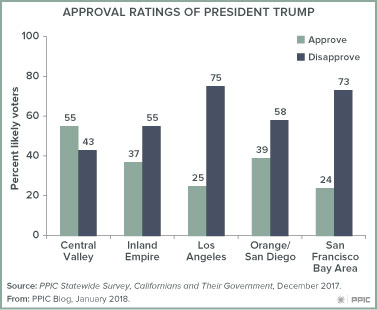
Regional trends in presidential disapproval ratings also point to a challenging environment for Republicans running in House elections this year. Predictably, there is overwhelming disapproval of President Trump in the Democratic strongholds of Los Angeles (75%) and San Francisco (73%) in the December 2017 PPIC survey. More surprisingly, over the course of 2017 disapproval of Trump’s performance increased to majority levels in Orange/San Diego (50% to 58%) and the Inland Empire (39% to 55%), where several of the House seats that are now held by Republicans are located. Coincidentally, two Republican House members in Orange/San Diego decided not to run for reelection.

There are two bright spots for Republicans in the president’s approval ratings. First, President Trump has held a solid base of support among Republican likely voters, according to a comparison of the January 2017 PPIC survey (76% approve) and the December 2017 PPIC survey (78% approve). Second, his approval increased to a majority in the Central Valley according to a comparison of the January 2017 PPIC survey (40%) and the December 2017 PPIC survey (55%). Importantly, several of the House seats now held by Republicans are in the Central Valley.

Finally, in placing the 2018 midterm election in recent historical context, it is especially noteworthy that the level of disapproval of President Trump at the end of his first year in office is relatively high compared to the past two US presidents. The December 2009 PPIC survey found that a majority of California likely voters approved of President Barack Obama (54% approve, 40% disapprove) in the midst of the Great Recession. The December 2001 PPIC survey found that overwhelming majorities approved of President George W. Bush (78% approve, 20% disapprove) in the wake of the 9/11 terrorist attack.

In California, the combination of presidential disapproval ratings (63%) and voter registration trends (45% Democrat to 26% Republican) sets the stage for the Republicans’ efforts to hold on to House seats to maintain control of the US Congress. However, the wildcard in the 2018 California election is the size and composition of the voter turnout—and in the 2014 midterm election, turnout hit a record low.

The PPIC Statewide Survey will be closely monitoring President Trump’s approval ratings, as well as indicators of the voters who are motivated to cast ballots in what will be a consequential election for California and the nation.

Video: Travis Allen’s Priorities

Mark Baldassare, PPIC president and CEO, asked Assemblymember Travis Allen, candidate for governor in 2018, to name the top three issues with major consequences for the state’s future—a question Baldassare has asked of all gubernatorial candidates appearing before PPIC audiences. Allen said his top priorities would be

  • Cutting taxes
  • Getting tough on crime, and
  • Fixing roads and expanding freeways

Allen, who is campaigning to repeal the state gas tax increase passed last year, said California is already collecting enough tax revenue to improve roads and unclog the freeways.

“We can fix our roads, we can expand our freeways, we don’t need to raise taxes further to do it,” he said. He added that voters should be the ones to decide if they want to raise taxes.

The conversation with Allen is part of the PPIC Speaker Series on California’s Future. PPIC is inviting all major candidates for governor to participate if they reach a certain threshold in the polls. The goal is to give Californians a better understanding of how the candidates intend to address the challenges facing our state.

Watch all candidate videos

Commentary: Will California’s Pot Law Limit Illegal Marijuana Sales?

This commentary was published in Newsweek on January 2, 2018.

The new year brings with it a new age of legal marijuana: As of Monday, the growing, sale and use of recreational cannabis in California is now legal for individuals over the age of 21. But will it change much in the state?

Read the full commentary on newsweek.com.

Video: John Cox’s Priorities

Businessman John Cox, candidate for governor in 2018, was asked in a San Francisco forum last week to name the top three issues that will have major consequences in California’s future. Mark Baldassare, PPIC president and CEO, posed the question, which has been answered by all gubernatorial candidates appearing before PPIC audiences.

Cox said his top priorities are:

  • Removing the “corruptive” influence of special interest money. “The idea that special interests fund the campaigns of people they are looking to to get things done—it’s an indefensible system,” he said. “I don’t necessarily think that we send a whole bunch of corrupt people to Sacramento,” he said. “The trouble is, it’s a corrupt structure.” Legislators, he said, “are almost required to be professional fundraisers.”
  • Making the state more affordable and improving the business climate. The cost of housing, electricity, gasoline—the essentials to quality of life—are pushing the middle class into “almost-poverty situations,” Cox said, adding that improving the business climate is also essential so that the state can grow.
  • Addressing state employee pension debt. Cox said an overly generous legislature as well as governors and special interests have created a “debt bomb.” Our unfounded pension debt is a “sword of Damocles hanging over our economy,” he said.

How would Cox diminish the influence of special interests? He is sponsoring the Neighborhood Legislature Reform Act, which he hopes to qualify for the statewide ballot. The initiative calls for carving up each assembly and state senate district into 100 neighborhoods, each with its own representative. The 100 representatives in each neighborhood district would meet to choose one to go to Sacramento. In other words, there would still be just 120 legislators meeting in the Capitol. With districts that number just a few thousand households, candidates could run campaigns with a few hundred dollars, Cox said. The idea, he said, is that “you don’t need money to run a race.”

The conversation with Cox is part of the PPIC Speaker Series on California’s Future. PPIC is inviting all major candidates for governor to participate if they reach a certain threshold in the polls. The goal is to give Californians a better understanding of how the candidates intend to address the challenges facing our state.

Watch all candidate videos.

Video: Preview of the Statewide Election

Setting the stage for a year of crucial decisions, the December PPIC Statewide Survey took a first look at the 2018 governor’s race. Two Democrats—Gavin Newsom, the state’s lieutenant governor, and Antonio Villaraigosa, former mayor of Los Angeles—lead among likely voters. But the survey also underscored that it’s early in the campaign to replace retiring governor Jerry Brown. Among likely voters, a third are undecided and just a quarter are following news about the candidates fairly or very closely.

In the US Senate primary, incumbent Dianne Feinstein leads fellow Democrat Kevin de León, state senate president pro tempore, by a two-to-one margin in a matchup of the two candidates. A third of likely voters are undecided in this race, as well.

Dean Bonner, associate survey director at PPIC, presented the key findings at a Sacramento briefing last week. As he noted, the survey findings reflect a divided and unsettled electorate. Likely voters are split on what is more important in a candidate for statewide office: new ideas and a different approach (48%) or experience and a proven record (42%). Asked about how candidates for statewide office should interact with the federal government, half of likely voters (51%) prefer that candidates push back against the Trump administration and 41% prefer that candidates work with the administration.

Video: Gavin Newsom’s Priorities

Gavin Newsom, California’s lieutenant governor and a candidate for governor in 2018, was asked in a San Francisco forum last week to name the three issues that will make the biggest difference in California’s future. Newsom, who is also a former mayor of San Francisco, predicted that both California and the nation will be grappling with these issues over the next ten years:

  • Debt and demographics. With California’s population aging rapidly, the state and its cities face growing public employee pension and health care liabilities. “As a progressive Democrat, I’m not naïve about the commitments we’ve made and the commitments we must fulfill,” Newsom said. “Nor am I naïve, as a former mayor, about the challenge of meeting those commitments . . . Cities like Richmond are facing the prospect that by 2021, by one estimate, upwards of 40% of their general fund will go to retiree contributions.”
  • Energy and climate change. The state has set ambitious goals to reduce greenhouse gas emissions and increase energy efficiency. “The next governor has to deliver,” he said.
  • Information technology and globalization. “The issue that animates my anxiety: work, the future of work.” The days of having a job or career have given way to something radically different, forcing us to think in terms of portable benefits and retirement security, he said. Further, workers in retail, food and beverage, and clerical jobs—the top employment categories—are on the “edge of automation.” Displacement of these workers will require us to have a different conversation about skills, education, and social mobility, Newsom said.

The conversation with Newsom was part of the PPIC Speaker Series on California’s Future. PPIC is inviting all major candidates for governor to participate in a public event if they reach a certain threshold in the polls. The goal is to give Californians a better understanding of how the candidates intend to address the challenges facing our state.

Watch all candidate videos.