Commentary: Will California’s Pot Law Limit Illegal Marijuana Sales?

This commentary was published in Newsweek on January 2, 2018.

The new year brings with it a new age of legal marijuana: As of Monday, the growing, sale and use of recreational cannabis in California is now legal for individuals over the age of 21. But will it change much in the state?

Read the full commentary on newsweek.com.

Video: John Cox’s Priorities

Businessman John Cox, candidate for governor in 2018, was asked in a San Francisco forum last week to name the top three issues that will have major consequences in California’s future. Mark Baldassare, PPIC president and CEO, posed the question, which has been answered by all gubernatorial candidates appearing before PPIC audiences.

Cox said his top priorities are:

  • Removing the “corruptive” influence of special interest money. “The idea that special interests fund the campaigns of people they are looking to to get things done—it’s an indefensible system,” he said. “I don’t necessarily think that we send a whole bunch of corrupt people to Sacramento,” he said. “The trouble is, it’s a corrupt structure.” Legislators, he said, “are almost required to be professional fundraisers.”
  • Making the state more affordable and improving the business climate. The cost of housing, electricity, gasoline—the essentials to quality of life—are pushing the middle class into “almost-poverty situations,” Cox said, adding that improving the business climate is also essential so that the state can grow.
  • Addressing state employee pension debt. Cox said an overly generous legislature as well as governors and special interests have created a “debt bomb.” Our unfounded pension debt is a “sword of Damocles hanging over our economy,” he said.

How would Cox diminish the influence of special interests? He is sponsoring the Neighborhood Legislature Reform Act, which he hopes to qualify for the statewide ballot. The initiative calls for carving up each assembly and state senate district into 100 neighborhoods, each with its own representative. The 100 representatives in each neighborhood district would meet to choose one to go to Sacramento. In other words, there would still be just 120 legislators meeting in the Capitol. With districts that number just a few thousand households, candidates could run campaigns with a few hundred dollars, Cox said. The idea, he said, is that “you don’t need money to run a race.”

The conversation with Cox is part of the PPIC Speaker Series on California’s Future. PPIC is inviting all major candidates for governor to participate if they reach a certain threshold in the polls. The goal is to give Californians a better understanding of how the candidates intend to address the challenges facing our state.

Watch all candidate videos.

Video: Preview of the Statewide Election

Setting the stage for a year of crucial decisions, the December PPIC Statewide Survey took a first look at the 2018 governor’s race. Two Democrats—Gavin Newsom, the state’s lieutenant governor, and Antonio Villaraigosa, former mayor of Los Angeles—lead among likely voters. But the survey also underscored that it’s early in the campaign to replace retiring governor Jerry Brown. Among likely voters, a third are undecided and just a quarter are following news about the candidates fairly or very closely.

In the US Senate primary, incumbent Dianne Feinstein leads fellow Democrat Kevin de León, state senate president pro tempore, by a two-to-one margin in a matchup of the two candidates. A third of likely voters are undecided in this race, as well.

Dean Bonner, associate survey director at PPIC, presented the key findings at a Sacramento briefing last week. As he noted, the survey findings reflect a divided and unsettled electorate. Likely voters are split on what is more important in a candidate for statewide office: new ideas and a different approach (48%) or experience and a proven record (42%). Asked about how candidates for statewide office should interact with the federal government, half of likely voters (51%) prefer that candidates push back against the Trump administration and 41% prefer that candidates work with the administration.

Video: Gavin Newsom’s Priorities

Gavin Newsom, California’s lieutenant governor and a candidate for governor in 2018, was asked in a San Francisco forum last week to name the three issues that will make the biggest difference in California’s future. Newsom, who is also a former mayor of San Francisco, predicted that both California and the nation will be grappling with these issues over the next ten years:

  • Debt and demographics. With California’s population aging rapidly, the state and its cities face growing public employee pension and health care liabilities. “As a progressive Democrat, I’m not naïve about the commitments we’ve made and the commitments we must fulfill,” Newsom said. “Nor am I naïve, as a former mayor, about the challenge of meeting those commitments . . . Cities like Richmond are facing the prospect that by 2021, by one estimate, upwards of 40% of their general fund will go to retiree contributions.”
  • Energy and climate change. The state has set ambitious goals to reduce greenhouse gas emissions and increase energy efficiency. “The next governor has to deliver,” he said.
  • Information technology and globalization. “The issue that animates my anxiety: work, the future of work.” The days of having a job or career have given way to something radically different, forcing us to think in terms of portable benefits and retirement security, he said. Further, workers in retail, food and beverage, and clerical jobs—the top employment categories—are on the “edge of automation.” Displacement of these workers will require us to have a different conversation about skills, education, and social mobility, Newsom said.

The conversation with Newsom was part of the PPIC Speaker Series on California’s Future. PPIC is inviting all major candidates for governor to participate in a public event if they reach a certain threshold in the polls. The goal is to give Californians a better understanding of how the candidates intend to address the challenges facing our state.

Watch all candidate videos.

Video: How Californians View National Issues

With the nation focused on a range of contentious issues, the September PPIC Statewide Survey provides a California perspective. Dean Bonner, associate survey director, shared the key findings at a Sacramento briefing last week.

Among them:

  • A record-high share of Californians have a favorable opinion of the Affordable Care Act, and most want Republicans to work with Democrats to improve the law. While most Californians say it is the federal government’s responsibility to make sure that all Americans have health coverage, just a third favor a single-payer, government-run national health insurance system.
  • Three-fourths of Californians—also a PPIC record high—view immigrants as a benefit rather than a burden. There is broad and bipartisan support for protections provided by DACA, which shields from deportation some undocumented immigrants brought to the US as children and allows them to get a work permit if they pass a background check.
  • Half of Californians say they are very concerned about the possibility of North Korea having a nuclear missile that could reach the state.
  • Two-thirds of Californians view possible Russian interference in the 2016 as a serious issue.
  • Half of Californians say race relations have gotten worse in the United States over the last year. They are less pessimistic when it comes to race relations in the state.

Video: California’s Voter Turnout Challenge

California has a voter turnout problem with two distinct elements. Registration is falling compared to other states, and turnout among those who are registered in midterm elections is down. A new PPIC report examines the state’s challenge and suggests some solutions. Report author and PPIC research fellow Eric McGhee presented it at a briefing in Sacramento last week. He found that each element of the state’s turnout has a different origin in the state’s demographics:

  • Registration. The composition of California’s electorate has been changing quickly. Latino and Asian American communities have become eligible to vote at faster rates in California than in other states. But these groups register to vote at lower rates than other Californians, leading to an overall decline in California’s registration rate relative to other states.
  • Turnout. One group of the state’s registered voters has become less likely to turn out in midterm elections: young people. The issue here is one of consistency, McGhee said. “Young people are showing up for presidential elections—they’re just not voting in the following midterm,” he said.

What are the solutions? McGhee said that while the state has passed a number of laws to ease voter registration, changes to the process will not necessarily solve the problem. He said these reforms will need to be coupled with aggressive outreach targeting each group—Latinos, Asian Americans, and young voters—to inspire them to participate in elections.

Read the report California’s Missing Voters: Who is Not Voting and Why.

Next Steps in Implementing California Marijuana Law

Despite uncertainty at the federal level, California is making steady progress toward creating a system to regulate the legal use of marijuana. In many ways, the most interesting activity in marijuana policy is taking place at the local level, as counties and towns wrestle with how to define the role of the industry in their communities.

This year’s state budget includes a trailer bill designed to address a number of implementation issues raised by the passage of the Medical Cannabis Regulation and Safety Act in 2015 and Proposition 64 last fall. The biggest challenge was reconciling the two laws to create a single regulatory framework for both medical and recreational marijuana, a recommendation put forth in a recent PPIC report. The trailer bill also includes other provisions that aim to clarify and fill in details around implementation. For example, the bill:

  • Enhances environmental protections and specifies organic standards.
  • Makes it possible for smaller growers to form co-ops to enable them to compete with larger producers.
  • Allows for the designation of appellations, similar to the wine industry.
  • Supports a study of driving under the influence and creates a task force to make recommendations about enforcement. It also creates a new “open container” definition for cannabis and driving, making it an offense (with a $100 fine) to have in a car marijuana that is loose or in a container that is open or has a broken seal.
  • Establishes a method to collect the cultivation and excise taxes imposed by Proposition 64.

Although Californians have supported the legalization of both medical and recreational marijuana, possession of the substance remains illegal under federal law. In past years, Congress has passed legislation that makes enforcement of federal marijuana law a low priority. However, Attorney General Jeff Sessions, who has opposed relaxing restrictions on marijuana, has reportedly sent a letter to Congress asking that it rescind that directive. Like so many federal-state issues at that moment, it is very difficult to predict future decisions concerning enforcement of federal marijuana law.

The relationship between the state and local jurisdictions is clearer. One section of the trailer bill reaffirmed that the new regulatory structure does not limit the authority of cities, towns, and counties. But the clarity of that relationship doesn’t mean that there isn’t controversy. Conflicts have emerged within communities as they try to balance different local interests.

For example, Proposition 64 allowed for the cultivation of up to six plants per individual. In January, the city of Fontana passed an ordinance requiring any resident who wanted to grow up to six plants purchase a $411 permit. Getting a permit required that the applicant have no prior drug convictions or overdue fines. The ACLU (American Civil Liberties Union) and the advocacy group Drug Policy Alliance have joined together to file a lawsuit claiming the ordinance is too restrictive.

Calaveras County also illustrates the challenges of implementing marijuana regulations at the local level. At the same time that Proposition 64 received support statewide, 67% of Calaveras voters approved a county tax on marijuana production. The tax vote appeared to signal the county’s support for the marijuana industry. This past spring, however, after four of the five seats on the county board turned over, that body began considering a ban on commercial cultivation. With more than 1,000 registered growers (who each paid $5,000 in fees to operate) in a county of 45,000 people, the proposed ban is controversial.

Findings from the PPIC Statewide Survey support the idea that cannabis becomes divisive when the issue moves closer to home. When asked about the federal role, 60% of California adults and 66% of likely voters in our May survey said that the federal government should not enforce federal marijuana law in states that have decided to allow marijuana use. And though a majority of California adults (56%) say marijuana should be legal, state residents are divided when it comes to retail sales of marijuana in their communities. While 48% favor retail sales of recreational marijuana in their city or community, a similar proportion (47%) are opposed. Regionally, opposition to retail sales is highest in Orange/San Diego Counties (53% oppose). As cities across the state determine the regulatory standards for marijuana sales, they may find divergent views within their communities.

Federal, state, and local governments all have a say in marijuana regulation. It is clear from the issues yet to be resolved that the statewide election was just the beginning of a complex process to build the regulated, legal market for cannabis that California voters supported.

Video: Attorney General Becerra on the Issues

The Trump administration has clashed with California on a range of issues, and the state’s new attorney general, Xavier Becerra, is at the forefront of the legal battles with Washington. Before a large crowd in Sacramento, Becerra talked about his views and what he has done so far on a range of issues. He spoke with Mark Baldassare, PPIC president and CEO.

Some key highlights:

  • Environment: Becerra said he has been most active so far on this issue and vowed to continue to be aggressive, whether it is initiating lawsuits, joining other suits, or moving forward with the Paris climate agreement, to the extent the state can do so. “I’ve got the governor’s back on anything he wants to do on the environment,” he said.
  • Immigration: Becerra said he favors legislation to make California a sanctuary state as long as it does not undermine the ability of local law enforcement to protect public safety by, for example, combating drug and sex trafficking.
  • Health care: Becerra said that single-payer health care is ultimately the right approach to coverage. “I hope California gets further along in recognizing that affordability only comes when you have universality,” he said.

Video: Villaraigosa on His Priorities

When Antonio Villaraigosa was asked to name the top issues most important to the state’s future, he started with the economy. His key concerns are poverty and the state’s business climate, its “byzantine and bureaucratic regulatory framework.”

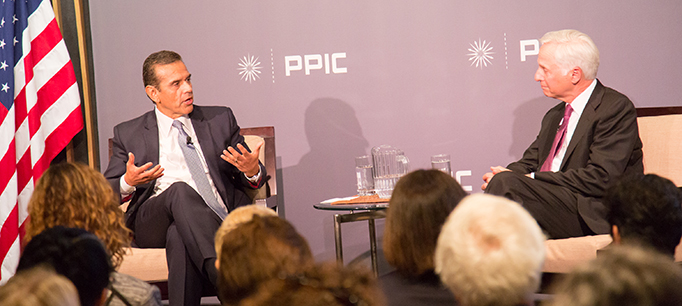
Villaraigosa, candidate for governor and former mayor of Los Angeles, spoke at the Speaker Series on California’s Future sponsored by the Public Policy Institute of California (PPIC). As part of the series, PPIC is inviting all major candidates for governor to participate in a public event. Other highlights of his remarks:

  • Health care: He believes in universal health care but is skeptical about how to pay for the current plan before the legislature: “You’re selling snake oil when you say that single payer is something that’s going to happen any time soon.”
  • Infrastructure: He emphasized his long-term support for high-speed rail. He sees it as an economic development strategy to transform the Central Valley by connecting it to the two big centers of the economy, Los Angeles and the Bay Area.
  • Higher education: He said the state needs to look at how community colleges are funded and marshal its resources to make sure students get through the system and transfer to four-year colleges. But he’s not an advocate for making community college free to all: “It’s already free for poor people, and that’s who it should be free for.

Watch all candidate videos.

Video: Pessimism about Nation’s Direction

Californians have grown more pessimistic about the direction of the nation and the US economy since the beginning of the year, the May PPIC Statewide Survey shows. Underscoring that sentiment: just 27 percent of residents approve of the way President Trump is doing his job. Only 26 percent approve of Congress—a 10 point decline from March.

Researcher David Kordus presented these and other key findings at a survey briefing in Sacramento last week. On other federal issues, the survey found that most Californians disapprove of the House health care bill, and half expect negative effects from increased immigration enforcement.

Californians are feeling better about the state of their state by some measures: a solid majority favor Governor Brown’s budget plan, and fewer adults than in past years see the state budget situation as a big problem. But the state faces important challenges. Housing is one of them, with 59 percent of all adults saying affordability is a big problem in their part of the state. And solid majorities of Californians say the gap between rich and poor is getting larger. Majorities support state action to address these issues.

Learn more

Read the PPIC Statewide Survey: Californians and Their Government
Find out more about the PPIC Statewide Survey