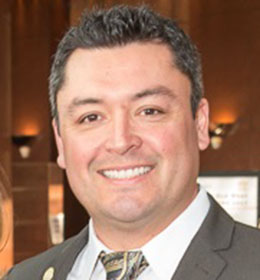
Video: Countdown to the Primary

Less than four months before the June primary, Democrats Gavin Newsom and Antonio Villaraigosa are in a virtual tie among likely voters in the gubernatorial race. But a quarter of likely voters are undecided—as many as support either of the front-runners in the top-two contest. In the US Senate race, Dianne Feinstein continues to lead fellow Democrat Kevin de León by double digits, with a third of likely voters undecided.

These are among the key findings in the January PPIC Statewide Survey, presented by researcher Lunna Lopes at a Sacramento briefing last week.

Among other highlights of the survey:

  • Likely voters are divided on two ideas that may be on the fall ballot: repeal of the recently passed increase in the state gasoline tax and a change in the strict limits on commercial property taxes imposed by Proposition 13. Under the property tax proposal, commercial properties would be taxed according to their fair market value but limits on residential property taxes would remain in place.
  • Most Californians favor the governor’s proposed budget and believe the governor and legislature will be able to work together and accomplish a lot. However, expectations of cooperation are low for the president and Congress.
  • Many Californians closely following news about sexual misconduct in the state legislature, and they are divided about how Democratic leaders are handling this issue so far.
  • Californians are most likely to name immigration as the top issue facing the state today, and majorities across parties favor the DACA protections.

Learn moreRead the January PPIC Statewide Survey: Californians and Their Government
Find out more about the PPIC Statewide Survey


Governor’s Budget Banks on Voters Passing Water Bond

Governor Brown’s proposed budget―the last of his tenure―highlights his priorities for the state. For water, the proposal includes new funding to address some pressing public safety and environmental health issues, including improving drinking water quality in low-income communities, flood protection, groundwater management, and air and water quality at the Salton Sea.

Carrying out this proposal will depend not only on passing the budget, but also on getting additional approvals from California voters and the legislature for some of the needed funds.

To pay for most of the new initiatives, the governor is banking on California voters approving a $4 billion parks and water bond (SB 5) that will be on the ballot in June. More than $400 million in proposed spending on water for 2018–19 is contingent on SB 5, including safe drinking water projects ($63 million), flood management ($99 million), groundwater sustainability ($146 million), and restoration of the Salton Sea ($30 million).

To improve water quality in impoverished communities, the budget proposes using $4.7 million of general fund dollars to administer a new program to cover the ongoing costs of providing safe water. But the governor is counting on the legislature to approve a funding stream for the program itself—on the order of $100 million annually. One current measure (SB 623) would do this by assessing fees on agricultural chemicals and water bills. Or the governor may propose a similar measure as a trailer bill to the budget. Like any new tax, this kind of fiscal measure requires approval by at least two-thirds of both houses, which can be a significant hurdle. To date, water agencies have opposed this measure.

The budget proposal’s heavy reliance on bonds to pay for water projects continues a tradition that voters have supported over the past two decades. Since 2000, seven state general obligation bonds—voter-approved debt reimbursed with general fund taxes—have provided roughly $22 billion for water projects. State agencies are still awarding funds from Proposition 1—a $7.5 billion bond approved in November 2014. Bond funds have generally gone to “fiscal orphans”—areas of public and environmental health that do not have adequate alternative sources of funding. But bonds have not created a reliable way to fund ongoing needs.

The current proposal to create a steady stream of funding for the costs of safe drinking water programs is one way to break from this tradition. But it can also be a more difficult path. Setting up long-term funding streams, such as new taxes and fees, will require going beyond bonds. Leadership at the state and local levels are needed to pave the way.

Testimony: How Can California Produce More College Graduates?

Hans Johnson, director and senior fellow at the PPIC Higher Education Center, testified today, February 6, 2018, before the Assembly Budget Subcommittee No. 2 on Education Finance and the Assembly Higher Education Committee. The master plan defined a strategy to meet the state’s education needs in 1960—but today, California faces new challenges. The topic of today’s hearing: how to meet the state’s future economic need for more college graduates. Here are his prepared remarks.

PPIC’s work has revealed a serious gap between the number of highly educated workers that California’s future economy will need and the number the state is on pace to produce. We call this the workforce skills gap—and it’s quite large. To meet economic demand and secure a more prosperous future for our state, California’s higher education institutions will need to produce 1.1 million more college graduates by 2030.

Admittedly, doing so is an ambitious goal. But there is significant room for improving how many students graduate from college—especially if we consider that currently only about 30 percent of California’s 9th graders will earn a bachelor’s degree.

PPIC has quantified the role of each university segment—the University of California, the California State University, and private nonprofit colleges in California—in closing the workforce skills gap. Overall, the number of bachelor’s degrees would need to increase by about one-third over baseline projections. Almost half of the gains would need to occur at CSU, the nation’s largest public university system. UC and private nonprofit colleges would also play an important role.
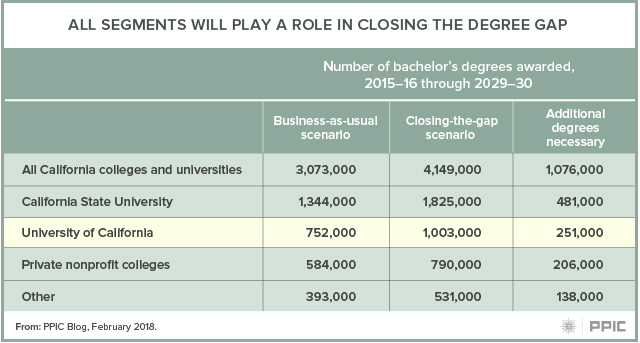
Most immediate to today’s conversation about goal setting for the state’s public systems, PPIC has identified the combination of increases in freshman eligibility, transfer, and completion rates necessary to close the gap.

Our preferred approach—a closing-the-gap scenario—combines increases in eligibility, transfer, and graduation rates, as shown below. Along with increases in enrollment and completion at private institutions, reaching these targets would fully close the workforce skills gap.
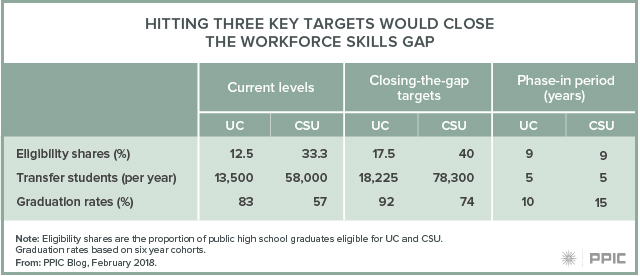
In our scenario, each target would be reached gradually through a phase-in period. In the first few years, projected increases would be minimal as the systems would enroll more students and implement policies to improve completion and transfer. But within five years, the increases would become quite large. By 2020–21, CSU would award almost 25,000 additional bachelor’s degrees; UC would award more than 12,000.
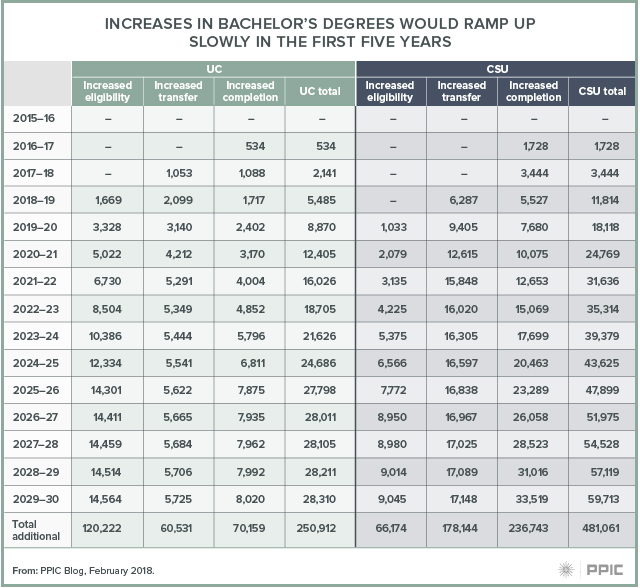
For the purposes of setting annual goals, we are identifying annual targets in new freshmen enrollment, transfer, and completion rates that would match the closing-the-skills gap degree targets. Enrollment and transfer targets depend on graduation rates and time to degree—meaning that enrollment increases could be lower if graduation rates improve and students complete their degrees more quickly. For example, students who take 12 units per semester will take five years of continuous enrollment to earn the 120 units necessary for graduation.  If those students instead took 15 units per semester, they would graduate in four years and free up additional space for other students.

It has been a couple years since PPIC first developed our projections, and we’ve now been able to chart early progress by the systems. Later you will hear in detail from the segments about their plans, but right now I am happy to report some good news: the number of bachelor’s degrees awarded at UC and CSU is actually higher than our initial scenario called for.
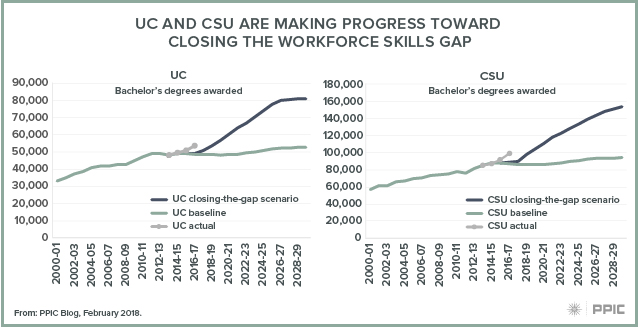
Of course, we are just at the start of our projection period, and to close the gap the numbers must ramp up quickly after the first few years. Nonetheless, growth in graduation rates and enrollment has led to a notable expansion in degrees awarded at both systems. Over the past two years, UC and CSU combined have awarded 295,000 bachelor’s degrees—21,000 more than in our closing-the-gap-scenario and 23,000 more than in our baseline scenario. In addition, the number of transfer students has increased 8%, also higher than in our closing-the-gap scenario.

In addition, community colleges and CSU have adopted new goals for student success that are entirely consistent with PPIC’s closing-the-gap scenario. CSU’s new graduation initiative calls for reducing time to degree and increasing both four-year and six-year graduation rates. CSU’s goal of a 70% six-year graduation rate by 2025 is in line with and in fact slightly more ambitious than our scenario. In their new “Vision for Success,” the community colleges have adopted a goal to increase transfer to UC and CSU by 35% over the next five years, a goal that is entirely consistent with our work.

There is an important additional benefit of meeting these goals: reducing equity gaps. Today, students who have been underrepresented in higher education—including Latino, African American, low-income, and first-generation students—make up a majority of California’s high school graduates. Strong increases in college preparation among the state’s high school graduates are expanding the pool of potential college graduates, with the share of students—including African American and Latino students—completing the college preparatory requirements of UC and CSU reaching an all-time high. Ensuring that the growing number of prepared high school graduates have meaningful access to and success in higher education will not only help California meet its economic challenges, it will ensure that higher education continues to serve as a ladder of economic and social mobility.

Our focus at PPIC has been on college graduates with at least a bachelor’s degree, but we acknowledge the importance of other postsecondary training. We have a series of reports and ongoing projects that identify successful vocational pathways and high value awards (certificates and associate degrees) offered by the state’s community colleges. Lande Ajose of California Competes will discuss in more detail the need for sub-baccalaureate post-secondary education. We also acknowledge the importance of post-baccalaureate education, including professional and academic graduate degrees offered primarily by UC and the state’s private nonprofit colleges. Those degree holders have the best labor market outcomes in the state.

Figuring out how to pay for all these increases is no easy task and will be discussed later in this hearing.  Let me alert you to two projects underway at PPIC that will help shed light on this issue. One will examine the role that tuition policy could play and the other will focus on capital finance. In addition, we will continue to monitor affordability issues, including student debt, identified by respondents to the PPIC Statewide Survey as the number one higher education issue.

Finally, it is worth noting that the governor has proposed a funding formula for the community colleges that for the first time will provide additional funding based on student outcomes and enrolling low-income students. PPIC has argued that this approach has the potential to incentivize investment by the state’s higher education systems in areas that further state priorities.


Video: John Chiang’s Priorities

John Chiang, the state’s treasurer and a candidate for governor this year, was asked last week to name the top three issues that will make the most difference for the state’s future. The question is the first one Mark Baldassare, PPIC president and CEO, asks of all gubernatorial candidates appearing before PPIC audiences. Chiang said his priorities are

  • Education
  • Housing
  • Jobs, climate change, health care—issues Chiang lumped together as the “things that are absolutely critical in everybody’s life.”

Chiang praised Governor Jerry Brown for the state’s K–12 finance formula that targets extra resources toward lower-income students, English Learners, and those in foster care. He said he would target more money toward students with special needs.

Referring to the state’s housing situation as an “extraordinary crisis,” Chiang said that even if an affordable housing bond measure passes in November, the state will need to return to the voters to get more money. He advocated reviving local redevelopment agencies, which the governor eliminated in 2011, to give local governments an economic tool to build housing.

Chiang referred to his background as treasurer, state controller, and member of the state Board of Equalization in emphasizing the need to ensure a way to pay for proposals such as single-payer health care—an idea he said he favors in concept. While describing the current system as inefficient, he said that the state can’t achieve single payer health care immediately. How long will it take? Chiang said more clarity from the federal government is crucial to understanding what the state can afford. “Let’s build what we can build. We don’t have to build a mansion at the beginning. Let’s build a starter house.” Chiang also said that the state needed to figure out how to insure an additional 2.9 million Californians who are currently uninsured.

The conversation with Chiang is part of the PPIC Speaker Series on California’s Future. PPIC is inviting all major candidates for governor to participate if they reach a certain threshold in the polls. The goal is to give Californians a better understanding of how the candidates intend to address the challenges facing our state.

Watch all candidate videos


Funding Increase for Community Colleges

Nearly 70% of new funding for higher education—or $570 million—in Governor Brown’s proposed budget goes to the state’s community colleges. This continues a trend that has seen community colleges get an ever-growing portion of higher education funding even as overall funds for higher education have shrunk—from 18% of the General Fund 40 years ago to just under 12% now. This trend is likely to continue—mostly because Proposition 98, passed by the voters in 1988, sets minimum funding levels for the state’s K–12 and community college systems.

Blog figure: 2018-19 Budget, Community College FundingThese mandated minimum funding levels have protected community colleges from the kind of budget cuts that have affected California’s other public higher education institutions. In addition, Governor Brown has prioritized investments in the community college system, which serves 2.1 million students and is the gateway to higher education for the vast majority of California students.

Governor Brown and the legislature have vastly increased investment in community college programs intended to improve student outcomes and eliminate achievement gaps, including programs focused on adult education and career technical education. Moreover, last year the governor provided a one-time allocation of $150 million to develop the Guided Pathways program, aimed at integrating disparate student success programs into one model and creating clear pathways for students to earn a certificate or degree, or transfer to a four-year college.

The governor’s current budget proposal also contains a new funding formula for the community colleges. This formula would shift future funding to districts with higher proportions of low-income students and those that have achieved better student outcomes. Under this formula, each district would get 50% of its funding based on enrollment, 25% based on enrollment of low-income students—those who receive a tuition waiver or Pell grant—and 25% based on district performance. Performance would be measured by the number of degrees and certificates provided, the number of students who complete a degree or certificate in three years or less, and the number of Associate Degrees for Transfer granted.

California’s community colleges have long struggled with low completion rates, low transfer rates, and persistent achievement gaps. Additional funds and a new funding formula may help to address these issues and lead to greater student success—which, for most community college students, means transferring to a four-year institution. Today, more than half of CSU students are community college transfers, as are nearly one-third of UC students. If current investments in community colleges do in fact improve student outcomes, then California’s four-year institutions will need to be ready for even more transfers.


Building Community to Support Healthy Forests

California’s mountainous headwater forests are in crisis, and an all-hands-on-deck approach is needed to improve their health. A combination of factors—dense forests with too many small trees, abundant ground fuels, and large patches of dead trees―leaves them increasingly vulnerable to severe wildfire. The best way to address the impacts of tree mortality and improve forest health is with strategic use of fire and mechanical thinning.

A big challenge to increasing the pace and scale of forest management is the patchwork nature of California’s headwaters. Implementing forest management is particularly challenging for many people who own family forests (parcels less than 5,000 acres in size), which make up about a quarter of the Sierra Nevada headwater forests. The high cost of forestry work on these small land holdings is a major barrier for many owners.

Resource conservation districts (RCDs) are one of several locally governed entities that can play an important role in helping landowners improve forest health. RCDs are authorized by the state to perform a variety of resource and land management functions, including forest stewardship, fuels management, and watershed planning and management. There are about 20 RCDs covering most of the Sierra Nevada headwater region. RCDs are well versed in local resource management issues and often are more trusted by local landowners than state or federal agencies.

RCDs can organize forest management projects across multiple private properties. For example, in 2017 the Placer County RCD used grant funding to pay for dead tree removal on family-owned forest properties in the rural community of Foresthill—an area that was hit hard by tree loss caused by drought and pests. RCDs could also assist groups of forest owners in identifying common management needs and pooling private resources to pay for on-going management.

RCDs are well placed to facilitate relationships between forest owners and other potential partners in management projects. For example, the Sierra RCD in Fresno County is implementing a district-wide carbon management program that makes use of dead trees from the massive tree die-off. With the help of the California Association of Resource Conservation Districts and the Governor’s Office of Planning and Research, the Sierra RCD is working with CAL FIRE and the US Forest Service to process these dead trees into a charcoal-like product called “biochar,” which can be used to increase soil health on nearby agricultural lands in the Central Valley.

Steve Haze, the district manager of the Sierra RCD, says these kinds of strategic partnerships can help “carve out a niche and add value to the effort” of removing large numbers of dead trees. Many RCDs are in a unique position to find overlapping interests and turn them into projects with multiple benefits in their districts.

While many RCDs may be keen to take on new roles and responsibilities to meet their local forest management needs, establishing long-term funding to support these efforts is a major challenge.  Less than 15 of the state’s 99 RCDs have adequate funding through local property taxes; the rest are supported by less-stable sources such as grants or appropriations from county governments. Finding durable funding sources for headwater RCDs could help spur long-term forest management work that would bring benefits to entire watersheds.

Learn more
Read Improving the Health of California’s Headwater Forests (PPIC, 2017)
Read California’s Water: Protecting Headwaters (from the California’s Water briefing kit)
Visit the PPIC Water Policy Center’s drought resource page


Video: Legislative Leaders Address Sexual Misconduct

When Anthony Rendon was asked to name the biggest issues for the governor and state legislature to address this year, he prefaced his answer with a look back. “Last year was a banner year,” the California assembly speaker said, citing infrastructure, housing, and climate change efforts. Then he added a caveat:

“Some of that was obscured—and rightly so—by the sexual harassment crises that developed in the fall. This year we have to start with that.”

Rendon said the assembly is revising sexual harassment policies and procedures that have not been updated since 1993, and he acknowledged that this is only the start in a larger change needed in the way the institution conducts its business.

Rendon spoke as part of an annual event that brings together California’s legislative leaders from both parties in a conversation with Mark Baldassare, PPIC president and CEO. Rendon was the lone leader on stage for much of the event because the state senate was discussing the fate of a colleague accused of sexual harassment.  Patricia Bates, Republican state senate leader, and Kevin de León, president pro tem, later joined the assembly speaker on stage.

Bates said her top issue for 2018 is addressing the high cost of living in California. “Affordability affects every socioeconomic level in our state,” she said.

De León referred to California’s resistance to the direction of federal policies in describing his top priority: defending what he called “our incredible gains” in California—a higher minimum wage, gun safety and ammunition regulation, and extension of the Global Warming Solutions Act. He also emphasized protecting the state’s immigrants.

Both senate leaders described a bipartisan approach to addressing sexual harassment. Bates commended de León for quickly turning the investigation of allegations over to outside law firms independent of the senate. The leaders pointed to process changes in the works to address harassment, and both said that changing the culture is a much longer term goal. How does cultural change come about?

“You build in trust with the policies that are there—that they are responsive, they are fair, they give due process, and they have just consequences,” Bates said.

Examining the Federal EITC’s Impact on Poverty

The federal Earned Income Tax Credit (EITC) plays an important role in keeping Californians out of poverty. The credit supplements earnings for low-income workers at tax time, providing $2,400 on average to qualified tax filers.

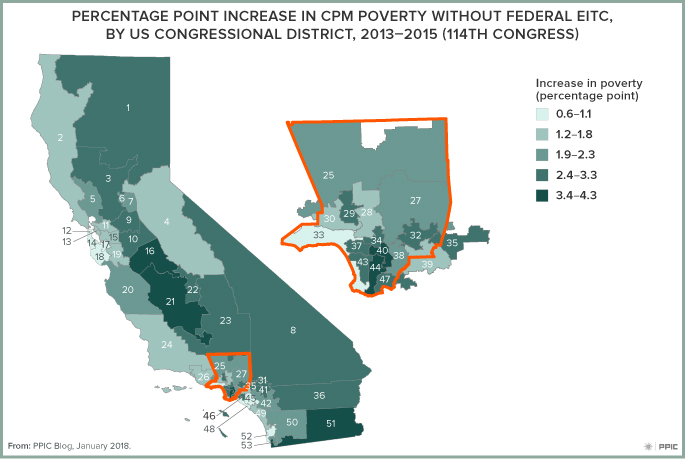
Without the EITC, we estimate an additional 814,000 Californians would live in poverty, according to the latest data from the California Poverty Measure (CPM), an ongoing collaboration between PPIC and the Stanford Center on Poverty and Inequality. This reduction in poverty makes the EITC nearly comparable to CalFresh (formerly known as food stamps), the safety net program that keeps the most Californians out of poverty. Our estimates reflect data from 2013 to 2015 and do not include the state EITC, which was introduced in 2015 and expanded in 2017. The state EITC lowers poverty by very little because the largest credits go to workers with very low earnings, whose families mostly live well below the poverty line.

The role that the EITC plays varies widely across regions. Statewide, the poverty rate would be 2.2 percentage points higher without the EITC (22.6% instead of 20.4%). But in Lake and Mendocino Counties (combined), the poverty rate without the EITC would be 4.1 percentage points higher than it is currently, reaching 26.8%. Poverty in Marin County, on the other hand, would increase only 0.2 points, to 16.5%. Such differences could be due to several factors—for example, the share of eligible families who take advantage of the credit and the local availability of jobs.

PPIC recently released data showing poverty rates, poverty thresholds, and the effects of safety net programs not only by county, but also by state assembly and senate district and by US congressional district. These data provide an opportunity to dig more deeply into the varying roles of safety net programs across the state.

The EITC, for example, has the largest effect in some of the highest-poverty congressional districts, including District 40 (Rep. Roybal-Allard) and District 44 (Rep. Barragán). But in some relatively high-poverty districts it plays a smaller role (District 46, Rep. Correa). The data we provide can be a starting point for investigating—and potentially remedying—incomplete access to the EITC.


Farming Wetlands to Grow Birds

California has lost 95% of its natural wetlands. Managing what’s left is complicated by inadequate water and infrastructure. We talked to Ric Ortega, general manager for the Grassland Water District in the San Joaquin Valley, on what is needed to maintain wetlands in this difficult environment.

PPIC: What are California’s biggest challenges for managing wetlands?

Ric Ortega: About 25 years ago Congress directed the US Department of the Interior and the state to provide adequate, reliable water to the last remaining wetlands in California. But on average, only half of the spring and summer water required to meet the needs of wildlife is delivered. Drought years are far worse with most habitat remaining dry.

Remarkably, even the water that is available can’t always be delivered to the habitat. To mitigate for the impact of building the federal Central Valley Project, 19 wildlife refuges were established. Currently, five of the 19 refuges don’t have infrastructure in place to receive the water that is allocated to them.

Sadly, 14 refuges south of the Delta—including ours—are chronically short of water. It’s also getting more difficult to move refuge water supply through the Delta on a schedule that the wildlife requires. Maintaining timely Delta exports to refuges is critical, especially in drought years.

PPIC: What is your district doing to improve ecosystem conditions?

RO: The Grassland Ecological Area is home to the largest remaining block of wetlands in the west. It supports 300 species of birds, many of which overwinter and breed here. Our biggest challenge is delivering adequate water to the habitat when the plants and animals need it.

In good water years, we basically have to farm the remaining habitat to feed the 10 million birds that move through the Central Valley along the Pacific Flyway each year. What I mean by that is we try to maximize the productivity of the marsh, and that starts with growing the grasses that produce food for the birds. We need adequate spring and summer water to grow those grasses and provide breeding habitat.

Private landowners in our district manage their habitat to produce crops of beneficial food plants for migratory waterfowl. These efforts also benefit many other species—for example, the threatened giant garter snake and the endangered tri-colored blackbird. We work closely with farmers and partner groups like the California Waterfowl Association and Ducks Unlimited to leverage grant funding and share costs for habitat restoration projects and water supply improvements. And we work closely with organizations like Audubon and the Nature Conservancy to provide specific habitat for shorebirds and song birds at the right times of the year.

PPIC: What changes are affecting how your district manages water for ecosystems?

RO: Funding is becoming a larger problem.  The cost of buying and moving water has skyrocketed―our conveyance fees tripled during the drought. We rely on a “restoration fund” managed by the US Bureau of Reclamation. They use some of this to acquire water from willing sellers and also to deliver that water to the habitat. The fund also provides a vital revenue stream to our local economy—about $15 million goes to local agricultural districts that sell and move water to state, federal, and private refuges.

Implementation of the Proposition 1 water bond will be a huge step forward for California wetlands. It included $89 million to help build needed infrastructure so all refuges can receive their water supply. The water storage portion of the bond also has some projects that could help wildlife.

Our refuge’s water system is intricately linked with local agricultural water supply. As farmers get more efficient with their water use, less farm runoff is making it to the refuges. Also, with less water moving through the system, water quality degrades. We need to manage our water resources more in line with the hydrologic conditions at hand. Water conservation is paramount in dry times, but in wet years we should promote more flood irrigation to recharge the aquifer, spill into the marshes, and flush salts from the basins. We also need more flexibility to move environmental water around the state to support wildlife and the Pacific Flyway.

Learn more
Read “Reforming Water Management for the Environment” (PPIC Blog)
Watch a panel discussion on partnerships for healthy ecosystems (with Ric Ortega)
Visit the PPIC Water Policy Center’s Ecosystems resource page

Photo courtesy of Gary Kramer

Improving Community College Course Catalogs

Before the start of a new semester, students at California’s community colleges must sift through hundreds of courses and decide which ones will help them make progress toward their college and career goals. However, course prerequisites and program requirements can be complicated, and staff and counseling centers aren’t always readily available to help students make informed decisions. Course catalogs are a widely available resource at all 114 California community colleges—and improving these catalogs could help students better navigate their way through college.

Course catalogs contain most, if not all, of the information students need to build their college and career pathways. These resources are about 300 pages long on average and list detailed information about the college itself and the courses taught in a given academic year. They generally include degree and program descriptions, assessment and placement procedures, course prerequisites, credits earned per course, and much more. But course catalogs are often not structured in a way that makes this crucial information accessible.

Using clear flowcharts and diagrams is one way to help students understand the sequence of courses they need to take to achieve their academic goals. For instance, there is evidence that many students don’t fulfill math requirements, earn a degree or certificate, or transfer to a four-year university due to lengthy and confusing math course sequences. While most colleges depict course sequences using flowcharts and diagrams (88 out of the 114 colleges), there are still students at 26 colleges who have to figure out the appropriate sequence for themselves. San Jose City College has a good example of a flowchart that illustrates the sequence of math courses students need to take depending on their academic discipline—with different possible sequences for STEM and non-STEM majors (see p. 40 of the course catalog). Even among colleges that do provide helpful illustrations, less than half (46 colleges) provide them in a central resource like a college catalog. This adds an extra step for students who need to know which math courses will count toward their degree.

In addition, students on a vocational track may want to collect or combine different types of certificates within the same program. But only five colleges attempt to illustrate the course requirements for related degrees and certificates, and even then, the information is only available for a small number of programs. Including a diagram helps organize and distill this complicated set of information. For example, LA Trade Tech College designed a flowchart for the renewable energy program that shows how students can advance through and collect different degrees and certificates within a single program (see p. 120 of the course catalog).

There is a growing awareness that students need comprehensive tools that will allow them to make informed course selections. As part of the Guided Pathways project—which aims to better align campuses’ program structures with those of four-year colleges and the needs of the labor market—20 California community colleges are using “program maps” that include clear course sequences and academic milestones to help streamline students’ decision-making process. Leveraging the course catalog to make key information more accessible is another way that colleges can help students more efficiently achieve their college and career goals.

Visit the PPIC Higher Education Center.