The University of California Board of Regents invited Mark Baldassare, PPIC president and CEO, and Hans Johnson, PPIC senior fellow and director of the PPIC Higher Education Center, to present their perspectives on the role of higher education in California’s future, November 16, 2017. Here are their prepared remarks:
Good morning, I am Mark Baldassare, president and CEO of the Public Policy Institute of California (PPIC). I am here with my colleague and PPIC’s higher education center director Hans Johnson to present the institute’s research findings on the need for college graduates in California’s future economy. To kick off this session, I am going to make a few remarks about public opinion to place this issue in perspective.
The November PPIC Statewide Survey points to the importance of this topic for most Californians. Eighty percent of California adults say that the state’s higher education system is very important to the quality of life and economic vitality of the state, and another 14% say it is somewhat important. Strong majorities across political, regional, racial/ethnic, and demographic groups say that the state’s higher education system is very important. In fact, strong majorities of Californians have been saying that higher education is very important to the state’s future since we first asked this question in 2007.
In the context of the 2018 governor’s race, 63% of California adults say that candidate positions on higher education are very important, and another 28% say they are somewhat important to them. Majorities across political, regional, racial/ethnic, and demographic groups hold this view.
When asked about the current workforce, 83% of Californians say that a four-year degree from a college and university prepares someone very well (30%) and somewhat well (53%) for a well-paying job in today’s economy. Fifty percent of Californians think that a college education is necessary for a person to be successful in today’s work world, with majorities of Latinos (67%), Asian Americans (54%), and African Americans (51%) and fewer whites (35%) holding this view. Moreover, about half of Californians, with pluralities across the state’s major regions, say that California will not have the college-educated residents needed for the jobs and skills likely to be in demand 20 years from now.
In sum, the importance of a higher education and the need for college graduates are issues on the minds of many residents today. Hans will provide the demographic and workforce analysis that demonstrates why the state’s higher education system is essential for a better future for all Californians.
PPIC has produced a series of reports on California’s future population and economy. Our report Will California Run Out of College Graduates? provides projections of the demand for and supply of workers across all levels of educational attainment to 2030. Our primary finding is that California faces a shortage of highly educated workers. Specifically, economic projections to 2030 show that about two in five jobs will require at least a bachelor’s degree, while demographic projections suggest only about one in three Californians will have at least a bachelor’s degree. This shortfall equates to 1.1 million workers.

In this presentation, I first describe how California’s population and economy are changing and then identify how the state and its higher education institutions can increase college enrollment and completion to produce more college graduates.
California’s economy increasingly demands highly educated workers
To develop our economic projections, we apply trends in educational attainment levels to occupational projections developed by the California Employment Development Department. We examine changes in labor market demand that are occurring due to shifts both in occupational structure and changes in educational attainment within occupations. Our primary finding is that the state’s economy will continue along a well-established trajectory, with a growing share of jobs requiring at least a bachelor’s degree.
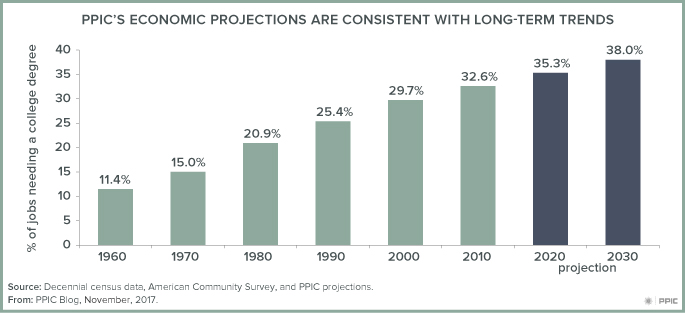
There are two key drivers of increasing demand for college graduates: (1) faster growth in occupations that commonly require a college degree (e.g., computer technology), and (2) increases in demand for highly educated workers within occupations (e.g., nursing). In recent years, most (74%) of the increased demand for highly educated workers has occurred because of faster job growth in occupations that commonly require a college degree. Among occupations with at least 100,000 full-time year-round workers, there have been especially rapid growth rates for software developers (56% increase between 2010 and 2015), computer scientists and systems analysts (42% increase), and managers (35% increase). These and other highly skilled occupations have experienced faster growth than most occupations that require lower levels of education.

That said, the increase in educational attainment within occupations has been significant. For example, the share of registered nurses with a bachelor’s degree has grown from 57% in 2000 to 68% in 2015. From 2010 to 2015, about 26% of the increase in jobs for college graduates was attributable to growing demand for highly educated workers within specific occupations.
Are college degrees really necessary for these jobs? To answer this question, we examined a number of labor market outcomes. Within and across occupations, we find that workers with bachelor’s degrees have higher labor force participation rates, lower unemployment rates, and higher wages than those without—and that, in general, as educational attainment increases, wages also increase. Overall, the wage premium for college graduates relative to less-educated workers has grown. By 2015, the average annual wage for full-time year-round workers was more than twice as high for workers with a bachelor’s degree than for those with only a high school diploma.
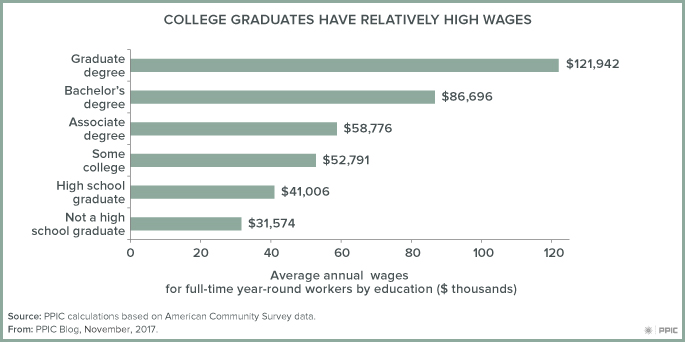
Within each of 51 occupational groupings we see higher wages for college graduates than for high school graduates. Among registered nurses, for example, those with a bachelor’s degree earned 12% more than those with an associate degree.
California’s educational institutions are not keeping up with demand
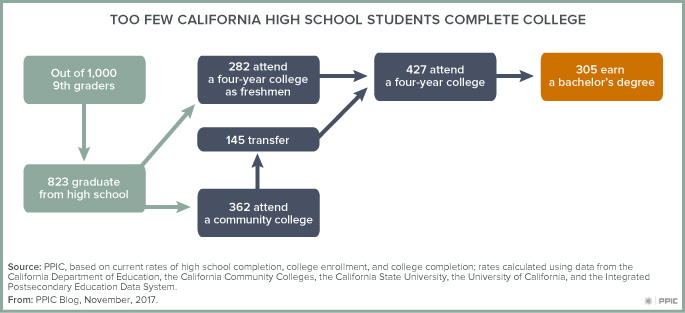
Too few Californians are graduating from college. At current college enrollment and completion rates, only 30.5% of 9th graders in California will eventually earn a bachelor’s degree either in California or elsewhere in the United States. Among all states, California ranks 47th in the share of high school graduates who enroll in four-year colleges and 5th in the share who go to community colleges. Low rates of transfer from community colleges to four-year colleges exacerbate the problem.
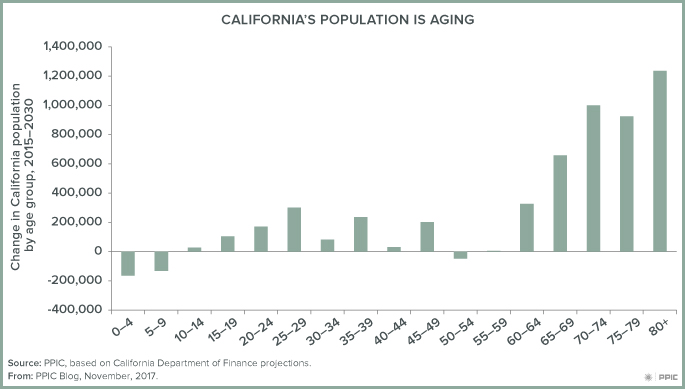
A critical challenge is the retirement of the baby boom generation. Called the “silver tsunami” by some, this is the first time in California’s history that such a large and well-educated group is exiting the labor force. In contrast, the number of young adults in California is projected to increase only modestly.
Not all degrees are equal
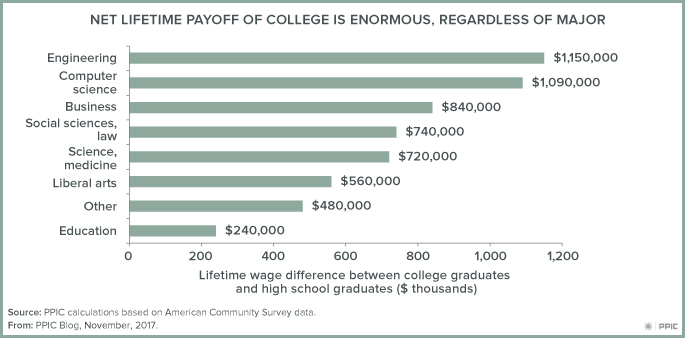
On average, college graduates have very strong labor market outcomes. At any point in time, some college graduates are working in jobs that do not necessarily require a college degree, but over the course of their careers the vast majority of college graduates will move into occupations that reward their educational training. Our estimates show that students who earn bachelor’s degrees in engineering and computer science fare very well in the labor market, but even those with less remunerative majors, such as education and the liberal arts, will earn far more in wages than less-educated workers, even after taking into account all the costs of going to college.
How to close the degree gap
To close the degree gap, California and its higher education institutions need to establish new policies and practices to enroll more students, especially in our four-year colleges and universities, and improve graduation rates among students already in college. In previous testimony, PPIC has identified targets for each of the state’s public systems with respect to admission, transfer (from community colleges to four-year colleges), and improved graduation rates.
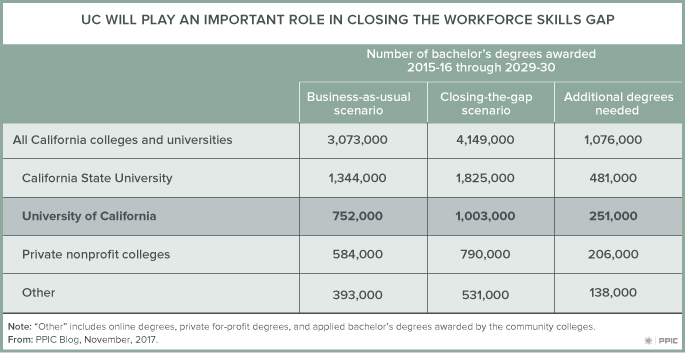
The University of California (UC) will play a central role. In our scenario, UC would need to award approximately one-quarter of the additional degrees necessary to close the gap. This is an ambitious target, but the increase over current levels (and over the baseline projection) would not be without precedent. For example, between the 1999–2000 and 2016–17 academic years, the number of bachelor’s degrees awarded by UC increased 62% (from slightly more than 33,000 to almost 54,000). Our closing-the-gap scenario would require UC to award about 81,000 degrees by 2029–30, a 51% increase over current levels.
Improving access and success among groups historically underrepresented in higher education—including low-income students, first-generation college students, Latinos, and African Americans—is essential if we are to close the degree gap. Compared to other public research universities, UC has an impressive record in enrolling low-income and first-generation students.
The California State University (CSU) system and the California Community College system have adopted new goals that are entirely consistent with PPIC’s targets. New initiatives, including remediation reform at the community colleges and at CSU, have the potential to substantially improve student success rates. CSU’s new graduation initiative aims to increase graduation rates and eliminate gaps between groups of students. College preparation among the state’s high school graduates has also increased, with the share of students completing the college preparatory requirements of UC and CSU reaching an all-time high. Strong demand for UC is likely to continue as college preparation continues to improve and the transfer pathway is better articulated. UC has seen consistent increases in graduation rates for many years, and new efforts to improve on-time graduation are likely to continue this trend.
Finding ways to accommodate all these students remains a central challenge, but one we must meet in order to ensure a better future for all Californians.


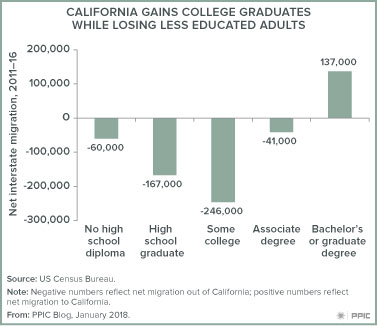 College graduates come to California from all over, but seven states send California substantially more college graduates than they get in return. Between 2011 and 2016, net gains of college graduates from New York (45,000), Illinois (32,000), New Jersey (20,000), Pennsylvania (17,000), Michigan (15,000), Florida (14,000), and Massachusetts (14,000) totaled more than 150,000. California experienced sizable net losses of college graduates to just four states: Texas (-26,000), Oregon (-20,000), Nevada (-14,000), and Arizona (-11,000).
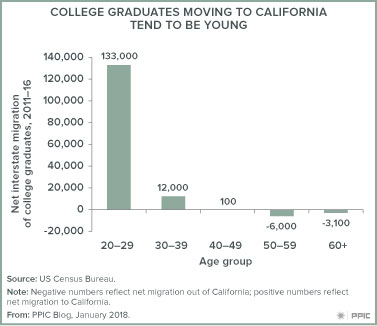 The migration of young college graduates to California is a consequence of the state’s growing demand for highly skilled and highly educated workers. But the numbers are not high enough to meet the state’s changing needs. PPIC’s research has shown that

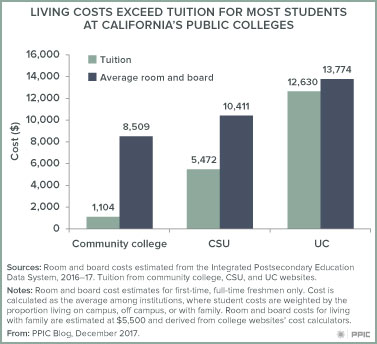 However, housing costs also play a significant role in the total cost of attending college. Californians are well aware of the issue: 85% of residents in the PPIC survey say colleges and universities should do more to make sure that all students have affordable housing options. Indeed, even with the rapid increases in tuition, living costs for many students exceed tuition at California’s public institutions—the state’s community colleges, California State University (CSU), and the University of California (UC). Average room and board costs also differ substantially across the three systems, from $8,509 per year at the community colleges to $13,774 at UC.
 Students’ housing choices also partially depend on where they go to school. Only nine cities in California have UC campuses (excluding UCSF which only enrolls graduate students), and most UC freshmen live on campus in their first year. Historically, the 113 community colleges and 23 CSU campuses have been seen as local and low-cost options. Indeed, both systems show about 30% or more of freshmen living with their families, which helps keep average room and board costs lower than at UC. But it is worth noting that the share of CSU freshmen living on campus may grow.