Video: Preparing California for the 2020 Census

The 2020 census will be a defining moment for California. Much is at stake—including billions in federal funds and the state’s political representation in the US Congress. The lasting impact of an undercount can’t be overstated. Governments, K–12 and higher education institutions, businesses, and nonprofits depend on the census to understand the needs of their communities, target services, and plan for the future.

A panel of experts discussed the critical role of the decennial census at a PPIC event in Sacramento on April 24. They examined the challenges of reaching “hard-to-count” communities, the state’s part in ensuring an accurate tally, the impact of the recently-added citizenship question, and more.

The event opened with a wide-ranging conversation between Marc Berman, state assembly member, and Mark Baldassare, PPIC president. One of Berman’s biggest concerns is that California could lose its political clout in DC. The state has “40 million unique stories,” he said, and the census is about “making sure that every voice” gets counted. But the new citizenship question is counterproductive, in his view. We know that adding it “will discourage a lot of people from participating,” he said. “People are so fearful” that it could make a successful census count that much more difficult, he added.

For the first time, the US Census Bureau will try to collect most responses (55%) online, with the rest obtained by mail or in person. John Thompson, former director of the bureau, identified the government’s main rationale for the change—namely, cost. He also detailed best practices for adding a new census question: In the past, he said, the bureau would spend years testing it, partly to craft appropriate messaging and to ensure that residents were comfortable answering it. The new citizenship question did not have that review, a concern Thompson raised with Commerce Secretary Wilbur Ross to no avail.

John Dobard, associate director of political voice with Advancement Project California, discussed ways to involve the state’s hard-to-reach communities. One way to overcome residents’ fear of participation, he said, is to involve trusted leaders in outreach. Otherwise, entire multi-generational immigrant families could be left out.

An undercount could mean a direct hit to essential state services—such as the Children’s Health Insurance Program. In that scenario, young children in poverty would be hurt most of all, said Sarah Bohn, a panelist and PPIC research fellow.

Ditas Katague, the state’s 2020 census director, said her office is steeped in planning for the statewide rollout. Importantly, she said, California needs an “agile, flexible ground team,” and called on citizen volunteers to join state and local agencies, nonprofits, and philanthropic groups to help make that happen.

The 2020 Census Is Critical for California

The decennial census plays an essential role in American democracy. Most fundamentally, it ensures that communities get the right number of representatives in government. Less well known is the role it plays in determining how hundreds of billions of federal dollars are allocated to states and localities for a wide range of public services, including health care and child nutrition programs.

Although census information is essential, the Census Bureau is currently budget constrained, behind schedule, and scaling back the number of full-scale test runs it was planning. This is of particular concern since several key changes to the census process are in the works: the majority of census information will be collected online, resources for door-to-door outreach may be reduced, and a question about immigration status will be added to the official questionnaire. These and other factors increase the potential for an undercount, especially among vulnerable populations. Just today, California Attorney General Xavier Becerra has filed a lawsuit over this issue.

Why are the stakes so high? A significant undercount could cost California political representation in Congress at a time of record polarization and a deep partisan divide over the direction of the state and the nation. Critical decisions that affect California’s future will be determined to a large extent by federal rules on such issues as climate change, health care, and immigration.

An undercount also means that an important amount of federal funding could dry up. Federal, state, and local government programs that target disadvantaged neighborhoods or populations rely critically on census surveys to identify those in need and distribute funds accordingly. For example, two programs crucial to the health and well-being of children in California—the Children’s Health Insurance Program and the Women, Infants, and Children program—rely on population estimates that use the decennial census count as a baseline for population estimates with which they aim to accurately allocate funds across states.

The impact on California could be huge—and 2020 is fast approaching. At a time when objective facts and information are in short supply, PPIC will be working to raise awareness about the importance of the 2020 Census for California and motivate elected leaders and organizations across the state to work together to ensure an accurate count. Stay tuned for more facts and analysis of the 2020 Census from PPIC.

California Needs More Math and Science Teachers

Recent reforms in educational standards—including the Common Core math standards and the Next Generation Science Standards—have altered the expectations placed on California’s teachers. Other changes, such as requiring college prep courses for high school graduation, will further increase the demand for math and science teachers. The state’s teacher workforce has already changed significantly in the past 15 years, but it will need to further evolve to meet the demands of the future.

These are a few of the challenges ahead:

  • Although the number of math and science teachers has increased in the state, there are fewer of them than in other core subjects. As a result, the average class size in math and science at all levels is larger in California than in other states. For instance, the average class size for high school science in California is 27, well above the national average (22). Similarly, average enrollment in high school math is 25, which is again higher than the national average (21).
  • The teacher workforce in math and science is aging rapidly. In 2016, the median age of the state’s math and science teachers was 44, three years older than the national average. In the next five years, California will need to replace at least 11% of these teachers due to retirement. About 12% of districts will need to replace at least 20% of their teachers.
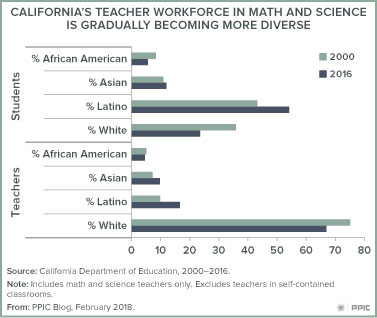
  • The composition of the teacher workforce in math and science has changed in recent years, yet it still does not reflect the diversity of California students. In the 2000–01 school year, only 10% of math and science teachers were Latino; today, 17% of them are (while 54% of the student body is Latino). The share of Asian teachers has increased slightly, while the share of African American teachers remains unchanged. Research shows that teachers of color play a critical role in helping students of color succeed.

As California’s schools continue to implement new math and science standards, the challenge of developing a larger and more diverse teacher workforce will loom large. There are examples of efforts both in California and in other states designed to address some of these challenges. For example, Call Me MISTER in South Carolina aims to recruit college students to increase the incoming teacher pool, while other programs—like Boston Public Schools’ High School to Teacher Program—reach out to students in high schools. In addition, some programs focus on recruiting members of the local community (e.g., Teach Tomorrow in Oakland, the San Francisco Teacher Residency program, and the Grow Your Own programs in Illinois).

These initiatives represent potential models, but they would need to scale up quickly to address the challenges ahead. PPIC’s ongoing research into the implementation of the Next Generation Science Standards suggests that the high demand for quality science teachers is an emerging implementation concern.


Occupational Shifts Favor California’s High-Skill Workers

[vc_row][vc_column][vc_column_text]The recession and recovery have reshaped California’s workforce. Between 2008, when employment peaked, and 2010, when it bottomed out, the state lost three quarters of a million jobs. Since then, the state has experienced sustained job growth; according to US Census Bureau data, by 2016 there were 1 million more workers in California than there had been in 2008. This job growth has not been evenly distributed. Some occupations experienced large losses during the recession and have not fully recovered, while others experienced small losses and now have much higher employment levels than they did at their pre-recession peak. While there are some high-growth occupations that do not require high levels of education, workers with at least a bachelor’s degree have prospered the most over the past several years.

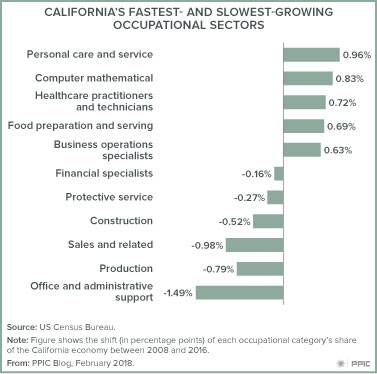
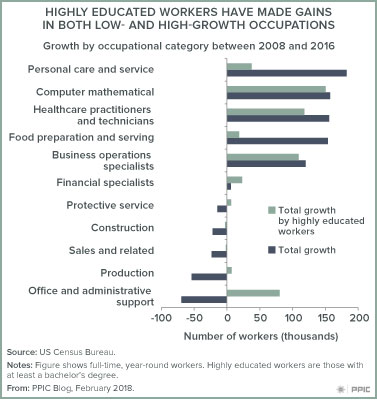
Overall, California’s workforce is becoming more educated: the share of the full-time year-round workforce with at least a bachelor’s degree grew from 31% in 2008 to 35% in 2016. Highly educated workers got more than half of the jobs created in the five fastest-growing occupational categories (based on increases in the share of total full-time year-round workers) between 2008 and 2016:

  1. Personal care and service
  2. Computer and mathematical
  3. Healthcare practitioners and technicians
  4. Food preparation and serving
  5. Business operations specialists

All of these occupations experienced small declines during the recession and strong growth during the recovery. The number of full-time year-round workers increased 28%—from 2.5 million in 2008 to 3.2 million in 2016. Workers in some of these occupations, such as food preparation and serving, earn relatively low wages and tend to have low levels of educational attainment, while workers in other areas, such as computer and mathematical, collect high wages and tend to be college graduates. Altogether, workers with at least a bachelor’s degree made up 433,000 (56%) of the 770,000 jobs gained between 2008 and 2016 by the top five categories.

Workers with at least a bachelor’s degree also made gains in the five slowest-growing occupational categories:

  1. Protective service
  2. Construction
  3. Production
  4. Sales and related
  5. Office and administrative support

These occupations experienced sharp losses during the recession and have not returned to their pre-recession peaks. The number of full-time year-round workers in these occupations declined from 5.3 million in 2008 to 5.1 million in 2016. On average, educational attainment levels are low in these occupations, but workers with at least a bachelor’s degree fared relatively well: the number with at least a bachelor’s degree grew by 89,000, even though these categories have experienced a net loss of 184,000 jobs.

In short, the recession and recovery have accelerated some long-term trends in California’s economy. High-skill occupations and highly educated workers have fared well, while less-educated workers in lower-skilled jobs have faced declining employment opportunities.

[/vc_column_text][/vc_column][/vc_row]

Retraining Workers for the Future Economy

As the economy continues to shift toward computers and digital technology—and braces for a potential future with more robots—workers have been called upon to adapt and learn new skills. New industries and new kinds of jobs may lead to economic growth, but whether these gains are shared by all of California’s workers depends critically on their retraining. And that retraining, in turn, depends on the ability of educational institutions to also adapt to new labor market needs.

While workers can sometimes learn new skills on the job or on their own, other times retraining means obtaining a new credential and returning to the classroom. That’s especially true for people who work in technical industries that are being reshaped by forces like routinization, automation, and outsourcing.

California’s higher education system has an important role to play in delivering retraining options. The state’s community colleges are the primary provider, with hundreds of programs in skilled trades and applied sciences and technologies. Notably, community colleges offer retraining options at a much lower cost to students than do private for-profit two-year colleges, another major provider. In addition, many community college programs show substantial economic returns for students—especially in health professions.

Effective retraining through the state’s colleges would help ensure that all Californians are productive and self-sufficient, which would benefit not just families but also employers and the state economy. However, the current model of higher education was largely built for 18-year-old, first-time freshmen and does not necessarily work for older, returning students, who are almost certainly balancing training with career, family, and other demands.

Flexible course scheduling—for example, through online courses or “distance” education—is one way to better reach workers. California’s community colleges are the clear leader in offering online options. PPIC research has highlighted some limitations to online training and outlined ways to improve student outcomes. Online courses for technical programs may require additional innovation, especially those that require hands-on training. Governor Brown’s proposed budget for fiscal year 2018–19 includes funding for a fully online community college that has the potential to bring innovation to how retraining opportunities (and educational opportunities, broadly speaking) are offered to Californians.

For individuals or training programs not amenable to online options, expanding course offerings near job centers is key. Cal State Los Angeles’s satellite campus in downtown LA aims to do exactly this. Information about the job market is also crucial—and California’s community colleges have taken a big step in the right direction by providing easily accessible information on the labor market outcomes of different colleges and programs across the state.

Retrained workers may pursue all kinds of new skills, but career technical programs, most of which are in community colleges, are particularly important because they offer short-term credentials in industry-relevant fields. Efforts to make career technical programs more flexible—through, for example, online courses, convenient locations, and partnerships with employers—are critical to filling student, employer, and state needs in a rapidly changing workplace.

Learn more
Visit the PPIC Higher Education Center


Testimony: Safety Net Plays Key Role in Reducing Poverty

Sarah Bohn, research fellow at the Public Policy Institute of California, testified today, February 14, 2018, before the Senate Budget and Fiscal Review Committee, Informational Hearing on Human Services. The topic of today’s hearing: poverty and social safety net programs. Here are her prepared remarks.

Poverty is high in California, and it has not improved as much as the economy has in recent years. In fact, California’s poverty rate is highest in country, according to our estimates. Throughout this presentation, I will rely on the California Poverty Measure research (a joint effort between PPIC and Stanford) that accounts not only for earnings but also for benefits from major safety net programs and the cost of housing to give a comprehensive, accurate, and state-specific account of the resources families have on hand to meet their basic needs.

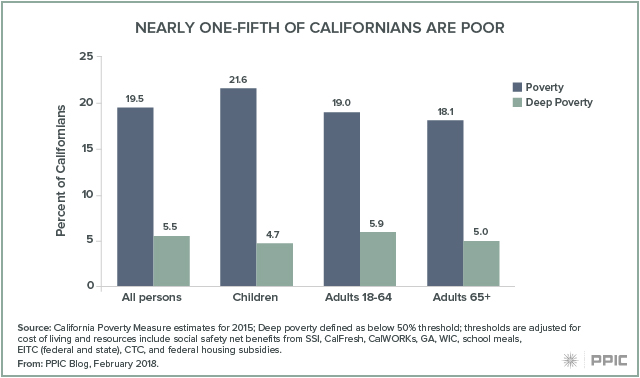
We find that 19.5% of Californians were poor as of 2015—that means 7.5 million people living below a basic needs threshold (less than $30,000 in total resources for a family of four). The poverty rate is slightly higher for children at 21.6%. In addition, 5.5% of Californians are in deep poverty—which means they have less than half of what it takes to meet basic needs, or about $15,000 annually for a family of four. Overall, the share of Californians in poverty remains higher than it was before the last recession started and is relatively high by historical standards.

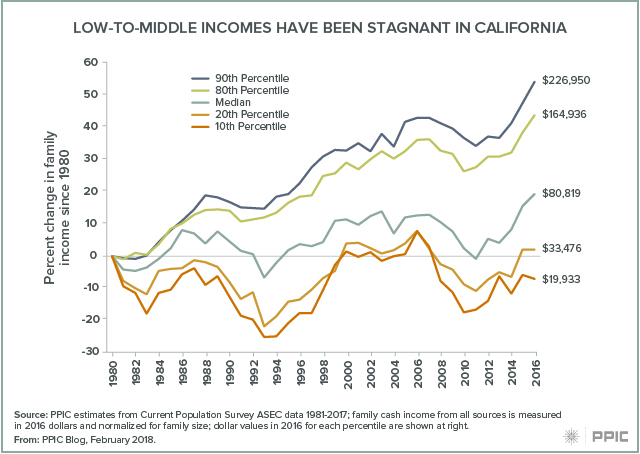
To understand why, providing a long-term picture of how all Californians have fared is helpful. For the bottom half of California families, income has been quite stagnant for at least the past three decades. The bottom 10% are earning less than they were in 1980 (about $20,000) and the bottom 20% are earning just 4% more.  Compare that to the top 10%, which are earning 54% more than they did in 1980.  Much of this is driven by how economic opportunities (especially in the labor market) have changed and polarized – generating both high rates of poverty and high income inequality.

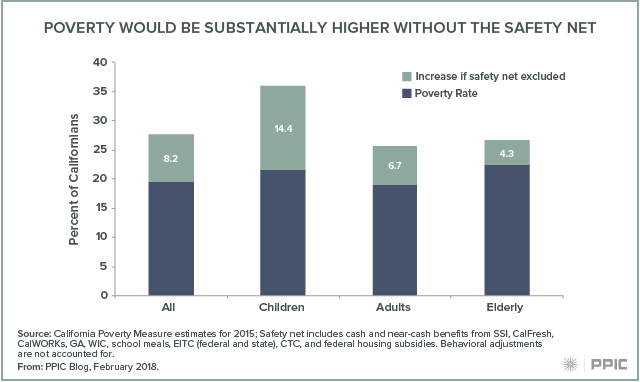
How does this relate to the safety net? With stagnant earnings since 1980, safety net resources become an even more important factor in making ends meet as cost of living increases. Our estimates show that major safety net program benefits play a critical role in mitigating poverty. The California poverty rate would be 8 points higher were it not for these programs—that means an additional 3.1 million Californians would be in poverty. The deep poverty rate would more than double were it not for the safety net.

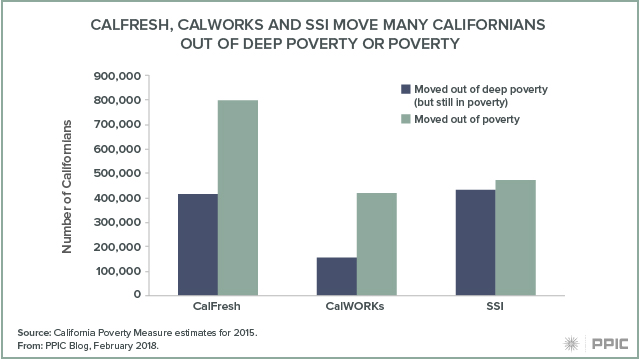
Looking specifically at CalFresh, CalWORKs, and SSI—the programs we’re focusing on today—we estimate that a large number of Californians are moved out of deep poverty or poverty because of the program benefits they or their family members receive.

Specifically, CalFresh moves 400,000 people out of deep poverty; 800,000 are moved out of poverty.  The numbers are a bit smaller for CalWORKs families (150,000 from deep poverty and 400,000 from poverty), in part because the program reaches fewer families. And finally, SSI moves about 400,000 out of deep poverty and about the same number out of poverty. Keep in mind that families on these programs may be far from the poverty line, so even if they are not technically moved out of poverty, program resources can still be an important way for them to meet basic needs. Families may also benefit from multiple programs in combination.

The safety net plays a critical role in helping make ends meet but income from work is still the biggest component of family resources, even for families in poverty. And as we saw over the long term, the trend in income alone is not positive for families in the bottom half of the income distribution. So in addition to helping families manage in the short term, ideally social safety net programs could contribute to mobility over the long term, counteracting the trend in income inequality. However, one factor limiting the potential impact of safety net resources is the high cost of living in California, driven mostly by housing but also other living expenses like child care and medical costs.

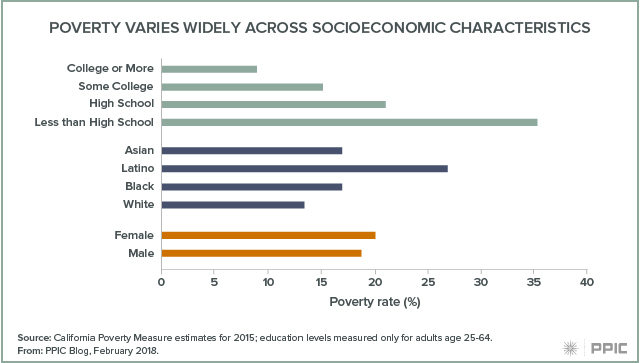
After we consider these other expenses, we end up with poverty rates that are high compared to other states and high within and across California as well.  This is what the poverty looks like across a number of demographic characteristics.

You’ll notice that the incidence of poverty varies the most across education levels (and here we’re only looking at adults age 25–64 who’ve had enough time to acquire education). Men and women are about equally likely to be in poverty. Latinos in California are twice as likely to be poor as white residents (27% vs. 13%), and black and Asian residents fall in between.

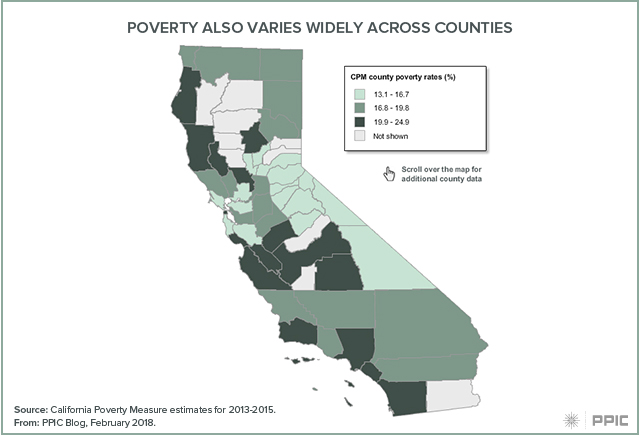
Across the state, poverty varies considerably. The highest rate is in Los Angeles, at 25% (with Santa Cruz and Santa Barbara close behind). The lowest is in Placer County at 13% (nearby Sierra counties of Alpine, Mariposa, and others have similar rates).

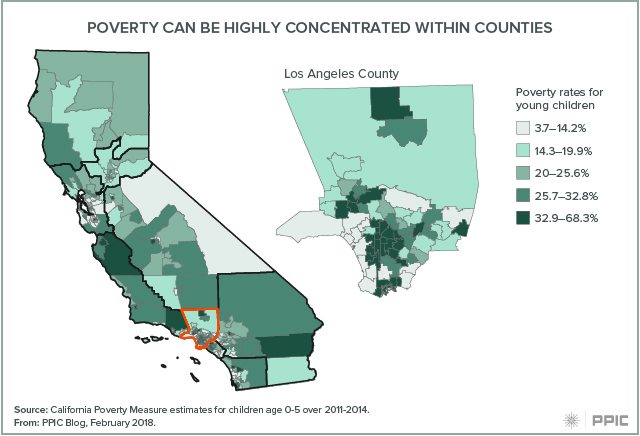
As we all see day to day, poverty is concentrated much more narrowly than at the county level—sometimes it varies neighborhood to neighborhood. In fact, we find that the highest and lowest rates of child poverty in the state are in neighborhoods of Los Angeles that are just 20 to 30 miles apart. Similar differences can be seen in neighborhoods across the Silicon Valley. The concentration of poverty raises concerns that there are other factors about places—beyond just income level—that diminish the chances for residents to get ahead.

This map is surprising because it does not track one-for-one with unemployment or other economic indicators. Access to good-paying jobs is the number one factor in preventing poverty. But it is not sufficient because the cost of living (housing, child care) looms large—and those expenses tend to be higher in exactly the places where unemployment is lower and wages higher, making it hard to make ends meet even with a full-time job. High living expenses coupled with the long-term stagnation in low to middle incomes yields the high rates of poverty we see today even with very low unemployment rates.

In this context it is critically important to be aware of the role social safety net programs play in helping Californians make ends meet—as I mentioned the poverty rate would be 40% higher were it not for major means tested programs in California.  Nonetheless, California has the highest poverty rate in the country—even with a booming economy—so it is exactly the right time to discuss where the safety net falls short and what needs to be done.

Testimony: How Can California Produce More College Graduates?

Hans Johnson, director and senior fellow at the PPIC Higher Education Center, testified today, February 6, 2018, before the Assembly Budget Subcommittee No. 2 on Education Finance and the Assembly Higher Education Committee. The master plan defined a strategy to meet the state’s education needs in 1960—but today, California faces new challenges. The topic of today’s hearing: how to meet the state’s future economic need for more college graduates. Here are his prepared remarks.

PPIC’s work has revealed a serious gap between the number of highly educated workers that California’s future economy will need and the number the state is on pace to produce. We call this the workforce skills gap—and it’s quite large. To meet economic demand and secure a more prosperous future for our state, California’s higher education institutions will need to produce 1.1 million more college graduates by 2030.

Admittedly, doing so is an ambitious goal. But there is significant room for improving how many students graduate from college—especially if we consider that currently only about 30 percent of California’s 9th graders will earn a bachelor’s degree.

PPIC has quantified the role of each university segment—the University of California, the California State University, and private nonprofit colleges in California—in closing the workforce skills gap. Overall, the number of bachelor’s degrees would need to increase by about one-third over baseline projections. Almost half of the gains would need to occur at CSU, the nation’s largest public university system. UC and private nonprofit colleges would also play an important role.
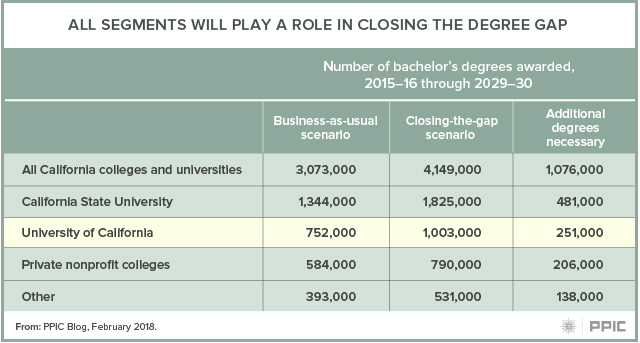
Most immediate to today’s conversation about goal setting for the state’s public systems, PPIC has identified the combination of increases in freshman eligibility, transfer, and completion rates necessary to close the gap.

Our preferred approach—a closing-the-gap scenario—combines increases in eligibility, transfer, and graduation rates, as shown below. Along with increases in enrollment and completion at private institutions, reaching these targets would fully close the workforce skills gap.
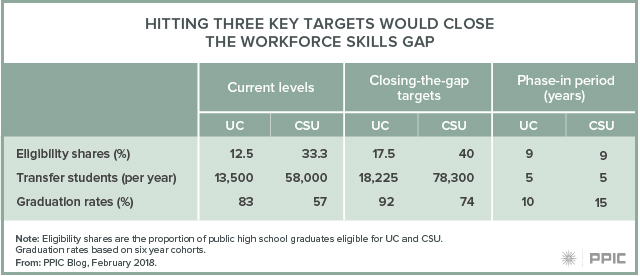
In our scenario, each target would be reached gradually through a phase-in period. In the first few years, projected increases would be minimal as the systems would enroll more students and implement policies to improve completion and transfer. But within five years, the increases would become quite large. By 2020–21, CSU would award almost 25,000 additional bachelor’s degrees; UC would award more than 12,000.
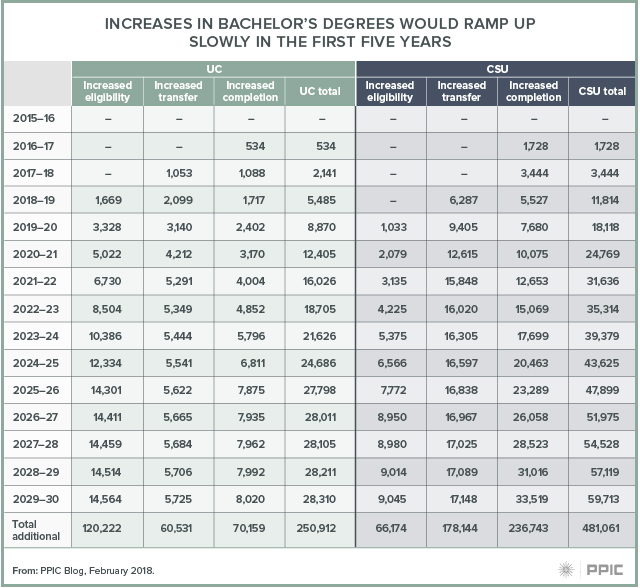
For the purposes of setting annual goals, we are identifying annual targets in new freshmen enrollment, transfer, and completion rates that would match the closing-the-skills gap degree targets. Enrollment and transfer targets depend on graduation rates and time to degree—meaning that enrollment increases could be lower if graduation rates improve and students complete their degrees more quickly. For example, students who take 12 units per semester will take five years of continuous enrollment to earn the 120 units necessary for graduation.  If those students instead took 15 units per semester, they would graduate in four years and free up additional space for other students.

It has been a couple years since PPIC first developed our projections, and we’ve now been able to chart early progress by the systems. Later you will hear in detail from the segments about their plans, but right now I am happy to report some good news: the number of bachelor’s degrees awarded at UC and CSU is actually higher than our initial scenario called for.
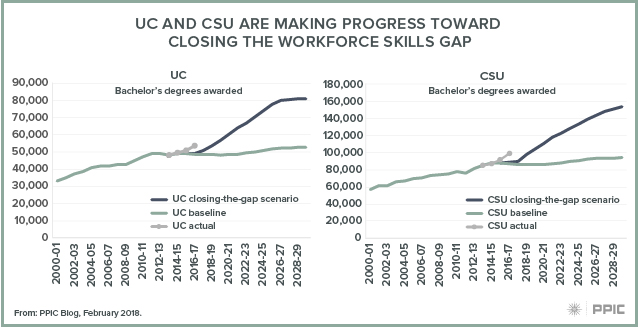
Of course, we are just at the start of our projection period, and to close the gap the numbers must ramp up quickly after the first few years. Nonetheless, growth in graduation rates and enrollment has led to a notable expansion in degrees awarded at both systems. Over the past two years, UC and CSU combined have awarded 295,000 bachelor’s degrees—21,000 more than in our closing-the-gap-scenario and 23,000 more than in our baseline scenario. In addition, the number of transfer students has increased 8%, also higher than in our closing-the-gap scenario.

In addition, community colleges and CSU have adopted new goals for student success that are entirely consistent with PPIC’s closing-the-gap scenario. CSU’s new graduation initiative calls for reducing time to degree and increasing both four-year and six-year graduation rates. CSU’s goal of a 70% six-year graduation rate by 2025 is in line with and in fact slightly more ambitious than our scenario. In their new “Vision for Success,” the community colleges have adopted a goal to increase transfer to UC and CSU by 35% over the next five years, a goal that is entirely consistent with our work.

There is an important additional benefit of meeting these goals: reducing equity gaps. Today, students who have been underrepresented in higher education—including Latino, African American, low-income, and first-generation students—make up a majority of California’s high school graduates. Strong increases in college preparation among the state’s high school graduates are expanding the pool of potential college graduates, with the share of students—including African American and Latino students—completing the college preparatory requirements of UC and CSU reaching an all-time high. Ensuring that the growing number of prepared high school graduates have meaningful access to and success in higher education will not only help California meet its economic challenges, it will ensure that higher education continues to serve as a ladder of economic and social mobility.

Our focus at PPIC has been on college graduates with at least a bachelor’s degree, but we acknowledge the importance of other postsecondary training. We have a series of reports and ongoing projects that identify successful vocational pathways and high value awards (certificates and associate degrees) offered by the state’s community colleges. Lande Ajose of California Competes will discuss in more detail the need for sub-baccalaureate post-secondary education. We also acknowledge the importance of post-baccalaureate education, including professional and academic graduate degrees offered primarily by UC and the state’s private nonprofit colleges. Those degree holders have the best labor market outcomes in the state.

Figuring out how to pay for all these increases is no easy task and will be discussed later in this hearing.  Let me alert you to two projects underway at PPIC that will help shed light on this issue. One will examine the role that tuition policy could play and the other will focus on capital finance. In addition, we will continue to monitor affordability issues, including student debt, identified by respondents to the PPIC Statewide Survey as the number one higher education issue.

Finally, it is worth noting that the governor has proposed a funding formula for the community colleges that for the first time will provide additional funding based on student outcomes and enrolling low-income students. PPIC has argued that this approach has the potential to incentivize investment by the state’s higher education systems in areas that further state priorities.

 

Video: John Chiang’s Priorities

John Chiang, the state’s treasurer and a candidate for governor this year, was asked last week to name the top three issues that will make the most difference for the state’s future. The question is the first one Mark Baldassare, PPIC president and CEO, asks of all gubernatorial candidates appearing before PPIC audiences. Chiang said his priorities are

  • Education
  • Housing
  • Jobs, climate change, health care—issues Chiang lumped together as the “things that are absolutely critical in everybody’s life.”

Chiang praised Governor Jerry Brown for the state’s K–12 finance formula that targets extra resources toward lower-income students, English Learners, and those in foster care. He said he would target more money toward students with special needs.

Referring to the state’s housing situation as an “extraordinary crisis,” Chiang said that even if an affordable housing bond measure passes in November, the state will need to return to the voters to get more money. He advocated reviving local redevelopment agencies, which the governor eliminated in 2011, to give local governments an economic tool to build housing.

Chiang referred to his background as treasurer, state controller, and member of the state Board of Equalization in emphasizing the need to ensure a way to pay for proposals such as single-payer health care—an idea he said he favors in concept. While describing the current system as inefficient, he said that the state can’t achieve single payer health care immediately. How long will it take? Chiang said more clarity from the federal government is crucial to understanding what the state can afford. “Let’s build what we can build. We don’t have to build a mansion at the beginning. Let’s build a starter house.” Chiang also said that the state needed to figure out how to insure an additional 2.9 million Californians who are currently uninsured.

The conversation with Chiang is part of the PPIC Speaker Series on California’s Future. PPIC is inviting all major candidates for governor to participate if they reach a certain threshold in the polls. The goal is to give Californians a better understanding of how the candidates intend to address the challenges facing our state.

Watch all candidate videos


Video: Legislative Leaders Address Sexual Misconduct

When Anthony Rendon was asked to name the biggest issues for the governor and state legislature to address this year, he prefaced his answer with a look back. “Last year was a banner year,” the California assembly speaker said, citing infrastructure, housing, and climate change efforts. Then he added a caveat:

“Some of that was obscured—and rightly so—by the sexual harassment crises that developed in the fall. This year we have to start with that.”

Rendon said the assembly is revising sexual harassment policies and procedures that have not been updated since 1993, and he acknowledged that this is only the start in a larger change needed in the way the institution conducts its business.

Rendon spoke as part of an annual event that brings together California’s legislative leaders from both parties in a conversation with Mark Baldassare, PPIC president and CEO. Rendon was the lone leader on stage for much of the event because the state senate was discussing the fate of a colleague accused of sexual harassment.  Patricia Bates, Republican state senate leader, and Kevin de León, president pro tem, later joined the assembly speaker on stage.

Bates said her top issue for 2018 is addressing the high cost of living in California. “Affordability affects every socioeconomic level in our state,” she said.

De León referred to California’s resistance to the direction of federal policies in describing his top priority: defending what he called “our incredible gains” in California—a higher minimum wage, gun safety and ammunition regulation, and extension of the Global Warming Solutions Act. He also emphasized protecting the state’s immigrants.

Both senate leaders described a bipartisan approach to addressing sexual harassment. Bates commended de León for quickly turning the investigation of allegations over to outside law firms independent of the senate. The leaders pointed to process changes in the works to address harassment, and both said that changing the culture is a much longer term goal. How does cultural change come about?

“You build in trust with the policies that are there—that they are responsive, they are fair, they give due process, and they have just consequences,” Bates said.

Examining the Federal EITC’s Impact on Poverty

The federal Earned Income Tax Credit (EITC) plays an important role in keeping Californians out of poverty. The credit supplements earnings for low-income workers at tax time, providing $2,400 on average to qualified tax filers.

Without the EITC, we estimate an additional 814,000 Californians would live in poverty, according to the latest data from the California Poverty Measure (CPM), an ongoing collaboration between PPIC and the Stanford Center on Poverty and Inequality. This reduction in poverty makes the EITC nearly comparable to CalFresh (formerly known as food stamps), the safety net program that keeps the most Californians out of poverty. Our estimates reflect data from 2013 to 2015 and do not include the state EITC, which was introduced in 2015 and expanded in 2017. The state EITC lowers poverty by very little because the largest credits go to workers with very low earnings, whose families mostly live well below the poverty line.

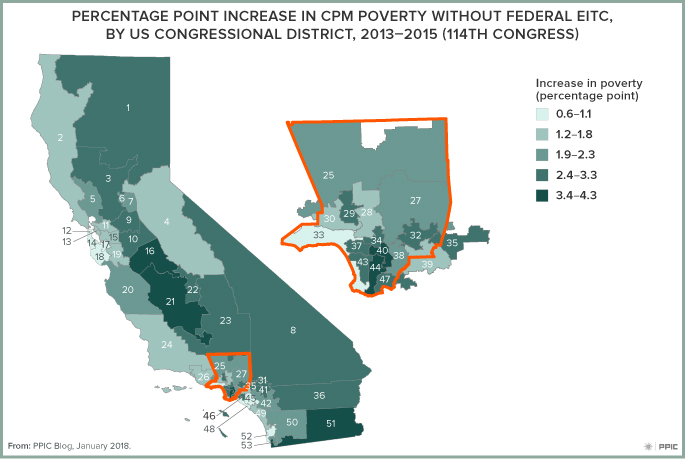
The role that the EITC plays varies widely across regions. Statewide, the poverty rate would be 2.2 percentage points higher without the EITC (22.6% instead of 20.4%). But in Lake and Mendocino Counties (combined), the poverty rate without the EITC would be 4.1 percentage points higher than it is currently, reaching 26.8%. Poverty in Marin County, on the other hand, would increase only 0.2 points, to 16.5%. Such differences could be due to several factors—for example, the share of eligible families who take advantage of the credit and the local availability of jobs.

PPIC recently released data showing poverty rates, poverty thresholds, and the effects of safety net programs not only by county, but also by state assembly and senate district and by US congressional district. These data provide an opportunity to dig more deeply into the varying roles of safety net programs across the state.

The EITC, for example, has the largest effect in some of the highest-poverty congressional districts, including District 40 (Rep. Roybal-Allard) and District 44 (Rep. Barragán). But in some relatively high-poverty districts it plays a smaller role (District 46, Rep. Correa). The data we provide can be a starting point for investigating—and potentially remedying—incomplete access to the EITC.