The Trump administration has clashed with California on a range of issues, and the state’s new attorney general, Xavier Becerra, is at the forefront of the legal battles with Washington. Before a large crowd in Sacramento, Becerra talked about his views and what he has done so far on a range of issues. He spoke with Mark Baldassare, PPIC president and CEO.
Some key highlights:
Environment: Becerra said he has been most active so far on this issue and vowed to continue to be aggressive, whether it is initiating lawsuits, joining other suits, or moving forward with the Paris climate agreement, to the extent the state can do so. “I’ve got the governor’s back on anything he wants to do on the environment,” he said.
Immigration: Becerra said he favors legislation to make California a sanctuary state as long as it does not undermine the ability of local law enforcement to protect public safety by, for example, combating drug and sex trafficking.
Health care: Becerra said that single-payer health care is ultimately the right approach to coverage. “I hope California gets further along in recognizing that affordability only comes when you have universality,” he said.
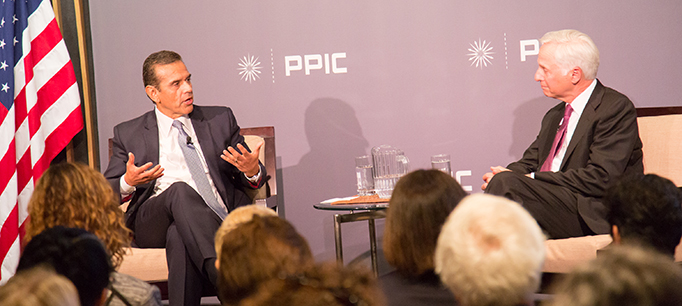
When Antonio Villaraigosa was asked to name the top issues most important to the state’s future, he started with the economy. His key concerns are poverty and the state’s business climate, its “byzantine and bureaucratic regulatory framework.”
Villaraigosa, candidate for governor and former mayor of Los Angeles, spoke at the Speaker Series on California’s Future sponsored by the Public Policy Institute of California (PPIC). As part of the series, PPIC is inviting all major candidates for governor to participate in a public event. Other highlights of his remarks:
Health care: He believes in universal health care but is skeptical about how to pay for the current plan before the legislature: “You’re selling snake oil when you say that single payer is something that’s going to happen any time soon.”
Infrastructure: He emphasized his long-term support for high-speed rail. He sees it as an economic development strategy to transform the Central Valley by connecting it to the two big centers of the economy, Los Angeles and the Bay Area.
Higher education: He said the state needs to look at how community colleges are funded and marshal its resources to make sure students get through the system and transfer to four-year colleges. But he’s not an advocate for making community college free to all: “It’s already free for poor people, and that’s who it should be free for.
A quarter of young children in California live in poverty, yet the local variation in poverty rates is dramatic. Our recent report shows, for example, that the areas with the lowest and highest rates of child poverty in the state are less than 20 miles apart: child poverty is 4% in Redondo Beach, Manhattan Beach, and Hermosa Beach in Los Angeles County and 68% near southeastern LA City. (Data is for 2011–2014 combined, the most recent available).
Families adapt to California’s high cost of living in ways that vary across the state. The interactive map that accompanies our report allows stakeholders to investigate how their local area (defined to have a population of roughly 100,000) stacks up relative to other areas, their region, and the state as a whole.
For example, Selma, Kerman, and Coalinga make up a local area just west and south of Fresno. The area has a relatively high poverty rate of 30% among young children. Most of these children’s parents have limited education: 55% lack a high school degree compared with a statewide average of 37%. But for the most part they are working full-time (62% vs. 50% statewide). They also report the lowest annual housing costs ($5,888) of any area in the state. (We standardized this cost to represent a family of four.) This means they have a relatively low housing burden. Specifically, 18% of families living in poverty in this area use over half of their family resources to pay for housing, compared to the statewide average of 32%.
At the same time, 52% of poor children in this area live in overcrowded housing—about the same as in the state as a whole (55%) and higher than the regional average in the Central Valley (46%). Also, the share of working parents in these poor families who commute 60 minutes or more each way is relatively high at 14%, compared with 10% in the state as a whole.
In sum, the picture that emerges shows families of young children in poverty in this local area tend to have low housing costs relative to other parts of the state. Nevertheless, the cost of housing in inland California is still high compared to the rest of the country, and the data suggest poor families with young children in Selma, Kerman, and Coalinga are indeed making adaptations to cope with these costs—such as living in more crowded conditions and, in some cases, commuting long distances.
Child poverty is a difficult problem, both because it is so high in California and because the family circumstances that poor children experience can differ so much. Investigating varying patterns of housing and commuting across the state can help suggest how policies aimed at reducing the incidence—or severity—of poverty can be tailored to meet local and regional needs.
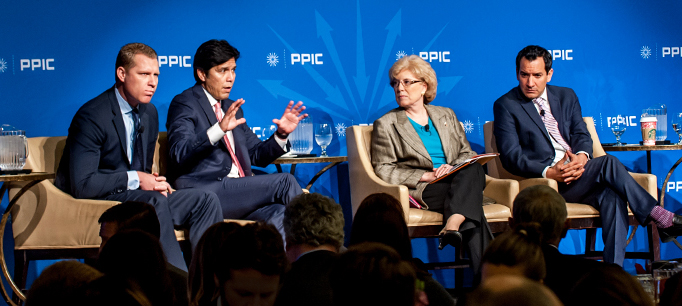
Despite their political differences, California’s legislative leaders have similar views of the state’s most pressing challenges. In a conversation facilitated by PPIC this week in Sacramento, the two top legislators from both major parties provided a preview of the issues they expect to tackle this session. With the impact of federal policy changes still unclear, the legislative leaders focused on longstanding challenges.
Asked to list the top issues the legislature and governor need to work on this session, Anthony Rendon, the Democratic speaker of the state assembly, named housing and transportation—topics he heard about repeatedly as he campaigned around the state. He said he saw the impact of a housing and transportation crisis first hand when walking precincts in the Inland Empire. “If you knock on someone’s door at 7:00, 7:30 p.m., they’re not home yet. They’re still on the freeway.”
Jean Fuller, the Republican leader of the state senate, sees the top issues as affordability in California generally and jobs. “We are concerned about housing, but we are also very concerned about jobs.” She noted that in her district, which stretches from Visalia to Twenty-Nine Palms, there is double-digit unemployment.
Kevin de León, the Democratic state senate president pro tem, said the past legislative session had been particularly productive; he highlighted minimum wage, gun safety, and climate change legislation. In this session, he said, “we have to deliver on the issues of housing and transportation and the issue of economic growth.”
For Chad Mayes, Republican leader of the assembly, poverty is the number one issue in the state, which has the highest poverty rate in the nation. “If you use that as a performance measure for how well our board of directors—the state legislature—is doing, I think you’d have to say we have been failing.” He added: “We’re failing, in large part because of housing costs.”
The speakers acknowledged major policy differences. But they pointed to past successes in bridging them as a sign that they can do so again.
“Things are not broken here, in comparison to DC,” said de León.
Income inequality has been growing for decades and—despite the recovery from the Great Recession—remains historically high. Today, the low end of the income spectrum (the 10th percentile) in California is 19% lower than what it was in 1980, and the upper end of the spectrum (90th percentile) is 40% higher, according to our new report. As a result of these trends, the ratio of high to low incomes—a key measure of income inequality—is nearly twice the size it was three decades ago.
In Los Angeles County, high-income families have 15 times more income than low-income families.
Both income and income inequality vary substantially across California. Looking at after-tax family incomes, we find that, in 2014, the Bay Area had the highest incomes. However, the gap between high and low incomes was biggest in Los Angeles County, the Central Valley, and northern parts of the state—places where low incomes tend to be particularly low. For example, in Los Angeles County, high-income families have 15 times more income than low-income families. At the other end, the Inland Empire and Orange County have the lowest income inequality.
Why does the gap between families across the income spectrum matter? In part because low-income families may have insufficient resources to meet their basic needs. If family incomes are widely spread (inequality is high) but even families at the low end of the economic spectrum are able to attain a sufficient level of well-being (poverty is low), income inequality may not be a big problem. But that is not the case: one in five Californians live in poverty.
Inequality itself may also raise concerns for a host of social, cultural, and political reasons. One economic consequence of inequality is that the greater spread of incomes may inhibit upward mobility. Recent research finds a correlation between income inequality in a region and the upward mobility of its children. Low-income children who grew up in areas with higher income inequality have, on average, lower incomes as adults than otherwise similar children who grew up in regions with less income inequality. In this and other ways, the consequences of growing income inequality may play out over generations, highlighting the need for policies that take this long-range view into account.
Source: Based on California Poverty Measure data, 2012–2013 (Bohn and Danielson 2016).
Notes: Dollar amounts are rounded to the nearest $1,000. Income shown includes cash from work and retirement sources net of federal and state income and payroll taxes; low-income tax credits are not included. Dollar amounts adjusted to represent a family of four. The inequality ratio shown is calculated as the ratio of the 90th percentile of income to the 10th percentile of income; higher numbers indicate greater income inequality. Regions defined as follows. Northern: Butte, Colusa, Del Norte, Glenn, Humboldt, Lake, Lassen, Mendocino, Modoc, Nevada, Plumas, Shasta, Sierra, Siskiyou, Tehama, and Trinity Counties; Sacramento area: El Dorado, Placer, Sacramento, Sutter, Yolo, and Yuba Counties; Bay Area: Alameda, Contra Costa, Marin, Napa, San Francisco, San Mateo, Santa Clara, Santa Cruz, Solano, and Sonoma Counties; Central Valley and Sierra: Alpine, Amador, Calaveras, Fresno, Inyo, Kern, Kings, Madera, Mariposa, Merced, Mono, San Joaquin, Stanislaus, Tulare, and Tuolumne Counties; Central Coast: Monterey, San Benito, San Luis Obispo, Santa Barbara, and Ventura Counties; Inland Empire: Imperial, Riverside, and San Bernardino Counties. Los Angeles, Orange, and San Diego Counties are shown separately.
When Uber officials announced the company was moving to Oakland, there was a wave of fear and anger that well-paid tech workers would push longtime residents out of the city. Fresno, with its high concentration of poverty, struggles to attract the kind of private investment that caused angst in Oakland. In South Gate, housing is relatively affordable, which should be good news. But there are few homes for residents to buy because most are rentals owned by outside investors.
These stories, told by leaders of these communities at a recent PPIC event, were different. But common across the agendas of all three leaders was an emphasis on education as a key part of the solutions they are working on to address income inequality and poverty.
Jorge Morales, councilmember and former mayor of South Gate, said business owners told him that city residents didn’t have the education needed to get jobs beyond the entry level. Now, thanks to a partnership with the Los Angeles Community College District, a new campus will open in South Gate. The focus will be on jobs that become careers, Morales said.
“One of the mistakes we made as policy makers is that when manufacturing jobs started to leave, we all got excited about the revenue—about the sales taxes size—and we started building shopping centers everywhere.””What did that do? That provided the jobs that didn’t provide a living for folks.”
Ashley Swearingen, mayor of Fresno, said that missing the dot com boom of the late 1990s was a wake-up call for her city.
“We were not as a city and a region prepared to ride that wave of expansion,” she said. “That tidal wave of prosperity hit the state, but not a drop hit the ground in the places I was living and working.” The city partnered with Fresno State University to “undo and redo everything about our community” from its public systems to its civic environment, and entrepreneurship education is woven through school curriculums beginning in elementary school.
Libby Schaaf, mayor of Oakland, said she is most passionate about a program she is raising money to start, the Oakland Promise. She said that among this year’s ninth-graders, only 10% will have a college degree by the time they are 23 years old. The Oakland Promise is a “cradle-to-career strategy to triple that number in 10 years.” Each baby born into poverty will get a $500 college savings account, and parents will get another $500 in direct support for home visits and literacy training. Every kindergartener will receive a $100 college savings account. Students will be connected with internships, mentors, peer support groups, and help with financing college.
“You have got to intervene at every moment, from birth until college completion,” she said.
Schaaf says she has raised $23 million for the program and needs $15 million more.
Starting this year, California tax filers with very low incomes from wages are now able to claim a tax credit that builds on the federal Earned Income Tax Credit (EITC). Californians without dependent children can claim the credit if their wages are less than about $7,000, and those with children can claim it if their wages are less than about $14,000.
California joins 25 other states that have their own EITCs. Since California’s credit is brand new, we do not yet know who will claim it. However, our research enables us to characterize the population of those likely eligible for the credit. These estimates are based on family characteristics and incomes reported for 2013.
About 3 million tax filers in California are eligible to claim the federal credit on behalf of themselves and their families. We project that roughly 600,000 filers will be eligible for the California EITC—or about a fifth of those eligible for the federal EITC. If we broaden the scope to include both filers and their family members who will also benefit from the credit, the number of Californians affected by the federal EITC increases to nearly 10 million and by the state credit to 2 million.
Single filers with dependents can generally claim the largest credit. Among those in this group who are eligible for the state EITC, we calculate that the state EITC amount is $932 on average and the federal EITC amount is $2,579, for a combined total of $3,511. This amounts to a 58% boost in earnings on average—20% from the state credit and 38% due to the federal credit. While these filers are working a substantial number of hours (29 hours per week on average), only 37% report working year round (48 weeks or more).
In contrast, single filers with dependents who are eligible only for the federal EITC because their earnings are too high to claim the state EITC see about a 16% increase in income. Compared to those who can claim the state EITC, those eligible only for the federal EITC typically work full time (40 hours a week on average) and year round (83% worked 48 weeks or more).
We know from the research literature that the federal EITC boosts family incomes both directly and indirectly by encouraging work. While it is still too early to assess the full impact of the new California EITC, this early glimpse suggests that the direct effects of the state EITC will be large, at least among a key group of filers eligible to claim the credit.
The majority leader of the US House of Representatives ticked off the issues in an ambitious agenda that he and Congressman Paul Ryan, the House Speaker, are working on in Congress. Congressman Kevin McCarthy told a Sacramento audience that they include national security, the economy, tax reform, poverty, regulatory reform, innovation in government, and water.
McCarthy shares a sense of urgency with Senator Dianne Feinstein about getting a water bill through Congress this year. But he made clear in his conversation with Mark Baldassare, president and CEO of PPIC, that he and the senator—who spoke to a PPIC audience last month—differ in their policy priorities. His include building more water storage and pumping more water from the Sacramento-San Joaquin River Delta.
McCarthy said he thought a water bill could be passed this year, perhaps in a bill that addresses the water problem in Flint, Michigan.
“I think there’s a window of opportunity,” he said.
When the conversation turned to the presidential race, McCarthy was asked to compare two political outsiders—presidential candidate Donald Trump and former Governor Arnold Schwarzenegger. McCarthy said both tapped frustration in the electorate and both brought new voters to the process.
“When I went to the rallies with Arnold it was amazing,” he said. “There’d be 7,000 people in Bakersfield. Lived there my whole life, but I’d see people I’d never met before.”
Today, he said, “the country feels as though the government is not listening to them, they’re divided on all sides, and they’re just not going to take it anymore.”
“I don’t believe it’s a bad thing at all. I believe it’s good.”
As interest groups work to turn their ideas into initiatives for next year’s statewide ballot, the September PPIC Statewide Survey examined Californians’ views in two areas that may be put before voters in 2016: taxes and public employee pension reform.
Mark Baldassare, PPIC president and CEO, and Dean Bonner, associate survey director, presented the findings at a briefing in Sacramento last week.
Among the survey findings:
Half of likely voters favor extending the tax increases in Proposition 30 temporarily, but just a third favor making them permanent.
There is bipartisan support for raising taxes on cigarette purchases.
A majority of likely voters favor changing Proposition 13 to tax commercial properties according to their current market value.
Solid majorities of Californians see public pension spending as a problem, and most think voters should weigh in on changes to the system.
Most likely voters favor placing new public employees in a defined contribution system, similar to a 401(k) plan, rather than a defined benefits system.
The survey shows that Californians give their state leaders—the governor, legislature, and their own legislators—high approval ratings at the close of the legislative session. Baldassare offered his explanation at the briefing: there was little drama around the budget, the economy’s going well, and very few respondents in the survey mentioned fiscal issues as the most important ones.
Congress, on the other hand fares far less well in Californians’ eyes. Its 17% rating is not only much lower than the ratings likely voters give their state leaders, it is much lower than those of President Obama, Senators Barbara Boxer and Dianne Feinstein, and Californians’ own representative in the US House.
“Congress is a government institution that needs work, according to most Californians,” Baldassare said.
California is one of 12 states in which poverty declined last year, according to newly released US Census statistics. The state’s official poverty rate is down by 0.6 percentage points to 16.4%, from 17.0% in 2012. But poverty in the state remains high relative to the early 2000s. In 2007, the year the Great Recession began, California’s official poverty rate was 12.4%.
Official poverty statistics are intended to capture cash resources at hand. In other research we have analyzed the role of social safety net programs in augmenting cash resources and helping families to avoid dire economic need.
It’s important to note that jobs are still the biggest source of income for Californians overall, even among those living in poverty. And good news out last week shows the economy is continuing to improve—the unemployment rate in California is now 6.1%, less than half of what it was during the worst of the economic crisis.
At the same time we are all aware that well-being is complex, so it is instructive to look at multiple measures. Food insecurity—defined as ranging from worrying about being able to afford enough food to actually cutting back on meals—is also down from a recent high of 16.2% in California (across 2009–2011) and is estimated to be 13.5% for 2012–2014. In addition, the number of homeless in California—often not well-represented in indicators of need—is estimated to have declined by 13% between 2012 and 2014. The share of all California children with a validated report of maltreatment (most commonly for reasons of neglect) has also dropped, although this appears to be a longer term trend that predates the recession.
Broadly speaking, then, trends in well-being appear to be positive, even though we have a ways to go before poverty and other indicators decline to the levels experienced before the recession.