Video: Strategies for Reducing Child Poverty

High housing costs and low-wage work make it hard for low-income Californians to meet their basic needs. The result? Nearly a quarter of California’s youngest residents live in poverty—a fact with profound educational, health, and economic repercussions now and in the future. Social safety net benefits help low-income families supplement their incomes but do not reach the working poor in high-cost areas and the very poor across the state.

A new PPIC report examines how high housing costs and low wages contribute to child poverty. It also looks at additional policy approaches: an expansion of the Earned Income Tax Credit, establishment of a state child credit, and an overhaul of the state renter’s credit. Each approach holds promise, and each involves trade-offs.

Researcher Caroline Danielson presented the report in Sacramento last week. She also demonstrated an interactive tool that allows for a deeper exploration of how policy changes could affect California’s diverse counties. It underscores the need for policymakers to be strategic in determining how best to help families in need throughout the state.

Explore the accompanying tool Interactive: Reducing Child Poverty in California.

Video: Gavin Newsom’s Priorities

Gavin Newsom, California’s lieutenant governor and a candidate for governor in 2018, was asked in a San Francisco forum last week to name the three issues that will make the biggest difference in California’s future. Newsom, who is also a former mayor of San Francisco, predicted that both California and the nation will be grappling with these issues over the next ten years:

  • Debt and demographics. With California’s population aging rapidly, the state and its cities face growing public employee pension and health care liabilities. “As a progressive Democrat, I’m not naïve about the commitments we’ve made and the commitments we must fulfill,” Newsom said. “Nor am I naïve, as a former mayor, about the challenge of meeting those commitments . . . Cities like Richmond are facing the prospect that by 2021, by one estimate, upwards of 40% of their general fund will go to retiree contributions.”
  • Energy and climate change. The state has set ambitious goals to reduce greenhouse gas emissions and increase energy efficiency. “The next governor has to deliver,” he said.
  • Information technology and globalization. “The issue that animates my anxiety: work, the future of work.” The days of having a job or career have given way to something radically different, forcing us to think in terms of portable benefits and retirement security, he said. Further, workers in retail, food and beverage, and clerical jobs—the top employment categories—are on the “edge of automation.” Displacement of these workers will require us to have a different conversation about skills, education, and social mobility, Newsom said.

The conversation with Newsom was part of the PPIC Speaker Series on California’s Future. PPIC is inviting all major candidates for governor to participate in a public event if they reach a certain threshold in the polls. The goal is to give Californians a better understanding of how the candidates intend to address the challenges facing our state.

Watch all candidate videos.

Video: How Californians View National Issues

With the nation focused on a range of contentious issues, the September PPIC Statewide Survey provides a California perspective. Dean Bonner, associate survey director, shared the key findings at a Sacramento briefing last week.

Among them:

  • A record-high share of Californians have a favorable opinion of the Affordable Care Act, and most want Republicans to work with Democrats to improve the law. While most Californians say it is the federal government’s responsibility to make sure that all Americans have health coverage, just a third favor a single-payer, government-run national health insurance system.
  • Three-fourths of Californians—also a PPIC record high—view immigrants as a benefit rather than a burden. There is broad and bipartisan support for protections provided by DACA, which shields from deportation some undocumented immigrants brought to the US as children and allows them to get a work permit if they pass a background check.
  • Half of Californians say they are very concerned about the possibility of North Korea having a nuclear missile that could reach the state.
  • Two-thirds of Californians view possible Russian interference in the 2016 as a serious issue.
  • Half of Californians say race relations have gotten worse in the United States over the last year. They are less pessimistic when it comes to race relations in the state.

Video: Attorney General Becerra on the Issues

The Trump administration has clashed with California on a range of issues, and the state’s new attorney general, Xavier Becerra, is at the forefront of the legal battles with Washington. Before a large crowd in Sacramento, Becerra talked about his views and what he has done so far on a range of issues. He spoke with Mark Baldassare, PPIC president and CEO.

Some key highlights:

  • Environment: Becerra said he has been most active so far on this issue and vowed to continue to be aggressive, whether it is initiating lawsuits, joining other suits, or moving forward with the Paris climate agreement, to the extent the state can do so. “I’ve got the governor’s back on anything he wants to do on the environment,” he said.
  • Immigration: Becerra said he favors legislation to make California a sanctuary state as long as it does not undermine the ability of local law enforcement to protect public safety by, for example, combating drug and sex trafficking.
  • Health care: Becerra said that single-payer health care is ultimately the right approach to coverage. “I hope California gets further along in recognizing that affordability only comes when you have universality,” he said.

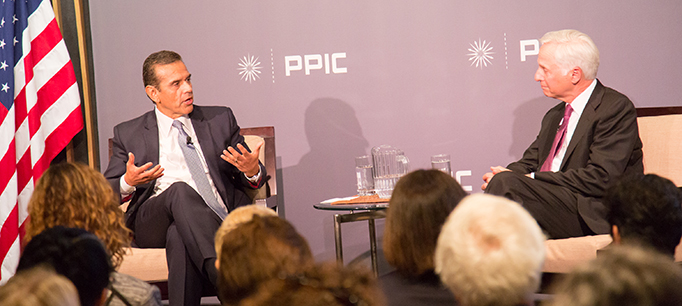
Video: Villaraigosa on His Priorities

When Antonio Villaraigosa was asked to name the top issues most important to the state’s future, he started with the economy. His key concerns are poverty and the state’s business climate, its “byzantine and bureaucratic regulatory framework.”

Villaraigosa, candidate for governor and former mayor of Los Angeles, spoke at the Speaker Series on California’s Future sponsored by the Public Policy Institute of California (PPIC). As part of the series, PPIC is inviting all major candidates for governor to participate in a public event. Other highlights of his remarks:

  • Health care: He believes in universal health care but is skeptical about how to pay for the current plan before the legislature: “You’re selling snake oil when you say that single payer is something that’s going to happen any time soon.”
  • Infrastructure: He emphasized his long-term support for high-speed rail. He sees it as an economic development strategy to transform the Central Valley by connecting it to the two big centers of the economy, Los Angeles and the Bay Area.
  • Higher education: He said the state needs to look at how community colleges are funded and marshal its resources to make sure students get through the system and transfer to four-year colleges. But he’s not an advocate for making community college free to all: “It’s already free for poor people, and that’s who it should be free for.

Watch all candidate videos.

Video: Pessimism about Nation’s Direction

Californians have grown more pessimistic about the direction of the nation and the US economy since the beginning of the year, the May PPIC Statewide Survey shows. Underscoring that sentiment: just 27 percent of residents approve of the way President Trump is doing his job. Only 26 percent approve of Congress—a 10 point decline from March.

Researcher David Kordus presented these and other key findings at a survey briefing in Sacramento last week. On other federal issues, the survey found that most Californians disapprove of the House health care bill, and half expect negative effects from increased immigration enforcement.

Californians are feeling better about the state of their state by some measures: a solid majority favor Governor Brown’s budget plan, and fewer adults than in past years see the state budget situation as a big problem. But the state faces important challenges. Housing is one of them, with 59 percent of all adults saying affordability is a big problem in their part of the state. And solid majorities of Californians say the gap between rich and poor is getting larger. Majorities support state action to address these issues.

Learn more

Read the PPIC Statewide Survey: Californians and Their Government
Find out more about the PPIC Statewide Survey

Child Poverty and California’s High Cost of Living

A quarter of young children in California live in poverty, yet the local variation in poverty rates is dramatic. Our recent report shows, for example, that the areas with the lowest and highest rates of child poverty in the state are less than 20 miles apart: child poverty is 4% in Redondo Beach, Manhattan Beach, and Hermosa Beach in Los Angeles County and 68% near southeastern LA City. (Data is for 2011–2014 combined, the most recent available).

Families adapt to California’s high cost of living in ways that vary across the state. The interactive map that accompanies our report allows stakeholders to investigate how their local area (defined to have a population of roughly 100,000) stacks up relative to other areas, their region, and the state as a whole.

For example, Selma, Kerman, and Coalinga make up a local area just west and south of Fresno. The area has a relatively high poverty rate of 30% among young children. Most of these children’s parents have limited education: 55% lack a high school degree compared with a statewide average of 37%. But for the most part they are working full-time (62% vs. 50% statewide). They also report the lowest annual housing costs ($5,888) of any area in the state. (We standardized this cost to represent a family of four.) This means they have a relatively low housing burden. Specifically, 18% of families living in poverty in this area use over half of their family resources to pay for housing, compared to the statewide average of 32%.

At the same time, 52% of poor children in this area live in overcrowded housing—about the same as in the state as a whole (55%) and higher than the regional average in the Central Valley (46%). Also, the share of working parents in these poor families who commute 60 minutes or more each way is relatively high at 14%, compared with 10% in the state as a whole.

In sum, the picture that emerges shows families of young children in poverty in this local area tend to have low housing costs relative to other parts of the state. Nevertheless, the cost of housing in inland California is still high compared to the rest of the country, and the data suggest poor families with young children in Selma, Kerman, and Coalinga are indeed making adaptations to cope with these costs—such as living in more crowded conditions and, in some cases, commuting long distances.

Child poverty is a difficult problem, both because it is so high in California and because the family circumstances that poor children experience can differ so much. Investigating varying patterns of housing and commuting across the state can help suggest how policies aimed at reducing the incidence—or severity—of poverty can be tailored to meet local and regional needs.

Californians’ Views on ACA Repeal

With control of the presidency and both houses of Congress, Republicans now have the opportunity to act on their oft-stated promise to repeal and replace the Affordable Care Act (ACA), and legislation to replace the 2010 law is advancing in the House. In California, PPIC Statewide Surveys have found majorities of adults viewing the Affordable Care Act favorably since 2015. In our January survey, over half opposed repeal.

A slight majority (53%) of Californians said Congress should not vote to repeal the 2010 health care law, including majorities of those living in the San Francisco Bay Area (59%), Orange/San Diego Counties (59%), and Los Angeles County (56%). Statewide, 42% favored repeal, with just over half saying so in the Central Valley (51%) and Inland Empire (52%).

Not surprisingly, there were wide partisan differences on the question of repeal, with 78% of Democrats and 57% of independents opposing repeal and 80% of Republicans in favor. Whether living in coastal or inland counties, Democrats generally opposed repeal and Republicans generally favored it. But independents on the coast (61%) were more likely than independents in inland counties (46%) to oppose repeal.

In response to another question, 51% of Californians expressed a generally favorable opinion of the ACA. The Kaiser Family Foundation found in a survey conducted shortly after ours that adults nationwide held similar views (48% favorable in February). Majorities of adults in the San Francisco Bay Area (60%), Los Angeles County (56%), and Orange/San Diego Counties (53%) view the ACA favorably, compared with 44% and 41% in the Central Valley and Inland Empire, respectively. In California, there is little difference in opinion on the ACA by age or income, with about half across categories expressing a favorable view. White Californians (44%) are less likely to express a generally favorable opinion of the law, while majorities of other racial/ethnic groups hold a favorable view. Whites without a college degree (36%) are even less likely to view the ACA positively, and 60% favor repeal.

Though majorities of adults have viewed the ACA positively in our surveys over the past two years, opinions were more divided in prior surveys. We will continue to monitor Californians’ views as congressional proposals develop and as potential changes to health care in California become clear. Considering the support we found in our most recent survey for state action to address climate change and protect the rights of undocumented immigrants, it will be interesting to see what state action Californians may want to see if the federal government changes its approach to health care policy.

Learn more

Read the January PPIC Statewide Survey: Californians and their Government
Learn more about the PPIC Statewide Survey

Video: Reaching Children in Poverty

Despite California’s strong economic growth, 750,000 children under age 5 live in poverty, and they live in nearly every region of the state. Their economic circumstances vary, a new PPIC report finds. The authors of the report, Geography of Child Poverty in California, conclude that approaches that take local differences into account could reach poor families more effectively. In conjunction with the release of the report, PPIC convened a panel of service providers from around the state in Sacramento to describe lessons they have learned.

Liza Bray, executive director of Partners for Children South LA, said her organization uses a “collective impact” model and works with 16 organizations to link families to services in parts of Watts and Compton. The goal is reducing the risk of involvement in the child welfare system. She said the effort began by surveying residents to assess their top concerns. Leading the list: addressing developmental delays in children, housing, child care, and access to social safety net programs such as CalFresh, or food stamps.

Sabrina Kelley, resident services manager of the Fresno Housing Authority, underscored the importance of partnerships and surveying families about their needs. Her organization provides housing subsidies to about 50,000 people, half of them children under 8, in the city and county of Fresno. Her organization learned residents’ needs by initiating neighborhood walking tours. “We just walked the life of the residents,” she said. A conversation with children playing in a vacant lot led to the creation of the Almy Street Playground—designed in a neighborhood workshop and funded after the children wrote letters to the city council and potential corporate partners. Crucial to the effort was a partnership with Habitat for Humanity and other organizations.

Speakers at the PPIC event said that local solutions need the support of state policymakers. Suzan Bateson, executive director of the Alameda County Community Food Bank, said distributing food—while essential—is not the best way to alleviate poverty. Families are better served by maintaining and funding programs like CalFresh, she said.

“We are absolutely not going to ‘food bank’ our way out of this.”

Learn more

Read the report Geography of Child Poverty in California
Learn about poverty throughout the state with the accompanying interactive map

Bridging Equity Gaps in Health Career Training

California’s community colleges are the largest providers of workforce training in the state, offering a wide variety of career technical education (CTE) programs. Career training in health is particularly promising for students, as the health industry offers many in-demand, well-paying jobs for Californians with less than a bachelor’s degree. Health programs have higher completion rates than other CTE programs and attract a large and diverse student population. But gaps in achievement across student groups are a persistent problem.

PPIC’s latest report on career technical education in health provides detailed insights into the nature of equity gaps in student achievement. African American students are nearly 12 percentage points less likely to complete a health credential than their white peers. Latino students are about 6 points less likely.

To better understand racial/ethnic achievement gaps—and identify potential solutions—we examined three possible explanations: socioeconomic factors, program choice, and course-taking patterns. Individual demographic factors like age, immigration status, and economic disadvantage do matter, but cannot explain away the achievement gap. A student’s choice of health program also matters—that is, African American and Latino students are less likely to be enrolled in the health CTE programs with the highest completion rates, such as registered nursing and dental hygiene. But even after for controlling for socioeconomic factors and program choice, the racial/ethnic achievement gap persists (7 percentage points for African American students and 3 percentage points for Latino students).

By far the most consequential factor driving the racial/ethnic achievement gap in health programs is course-taking patterns—in particular, course progression patterns that are linked to student success. African American and Latino students are less likely to enroll full-time or in consecutive terms—these two patterns are strongly related to college completion. In addition, they are less likely to complete 30 or more units before entering the health program, another factor linked to future success. Finally, compared to white students who are otherwise similar, African American and Latino students are less likely to receive financial aid. Simply put, we find that if students entered similar programs and made similar progress course by course, the racial achievement gap would disappear.

These results suggest that there are many steps community colleges can take to alleviate completion gaps. In fact, systemwide efforts to support full-time attendance to and to guide students on choosing a program of study are among the reforms implemented through the Student Success effort in recent years. Our results suggest that efforts to enable underrepresented students to devote more time to their courses of study and pick up momentum toward their educational goals will do the most to reduce completion gaps. More information about the programs with the best completion rates and earnings potential can empower students to decide which career pathways to pursue. By identifying and addressing the drivers of inequity in CTE—in health as well as other programs—colleges can help more students take the crucial first step of earning a credential and then move along well-paying career pathways.

Learn more

Read the report Career Technical Education in Health: An Overview of Student Success at California’s Community Colleges
Visit the PPIC Higher Education Center